 Add to Chrome
 Add to Firefox
 Add to Edge
GeniWorld: A Generalizable Interactive World Model for Robotic Manipulation via Visual Actions
Aug 06, 2026
Generalist robot policies exhibit strong capabilities, but their robustness in complex and unseen environments remains limited. Scaling robot learning and evaluation in diverse real-world environments remains costly and challenging. Action-conditioned world models offer a promising alternative, but they often suffer from limited action controllability and poor generalization to out-of-distribution (OOD) scenarios. To this end, we present GeniWorld, an interactive world model for robots that generalizes robustly across unseen scenarios. Building on pretrained video generative models, we use URDF-based rendering to transform numerical actions into visual action representations, enabling spatially grounded action control. By explicitly decoupling embodiment kinematics from environmental dynamics, our model mitigates scene overfitting and facilitates modeling of robot-environment interactions. To achieve closed-loop control, we construct an autoregressive video prediction model integrated with high-frequency robot kinematic control, enabling interaction with both robot policies and human teleoperators. In our experiments, even when trained solely on limited fixed-scene data, our model achieves superior in-domain performance and robust zero-shot generalization to highly randomized, unseen environments. For downstream applications, GeniWorld serves as a scalable policy evaluator that remains reliable under environmental perturbations. Furthermore, even with limited real-world demonstrations, GeniWorld generates diverse manipulation trajectories within the world model, improving downstream policy performance and robustness in complex environments.

MaskWAM: Unifying Mask Prompting and Prediction for World-Action Models
Jun 11, 2026World Action Models (WAMs) present a promising paradigm for robotic control via video prediction. However, current WAMs suffer from fundamental spatial bottlenecks: standard text inputs introduce referential ambiguity in cluttered scenes, while unstructured RGB predictions lack semantic grounding and remain biased by task-irrelevant backgrounds. To overcome these limitations, we introduce MaskWAM, an object-centric world-action model. By jointly integrating masks as both explicit inputs and predictions via a unified Mixture of Transformers (MoT), MaskWAM unlocks robust policy generalization. This design provides two key benefits: (1) predicting future masks yields object-centric semantic supervision that suppresses visual noise, significantly enhancing even standard text-conditioned WAMs; and (2) coupling this predictive supervision with first-frame visual prompts, such as target object masks, establishes a precise spatial anchor that substantially reduces language ambiguity. Crucially, as WAMs are inherently vision-driven architectures, direct mask conditioning yields substantially stronger guidance than text alone, establishing a precise and robust paradigm for manipulating unseen objects. Evaluations on LIBERO, RoboTwin, and real-world tasks demonstrate that MaskWAM significantly outperforms baselines in both language-clear and language-ambiguous tasks.
HDSL: A Hierarchical Domain-Specific Language for Structured 3D Indoor Scene Generation and Localized Editing with LLM Agents
Jun 08, 2026Text-driven indoor scene generation and editing require an intermediate representation that language models can both produce and revise. Existing LLM-based systems often rely on scene graphs or global constraint lists, which are compact but underspecify local geometry and make instruction-based edits difficult to localize. We frame this problem as structured program generation and local program repair, and propose Hierarchical Descriptive Scene Language (HDSL), an XML/CSS-style domain-specific language for structured 3D indoor scenes. HDSL represents rooms, regions, objects, and support surfaces as a tree with local coordinates, making complex scenes easier to plan recursively and easier to retrieve for editing. Our pipeline uses LLM agents to generate HDSL subtrees with bounded verification, grounds non-virtual nodes through multimodal asset retrieval, and applies force-directed layout optimization to repair boundary and collision errors. For editing, Hierarchical Retrieval-Augmented Generation retrieves the relevant subtree, asks the LLM to rewrite only that local context, and merges the result back through a deterministic three-way merge. In our reproduced benchmark, HDSL improves average object coverage, text-scene alignment, and generation time over full text-to-scene baselines while remaining competitive with recent layout-only reproductions on geometry metrics; for editing, HRAG reduces token use by $5.22\times$ and runtime by $6.19\times$, produces valid DSL for all eight paired edits, and better preserves unrelated scene objects.
Scaffolding Metacognition in Programming Education: Understanding Student-AI Interactions and Design Implications
Nov 06, 2025Generative AI tools such as ChatGPT now provide novice programmers with unprecedented access to instant, personalized support. While this holds clear promise, their influence on students' metacognitive processes remains underexplored. Existing work has largely focused on correctness and usability, with limited attention to whether and how students' use of AI assistants supports or bypasses key metacognitive processes. This study addresses that gap by analyzing student-AI interactions through a metacognitive lens in university-level programming courses. We examined more than 10,000 dialogue logs collected over three years, complemented by surveys of students and educators. Our analysis focused on how prompts and responses aligned with metacognitive phases and strategies. Synthesizing these findings across data sources, we distill design considerations for AI-powered coding assistants that aim to support rather than supplant metacognitive engagement. Our findings provide guidance for developing educational AI tools that strengthen students' learning processes in programming education.
Examining GPT's Capability to Generate and Map Course Concepts and Their Relationship
Apr 11, 2025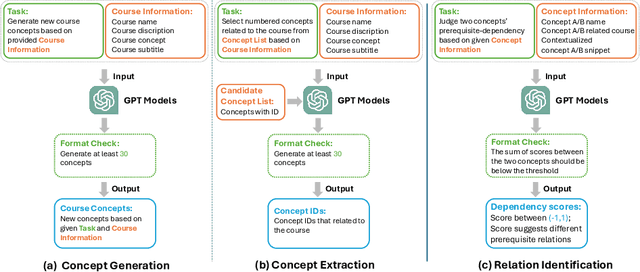
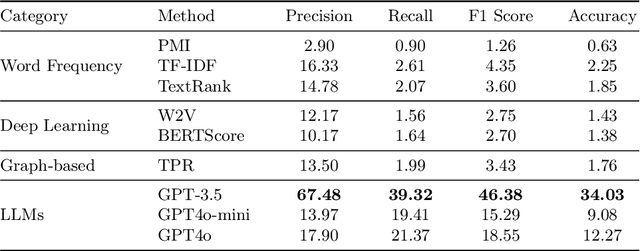
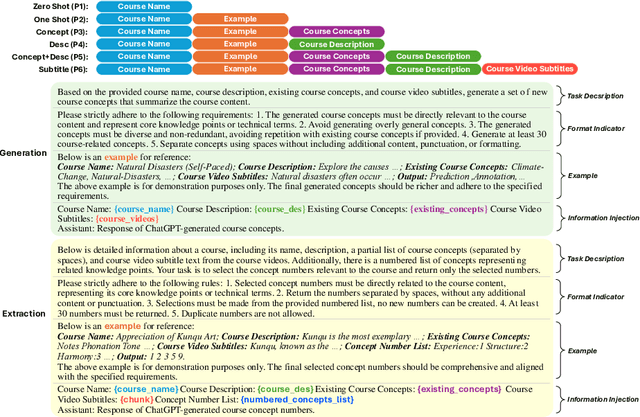
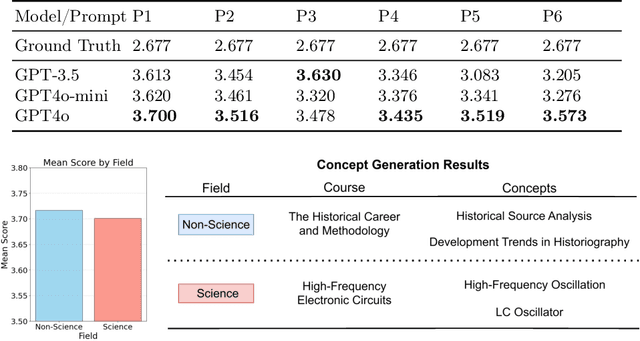
Extracting key concepts and their relationships from course information and materials facilitates the provision of visualizations and recommendations for learners who need to select the right courses to take from a large number of courses. However, identifying and extracting themes manually is labor-intensive and time-consuming. Previous machine learning-based methods to extract relevant concepts from courses heavily rely on detailed course materials, which necessitates labor-intensive preparation of course materials. This paper investigates the potential of LLMs such as GPT in automatically generating course concepts and their relations. Specifically, we design a suite of prompts and provide GPT with the course information with different levels of detail, thereby generating high-quality course concepts and identifying their relations. Furthermore, we comprehensively evaluate the quality of the generated concepts and relationships through extensive experiments. Our results demonstrate the viability of LLMs as a tool for supporting educational content selection and delivery.
DragScene: Interactive 3D Scene Editing with Single-view Drag Instructions
Dec 18, 2024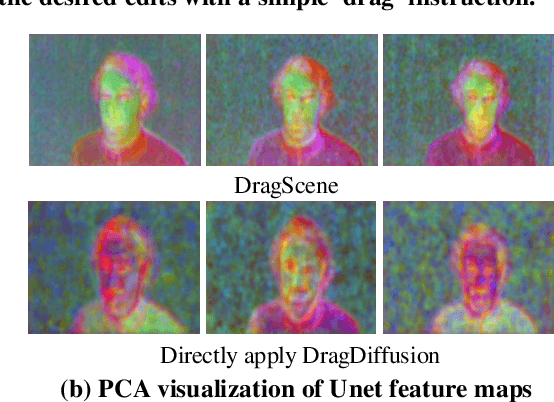

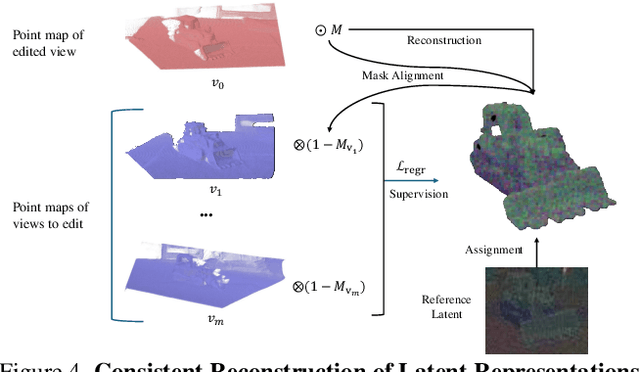
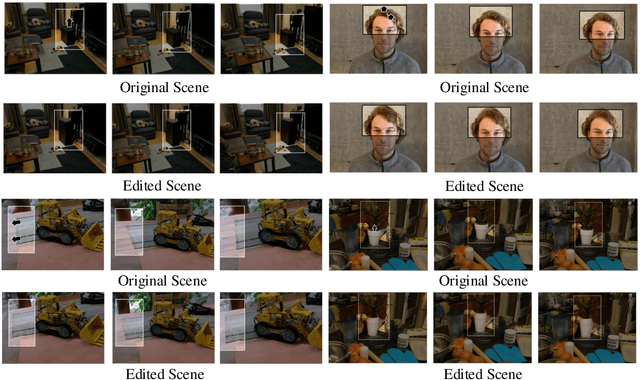
3D editing has shown remarkable capability in editing scenes based on various instructions. However, existing methods struggle with achieving intuitive, localized editing, such as selectively making flowers blossom. Drag-style editing has shown exceptional capability to edit images with direct manipulation instead of ambiguous text commands. Nevertheless, extending drag-based editing to 3D scenes presents substantial challenges due to multi-view inconsistency. To this end, we introduce DragScene, a framework that integrates drag-style editing with diverse 3D representations. First, latent optimization is performed on a reference view to generate 2D edits based on user instructions. Subsequently, coarse 3D clues are reconstructed from the reference view using a point-based representation to capture the geometric details of the edits. The latent representation of the edited view is then mapped to these 3D clues, guiding the latent optimization of other views. This process ensures that edits are propagated seamlessly across multiple views, maintaining multi-view consistency. Finally, the target 3D scene is reconstructed from the edited multi-view images. Extensive experiments demonstrate that DragScene facilitates precise and flexible drag-style editing of 3D scenes, supporting broad applicability across diverse 3D representations.
Tuning-Free Visual Customization via View Iterative Self-Attention Control
Jun 11, 2024



Fine-Tuning Diffusion Models enable a wide range of personalized generation and editing applications on diverse visual modalities. While Low-Rank Adaptation (LoRA) accelerates the fine-tuning process, it still requires multiple reference images and time-consuming training, which constrains its scalability for large-scale and real-time applications. In this paper, we propose \textit{View Iterative Self-Attention Control (VisCtrl)} to tackle this challenge. Specifically, VisCtrl is a training-free method that injects the appearance and structure of a user-specified subject into another subject in the target image, unlike previous approaches that require fine-tuning the model. Initially, we obtain the initial noise for both the reference and target images through DDIM inversion. Then, during the denoising phase, features from the reference image are injected into the target image via the self-attention mechanism. Notably, by iteratively performing this feature injection process, we ensure that the reference image features are gradually integrated into the target image. This approach results in consistent and harmonious editing with only one reference image in a few denoising steps. Moreover, benefiting from our plug-and-play architecture design and the proposed Feature Gradual Sampling strategy for multi-view editing, our method can be easily extended to edit in complex visual domains. Extensive experiments show the efficacy of VisCtrl across a spectrum of tasks, including personalized editing of images, videos, and 3D scenes.