 Add to Chrome
 Add to Firefox
 Add to Edge
Evolving Cache Schedules for Fast Diffusion Policy Inference
Jul 22, 2026
Diffusion policies achieve strong visuomotor control by iteratively denoising action chunks, but repeated denoising makes real-time deployment computationally demanding. Cache-based methods reduce inference cost by reusing intermediate activations, but existing training-free schedules typically allocate computation uniformly across blocks, ignoring heterogeneous redundancy across blocks and leading to a suboptimal performance-efficiency trade-off. To bridge this gap, we introduce Evolving Cache Schedules (EVO), a training-free acceleration framework that globally schedules cache refreshes via evolutionary search. EVO represents each candidate as a complete schedule over the block-timestep lattice. Thus, redundant transformer computations during iterative denoising can be skipped through cache reuse while preserving closed-loop rollout performance. To make the search practical, EVO introduces redundancy-aware initialization, which seeds the population with promising schedules, and target-conditioned early stopping, which verifies and terminates once a desired performance target is reached. The offline-optimized schedule can be directly plugged into pretrained diffusion policies without retraining. Extensive manipulation benchmarks show that EVO preserves near-full performance while substantially reducing computation, achieving up to 8.05x action-generation speedup and reducing FLOPs from 15.77G to as low as 1.96G. Source code is available at https://github.com/pillom/EVO.

Atomic Task Graph: A Unified Framework for Agentic Planning and Execution
Jul 02, 2026LLM-based agents have shown strong potential for solving complex multi-step tasks, yet existing performance improvements often rely on either scaling to larger backbone models or task-specific fine-tuning. The former incurs substantial computational costs, while the latter typically generalizes poorly across different tasks. Although prompt-based control is training-free and broadly applicable, existing methods still leave input-output dependencies between subtasks implicit in textual trajectories, making verified intermediate results difficult to reuse. To address these limitations, we propose Atomic Task Graph (ATG), a unified control framework for planning and execution. Specifically, ATG maintains an explicit graph to expose dependencies and support reuse. During planning, it recursively decomposes a high-level task into subtasks, forming a sequence of directed acyclic graphs (DAGs) whose evolution can be traced. During execution, the dependencies exposed by ATG allow independent branches to be executed in parallel, thereby improving execution efficiency. When failures are detected, ATG leverages the graph evolution history to localize the error source and repair only the affected region, preserving validated regions unchanged. Experiments show that ATG consistently outperforms strong baselines in success rate and execution efficiency across three interactive benchmarks using only 7B-8B backbones.
ElegantVLA: Learning When to Think for Efficient Vision-Language-Action Models
May 28, 2026Vision-Language-Action (VLA) models are a powerful paradigm for generalist robotic control. However, their high computational cost and limited control frequency hinder real-time robotic manipulation, especially when large vision-language backbones and iterative action heads run at every control step. Existing VLA acceleration methods often optimize individual components or rely on fixed acceleration rules, treating different control steps with largely fixed computation and overlooking the non-uniform reasoning demands of sequential embodied control. Inspired by human motor control, where cognitive and feedback resources concentrate on goal-sensitive stages, we argue that VLA models should learn when to invest full computation and when to reuse prior computation. We propose ElegantVLA, a plug-in phase-adaptive inference framework that accelerates VLA models through intra-model dynamic compute scheduling. ElegantVLA introduces a lightweight scheduler that observes temporal representation similarity, robot-motion cues, and episode progress to jointly allocate computation across the vision encoder, LLM, and action head. For perception-language reasoning, the scheduler selects a five-level Vision-LLM compute mode, from full recomputation to multi-step temporal reuse, based on visual-language representation stability. For action generation, it selects a three-level denoising mode, reusing intermediate denoising states during stable motion while preserving full refinement for goal-sensitive stages. By coordinating these decisions, ElegantVLA offers a general acceleration framework for modern VLA pipelines with explicit action-generation modules, without modifying or retraining the base model. Experiments on GR00T and CogACT achieve up to 2.55x and 3.77x speedup, and on six real-world GR00T tasks ElegantVLA cuts computation by 2.18x while raising control frequency from 13.8 Hz to 26.3 Hz.
Test-time Sparsity for Extreme Fast Action Diffusion
May 13, 2026Action diffusion excels at high-fidelity action generation but incurs heavy computational costs owing to its iterative denoising nature. Despite current technologies showing promise in accelerating diffusion transformers by reusing the cached features, they struggle to adapt to policy dynamics arising from diverse perceptions and multi-round rollout iterations in open environments. We propose test-time sparsity to tackle this challenge, which aims to accelerate action diffusion by dynamically predicting prunable residual computations for each model forward at test time. However, two bottlenecks remain in this paradigm: 1) repetitive conditional encoding and pruning offset most potential speed gains, and 2) the features cached from previous denoising timesteps cannot constrain large pruning errors under aggressive sparsity. To address the first bottleneck, we design a highly parallelized inference pipeline that minimizes the non-decoder delay to milliseconds. Specifically, we first design a lightweight pruner that shares the encoder with the diffusion transformer. Then, we decouple the encoding and pruning from the autoregressive denoising loop by processing all denoising timesteps in parallel, and overlap the pruner with the decoder forward inference through asynchronism. To overcome the second bottleneck, we introduce an omnidirectional reusing strategy, which achieves 95% sparsity by selectively reusing features cached from the current forward, previous denoising timesteps, and earlier rollout iterations. To learn the rollout-level reusing strategies, we sample a few action trajectories to supervise the sparsified diffusion step by step. Extensive experiments demonstrate that our method reduces FLOPs by 92% and accelerates action generation by 5x, achieving lossless performance with an inference frequency of 47.5 Hz. Our code is available at https://github.com/ky-ji/Test-time-Sparsity.
RoboStream: Weaving Spatio-Temporal Reasoning with Memory in Vision-Language Models for Robotics
Mar 13, 2026Enabling reliable long-horizon robotic manipulation is a crucial step toward open-world embodied intelligence. However, VLM-based planners treat each step as an isolated observation-to-action mapping, forcing them to reinfer scene geometry from raw pixels at every decision point while remaining unaware of how prior actions have reshaped the environment. Despite strong short-horizon performance, these systems lack the spatio-temporal reasoning required for persistent geometric anchoring and memory of action-triggered state transitions. Without persistent state tracking, perceptual errors accumulate across the execution horizon, temporarily occluded objects are catastrophically forgotten, and these compounding failures lead to precondition violations that cascade through subsequent steps. In contrast, humans maintain a persistent mental model that continuously tracks spatial relations and action consequences across interactions rather than reconstructing them at each instant. Inspired by this human capacity for causal spatio-temporal reasoning with persistent memory, we propose RoboStream, a training-free framework that achieves geometric anchoring through Spatio-Temporal Fusion Tokens (STF-Tokens), which bind visual evidence to 3D geometric attributes for persistent object grounding, and maintains causal continuity via a Causal Spatio-Temporal Graph (CSTG) that records action-triggered state transitions across steps. This design enables the planner to trace causal chains and preserve object permanence under occlusion without additional training or fine-tuning. RoboStream achieves 90.5% on long-horizon RLBench and 44.4% on challenging real-world block-building tasks, where both SoFar and VoxPoser score 11.1%, demonstrating that spatio-temporal reasoning and causal memory are critical missing components for reliable long-horizon manipulation.
Sparse ActionGen: Accelerating Diffusion Policy with Real-time Pruning
Jan 19, 2026Diffusion Policy has dominated action generation due to its strong capabilities for modeling multi-modal action distributions, but its multi-step denoising processes make it impractical for real-time visuomotor control. Existing caching-based acceleration methods typically rely on $\textit{static}$ schedules that fail to adapt to the $\textit{dynamics}$ of robot-environment interactions, thereby leading to suboptimal performance. In this paper, we propose $\underline{\textbf{S}}$parse $\underline{\textbf{A}}$ction$\underline{\textbf{G}}$en ($\textbf{SAG}$) for extremely sparse action generation. To accommodate the iterative interactions, SAG customizes a rollout-adaptive prune-then-reuse mechanism that first identifies prunable computations globally and then reuses cached activations to substitute them during action diffusion. To capture the rollout dynamics, SAG parameterizes an observation-conditioned diffusion pruner for environment-aware adaptation and instantiates it with a highly parameter- and inference-efficient design for real-time prediction. Furthermore, SAG introduces a one-for-all reusing strategy that reuses activations across both timesteps and blocks in a zig-zag manner, minimizing the global redundancy. Extensive experiments on multiple robotic benchmarks demonstrate that SAG achieves up to 4$\times$ generation speedup without sacrificing performance. Project Page: https://sparse-actiongen.github.io/.
TS-DP: Reinforcement Speculative Decoding For Temporal Adaptive Diffusion Policy Acceleration
Dec 13, 2025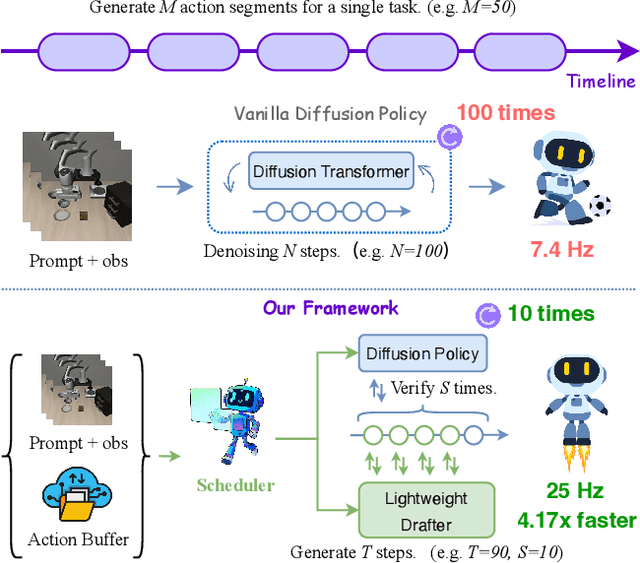
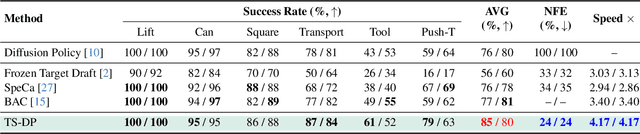

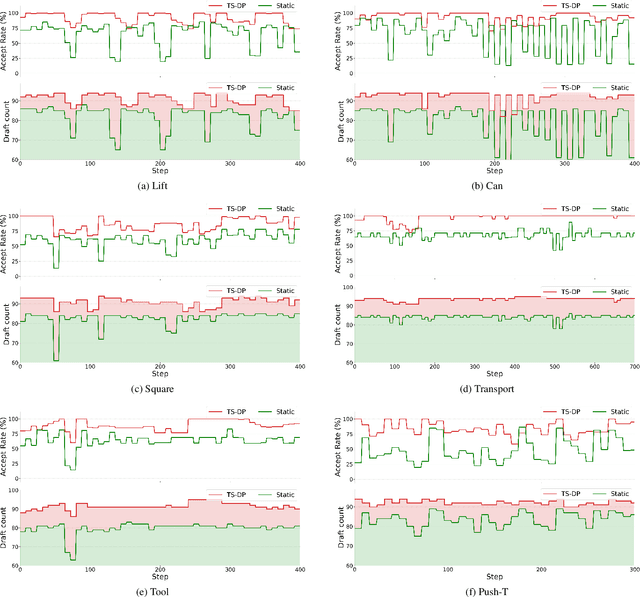
Diffusion Policy (DP) excels in embodied control but suffers from high inference latency and computational cost due to multiple iterative denoising steps. The temporal complexity of embodied tasks demands a dynamic and adaptable computation mode. Static and lossy acceleration methods, such as quantization, fail to handle such dynamic embodied tasks, while speculative decoding offers a lossless and adaptive yet underexplored alternative for DP. However, it is non-trivial to address the following challenges: how to match the base model's denoising quality at lower cost under time-varying task difficulty in embodied settings, and how to dynamically and interactively adjust computation based on task difficulty in such environments. In this paper, we propose Temporal-aware Reinforcement-based Speculative Diffusion Policy (TS-DP), the first framework that enables speculative decoding for DP with temporal adaptivity. First, to handle dynamic environments where task difficulty varies over time, we distill a Transformer-based drafter to imitate the base model and replace its costly denoising calls. Second, an RL-based scheduler further adapts to time-varying task difficulty by adjusting speculative parameters to maintain accuracy while improving efficiency. Extensive experiments across diverse embodied environments demonstrate that TS-DP achieves up to 4.17 times faster inference with over 94% accepted drafts, reaching an inference frequency of 25 Hz and enabling real-time diffusion-based control without performance degradation.
Block-wise Adaptive Caching for Accelerating Diffusion Policy
Jun 16, 2025Diffusion Policy has demonstrated strong visuomotor modeling capabilities, but its high computational cost renders it impractical for real-time robotic control. Despite huge redundancy across repetitive denoising steps, existing diffusion acceleration techniques fail to generalize to Diffusion Policy due to fundamental architectural and data divergences. In this paper, we propose Block-wise Adaptive Caching(BAC), a method to accelerate Diffusion Policy by caching intermediate action features. BAC achieves lossless action generation acceleration by adaptively updating and reusing cached features at the block level, based on a key observation that feature similarities vary non-uniformly across timesteps and locks. To operationalize this insight, we first propose the Adaptive Caching Scheduler, designed to identify optimal update timesteps by maximizing the global feature similarities between cached and skipped features. However, applying this scheduler for each block leads to signiffcant error surges due to the inter-block propagation of caching errors, particularly within Feed-Forward Network (FFN) blocks. To mitigate this issue, we develop the Bubbling Union Algorithm, which truncates these errors by updating the upstream blocks with signiffcant caching errors before downstream FFNs. As a training-free plugin, BAC is readily integrable with existing transformer-based Diffusion Policy and vision-language-action models. Extensive experiments on multiple robotic benchmarks demonstrate that BAC achieves up to 3x inference speedup for free.
SP-VLA: A Joint Model Scheduling and Token Pruning Approach for VLA Model Acceleration
Jun 15, 2025Vision-Language-Action (VLA) models have attracted increasing attention for their strong control capabilities. However, their high computational cost and low execution frequency hinder their suitability for real-time tasks such as robotic manipulation and autonomous navigation. Existing VLA acceleration methods primarily focus on structural optimization, overlooking the fact that these models operate in sequential decision-making environments. As a result, temporal redundancy in sequential action generation and spatial redundancy in visual input remain unaddressed. To this end, we propose SP-VLA, a unified framework that accelerates VLA models by jointly scheduling models and pruning tokens. Specifically, we design an action-aware model scheduling mechanism that reduces temporal redundancy by dynamically switching between VLA model and a lightweight generator. Inspired by the human motion pattern of focusing on key decision points while relying on intuition for other actions, we categorize VLA actions into deliberative and intuitive, assigning the former to the VLA model and the latter to the lightweight generator, enabling frequency-adaptive execution through collaborative model scheduling. To address spatial redundancy, we further develop a spatio-semantic dual-aware token pruning method. Tokens are classified into spatial and semantic types and pruned based on their dual-aware importance to accelerate VLA inference. These two mechanisms work jointly to guide the VLA in focusing on critical actions and salient visual information, achieving effective acceleration while maintaining high accuracy. Experimental results demonstrate that our method achieves up to 1.5$\times$ acceleration with less than 3% drop in accuracy, outperforming existing approaches in multiple tasks.
SAMCL: Empowering SAM to Continually Learn from Dynamic Domains
Dec 06, 2024Segment Anything Model (SAM) struggles with segmenting objects in the open world, especially across diverse and dynamic domains. Continual segmentation (CS) is a potential technique to solve this issue, but a significant obstacle is the intractable balance between previous domains (stability) and new domains (plasticity) during CS. Furthermore, how to utilize two kinds of features of SAM, images and prompts, in an efficient and effective CS manner remains a significant hurdle. In this work, we propose a novel CS method, termed SAMCL, to address these challenges. It is the first study to empower SAM with the CS ability across dynamic domains. SAMCL decouples stability and plasticity during CS by two components: $\textit{AugModule}$ and $\textit{Module Selector}$. Specifically, SAMCL leverages individual $\textit{AugModule}$ to effectively and efficiently learn new relationships between images and prompts in each domain. $\textit{Module Selector}$ selects the appropriate module during testing, based on the inherent ability of SAM to distinguish between different domains. These two components enable SAMCL to realize a task-agnostic method without any interference across different domains. Experimental results demonstrate that SAMCL outperforms state-of-the-art methods, achieving an exceptionally low average forgetting of just $0.5$%, along with at least a $2.5$% improvement in transferring to unseen domains. Moreover, the tunable parameter consumption in AugModule is about $0.236$MB, marking at least a $23.3$% reduction compared to other fine-tuning methods.