 Add to Chrome
 Add to Firefox
 Add to Edge
TRUST: Efficient Abdominal Trauma Recognition via Image-to-Ultrasound-Video Transfer Learning
Jun 26, 2026
Abdominal ultrasound is indispensable for rapid, noninvasive trauma triage. However, interpreting the subtle dynamic cues embedded in continuous scanning is time-intensive and operator-dependent. Parameter-Efficient Image-to-Video Transfer Learning (PEIVTL), which efficiently adapts pre-trained image models to the video domain, notably through visual-textual alignment, offers a promising paradigm for ultrasound video analysis. Nevertheless, substantial spatiotemporal and semantic variations arising from physician-dependent scanning practices continue to limit the effectiveness and generalizability of this framework. We propose TRUST, a scan-aware PEIVTL framework that explicitly models fine-grained spatiotemporal variations to enable reliable ultrasound video understanding. First, we introduce a Cross-Frequency Collaborative Adapter (CFCA) that establishes mutual constraints between low- and high-frequency components, enhancing discriminative spatial feature extraction under heavy speckle corruption. Second, we design a Multi-Granularity Motion-Aware (MGMA) module that integrates local temporal convolutions with motion-prior-guided global self-attention, jointly capturing stable intra-view patterns and abrupt inter-view transitions to characterize complex scanning dynamics. Third, a Visual Query Semantic Aggregation (VQSA) module dynamically generates text prototypes conditioned on visual features, enabling adaptive visual-textual alignment robust to intra-class variability under diverse scanning conditions. Experiments on in-house ultrasound trauma datasets demonstrate that TRUST outperforms state-of-the-art methods by 9.63% with superior computational efficiency.

Predictive Regularization Against Visual Representation Degradation in Multimodal Large Language Models
Mar 21, 2026While Multimodal Large Language Models (MLLMs) excel at vision-language tasks, the cost of their language-driven training on internal visual foundational competence remains unclear. In this paper, we conduct a detailed diagnostic analysis to unveil a pervasive issue: visual representation degradation in MLLMs. Specifically, we find that compared to the initial visual features, the visual representation in the middle layers of LLM exhibits both a degradation in global function and patch structure. We attribute this phenomenon to a visual sacrifice driven by the singular text-generation objective, where the model compromises its visual fidelity to optimize for answer generation. We argue that a robust MLLM requires both strong cross-modal reasoning and core visual competence, and propose Predictive Regularization (PRe) to force degraded intermediate features to predict initial visual features, thereby maintaining the inherent visual attributes of the MLLM's internal representations. Extensive experiments confirm that mitigating this visual degradation effectively boosts vision-language performance, underscoring the critical importance of fostering robust internal visual representations within MLLMs for comprehensive multimodal understanding.
Predictive Sample Assignment for Semantically Coherent Out-of-Distribution Detection
Dec 15, 2025Semantically coherent out-of-distribution detection (SCOOD) is a recently proposed realistic OOD detection setting: given labeled in-distribution (ID) data and mixed in-distribution and out-of-distribution unlabeled data as the training data, SCOOD aims to enable the trained model to accurately identify OOD samples in the testing data. Current SCOOD methods mainly adopt various clustering-based in-distribution sample filtering (IDF) strategies to select clean ID samples from unlabeled data, and take the remaining samples as auxiliary OOD data, which inevitably introduces a large number of noisy samples in training. To address the above issue, we propose a concise SCOOD framework based on predictive sample assignment (PSA). PSA includes a dual-threshold ternary sample assignment strategy based on the predictive energy score that can significantly improve the purity of the selected ID and OOD sample sets by assigning unconfident unlabeled data to an additional discard sample set, and a concept contrastive representation learning loss to further expand the distance between ID and OOD samples in the representation space to assist ID/OOD discrimination. In addition, we also introduce a retraining strategy to help the model fully fit the selected auxiliary ID/OOD samples. Experiments on two standard SCOOD benchmarks demonstrate that our approach outperforms the state-of-the-art methods by a significant margin.
Sharpness-aware Dynamic Anchor Selection for Generalized Category Discovery
Dec 15, 2025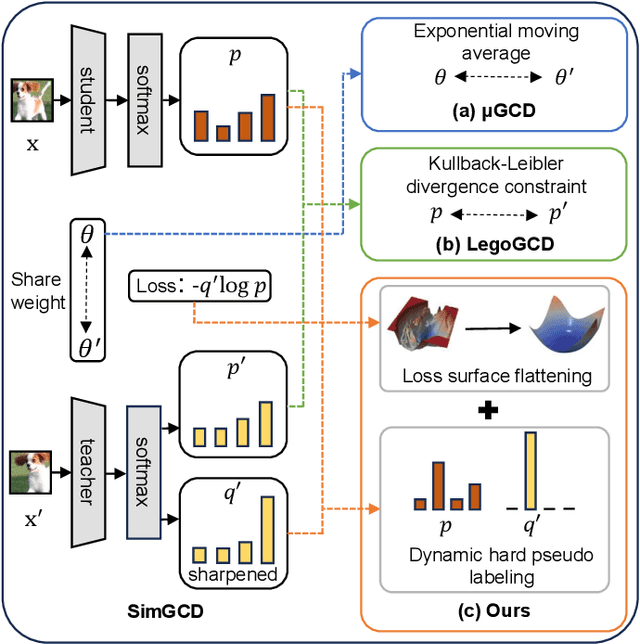
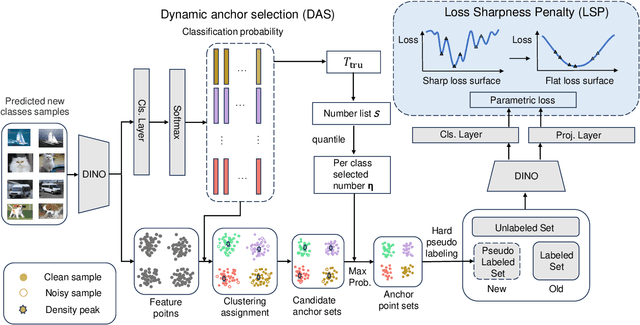
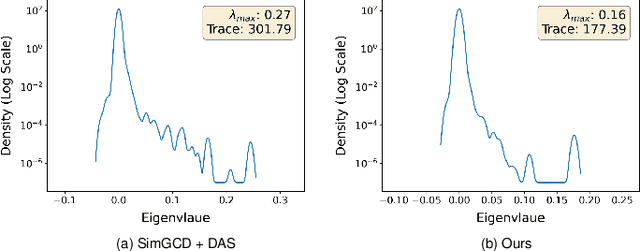
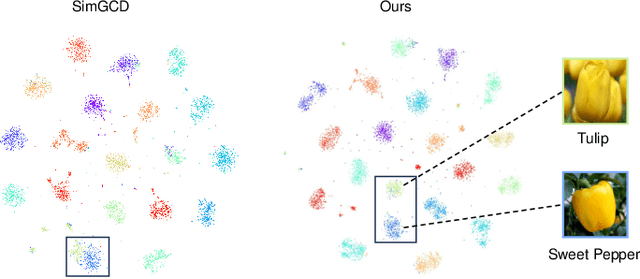
Generalized category discovery (GCD) is an important and challenging task in open-world learning. Specifically, given some labeled data of known classes, GCD aims to cluster unlabeled data that contain both known and unknown classes. Current GCD methods based on parametric classification adopt the DINO-like pseudo-labeling strategy, where the sharpened probability output of one view is used as supervision information for the other view. However, large pre-trained models have a preference for some specific visual patterns, resulting in encoding spurious correlation for unlabeled data and generating noisy pseudo-labels. To address this issue, we propose a novel method, which contains two modules: Loss Sharpness Penalty (LSP) and Dynamic Anchor Selection (DAS). LSP enhances the robustness of model parameters to small perturbations by minimizing the worst-case loss sharpness of the model, which suppressing the encoding of trivial features, thereby reducing overfitting of noise samples and improving the quality of pseudo-labels. Meanwhile, DAS selects representative samples for the unknown classes based on KNN density and class probability during the model training and assigns hard pseudo-labels to them, which not only alleviates the confidence difference between known and unknown classes but also enables the model to quickly learn more accurate feature distribution for the unknown classes, thus further improving the clustering accuracy. Extensive experiments demonstrate that the proposed method can effectively mitigate the noise of pseudo-labels, and achieve state-of-the-art results on multiple GCD benchmarks.
Enhancing Visual Grounding for GUI Agents via Self-Evolutionary Reinforcement Learning
May 18, 2025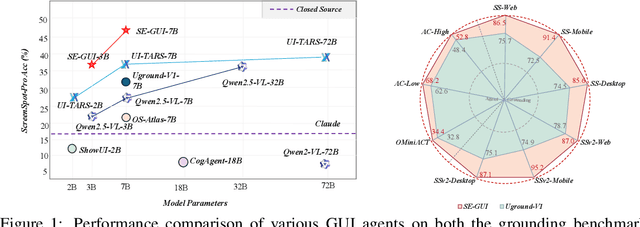
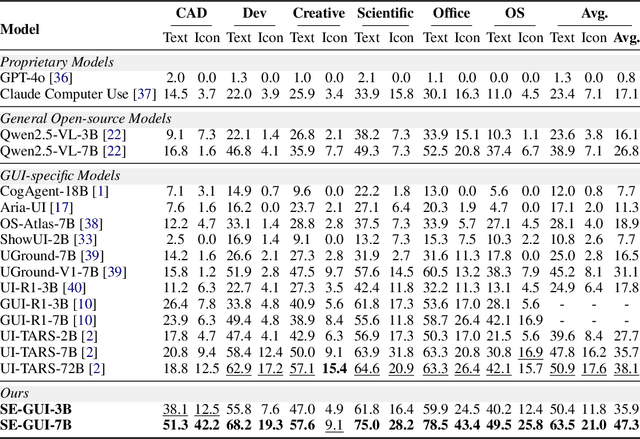
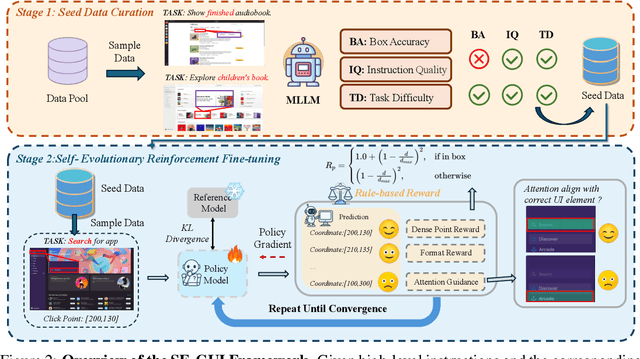
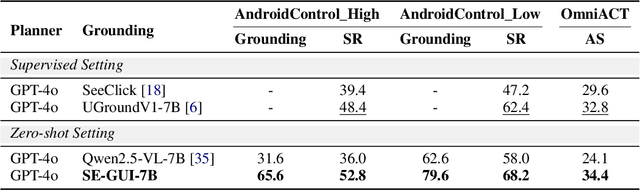
Graphical User Interface (GUI) agents have made substantial strides in understanding and executing user instructions across diverse platforms. Yet, grounding these instructions to precise interface elements remains challenging, especially in complex, high-resolution, professional environments. Traditional supervised finetuning (SFT) methods often require large volumes of diverse data and exhibit weak generalization. To overcome these limitations, we introduce a reinforcement learning (RL) based framework that incorporates three core strategies: (1) seed data curation to ensure high quality training samples, (2) a dense policy gradient that provides continuous feedback based on prediction accuracy, and (3) a self evolutionary reinforcement finetuning mechanism that iteratively refines the model using attention maps. With only 3k training samples, our 7B-parameter model achieves state-of-the-art results among similarly sized models on three grounding benchmarks. Notably, it attains 47.3\% accuracy on the ScreenSpot-Pro dataset, outperforming much larger models, such as UI-TARS-72B, by a margin of 24.2\%. These findings underscore the effectiveness of RL-based approaches in enhancing GUI agent performance, particularly in high-resolution, complex environments.
Restoring Forgotten Knowledge in Non-Exemplar Class Incremental Learning through Test-Time Semantic Evolution
Mar 21, 2025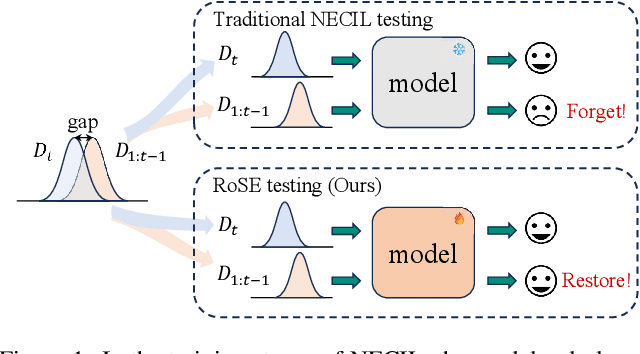
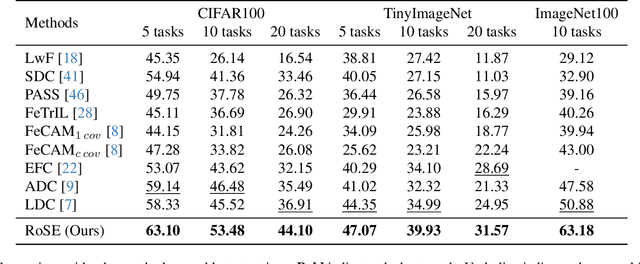
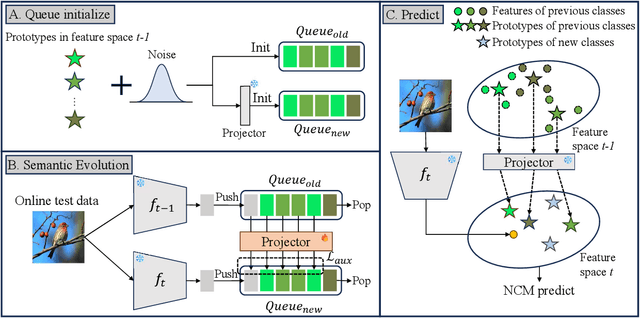
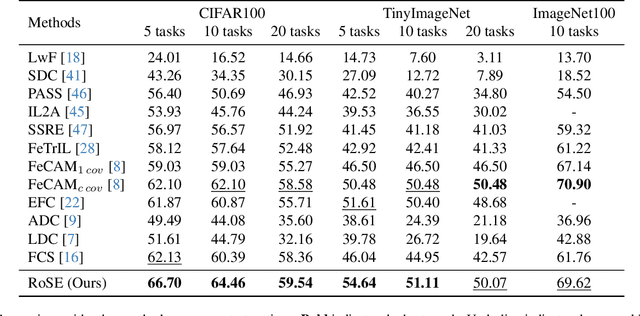
Continual learning aims to accumulate knowledge over a data stream while mitigating catastrophic forgetting. In Non-exemplar Class Incremental Learning (NECIL), forgetting arises during incremental optimization because old classes are inaccessible, hindering the retention of prior knowledge. To solve this, previous methods struggle in achieving the stability-plasticity balance in the training stages. However, we note that the testing stage is rarely considered among them, but is promising to be a solution to forgetting. Therefore, we propose RoSE, which is a simple yet effective method that \textbf{R}est\textbf{o}res forgotten knowledge through test-time \textbf{S}emantic \textbf{E}volution. Specifically designed for minimizing forgetting, RoSE is a test-time semantic drift compensation framework that enables more accurate drift estimation in a self-supervised manner. Moreover, to avoid incomplete optimization during online testing, we derive an analytical solution as an alternative to gradient descent. We evaluate RoSE on CIFAR-100, TinyImageNet, and ImageNet100 datasets, under both cold-start and warm-start settings. Our method consistently outperforms most state-of-the-art (SOTA) methods across various scenarios, validating the potential and feasibility of test-time evolution in NECIL.
Learning Part Knowledge to Facilitate Category Understanding for Fine-Grained Generalized Category Discovery
Mar 21, 2025Generalized Category Discovery (GCD) aims to classify unlabeled data containing both seen and novel categories. Although existing methods perform well on generic datasets, they struggle in fine-grained scenarios. We attribute this difficulty to their reliance on contrastive learning over global image features to automatically capture discriminative cues, which fails to capture the subtle local differences essential for distinguishing fine-grained categories. Therefore, in this paper, we propose incorporating part knowledge to address fine-grained GCD, which introduces two key challenges: the absence of annotations for novel classes complicates the extraction of the part features, and global contrastive learning prioritizes holistic feature invariance, inadvertently suppressing discriminative local part patterns. To address these challenges, we propose PartGCD, including 1) Adaptive Part Decomposition, which automatically extracts class-specific semantic parts via Gaussian Mixture Models, and 2) Part Discrepancy Regularization, enforcing explicit separation between part features to amplify fine-grained local part distinctions. Experiments demonstrate state-of-the-art performance across multiple fine-grained benchmarks while maintaining competitiveness on generic datasets, validating the effectiveness and robustness of our approach.
Early Preparation Pays Off: New Classifier Pre-tuning for Class Incremental Semantic Segmentation
Jul 19, 2024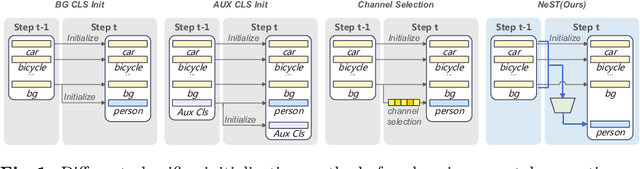
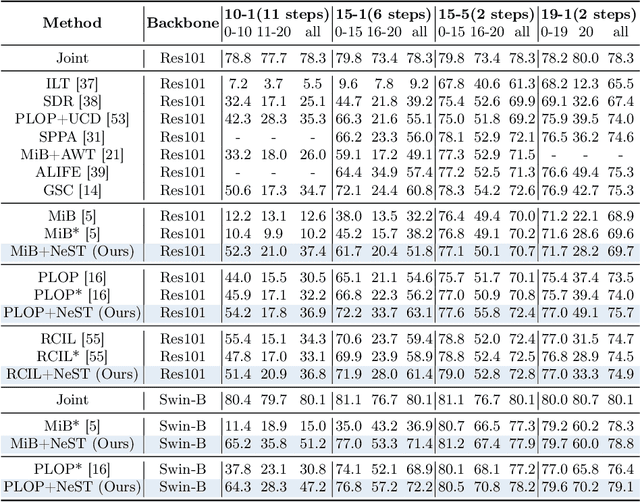
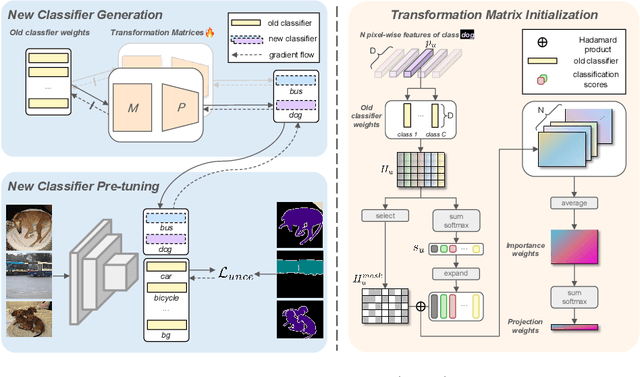
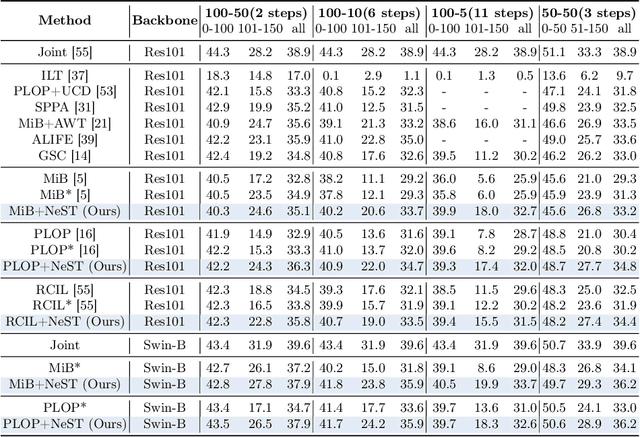
Class incremental semantic segmentation aims to preserve old knowledge while learning new tasks, however, it is impeded by catastrophic forgetting and background shift issues. Prior works indicate the pivotal importance of initializing new classifiers and mainly focus on transferring knowledge from the background classifier or preparing classifiers for future classes, neglecting the flexibility and variance of new classifiers. In this paper, we propose a new classifier pre-tuning~(NeST) method applied before the formal training process, learning a transformation from old classifiers to generate new classifiers for initialization rather than directly tuning the parameters of new classifiers. Our method can make new classifiers align with the backbone and adapt to the new data, preventing drastic changes in the feature extractor when learning new classes. Besides, we design a strategy considering the cross-task class similarity to initialize matrices used in the transformation, helping achieve the stability-plasticity trade-off. Experiments on Pascal VOC 2012 and ADE20K datasets show that the proposed strategy can significantly improve the performance of previous methods. The code is available at \url{https://github.com/zhengyuan-xie/ECCV24_NeST}.
GET: Unlocking the Multi-modal Potential of CLIP for Generalized Category Discovery
Mar 15, 2024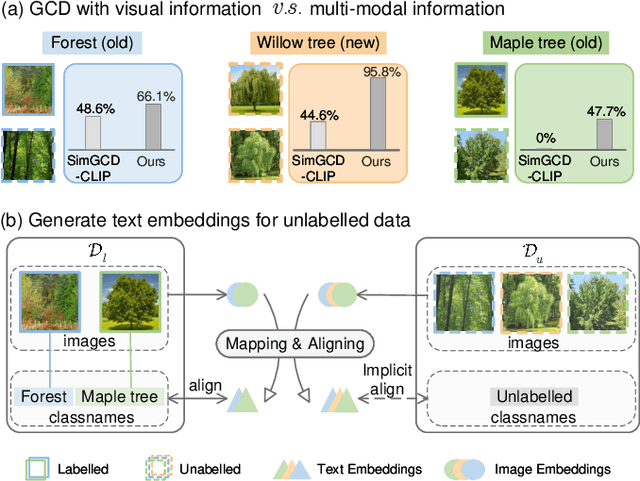
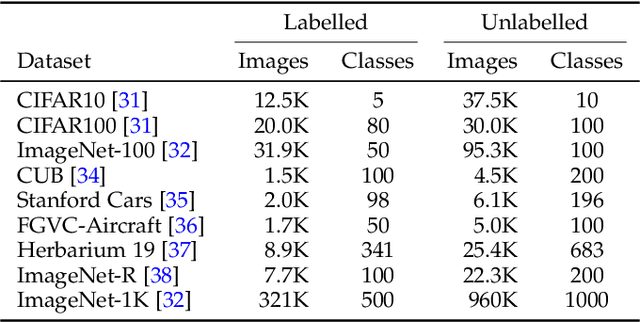
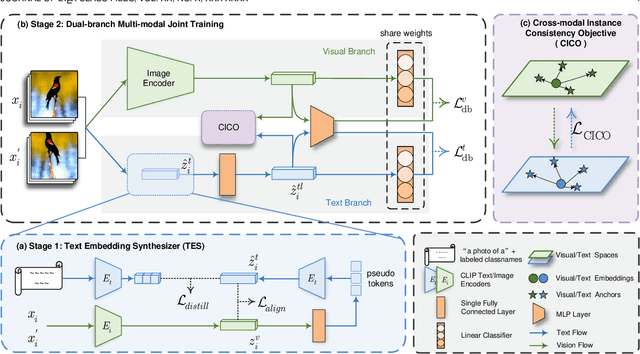
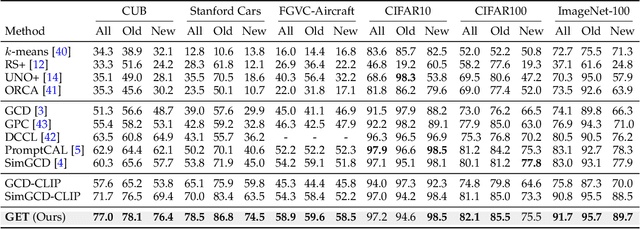
Given unlabelled datasets containing both old and new categories, generalized category discovery (GCD) aims to accurately discover new classes while correctly classifying old classes, leveraging the class concepts learned from labeled samples. Current GCD methods only use a single visual modality of information, resulting in poor classification of visually similar classes. Though certain classes are visually confused, their text information might be distinct, motivating us to introduce text information into the GCD task. However, the lack of class names for unlabelled data makes it impractical to utilize text information. To tackle this challenging problem, in this paper, we propose a Text Embedding Synthesizer (TES) to generate pseudo text embeddings for unlabelled samples. Specifically, our TES leverages the property that CLIP can generate aligned vision-language features, converting visual embeddings into tokens of the CLIP's text encoder to generate pseudo text embeddings. Besides, we employ a dual-branch framework, through the joint learning and instance consistency of different modality branches, visual and semantic information mutually enhance each other, promoting the interaction and fusion of visual and text embedding space. Our method unlocks the multi-modal potentials of CLIP and outperforms the baseline methods by a large margin on all GCD benchmarks, achieving new state-of-the-art. The code will be released at \url{https://github.com/enguangW/GET}.