 Add to Chrome
 Add to Firefox
 Add to Edge
Nemotron-Labs-3-Puzzle-75B-A9B: Compressing Hybrid MoE LLMs
Jul 05, 2026
We present Nemotron-Labs-3-Puzzle-75B-A9B, a compressed variant of Nemotron-3-Super optimized for interactive deployment. We designed the model to maximize server throughput under high user throughput constraints. In interactive serving workloads on a single 8xB200 node, Puzzle-75B-A9B achieves approximately 2x higher server throughput than Nemotron-3-Super at matched user throughput constraints. In ultra-long-context deployment on a single H100 GPU, the compressed model increases 1M-token concurrency from 1 request to 8 requests. Puzzle-75B-A9B is constructed using a multi-stage pipeline that combines the Iterative Puzzle compression framework with knowledge distillation, reinforcement learning, quantization, and a Multi-Token Prediction head. The compression process jointly optimizes heterogeneous MoE pruning, active parameter budget, and Mamba pruning to improve inference efficiency while preserving model quality. We evaluate Puzzle-75B-A9B on a broad suite of reasoning, coding, multilingual, long-context, and agentic benchmarks. Despite substantial compression, the model retains strong downstream accuracy relative to the parent model across a wide range of tasks. These results demonstrate that large hybrid MoE models can be substantially optimized for deployment efficiency while maintaining strong downstream capability.

Evaluating LLM Uncertainty in Long-Form Generation Using Deterministic Ground Truth
Jul 04, 2026As LLMs generate increasingly long outputs, effective uncertainty estimation must identify errors at fine-grained levels rather than discard entire responses. While such methods exist, evaluating uncertainty at any resolution (token to an entire generation) is challenging and highly sensitive to label imperfections, making zero-noise benchmarks essential; yet, long-form generation benchmarks tend to rely on fallible labels rather than deterministic ground truth. We introduce Single-answer Atomic Long-form Target (SALT), a benchmark of six procedurally generated tasks with single deterministic long textual ground truths, enabling unit-level evaluation of correctness, calibration, and ranking without external judges. Equipped with SALT, our analysis of 50+ LLMs reveals key insights: We identify which confidence functions dominate each uncertainty aspect and show that confidence ranking largely breaks at atomic resolution, even when clearer separability emerges at coarser line-level units. SALT further enables controlled atom-level interventions throughout generation, revealing two separable drivers of future errors: propagation from corrupted prefixes, dominated by global context correctness, and bounded degradation from increasing answer-context length. Finally, we demonstrate that reasoning, via Chain-of-Thought prompting or internalized through training, introduces a trade-off, improving accuracy while degrading confidence ranking. These findings directly impact risk-critical applications requiring reliable error identification and mitigation.
Nemotron 3 Ultra: Open, Efficient Mixture-of-Experts Hybrid Mamba-Transformer Model for Agentic Reasoning
Jun 12, 2026We introduce Nemotron 3 Ultra, a 550 billion total and 55 billion active parameter Mixture-of-Experts Hybrid Mamba-Attention language model. We pre-trained Nemotron 3 Ultra on 20 trillion text tokens, then extended the context length to 1M tokens, and post-trained using Supervised Fine Tuning (SFT), Reinforcement Learning (RL), and Multi-teacher On-Policy Distillation (MOPD). Nemotron 3 Ultra is our most capable model yet, employing multiple key technologies - LatentMoE, Multi Token Prediction (MTP), NVFP4 pre-training, multi-environment RLVR, MOPD, and reasoning budget control. Nemotron 3 Ultra achieves up to ~6x higher inference throughput as compared to state-of-the-art publicly available LLMs while attaining on-par accuracy. The state-of-the-art accuracy, high inference throughput, and 1M token context length make Nemotron 3 Ultra ideal for long-running autonomous agentic tasks. We open-source the base, post-trained, and quantized checkpoints, along with the training data and recipe on HuggingFace.
Nemotron 3 Super: Open, Efficient Mixture-of-Experts Hybrid Mamba-Transformer Model for Agentic Reasoning
Apr 14, 2026We describe the pre-training, post-training, and quantization of Nemotron 3 Super, a 120 billion (active 12 billion) parameter hybrid Mamba-Attention Mixture-of-Experts model. Nemotron 3 Super is the first model in the Nemotron 3 family to 1) be pre-trained in NVFP4, 2) leverage LatentMoE, a new Mixture-of-Experts architecture that optimizes for both accuracy per FLOP and accuracy per parameter, and 3) include MTP layers for inference acceleration through native speculative decoding. We pre-trained Nemotron 3 Super on 25 trillion tokens followed by post-training using supervised fine tuning (SFT) and reinforcement learning (RL). The final model supports up to 1M context length and achieves comparable accuracy on common benchmarks, while also achieving up to 2.2x and 7.5x higher inference throughput compared to GPT-OSS-120B and Qwen3.5-122B, respectively. Nemotron 3 Super datasets, along with the base, post-trained, and quantized checkpoints, are open-sourced on HuggingFace.
When Should LLMs Be Less Specific? Selective Abstraction for Reliable Long-Form Text Generation
Feb 13, 2026LLMs are widely used, yet they remain prone to factual errors that erode user trust and limit adoption in high-risk settings. One approach to mitigate this risk is to equip models with uncertainty estimation mechanisms that abstain when confidence is low. However, this binary "all-or-nothing" approach is excessively restrictive in long-form settings, often discarding valuable information. We introduce Selective Abstraction (SA), a framework that enables LLMs to trade specificity for reliability by selectively reducing the detail of uncertain content. We first formalize SA through the lenses of selective risk and coverage. We then propose Atom-wise Selective Abstraction, a claim-level instantiation that decomposes responses into atomic claims (short, self-contained statements each expressing a single fact) and replaces uncertain atoms with higher confidence, less specific abstractions. To evaluate this framework, we develop a novel end-to-end pipeline for open-ended generation that instantiates risk as factual correctness and measures coverage using an information-theoretic measure of retained information. Across six open-source models on the FactScore and LongFact-Objects benchmarks, atom-wise SA consistently outperforms existing baselines, improving the area under the risk-coverage curve (AURC) by up to 27.73% over claim removal, demonstrating that reducing specificity can boost accuracy and reliability while preserving most of their original meaning.
Extending Puzzle for Mixture-of-Experts Reasoning Models with Application to GPT-OSS Acceleration
Feb 12, 2026Reasoning-focused LLMs improve answer quality by generating longer reasoning traces, but the additional tokens dramatically increase serving cost, motivating inference optimization. We extend and apply Puzzle, a post-training neural architecture search (NAS) framework, to gpt-oss-120B to produce gpt-oss-puzzle-88B, a deployment-optimized derivative. Our approach combines heterogeneous MoE expert pruning, selective replacement of full-context attention with window attention, FP8 KV-cache quantization with calibrated scales, and post-training reinforcement learning to recover accuracy, while maintaining low generation length. In terms of per-token speeds, on an 8XH100 node we achieve 1.63X and 1.22X throughput speedups in long-context and short-context settings, respectively. gpt-oss-puzzle-88B also delivers throughput speedups of 2.82X on a single NVIDIA H100 GPU. However, because token counts can change with reasoning effort and model variants, per-token throughput (tok/s) and latency (ms/token) do not necessarily lead to end-to-end speedups: a 2X throughput gain is erased if traces grow 2X. Conversely, throughput gains can be spent on more reasoning tokens to improve accuracy; we therefore advocate request-level efficiency metrics that normalize throughput by tokens generated and trace an accuracy--speed frontier across reasoning efforts. We show that gpt-oss-puzzle-88B improves over gpt-oss-120B along the entire frontier, delivering up to 1.29X higher request-level efficiency. Across various benchmarks, gpt-oss-puzzle-88B matches or slightly exceeds the parent on suite-average accuracy across reasoning efforts, with retention ranging from 100.8% (high) to 108.2% (low), showing that post-training architecture search can substantially reduce inference costs without sacrificing quality.
NVIDIA Nemotron 3: Efficient and Open Intelligence
Dec 24, 2025We introduce the Nemotron 3 family of models - Nano, Super, and Ultra. These models deliver strong agentic, reasoning, and conversational capabilities. The Nemotron 3 family uses a Mixture-of-Experts hybrid Mamba-Transformer architecture to provide best-in-class throughput and context lengths of up to 1M tokens. Super and Ultra models are trained with NVFP4 and incorporate LatentMoE, a novel approach that improves model quality. The two larger models also include MTP layers for faster text generation. All Nemotron 3 models are post-trained using multi-environment reinforcement learning enabling reasoning, multi-step tool use, and support granular reasoning budget control. Nano, the smallest model, outperforms comparable models in accuracy while remaining extremely cost-efficient for inference. Super is optimized for collaborative agents and high-volume workloads such as IT ticket automation. Ultra, the largest model, provides state-of-the-art accuracy and reasoning performance. Nano is released together with its technical report and this white paper, while Super and Ultra will follow in the coming months. We will openly release the model weights, pre- and post-training software, recipes, and all data for which we hold redistribution rights.
Llama-Nemotron: Efficient Reasoning Models
May 02, 2025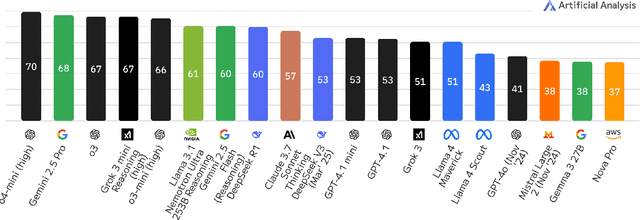
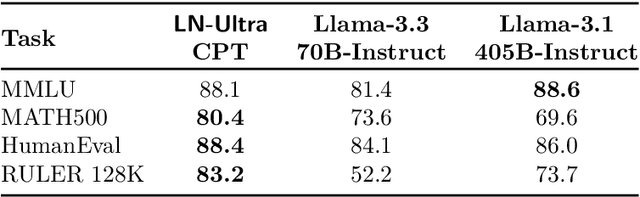
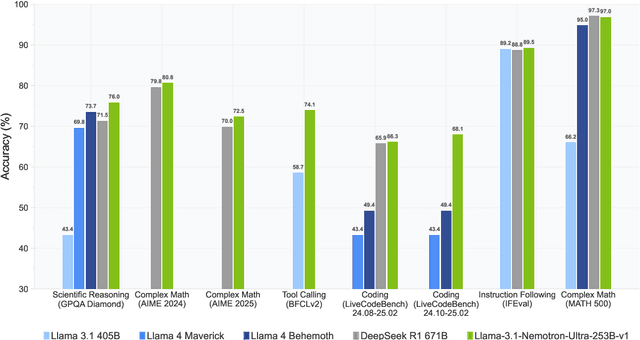
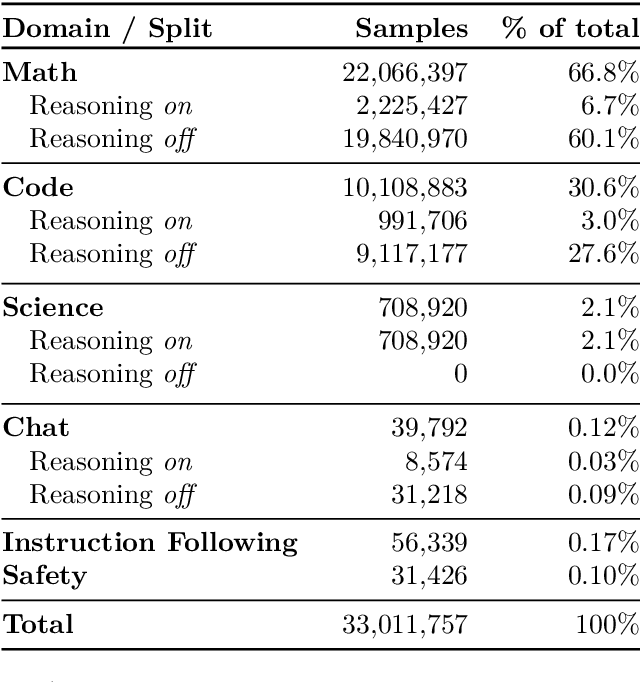
We introduce the Llama-Nemotron series of models, an open family of heterogeneous reasoning models that deliver exceptional reasoning capabilities, inference efficiency, and an open license for enterprise use. The family comes in three sizes -- Nano (8B), Super (49B), and Ultra (253B) -- and performs competitively with state-of-the-art reasoning models such as DeepSeek-R1 while offering superior inference throughput and memory efficiency. In this report, we discuss the training procedure for these models, which entails using neural architecture search from Llama 3 models for accelerated inference, knowledge distillation, and continued pretraining, followed by a reasoning-focused post-training stage consisting of two main parts: supervised fine-tuning and large scale reinforcement learning. Llama-Nemotron models are the first open-source models to support a dynamic reasoning toggle, allowing users to switch between standard chat and reasoning modes during inference. To further support open research and facilitate model development, we provide the following resources: 1. We release the Llama-Nemotron reasoning models -- LN-Nano, LN-Super, and LN-Ultra -- under the commercially permissive NVIDIA Open Model License Agreement. 2. We release the complete post-training dataset: Llama-Nemotron-Post-Training-Dataset. 3. We also release our training codebases: NeMo, NeMo-Aligner, and Megatron-LM.
FFN Fusion: Rethinking Sequential Computation in Large Language Models
Mar 24, 2025We introduce FFN Fusion, an architectural optimization technique that reduces sequential computation in large language models by identifying and exploiting natural opportunities for parallelization. Our key insight is that sequences of Feed-Forward Network (FFN) layers, particularly those remaining after the removal of specific attention layers, can often be parallelized with minimal accuracy impact. We develop a principled methodology for identifying and fusing such sequences, transforming them into parallel operations that significantly reduce inference latency while preserving model behavior. Applying these techniques to Llama-3.1-405B-Instruct, we create Llama-Nemotron-Ultra-253B-Base (Ultra-253B-Base), an efficient and soon-to-be publicly available model that achieves a 1.71X speedup in inference latency and 35X lower per-token cost while maintaining strong performance across benchmarks. Through extensive experiments on models from 49B to 253B parameters, we demonstrate that FFN Fusion becomes increasingly effective at larger scales and can complement existing optimization techniques like quantization and pruning. Most intriguingly, we find that even full transformer blocks containing both attention and FFN layers can sometimes be parallelized, suggesting new directions for neural architecture design.
No Data, No Optimization: A Lightweight Method To Disrupt Neural Networks With Sign-Flips
Feb 11, 2025Deep Neural Networks (DNNs) can be catastrophically disrupted by flipping only a handful of sign bits in their parameters. We introduce Deep Neural Lesion (DNL), a data-free, lightweight method that locates these critical parameters and triggers massive accuracy drops. We validate its efficacy on a wide variety of computer vision models and datasets. The method requires no training data or optimization and can be carried out via common exploits software, firmware or hardware based attack vectors. An enhanced variant that uses a single forward and backward pass further amplifies the damage beyond DNL's zero-pass approach. Flipping just two sign bits in ResNet50 on ImageNet reduces accuracy by 99.8\%. We also show that selectively protecting a small fraction of vulnerable sign bits provides a practical defense against such attacks.