 Add to Chrome
 Add to Firefox
 Add to Edge
ProLaViT: Learning Progressive Latent Visual Thoughts in Structured Latent Space
Jul 03, 2026
Multimodal Large Language Models (MLLMs) have achieved remarkable progress but still struggle with complex visual reasoning tasks requiring multi-step perception and logical deduction. While explicit visual generation incurs prohibitive computational costs, existing latent approaches often rely on external experts or lack rigorous cognitive logic. In this paper, we introduce ProLaViT (Progressive Latent Visual Thought), a framework empowering MLLMs to perform structured visual derivation in the continuous latent space. Unlike works dependent on heterogeneous external models, ProLaViT leverages an endogenous self-distillation mechanism, utilizing the model's own visual encoder to supervise latent thoughts. To facilitate this, we construct a scalable programmatic synthesis pipeline enabling the model to internalize algorithmic precision without inference time tools. We design two reasoning paradigms: (1) Coarse-to-Fine Causal Chain for spatial tasks, guiding attention from global context to local targets. (2) Dialectical Reasoning Chain for logical tasks, incorporating counter-factual thinking for verification. Furthermore, we propose a Distance-Weighted Diversity Loss to impose topology-aware constraints, preventing feature degeneration by enforcing semantic distinctiveness. Extensive experiments demonstrate that ProLaViT outperforms baselines on vision-centric benchmarks, achieving superior accuracy and interpretability with high efficiency.

DeepBD: A Grounded Agentic Workflow for Variant Prioritization and Diagnosis of Genetic Birth Defects
Jun 23, 2026Birth defects are a major cause of fetal loss, neonatal morbidity and long-term disability. In the subset with suspected genetic etiologies, exome and genome sequencing have moved many cases from variant detection to post-sequencing interpretation: clinicians must rank patient-specific candidate variants under incomplete fetal or infant phenotypes and heterogeneous evidence from population genetics, variant-effect prediction, gene-disease validity, phenotype ontologies, cellular and pathway context, protein structure and clinical literature. We present DeepBD, a grounded agentic workflow for variant prioritization and diagnostic interpretation of genetic birth defects. DeepBD organizes the workflow into LLM-assisted case structuring, a pretrained evidence engine, specialist evidence modules and a grounded diagnostic review layer. The evidence engine learns patient-specific variant scores from structured rule evidence, sequence and variant-effect representations and phenotype-conditioned biological context, whereas specialist modules and the agentic layer provide tool-based refinement, candidate-pool review and diagnosis-oriented synthesis from ranked candidates. Developed using an in-house fetal and infant cohort comprising 18,622 cases, DeepBD achieved Recall@1/3/5/10 of 0.658/0.882/0.912/0.929 on an internal held-out solved-case benchmark, outperforming standalone Exomiser, DeepRare and prompted LLM reranking baselines evaluated on Exomiser-derived top-20 candidate variants. Ablation and overlap analyses show that rule evidence, mechanistic context, and specialist refinement provide complementary signals. These findings support a grounded agentic workflow that separates evidence integration, tool-based refinement, and LLM-assisted diagnostic review for retrospective variant prioritization in genetic birth defects.
Focus When Necessary: Adaptive Routing and Collaborative Grounding for Training-Free Visual Grounding
Jun 15, 2026While Multimodal Large Language Models (MLLMs) excel in cross-modal reasoning, they often struggle to perceive fine-grained details in complex high-resolution images. Recent training-free methods address this through image scaling and localized cropping. However, applying these manipulations indiscriminately introduces computational redundancy for simple queries and can degrade accuracy by truncating essential global context or introducing irrelevant background noise. To this end, we propose LazyMCoT, a dynamic and training-free framework that adaptively allocates visual grounding efforts based on sample difficulty. The framework features an Adaptive Routing mechanism that evaluates predictive uncertainty using first-token statistics from a single forward pass. This efficiently bypasses confident cases while ensuring the recall of difficult samples via conformal calibration. For these challenging cases, a Collaborative Grounding module integrates the inherent cross-modal attention of the model with an external visual expert through a two-stage refinement process. This refinement process generates a precise localized display to recover small or occluded targets. Extensive experiments across diverse benchmarks demonstrate that LazyMCoT rivals training-based approaches by simultaneously improving reasoning accuracy and reducing average inference latency. Our code is availble at https://github.com/TencentBAC/LazyMCoT.
Conan-embedding-v3: Fusing Modality-Specific Models for Omni-Modal Embedding
Jun 08, 2026Omni-modal retrieval promises a single embedding space for text, image, video, document, and audio inputs, but building such a unified retriever is difficult since these modalities differ in data distribution, architecture, and optimization dynamics. In this work, we present Conan-embedding-v3, a decouple--fuse--recover framework for omni-modal retrieval. Conan-embedding-v3 first trains modality specialists independently and fuses their task vectors into a single dense backbone, a strategy we call Decoupled Specialist Fusion. We show that this fusion composes visual, video, and document retrieval capabilities, but also exposes a failure mode for projector-based modalities: when audio is attached through an external encoder and projector, fusing the backbone leaves the projector calibrated to the audio-specialist backbone, causing a large audio retrieval regression despite copying all audio-specific modules unchanged. We call this failure Projector Drift. To repair it, Conan-embedding-v3 applies Projector Recovery (i.e., full-parameter fine-tuning of the projector while keeping the backbone frozen) followed by balanced multi-modal rehearsal. The resulting model supports these retrieval pathways in one backbone, achieving 74.9 scores on MMEB while obtaining 55.61 on the 30-task MAEB audio suite.
Multi-Camera AR Guidance System for Surgical Instrument Handling and Assembly: Investigating Workload and Efficiency
Jun 03, 2026The handling and assembly of instruments during surgery imposes high cognitive demands on scrub nurses, particularly when instruments are unfamiliar. We present a supporting guidance system for surgical instrumentation that combines multi-camera 6D pose estimation with augmented reality in-situ visualization on a head-mounted display without the requirement for additional markers. Pose estimation and consecutive camera calibration are achieved through known objects. The 6D pose estimation network is trained purely on synthetic data, aiming for better generalizability and real-world applicability. The AR guidance displays tooltip localization cues and step-wise assembly animations. Via gaze-based selection and a foot pedal, users can switch between assembly steps in intraoperative use. In a technical evaluation, our approach outperforms state-of-art 6D pose estimation. A user study with 29 scrub nurses was conducted in a surgical simulation of knee arthroplasty, comparing the system against a paper manual. AR guidance significantly reduced the perceived workload compared. Objectively, AR guidance reduced task completion time by 21.3\% (4.76 minutes). Specifically, scrub nurses less experienced with the instrument set benefited when using the system. Error frequencies were comparable between conditions. Qualitative feedback highlighted improved process clarity, reduced information overload, and perceived independence. To summarize, our marker-free multi-camera AR guidance approach for surgical instruments can, subjectively and objectively, improve intraoperative instrumentation performance, particularly for untrained scrub nurses.
MultiCam: On-the-fly Multi-Camera Pose Estimation Using Spatiotemporal Overlaps of Known Objects
Mar 24, 2026Multi-camera dynamic Augmented Reality (AR) applications require a camera pose estimation to leverage individual information from each camera in one common system. This can be achieved by combining contextual information, such as markers or objects, across multiple views. While commonly cameras are calibrated in an initial step or updated through the constant use of markers, another option is to leverage information already present in the scene, like known objects. Another downside of marker-based tracking is that markers have to be tracked inside the field-of-view (FoV) of the cameras. To overcome these limitations, we propose a constant dynamic camera pose estimation leveraging spatiotemporal FoV overlaps of known objects on the fly. To achieve that, we enhance the state-of-the-art object pose estimator to update our spatiotemporal scene graph, enabling a relation even among non-overlapping FoV cameras. To evaluate our approach, we introduce a multi-camera, multi-object pose estimation dataset with temporal FoV overlap, including static and dynamic cameras. Furthermore, in FoV overlapping scenarios, we outperform the state-of-the-art on the widely used YCB-V and T-LESS dataset in camera pose accuracy. Our performance on both previous and our proposed datasets validates the effectiveness of our marker-less approach for AR applications. The code and dataset are available on https://github.com/roth-hex-lab/IEEE-VR-2026-MultiCam.
Render-of-Thought: Rendering Textual Chain-of-Thought as Images for Visual Latent Reasoning
Jan 21, 2026Chain-of-Thought (CoT) prompting has achieved remarkable success in unlocking the reasoning capabilities of Large Language Models (LLMs). Although CoT prompting enhances reasoning, its verbosity imposes substantial computational overhead. Recent works often focus exclusively on outcome alignment and lack supervision on the intermediate reasoning process. These deficiencies obscure the analyzability of the latent reasoning chain. To address these challenges, we introduce Render-of-Thought (RoT), the first framework to reify the reasoning chain by rendering textual steps into images, making the latent rationale explicit and traceable. Specifically, we leverage the vision encoders of existing Vision Language Models (VLMs) as semantic anchors to align the vision embeddings with the textual space. This design ensures plug-and-play implementation without incurring additional pre-training overhead. Extensive experiments on mathematical and logical reasoning benchmarks demonstrate that our method achieves 3-4x token compression and substantial inference acceleration compared to explicit CoT. Furthermore, it maintains competitive performance against other methods, validating the feasibility of this paradigm. Our code is available at https://github.com/TencentBAC/RoT
ReSeek: A Self-Correcting Framework for Search Agents with Instructive Rewards
Oct 01, 2025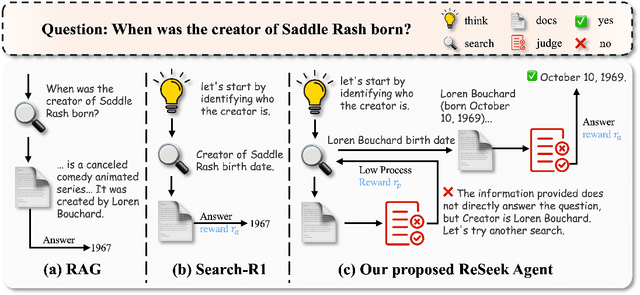
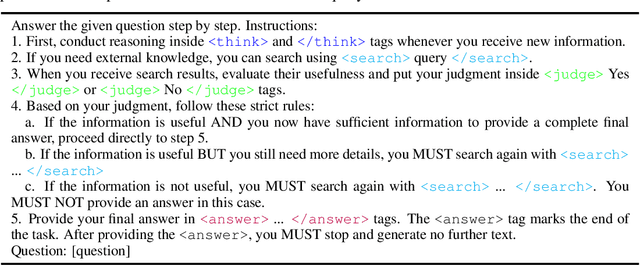
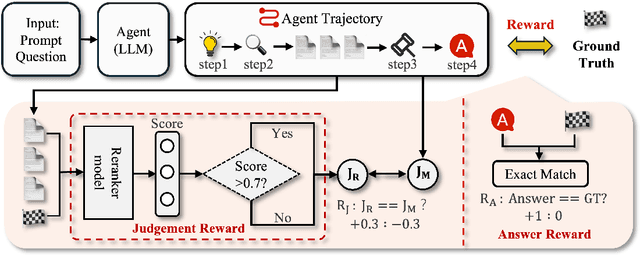
Search agents powered by Large Language Models (LLMs) have demonstrated significant potential in tackling knowledge-intensive tasks. Reinforcement learning (RL) has emerged as a powerful paradigm for training these agents to perform complex, multi-step reasoning. However, prior RL-based methods often rely on sparse or rule-based rewards, which can lead agents to commit to suboptimal or erroneous reasoning paths without the ability to recover. To address these limitations, we propose ReSeek, a novel self-correcting framework for training search agents. Our framework introduces a self-correction mechanism that empowers the agent to dynamically identify and recover from erroneous search paths during an episode. By invoking a special JUDGE action, the agent can judge the information and re-plan its search strategy. To guide this process, we design a dense, instructive process reward function, which decomposes into a correctness reward for retrieving factual information and a utility reward for finding information genuinely useful for the query. Furthermore, to mitigate the risk of data contamination in existing datasets, we introduce FictionalHot, a new and challenging benchmark with recently curated questions requiring complex reasoning. Being intuitively reasonable and practically simple, extensive experiments show that agents trained with ReSeek significantly outperform SOTA baselines in task success rate and path faithfulness.
Conan-Embedding-v2: Training an LLM from Scratch for Text Embeddings
Sep 16, 2025Large language models (LLMs) have recently demonstrated excellent performance in text embedding tasks. Previous work usually use LoRA to fine-tune existing LLMs, which are limited by the data and training gap between LLMs and embedding models. In this work, we introduce Conan-embedding-v2, a new 1.4B-parameter LLM trained from scratch and fine-tuned as a text embedder. First, we add news data and multilingual pairs for LLM pretraining to bridge the data gap. Based on this, we propose a cross-lingual retrieval dataset that enables the LLM to better integrate embeddings across different languages. Second, whereas LLMs use a causal mask with token-level loss, embedding models use a bidirectional mask with sentence-level loss. This training gap makes full fine-tuning less effective than LoRA. We introduce a soft-masking mechanism to gradually transition between these two types of masks, enabling the model to learn more comprehensive representations. Based on this, we propose a dynamic hard negative mining method that exposes the model to more difficult negative examples throughout the training process. Being intuitive and effective, with only approximately 1.4B parameters, Conan-embedding-v2 achieves SOTA performance on both the Massive Text Embedding Benchmark (MTEB) and Chinese MTEB (May 19, 2025).
TAlignDiff: Automatic Tooth Alignment assisted by Diffusion-based Transformation Learning
Aug 06, 2025Orthodontic treatment hinges on tooth alignment, which significantly affects occlusal function, facial aesthetics, and patients' quality of life. Current deep learning approaches predominantly concentrate on predicting transformation matrices through imposing point-to-point geometric constraints for tooth alignment. Nevertheless, these matrices are likely associated with the anatomical structure of the human oral cavity and possess particular distribution characteristics that the deterministic point-to-point geometric constraints in prior work fail to capture. To address this, we introduce a new automatic tooth alignment method named TAlignDiff, which is supported by diffusion-based transformation learning. TAlignDiff comprises two main components: a primary point cloud-based regression network (PRN) and a diffusion-based transformation matrix denoising module (DTMD). Geometry-constrained losses supervise PRN learning for point cloud-level alignment. DTMD, as an auxiliary module, learns the latent distribution of transformation matrices from clinical data. We integrate point cloud-based transformation regression and diffusion-based transformation modeling into a unified framework, allowing bidirectional feedback between geometric constraints and diffusion refinement. Extensive ablation and comparative experiments demonstrate the effectiveness and superiority of our method, highlighting its potential in orthodontic treatment.