 Add to Chrome
 Add to Firefox
 Add to Edge
From Inference to Adaptation: A Unified Optimal Transport View of Vision Language Model
Aug 18, 2026
Vision-language models (VLMs) have demonstrated remarkable zero-shot capabilities yet remain sensitive to real-world distribution shifts during inference. Although significant efforts are devoted to adapting VLMs at test time, they rely heavily on noisy pseudo-labels predicted directly from raw embedding similarities during inference, which are unreliable under distribution shift and mislead the adaptation. To avoid noise amplification, existing works craft coarse-grained surrogate objectives during adaptation, which fail to explicitly model sample-level relationships across different modalities, creating objective mismatch with inference, thus leading to marginal performance improvement. In this work, we aim to bridge the detached objectives of inference and adaptation for VLMs, and propose a principled VLM TTA method called \algname. For VLM inference, we formulate the zero-shot image classification task as a cross-modal alignment problem encoded via a Wasserstein OT formulation, providing robust pseudo-labels at the sample-level to effectively adapt VLMs. For VLM adaptation, we adopt a soft-label InfoNCE loss to adapt VLMs based on the OT-induced pseudo-labels, leveraging fine-grained supervisions to explicitly model relationships of individual image-text pairs via contrastive learning, which empowers accurate inference at the same granularity. Moreover, we theoretically reveal that the InfoNCE loss can be neatly reformulated as a Wasserstein OT formulation, thereby unifying the objectives of the inference and adaptation of VLMs to achieve their mutual benefits. Extensive experiments demonstrate the effectiveness and efficiency of our methods, outperforming the best-performing methods by up to 7% with state-of-the-art efficiency.

When Does Restricting a Coding Agent to execute_code Help? A Regime $\times$ Agent-Design Ablation
Jul 12, 2026Modern coding agents expose multiple tool surfaces -- IDE primitives, bash, and Model Context Protocol (MCP) code-execution -- and the field has shipped three contradictory claims about which one matters. We run the missing crossed comparison: an integrity-clean three-arm ablation (baseline / bash_only / code_only) on synthetic computation tasks and SWE-bench Mini modification tasks, holding model, harness, and prompts fixed, with two agents (Claude Code, OpenAI Codex CLI) so the comparison spans both regime and agent-design axes. Across the four resulting (regime, agent) cells, restricting the agent to a single execute_code MCP tool is cheaper than -- or statistically tied with -- its cheapest tool-rich rival in three cells (significantly on Artifact/Claude and SWE-bench/Codex; directionally on Artifact/Codex), with pass rates statistically tied within each cell. The lone exception is SWE-bench/Claude, where code_only is directionally costlier (+14.4%, not significant); a conditional-cost analysis localizes that gap to failure-cost on doomed-run trajectories, not a per-edit tax on successful runs. Two implications: the cheapest tool surface is jointly determined by task regime and agent design rather than by either axis alone, and the headline cost signal lives in cache-adjusted cost -- not pass rate, which is invariant across surfaces at the model sizes we evaluate. The benchmark harness, task suite, and analysis code are available at https://github.com/hyang0129/onlycodes.
Scalable Optimal Transport Algorithm for Network Alignment
Jul 11, 2026Network alignment identifies node correspondences across different networks and is a fundamental primitive in many data science applications, including social network analysis, fraud detection, and knowledge graph integration. However, state-of-the-art network alignment methods often achieve high accuracy by repeatedly constructing and updating dense matrices, sacrificing scalability in the process. To address this scalability limitation without compromising alignment accuracy, we present FastAlign, a scalable, sparsity-aware framework for optimal transport-based network alignment. Rather than introducing a new alignment model, FastAlign preserves the original OT formulation and reinterprets its computation as a set of recurring mixed sparse-dense operations. FastAlign combines sparsity-aware graph computation with domain-specific kernel fusion, including a custom SpMM kernel. Our results show that FastAlign achieves alignment quality comparable to state-of-the-art OT-based methods while substantially reducing end-to-end runtime up to 3.89x-9.45x on CPU and 2.24x-32.54x on GPU.
AvAtar: Learning to Align via Active Optimal Transport
May 23, 2026Alignment plays a fundamental role in many machine learning problems, such as multi-network analysis, multimodal learning, and point cloud registration. Recent works increasingly leverage optimal transport (OT) for distributional alignment, whose effectiveness largely depends on sparse supervision that is hard or costly to obtain in practice. Existing works, however, largely overlook how to actively acquire high-quality supervision to improve their alignment performance under OT frameworks. In this paper, we propose a principled active alignment framework for optimal transport alignment called AvAtar. We quantify the informativeness of a candidate by measuring its gradient-based impact on the global alignment result, computed as the gradient propagation from the global alignment result to all possible supervisions of the candidate through the entropy-regularized OT formulation. While differentiating through OT is challenging given its constrained nature, we leverage the adjoint-state method to reformulate the computation to a linear system solvable by the conjugate gradient method with linear complexity and guaranteed convergence. By encoding the global alignment result via effective utility functions, AvAtar is applicable to general alignment problems under the OT framework. Extensive experiments on three representative alignment tasks demonstrate the effectiveness, scalability, and generalizability of the proposed AvAtar.
MapSR: Prompt-Driven Land Cover Map Super-Resolution via Vision Foundation Models
Apr 16, 2026High-resolution (HR) land-cover mapping is often constrained by the high cost of dense HR annotations. We revisit this problem from the perspective of map super-resolution, which enhances coarse low-resolution (LR) land-cover products into HR maps at the resolution of the input imagery. Existing weakly supervised methods can leverage LR labels, but they typically use them to retrain dense predictors with substantial computational cost. We propose MapSR, a prompt-driven framework that decouples supervision from model training. MapSR uses LR labels once to extract class prompts from frozen vision foundation model features through a lightweight linear probe, after which HR mapping proceeds via training-free metric inference and graph-based prediction refinement. Specifically, class prompts are estimated by aggregating high-confidence HR features identified by the linear probe, and HR predictions are obtained by cosine-similarity matching followed by graph-based propagation for spatial refinement. Experiments on the Chesapeake Bay dataset show that MapSR achieves 59.64% mIoU without any HR labels, remaining competitive with the strongest weakly supervised baseline and surpassing a fully supervised baseline. Notably, MapSR reduces trainable parameters by four orders of magnitude and shortens training time from hours to minutes, enabling scalable HR mapping under limited annotation and compute budgets. The code is available at https://github.com/rikirikirikiriki/MapSR.
Beyond the Class Subspace: Teacher-Guided Training for Reliable Out-of-Distribution Detection in Single-Domain Models
Mar 11, 2026Out-of-distribution (OOD) detection methods perform well on multi-domain benchmarks, yet many practical systems are trained on single-domain data. We show that this regime induces a geometric failure mode, Domain-Sensitivity Collapse (DSC): supervised training compresses features into a low-rank class subspace and suppresses directions that carry domain-shift signal. We provide theory showing that, under DSC, distance- and logit-based OOD scores lose sensitivity to domain shift. We then introduce Teacher-Guided Training (TGT), which distills class-suppressed residual structure from a frozen multi-domain teacher (DINOv2) into the student during training. The teacher and auxiliary head are discarded after training, adding no inference overhead. Across eight single-domain benchmarks, TGT yields large far-OOD FPR@95 reductions for distance-based scorers: MDS improves by 11.61 pp, ViM by 10.78 pp, and kNN by 12.87 pp (ResNet-50 average), while maintaining or slightly improving in-domain OOD and classification accuracy.
Generalized Regularized Evidential Deep Learning Models: Theory and Comprehensive Evaluation
Dec 27, 2025Evidential deep learning (EDL) models, based on Subjective Logic, introduce a principled and computationally efficient way to make deterministic neural networks uncertainty-aware. The resulting evidential models can quantify fine-grained uncertainty using learned evidence. However, the Subjective-Logic framework constrains evidence to be non-negative, requiring specific activation functions whose geometric properties can induce activation-dependent learning-freeze behavior: a regime where gradients become extremely small for samples mapped into low-evidence regions. We theoretically characterize this behavior and analyze how different evidential activations influence learning dynamics. Building on this analysis, we design a general family of activation functions and corresponding evidential regularizers that provide an alternative pathway for consistent evidence updates across activation regimes. Extensive experiments on four benchmark classification problems (MNIST, CIFAR-10, CIFAR-100, and Tiny-ImageNet), two few-shot classification problems, and blind face restoration problem empirically validate the developed theory and demonstrate the effectiveness of the proposed generalized regularized evidential models.
FuXi-Air: Urban Air Quality Forecasting Based on Emission-Meteorology-Pollutant multimodal Machine Learning
Jun 09, 2025Air pollution has emerged as a major public health challenge in megacities. Numerical simulations and single-site machine learning approaches have been widely applied in air quality forecasting tasks. However, these methods face multiple limitations, including high computational costs, low operational efficiency, and limited integration with observational data. With the rapid advancement of artificial intelligence, there is an urgent need to develop a low-cost, efficient air quality forecasting model for smart urban management. An air quality forecasting model, named FuXi-Air, has been constructed in this study based on multimodal data fusion to support high-precision air quality forecasting and operated in typical megacities. The model integrates meteorological forecasts, emission inventories, and pollutant monitoring data under the guidance of air pollution mechanism. By combining an autoregressive prediction framework with a frame interpolation strategy, the model successfully completes 72-hour forecasts for six major air pollutants at an hourly resolution across multiple monitoring sites within 25-30 seconds. In terms of both computational efficiency and forecasting accuracy, it outperforms the mainstream numerical air quality models in operational forecasting work. Ablation experiments concerning key influencing factors show that although meteorological data contribute more to model accuracy than emission inventories do, the integration of multimodal data significantly improves forecasting precision and ensures that reliable predictions are obtained under differing pollution mechanisms across megacities. This study provides both a technical reference and a practical example for applying multimodal data-driven models to air quality forecasting and offers new insights into building hybrid forecasting systems to support air pollution risk warning in smart city management.
PLANETALIGN: A Comprehensive Python Library for Benchmarking Network Alignment
May 27, 2025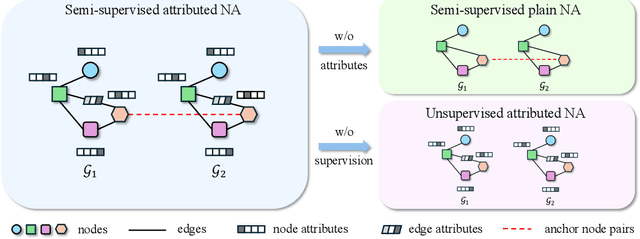
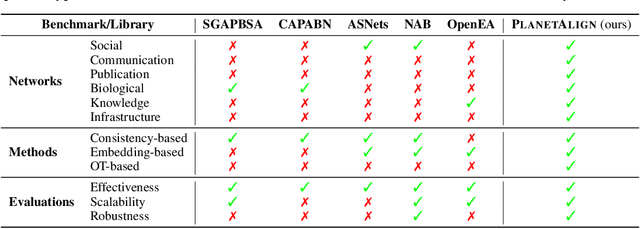
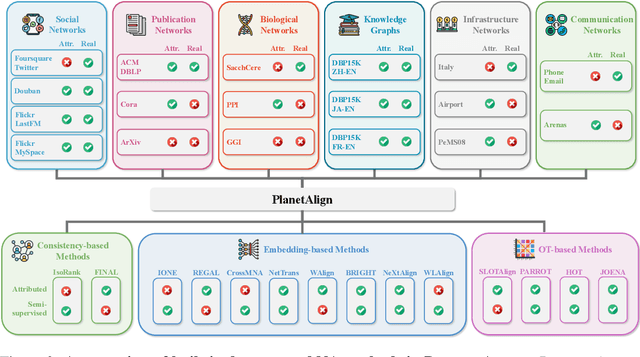
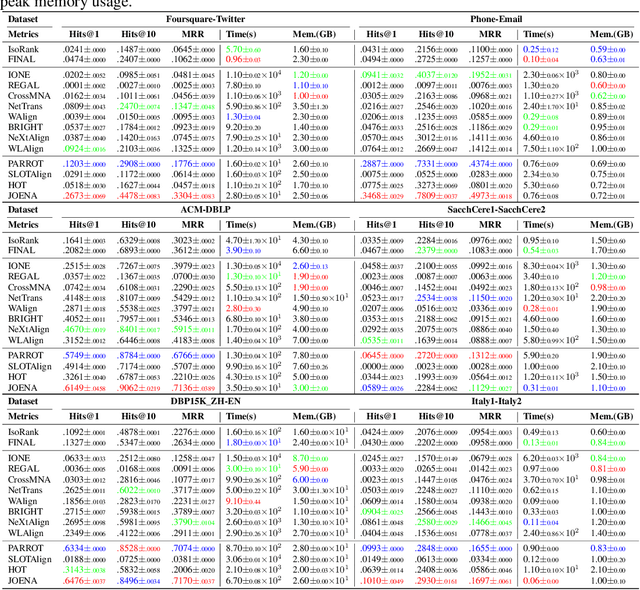
Network alignment (NA) aims to identify node correspondence across different networks and serves as a critical cornerstone behind various downstream multi-network learning tasks. Despite growing research in NA, there lacks a comprehensive library that facilitates the systematic development and benchmarking of NA methods. In this work, we introduce PLANETALIGN, a comprehensive Python library for network alignment that features a rich collection of built-in datasets, methods, and evaluation pipelines with easy-to-use APIs. Specifically, PLANETALIGN integrates 18 datasets and 14 NA methods with extensible APIs for easy use and development of NA methods. Our standardized evaluation pipeline encompasses a wide range of metrics, enabling a systematic assessment of the effectiveness, scalability, and robustness of NA methods. Through extensive comparative studies, we reveal practical insights into the strengths and limitations of existing NA methods. We hope that PLANETALIGN can foster a deeper understanding of the NA problem and facilitate the development and benchmarking of more effective, scalable, and robust methods in the future. The source code of PLANETALIGN is available at https://github.com/yq-leo/PlanetAlign.
ProDisc-VAD: An Efficient System for Weakly-Supervised Anomaly Detection in Video Surveillance Applications
May 04, 2025Weakly-supervised video anomaly detection (WS-VAD) using Multiple Instance Learning (MIL) suffers from label ambiguity, hindering discriminative feature learning. We propose ProDisc-VAD, an efficient framework tackling this via two synergistic components. The Prototype Interaction Layer (PIL) provides controlled normality modeling using a small set of learnable prototypes, establishing a robust baseline without being overwhelmed by dominant normal data. The Pseudo-Instance Discriminative Enhancement (PIDE) loss boosts separability by applying targeted contrastive learning exclusively to the most reliable extreme-scoring instances (highest/lowest scores). ProDisc-VAD achieves strong AUCs (97.98% ShanghaiTech, 87.12% UCF-Crime) using only 0.4M parameters, over 800x fewer than recent ViT-based methods like VadCLIP, demonstrating exceptional efficiency alongside state-of-the-art performance. Code is available at https://github.com/modadundun/ProDisc-VAD.