 Add to Chrome
 Add to Firefox
 Add to Edge
VideoLCM: Video Latent Consistency Model
Dec 14, 2023
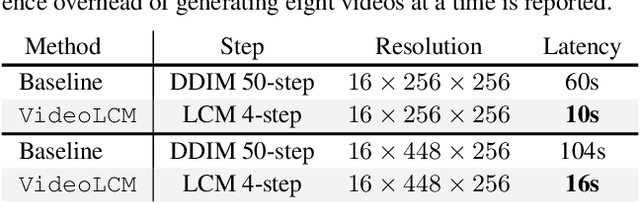
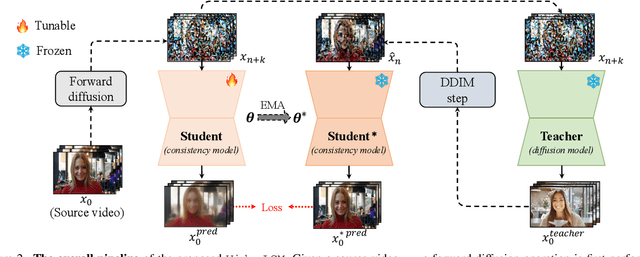
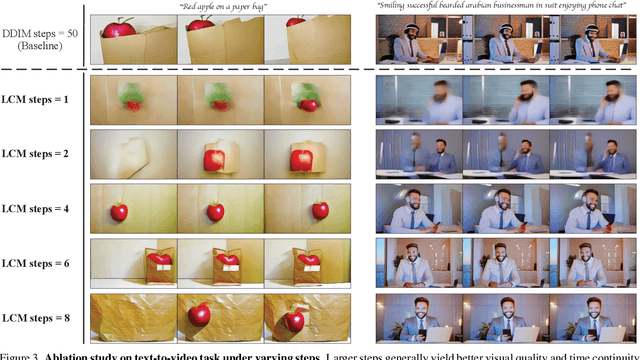
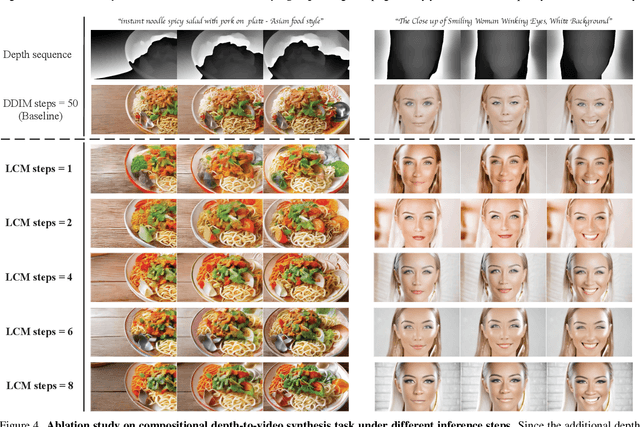
Consistency models have demonstrated powerful capability in efficient image generation and allowed synthesis within a few sampling steps, alleviating the high computational cost in diffusion models. However, the consistency model in the more challenging and resource-consuming video generation is still less explored. In this report, we present the VideoLCM framework to fill this gap, which leverages the concept of consistency models from image generation to efficiently synthesize videos with minimal steps while maintaining high quality. VideoLCM builds upon existing latent video diffusion models and incorporates consistency distillation techniques for training the latent consistency model. Experimental results reveal the effectiveness of our VideoLCM in terms of computational efficiency, fidelity and temporal consistency. Notably, VideoLCM achieves high-fidelity and smooth video synthesis with only four sampling steps, showcasing the potential for real-time synthesis. We hope that VideoLCM can serve as a simple yet effective baseline for subsequent research. The source code and models will be publicly available.

Hierarchical Spatio-temporal Decoupling for Text-to-Video Generation
Dec 07, 2023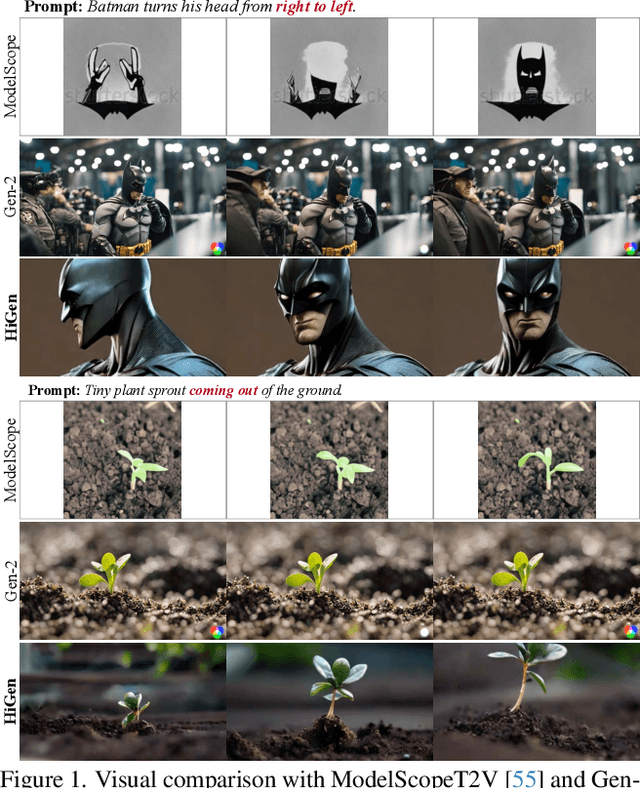
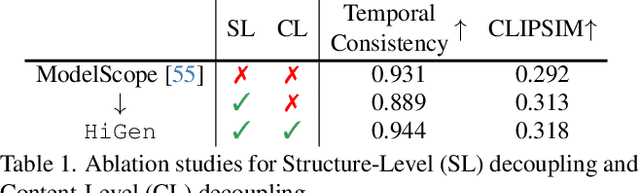
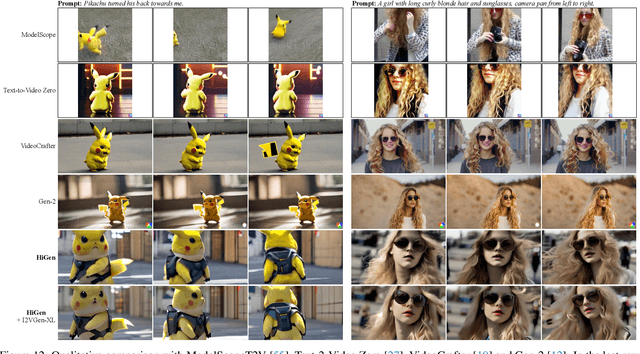
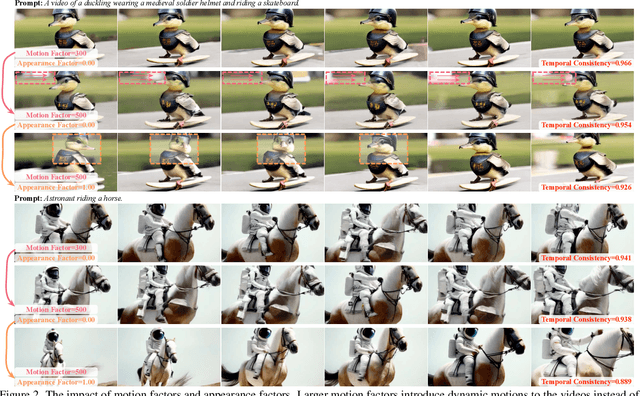
Despite diffusion models having shown powerful abilities to generate photorealistic images, generating videos that are realistic and diverse still remains in its infancy. One of the key reasons is that current methods intertwine spatial content and temporal dynamics together, leading to a notably increased complexity of text-to-video generation (T2V). In this work, we propose HiGen, a diffusion model-based method that improves performance by decoupling the spatial and temporal factors of videos from two perspectives, i.e., structure level and content level. At the structure level, we decompose the T2V task into two steps, including spatial reasoning and temporal reasoning, using a unified denoiser. Specifically, we generate spatially coherent priors using text during spatial reasoning and then generate temporally coherent motions from these priors during temporal reasoning. At the content level, we extract two subtle cues from the content of the input video that can express motion and appearance changes, respectively. These two cues then guide the model's training for generating videos, enabling flexible content variations and enhancing temporal stability. Through the decoupled paradigm, HiGen can effectively reduce the complexity of this task and generate realistic videos with semantics accuracy and motion stability. Extensive experiments demonstrate the superior performance of HiGen over the state-of-the-art T2V methods.
DreamVideo: Composing Your Dream Videos with Customized Subject and Motion
Dec 07, 2023Customized generation using diffusion models has made impressive progress in image generation, but remains unsatisfactory in the challenging video generation task, as it requires the controllability of both subjects and motions. To that end, we present DreamVideo, a novel approach to generating personalized videos from a few static images of the desired subject and a few videos of target motion. DreamVideo decouples this task into two stages, subject learning and motion learning, by leveraging a pre-trained video diffusion model. The subject learning aims to accurately capture the fine appearance of the subject from provided images, which is achieved by combining textual inversion and fine-tuning of our carefully designed identity adapter. In motion learning, we architect a motion adapter and fine-tune it on the given videos to effectively model the target motion pattern. Combining these two lightweight and efficient adapters allows for flexible customization of any subject with any motion. Extensive experimental results demonstrate the superior performance of our DreamVideo over the state-of-the-art methods for customized video generation. Our project page is at https://dreamvideo-t2v.github.io.
Check, Locate, Rectify: A Training-Free Layout Calibration System for Text-to-Image Generation
Nov 30, 2023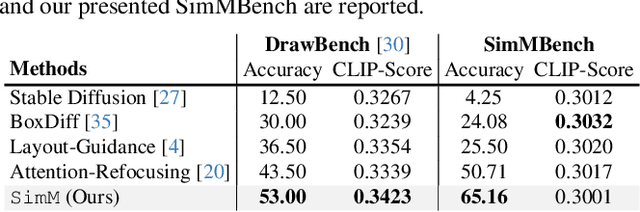
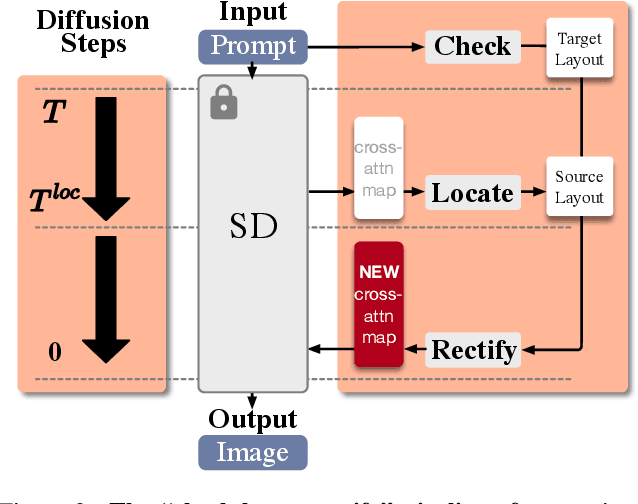
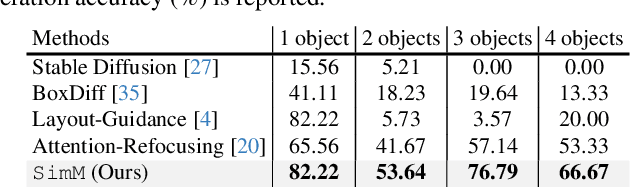
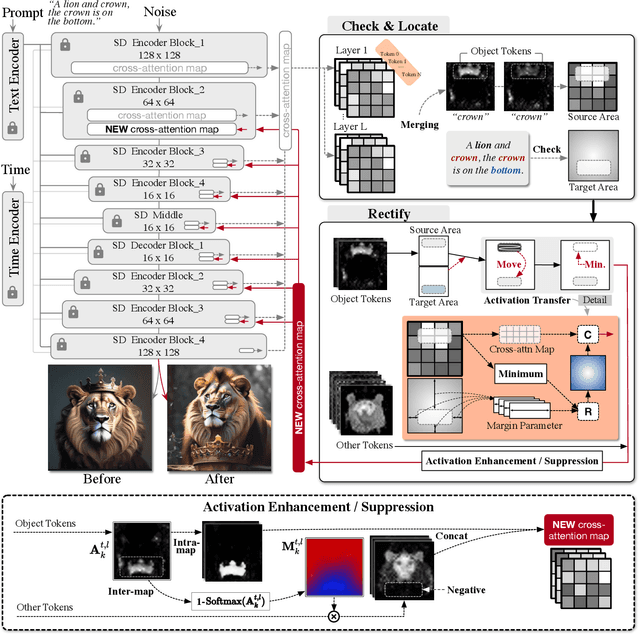
Diffusion models have recently achieved remarkable progress in generating realistic images. However, challenges remain in accurately understanding and synthesizing the layout requirements in the textual prompts. To align the generated image with layout instructions, we present a training-free layout calibration system SimM that intervenes in the generative process on the fly during inference time. Specifically, following a "check-locate-rectify" pipeline, the system first analyses the prompt to generate the target layout and compares it with the intermediate outputs to automatically detect errors. Then, by moving the located activations and making intra- and inter-map adjustments, the rectification process can be performed with negligible computational overhead. To evaluate SimM over a range of layout requirements, we present a benchmark SimMBench that compensates for the lack of superlative spatial relations in existing datasets. And both quantitative and qualitative results demonstrate the effectiveness of the proposed SimM in calibrating the layout inconsistencies. Our project page is at https://simm-t2i.github.io/SimM.
I2VGen-XL: High-Quality Image-to-Video Synthesis via Cascaded Diffusion Models
Nov 07, 2023Video synthesis has recently made remarkable strides benefiting from the rapid development of diffusion models. However, it still encounters challenges in terms of semantic accuracy, clarity and spatio-temporal continuity. They primarily arise from the scarcity of well-aligned text-video data and the complex inherent structure of videos, making it difficult for the model to simultaneously ensure semantic and qualitative excellence. In this report, we propose a cascaded I2VGen-XL approach that enhances model performance by decoupling these two factors and ensures the alignment of the input data by utilizing static images as a form of crucial guidance. I2VGen-XL consists of two stages: i) the base stage guarantees coherent semantics and preserves content from input images by using two hierarchical encoders, and ii) the refinement stage enhances the video's details by incorporating an additional brief text and improves the resolution to 1280$\times$720. To improve the diversity, we collect around 35 million single-shot text-video pairs and 6 billion text-image pairs to optimize the model. By this means, I2VGen-XL can simultaneously enhance the semantic accuracy, continuity of details and clarity of generated videos. Through extensive experiments, we have investigated the underlying principles of I2VGen-XL and compared it with current top methods, which can demonstrate its effectiveness on diverse data. The source code and models will be publicly available at \url{https://i2vgen-xl.github.io}.
Utilising a Large Language Model to Annotate Subject Metadata: A Case Study in an Australian National Research Data Catalogue
Oct 17, 2023
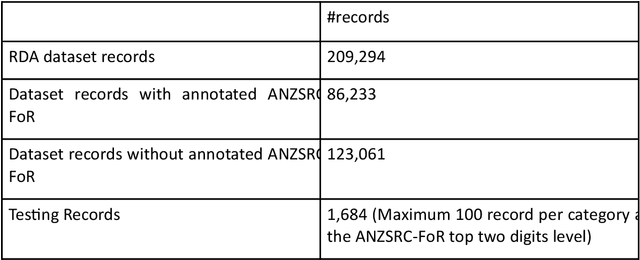
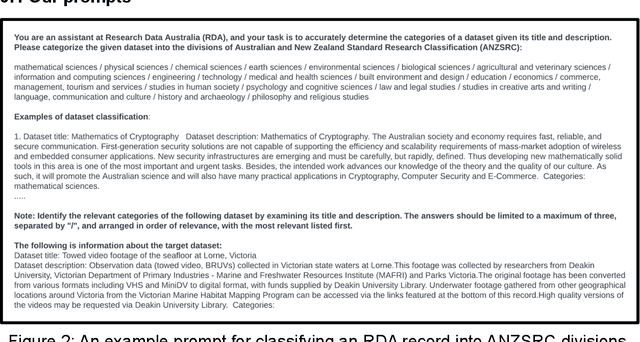
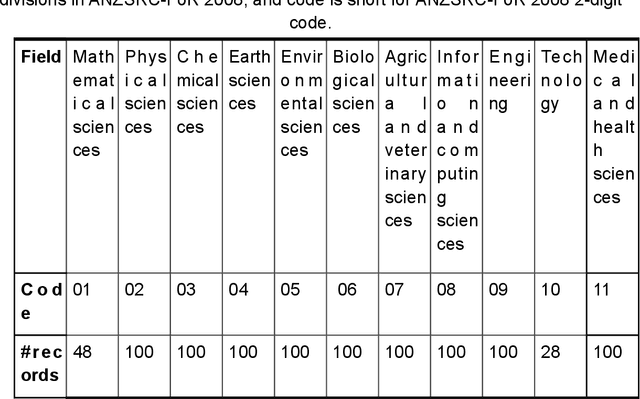
In support of open and reproducible research, there has been a rapidly increasing number of datasets made available for research. As the availability of datasets increases, it becomes more important to have quality metadata for discovering and reusing them. Yet, it is a common issue that datasets often lack quality metadata due to limited resources for data curation. Meanwhile, technologies such as artificial intelligence and large language models (LLMs) are progressing rapidly. Recently, systems based on these technologies, such as ChatGPT, have demonstrated promising capabilities for certain data curation tasks. This paper proposes to leverage LLMs for cost-effective annotation of subject metadata through the LLM-based in-context learning. Our method employs GPT-3.5 with prompts designed for annotating subject metadata, demonstrating promising performance in automatic metadata annotation. However, models based on in-context learning cannot acquire discipline-specific rules, resulting in lower performance in several categories. This limitation arises from the limited contextual information available for subject inference. To the best of our knowledge, we are introducing, for the first time, an in-context learning method that harnesses large language models for automated subject metadata annotation.
Few-shot Action Recognition with Captioning Foundation Models
Oct 16, 2023Transferring vision-language knowledge from pretrained multimodal foundation models to various downstream tasks is a promising direction. However, most current few-shot action recognition methods are still limited to a single visual modality input due to the high cost of annotating additional textual descriptions. In this paper, we develop an effective plug-and-play framework called CapFSAR to exploit the knowledge of multimodal models without manually annotating text. To be specific, we first utilize a captioning foundation model (i.e., BLIP) to extract visual features and automatically generate associated captions for input videos. Then, we apply a text encoder to the synthetic captions to obtain representative text embeddings. Finally, a visual-text aggregation module based on Transformer is further designed to incorporate cross-modal spatio-temporal complementary information for reliable few-shot matching. In this way, CapFSAR can benefit from powerful multimodal knowledge of pretrained foundation models, yielding more comprehensive classification in the low-shot regime. Extensive experiments on multiple standard few-shot benchmarks demonstrate that the proposed CapFSAR performs favorably against existing methods and achieves state-of-the-art performance. The code will be made publicly available.
Unleashing Potential of Evidence in Knowledge-Intensive Dialogue Generation
Sep 15, 2023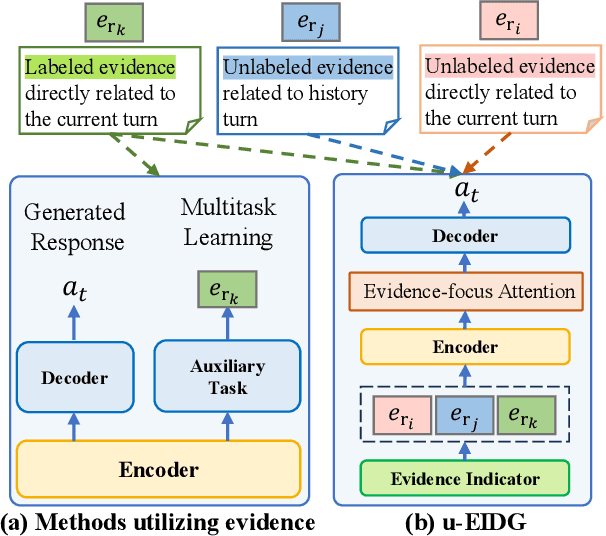
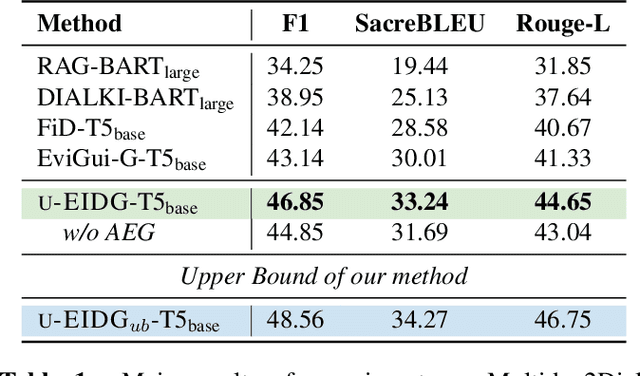
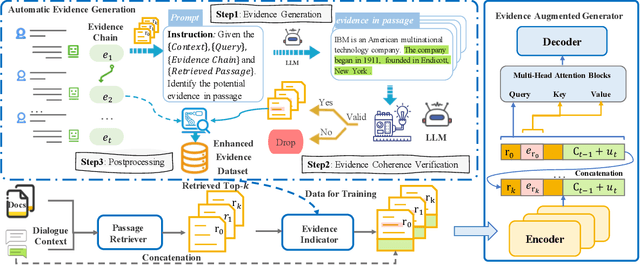
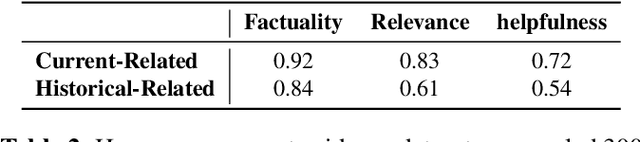
Incorporating external knowledge into dialogue generation (KIDG) is crucial for improving the correctness of response, where evidence fragments serve as knowledgeable snippets supporting the factual dialogue replies. However, introducing irrelevant content often adversely impacts reply quality and easily leads to hallucinated responses. Prior work on evidence retrieval and integration in dialogue systems falls short of fully leveraging existing evidence since the model fails to locate useful fragments accurately and overlooks hidden evidence labels within the KIDG dataset. To fully Unleash the potential of evidence, we propose a framework to effectively incorporate Evidence in knowledge-Intensive Dialogue Generation (u-EIDG). Specifically, we introduce an automatic evidence generation framework that harnesses the power of Large Language Models (LLMs) to mine reliable evidence veracity labels from unlabeled data. By utilizing these evidence labels, we train a reliable evidence indicator to effectively identify relevant evidence from retrieved passages. Furthermore, we propose an evidence-augmented generator with an evidence-focused attention mechanism, which allows the model to concentrate on evidenced segments. Experimental results on MultiDoc2Dial demonstrate the efficacy of evidential label augmentation and refined attention mechanisms in improving model performance. Further analysis confirms that the proposed method outperforms other baselines (+3~+5 points) regarding coherence and factual consistency.
Disentangling Spatial and Temporal Learning for Efficient Image-to-Video Transfer Learning
Sep 14, 2023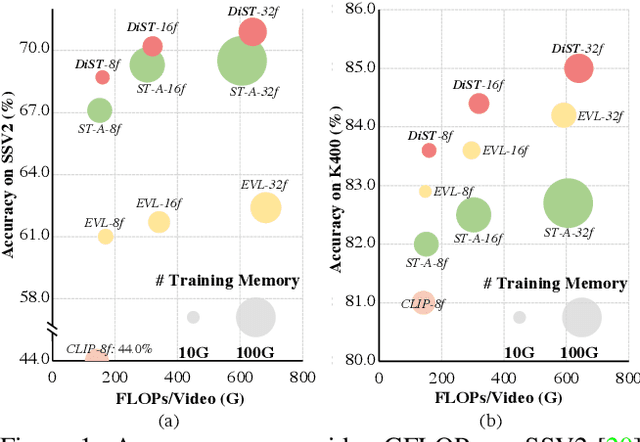
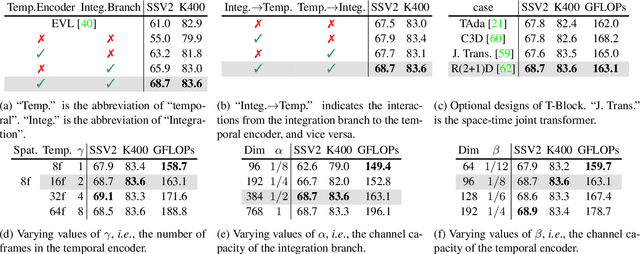

Recently, large-scale pre-trained language-image models like CLIP have shown extraordinary capabilities for understanding spatial contents, but naively transferring such models to video recognition still suffers from unsatisfactory temporal modeling capabilities. Existing methods insert tunable structures into or in parallel with the pre-trained model, which either requires back-propagation through the whole pre-trained model and is thus resource-demanding, or is limited by the temporal reasoning capability of the pre-trained structure. In this work, we present DiST, which disentangles the learning of spatial and temporal aspects of videos. Specifically, DiST uses a dual-encoder structure, where a pre-trained foundation model acts as the spatial encoder, and a lightweight network is introduced as the temporal encoder. An integration branch is inserted between the encoders to fuse spatio-temporal information. The disentangled spatial and temporal learning in DiST is highly efficient because it avoids the back-propagation of massive pre-trained parameters. Meanwhile, we empirically show that disentangled learning with an extra network for integration benefits both spatial and temporal understanding. Extensive experiments on five benchmarks show that DiST delivers better performance than existing state-of-the-art methods by convincing gaps. When pre-training on the large-scale Kinetics-710, we achieve 89.7% on Kinetics-400 with a frozen ViT-L model, which verifies the scalability of DiST. Codes and models can be found in https://github.com/alibaba-mmai-research/DiST.
Towards Real-World Visual Tracking with Temporal Contexts
Aug 20, 2023Visual tracking has made significant improvements in the past few decades. Most existing state-of-the-art trackers 1) merely aim for performance in ideal conditions while overlooking the real-world conditions; 2) adopt the tracking-by-detection paradigm, neglecting rich temporal contexts; 3) only integrate the temporal information into the template, where temporal contexts among consecutive frames are far from being fully utilized. To handle those problems, we propose a two-level framework (TCTrack) that can exploit temporal contexts efficiently. Based on it, we propose a stronger version for real-world visual tracking, i.e., TCTrack++. It boils down to two levels: features and similarity maps. Specifically, for feature extraction, we propose an attention-based temporally adaptive convolution to enhance the spatial features using temporal information, which is achieved by dynamically calibrating the convolution weights. For similarity map refinement, we introduce an adaptive temporal transformer to encode the temporal knowledge efficiently and decode it for the accurate refinement of the similarity map. To further improve the performance, we additionally introduce a curriculum learning strategy. Also, we adopt online evaluation to measure performance in real-world conditions. Exhaustive experiments on 8 wellknown benchmarks demonstrate the superiority of TCTrack++. Real-world tests directly verify that TCTrack++ can be readily used in real-world applications.