 Add to Chrome
 Add to Firefox
 Add to Edge
Towards Practical and Efficient Image-to-Speech Captioning with Vision-Language Pre-training and Multi-modal Tokens
Sep 15, 2023
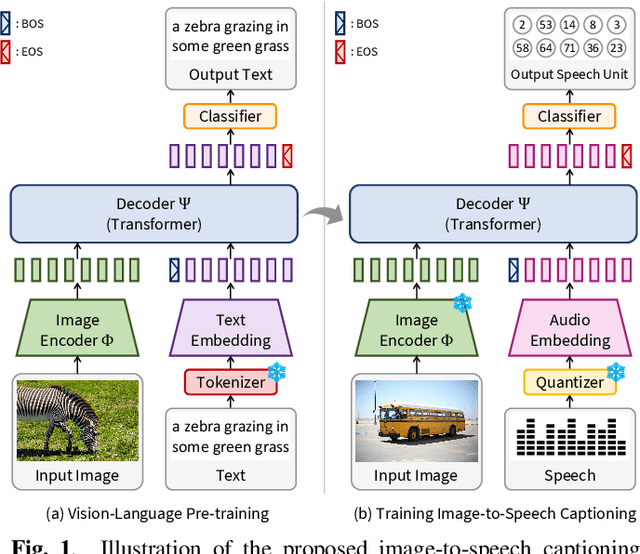

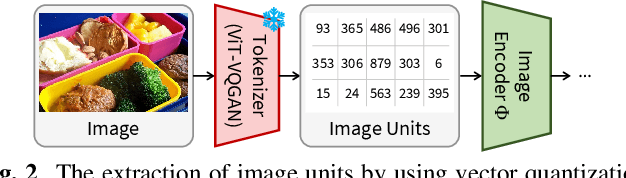

In this paper, we propose methods to build a powerful and efficient Image-to-Speech captioning (Im2Sp) model. To this end, we start with importing the rich knowledge related to image comprehension and language modeling from a large-scale pre-trained vision-language model into Im2Sp. We set the output of the proposed Im2Sp as discretized speech units, i.e., the quantized speech features of a self-supervised speech model. The speech units mainly contain linguistic information while suppressing other characteristics of speech. This allows us to incorporate the language modeling capability of the pre-trained vision-language model into the spoken language modeling of Im2Sp. With the vision-language pre-training strategy, we set new state-of-the-art Im2Sp performances on two widely used benchmark databases, COCO and Flickr8k. Then, we further improve the efficiency of the Im2Sp model. Similar to the speech unit case, we convert the original image into image units, which are derived through vector quantization of the raw image. With these image units, we can drastically reduce the required data storage for saving image data to just 0.8% when compared to the original image data in terms of bits. Demo page: https://ms-dot-k.github.io/Image-to-Speech-Captioning.

The Multimodal Information Based Speech Processing (MISP) 2023 Challenge: Audio-Visual Target Speaker Extraction
Sep 15, 2023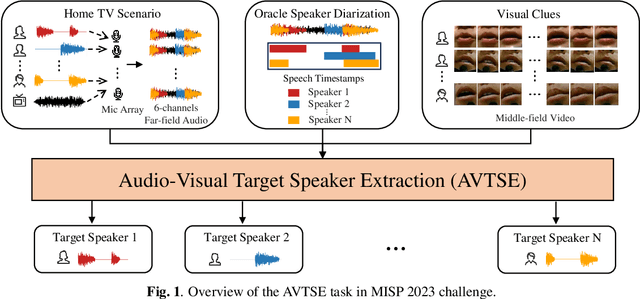
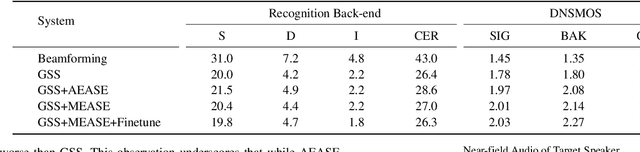
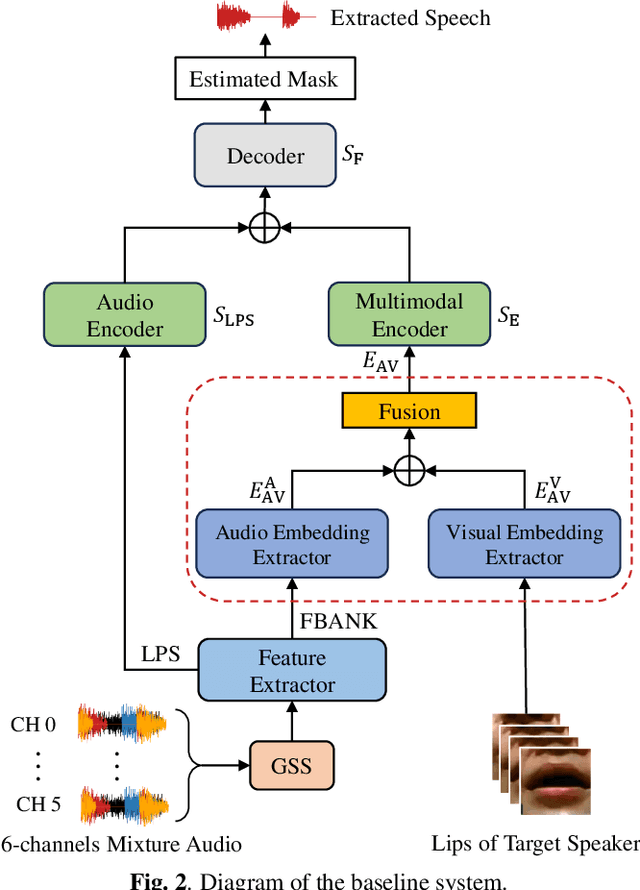
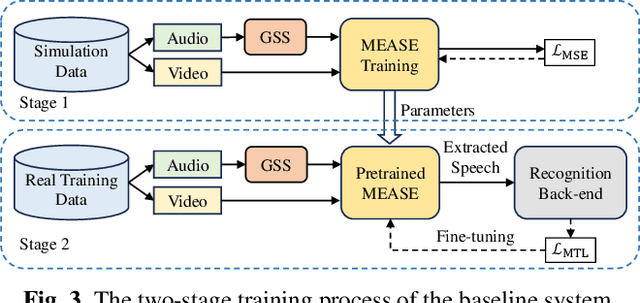
Previous Multimodal Information based Speech Processing (MISP) challenges mainly focused on audio-visual speech recognition (AVSR) with commendable success. However, the most advanced back-end recognition systems often hit performance limits due to the complex acoustic environments. This has prompted a shift in focus towards the Audio-Visual Target Speaker Extraction (AVTSE) task for the MISP 2023 challenge in ICASSP 2024 Signal Processing Grand Challenges. Unlike existing audio-visual speech enhance-ment challenges primarily focused on simulation data, the MISP 2023 challenge uniquely explores how front-end speech processing, combined with visual clues, impacts back-end tasks in real-world scenarios. This pioneering effort aims to set the first benchmark for the AVTSE task, offering fresh insights into enhancing the ac-curacy of back-end speech recognition systems through AVTSE in challenging and real acoustic environments. This paper delivers a thorough overview of the task setting, dataset, and baseline system of the MISP 2023 challenge. It also includes an in-depth analysis of the challenges participants may encounter. The experimental results highlight the demanding nature of this task, and we look forward to the innovative solutions participants will bring forward.
Bayes Risk Transducer: Transducer with Controllable Alignment Prediction
Aug 19, 2023Automatic speech recognition (ASR) based on transducers is widely used. In training, a transducer maximizes the summed posteriors of all paths. The path with the highest posterior is commonly defined as the predicted alignment between the speech and the transcription. While the vanilla transducer does not have a prior preference for any of the valid paths, this work intends to enforce the preferred paths and achieve controllable alignment prediction. Specifically, this work proposes Bayes Risk Transducer (BRT), which uses a Bayes risk function to set lower risk values to the preferred paths so that the predicted alignment is more likely to satisfy specific desired properties. We further demonstrate that these predicted alignments with intentionally designed properties can provide practical advantages over the vanilla transducer. Experimentally, the proposed BRT saves inference cost by up to 46% for non-streaming ASR and reduces overall system latency by 41% for streaming ASR.
Integration of Frame- and Label-synchronous Beam Search for Streaming Encoder-decoder Speech Recognition
Jul 24, 2023Although frame-based models, such as CTC and transducers, have an affinity for streaming automatic speech recognition, their decoding uses no future knowledge, which could lead to incorrect pruning. Conversely, label-based attention encoder-decoder mitigates this issue using soft attention to the input, while it tends to overestimate labels biased towards its training domain, unlike CTC. We exploit these complementary attributes and propose to integrate the frame- and label-synchronous (F-/L-Sync) decoding alternately performed within a single beam-search scheme. F-Sync decoding leads the decoding for block-wise processing, while L-Sync decoding provides the prioritized hypotheses using look-ahead future frames within a block. We maintain the hypotheses from both decoding methods to perform effective pruning. Experiments demonstrate that the proposed search algorithm achieves lower error rates compared to the other search methods, while being robust against out-of-domain situations.
Exploring the Integration of Speech Separation and Recognition with Self-Supervised Learning Representation
Jul 23, 2023


Neural speech separation has made remarkable progress and its integration with automatic speech recognition (ASR) is an important direction towards realizing multi-speaker ASR. This work provides an insightful investigation of speech separation in reverberant and noisy-reverberant scenarios as an ASR front-end. In detail, we explore multi-channel separation methods, mask-based beamforming and complex spectral mapping, as well as the best features to use in the ASR back-end model. We employ the recent self-supervised learning representation (SSLR) as a feature and improve the recognition performance from the case with filterbank features. To further improve multi-speaker recognition performance, we present a carefully designed training strategy for integrating speech separation and recognition with SSLR. The proposed integration using TF-GridNet-based complex spectral mapping and WavLM-based SSLR achieves a 2.5% word error rate in reverberant WHAMR! test set, significantly outperforming an existing mask-based MVDR beamforming and filterbank integration (28.9%).
Integrating Pretrained ASR and LM to Perform Sequence Generation for Spoken Language Understanding
Jul 20, 2023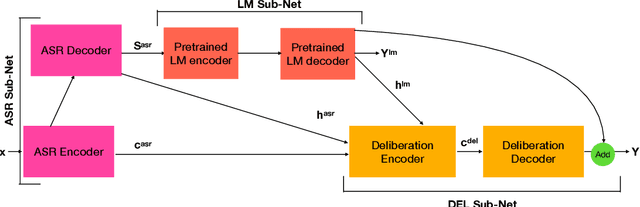
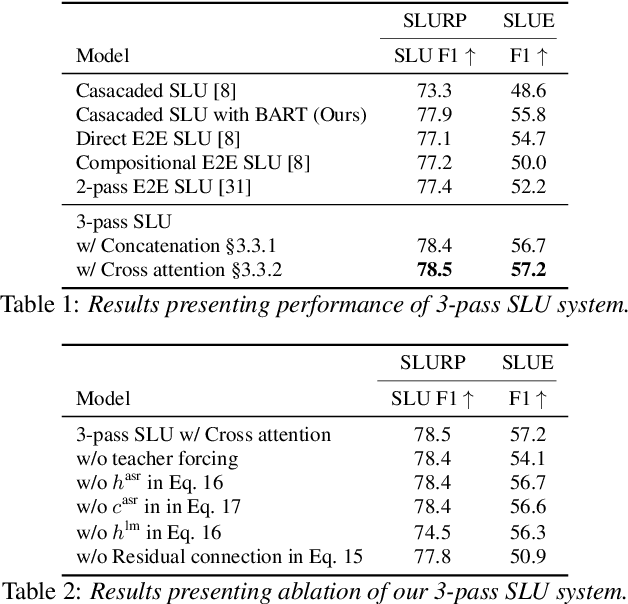

There has been an increased interest in the integration of pretrained speech recognition (ASR) and language models (LM) into the SLU framework. However, prior methods often struggle with a vocabulary mismatch between pretrained models, and LM cannot be directly utilized as they diverge from its NLU formulation. In this study, we propose a three-pass end-to-end (E2E) SLU system that effectively integrates ASR and LM subnetworks into the SLU formulation for sequence generation tasks. In the first pass, our architecture predicts ASR transcripts using the ASR subnetwork. This is followed by the LM subnetwork, which makes an initial SLU prediction. Finally, in the third pass, the deliberation subnetwork conditions on representations from the ASR and LM subnetworks to make the final prediction. Our proposed three-pass SLU system shows improved performance over cascaded and E2E SLU models on two benchmark SLU datasets, SLURP and SLUE, especially on acoustically challenging utterances.
BASS: Block-wise Adaptation for Speech Summarization
Jul 17, 2023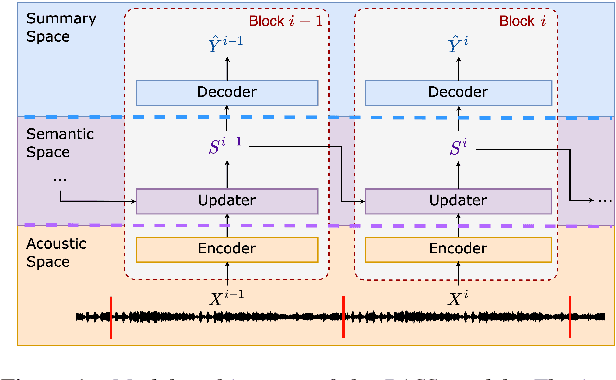
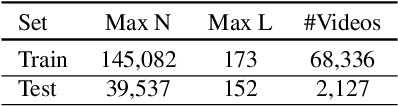
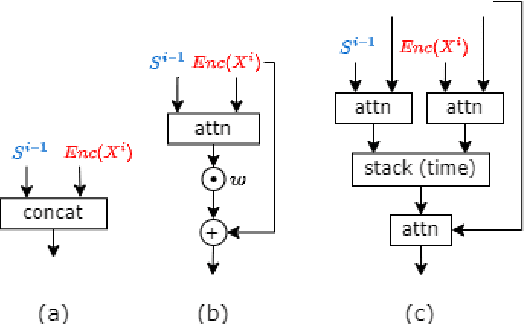

End-to-end speech summarization has been shown to improve performance over cascade baselines. However, such models are difficult to train on very large inputs (dozens of minutes or hours) owing to compute restrictions and are hence trained with truncated model inputs. Truncation leads to poorer models, and a solution to this problem rests in block-wise modeling, i.e., processing a portion of the input frames at a time. In this paper, we develop a method that allows one to train summarization models on very long sequences in an incremental manner. Speech summarization is realized as a streaming process, where hypothesis summaries are updated every block based on new acoustic information. We devise and test strategies to pass semantic context across the blocks. Experiments on the How2 dataset demonstrate that the proposed block-wise training method improves by 3 points absolute on ROUGE-L over a truncated input baseline.
The CHiME-7 DASR Challenge: Distant Meeting Transcription with Multiple Devices in Diverse Scenarios
Jul 14, 2023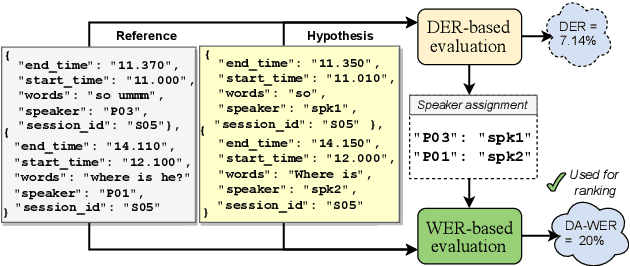
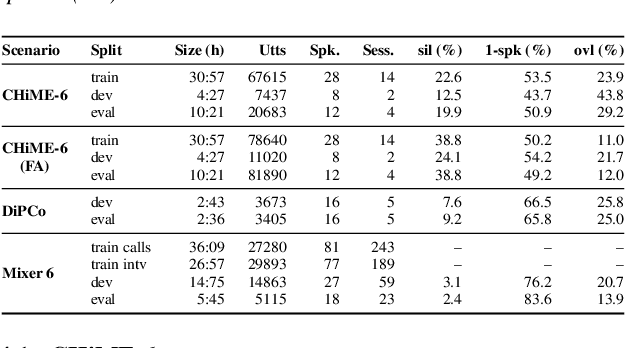
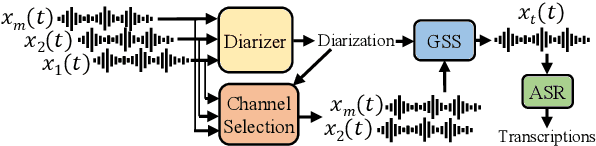
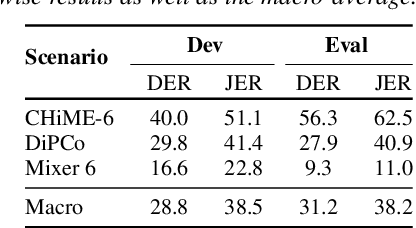
The CHiME challenges have played a significant role in the development and evaluation of robust automatic speech recognition (ASR) systems. We introduce the CHiME-7 distant ASR (DASR) task, within the 7th CHiME challenge. This task comprises joint ASR and diarization in far-field settings with multiple, and possibly heterogeneous, recording devices. Different from previous challenges, we evaluate systems on 3 diverse scenarios: CHiME-6, DiPCo, and Mixer 6. The goal is for participants to devise a single system that can generalize across different array geometries and use cases with no a-priori information. Another departure from earlier CHiME iterations is that participants are allowed to use open-source pre-trained models and datasets. In this paper, we describe the challenge design, motivation, and fundamental research questions in detail. We also present the baseline system, which is fully array-topology agnostic and features multi-channel diarization, channel selection, guided source separation and a robust ASR model that leverages self-supervised speech representations (SSLR).
Deep Speech Synthesis from MRI-Based Articulatory Representations
Jul 05, 2023
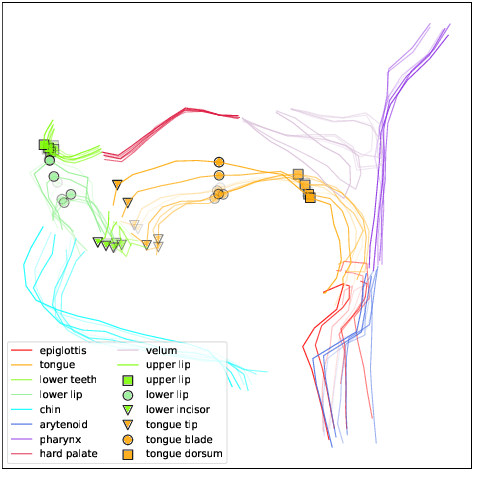

In this paper, we study articulatory synthesis, a speech synthesis method using human vocal tract information that offers a way to develop efficient, generalizable and interpretable synthesizers. While recent advances have enabled intelligible articulatory synthesis using electromagnetic articulography (EMA), these methods lack critical articulatory information like excitation and nasality, limiting generalization capabilities. To bridge this gap, we propose an alternative MRI-based feature set that covers a much more extensive articulatory space than EMA. We also introduce normalization and denoising procedures to enhance the generalizability of deep learning methods trained on MRI data. Moreover, we propose an MRI-to-speech model that improves both computational efficiency and speech fidelity. Finally, through a series of ablations, we show that the proposed MRI representation is more comprehensive than EMA and identify the most suitable MRI feature subset for articulatory synthesis.
Exploration on HuBERT with Multiple Resolutions
Jun 22, 2023

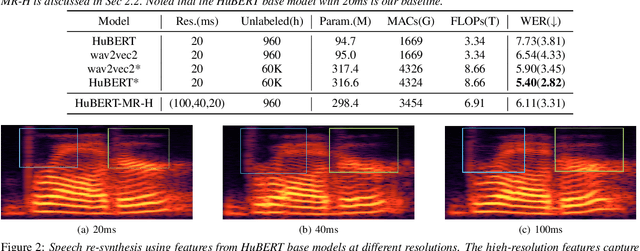

Hidden-unit BERT (HuBERT) is a widely-used self-supervised learning (SSL) model in speech processing. However, we argue that its fixed 20ms resolution for hidden representations would not be optimal for various speech-processing tasks since their attributes (e.g., speaker characteristics and semantics) are based on different time scales. To address this limitation, we propose utilizing HuBERT representations at multiple resolutions for downstream tasks. We explore two approaches, namely the parallel and hierarchical approaches, for integrating HuBERT features with different resolutions. Through experiments, we demonstrate that HuBERT with multiple resolutions outperforms the original model. This highlights the potential of utilizing multiple resolutions in SSL models like HuBERT to capture diverse information from speech signals.