 Add to Chrome
 Add to Firefox
 Add to Edge
Decoding Strategies for Diffusion-Based ASR: A Systematic Evaluation of Confidence-Based Thresholding
May 28, 2026
While LLM-based Automatic Speech Recognition (ASR) achieves high accuracy, its speed is limited by sequential autoregressive decoding. Diffusion Language Models (DLMs) offer a parallel alternative, yet their decoding strategies remain under-explored in ASR contexts. This paper analyzes three decoding schemes for DLM-based ASR: fixed-number, static confidence threshold, and dynamic confidence threshold. We propose measuring round-wise accuracy using Negative Log-Likelihood-based uncertainty as a proxy for decoding progress. Our results show that both threshold-based strategies significantly outperform fixed-number schemes in accuracy and speed. We attribute this to a property unique to ASR: most tokens reach high confidence early, allowing reliable ones to be harvested aggressively while leaving only difficult tokens for later rounds. Notably, the static-threshold strategy matches the accuracy of autoregressive decoding while offering superior efficiency.

Diffusion Large Language Models for Visual Speech Recognition
May 27, 2026Existing Visual Speech Recognition (VSR) systems commonly rely on left-to-right autoregressive decoding, which can force premature decisions on visually ambiguous tokens before sufficient context is available. We propose DLLM-VSR, to the best of our knowledge, the first Diffusion Large Language Model (DLLM)-based VSR framework, formulating transcription as iterative masked denoising with flexible-order decoding. With confidence-based unmasking, DLLM-VSR commits high-confidence positions early and uses the committed tokens as bidirectional context to refine ambiguous ones. To adapt DLLMs to VSR, we introduce a two-stage masked-denoising training strategy that separates visual-to-text content alignment from length modeling. We further observe a performance gap with oracle-length decoding, which assumes access to the true transcript length, indicating that reducing target-length uncertainty can improve DLLM-based VSR. To reduce this gap, we develop length-guided candidate decoding, which uses video duration to construct plausible transcript-length hypotheses, decodes under multiple hypotheses, and reranks candidates using length plausibility and decoding confidence. The proposed method achieves a state-of-the-art WER of 19.5\% on LRS3 using only its labeled training data.
Robust Grounding with MLLMs against Occlusion and Small Objects via Language-guided Semantic Cues
Apr 27, 2026While Multimodal Large Language Models (MLLMs) have enhanced grounding capabilities in general scenes, their robustness in crowded scenes remains underexplored. Crowded scenes entail visual challenges (i.e., occlusion and small objects), which impair object semantics and degrade grounding performance. In contrast, language expressions are immune to such degradation and preserve object semantics. In light of these observations, we propose a novel method that overcomes such constraints by leveraging Language-Guided Semantic Cues (LGSCs). Specifically, our approach introduces a Semantic Cue Extractor (SCE) to derive semantic cues of objects from the visual pipeline of an MLLM. We then guide these cues using corresponding text embeddings to produce LGSCs as linguistic semantic priors. Subsequently, they are reintegrated into the original visual pipeline to refine object semantics. Extensive experiments and analyses demonstrate that incorporating LGSCs into an MLLM effectively improves grounding accuracy in crowded scenes.
STRIDE: When to Speak Meets Sequence Denoising for Streaming Video Understanding
Mar 29, 2026Recent progress in video large language models (Video-LLMs) has enabled strong offline reasoning over long and complex videos. However, real-world deployments increasingly require streaming perception and proactive interaction, where video frames arrive online and the system must decide not only what to respond, but also when to respond. In this work, we revisit proactive activation in streaming video as a structured sequence modeling problem, motivated by the observation that temporal transitions in streaming video naturally form span-structured activation patterns. To capture this span-level structure, we model activation signals jointly over a sliding temporal window and update them iteratively as new frames arrive. We propose STRIDE (Structured Temporal Refinement with Iterative DEnoising), which employs a lightweight masked diffusion module at the activation interface to jointly predict and progressively refine activation signals across the window. Extensive experiments on diverse streaming benchmarks and downstream models demonstrate that STRIDE shows more reliable and temporally coherent proactive responses, significantly improving when-to-speak decision quality in online streaming scenarios.
Recursive Think-Answer Process for LLMs and VLMs
Mar 03, 2026Think-Answer reasoners such as DeepSeek-R1 have made notable progress by leveraging interpretable internal reasoning. However, despite the frequent presence of self-reflective cues like "Oops!", they remain vulnerable to output errors during single-pass inference. To address this limitation, we propose an efficient Recursive Think-Answer Process (R-TAP) that enables models to engage in iterative reasoning cycles and generate more accurate answers, going beyond conventional single-pass approaches. Central to this approach is a confidence generator that evaluates the certainty of model responses and guides subsequent improvements. By incorporating two complementary rewards-Recursively Confidence Increase Reward and Final Answer Confidence Reward-we show that R-TAP-enhanced models consistently outperform conventional single-pass methods for both large language models (LLMs) and vision-language models (VLMs). Moreover, by analyzing the frequency of "Oops"-like expressions in model responses, we find that R-TAP-applied models exhibit significantly fewer self-reflective patterns, resulting in more stable and faster inference-time reasoning. We hope R-TAP pave the way evolving into efficient and elaborated methods to refine the reasoning processes of future AI.
MAD: Modality-Adaptive Decoding for Mitigating Cross-Modal Hallucinations in Multimodal Large Language Models
Jan 29, 2026Multimodal Large Language Models (MLLMs) suffer from cross-modal hallucinations, where one modality inappropriately influences generation about another, leading to fabricated output. This exposes a more fundamental deficiency in modality-interaction control. To address this, we propose Modality-Adaptive Decoding (MAD), a training-free method that adaptively weights modality-specific decoding branches based on task requirements. MAD leverages the model's inherent ability to self-assess modality relevance by querying which modalities are needed for each task. The extracted modality probabilities are then used to adaptively weight contrastive decoding branches, enabling the model to focus on relevant information while suppressing cross-modal interference. Extensive experiments on CMM and AVHBench demonstrate that MAD significantly reduces cross-modal hallucinations across multiple audio-visual language models (7.8\% and 2.0\% improvements for VideoLLaMA2-AV, 8.7\% and 4.7\% improvements for Qwen2.5-Omni). Our approach demonstrates that explicit modality awareness through self-assessment is crucial for robust multimodal reasoning, offering a principled extension to existing contrastive decoding methods. Our code is available at \href{https://github.com/top-yun/MAD}{https://github.com/top-yun/MAD}
Robust Egocentric Visual Attention Prediction Through Language-guided Scene Context-aware Learning
Jan 05, 2026As the demand for analyzing egocentric videos grows, egocentric visual attention prediction, anticipating where a camera wearer will attend, has garnered increasing attention. However, it remains challenging due to the inherent complexity and ambiguity of dynamic egocentric scenes. Motivated by evidence that scene contextual information plays a crucial role in modulating human attention, in this paper, we present a language-guided scene context-aware learning framework for robust egocentric visual attention prediction. We first design a context perceiver which is guided to summarize the egocentric video based on a language-based scene description, generating context-aware video representations. We then introduce two training objectives that: 1) encourage the framework to focus on the target point-of-interest regions and 2) suppress distractions from irrelevant regions which are less likely to attract first-person attention. Extensive experiments on Ego4D and Aria Everyday Activities (AEA) datasets demonstrate the effectiveness of our approach, achieving state-of-the-art performance and enhanced robustness across diverse, dynamic egocentric scenarios.
GCAgent: Long-Video Understanding via Schematic and Narrative Episodic Memory
Nov 15, 2025Long-video understanding remains a significant challenge for Multimodal Large Language Models (MLLMs) due to inherent token limitations and the complexity of capturing long-term temporal dependencies. Existing methods often fail to capture the global context and complex event relationships necessary for deep video reasoning. To address this, we introduce GCAgent, a novel Global-Context-Aware Agent framework that achieves comprehensive long-video understanding. Our core innovation is the Schematic and Narrative Episodic Memory. This memory structurally models events and their causal and temporal relations into a concise, organized context, fundamentally resolving the long-term dependency problem. Operating in a multi-stage Perception-Action-Reflection cycle, our GCAgent utilizes a Memory Manager to retrieve relevant episodic context for robust, context-aware inference. Extensive experiments confirm that GCAgent significantly enhances long-video understanding, achieving up to 23.5\% accuracy improvement on the Video-MME Long split over a strong MLLM baseline. Furthermore, our framework establishes state-of-the-art performance among comparable 7B-scale MLLMs, achieving 73.4\% accuracy on the Long split and the highest overall average (71.9\%) on the Video-MME benchmark, validating our agent-based reasoning paradigm and structured memory for cognitively-inspired long-video understanding.
Unified Reinforcement and Imitation Learning for Vision-Language Models
Oct 22, 2025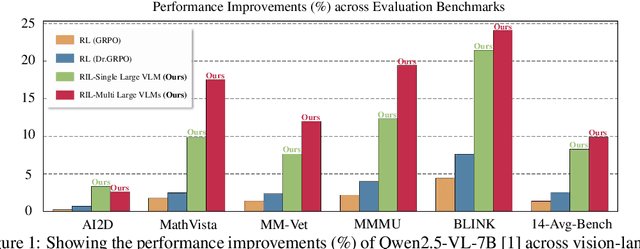
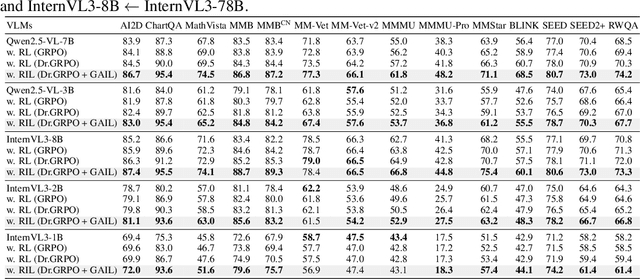
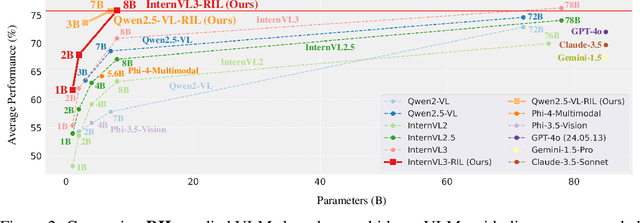
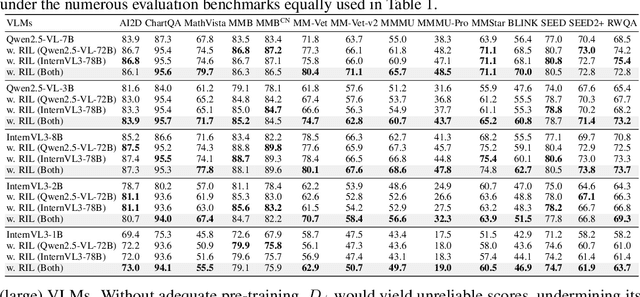
Vision-Language Models (VLMs) have achieved remarkable progress, yet their large scale often renders them impractical for resource-constrained environments. This paper introduces Unified Reinforcement and Imitation Learning (RIL), a novel and efficient training algorithm designed to create powerful, lightweight VLMs. RIL distinctively combines the strengths of reinforcement learning with adversarial imitation learning. This enables smaller student VLMs not only to mimic the sophisticated text generation of large teacher models but also to systematically improve their generative capabilities through reinforcement signals. Key to our imitation framework is an LLM-based discriminator that adeptly distinguishes between student and teacher outputs, complemented by guidance from multiple large teacher VLMs to ensure diverse learning. This unified learning strategy, leveraging both reinforcement and imitation, empowers student models to achieve significant performance gains, making them competitive with leading closed-source VLMs. Extensive experiments on diverse vision-language benchmarks demonstrate that RIL significantly narrows the performance gap with state-of-the-art open- and closed-source VLMs and, in several instances, surpasses them.
GenRecal: Generation after Recalibration from Large to Small Vision-Language Models
Jun 18, 2025Recent advancements in vision-language models (VLMs) have leveraged large language models (LLMs) to achieve performance on par with closed-source systems like GPT-4V. However, deploying these models in real-world scenarios, particularly on resource-constrained devices, remains challenging due to their substantial computational demands. This has spurred interest in distilling knowledge from large VLMs into smaller, more efficient counterparts. A key challenge arises here from the diversity of VLM architectures, which are built on different LLMs and employ varying token types-differing in vocabulary size, token splits, and token index ordering. To address this challenge of limitation to a specific VLM type, we present Generation after Recalibration (GenRecal), a novel, general-purpose distillation framework for VLMs. GenRecal incorporates a Recalibrator that aligns and adapts feature representations between heterogeneous VLMs, enabling effective knowledge transfer across different types of VLMs. Through extensive experiments on multiple challenging benchmarks, we demonstrate that GenRecal significantly improves baseline performances, eventually outperforming large-scale open- and closed-source VLMs.