 Add to Chrome
 Add to Firefox
 Add to Edge
TAMEn: Tactile-Aware Manipulation Engine for Closed-Loop Data Collection in Contact-Rich Tasks
Apr 08, 2026
Handheld paradigms offer an efficient and intuitive way for collecting large-scale demonstration of robot manipulation. However, achieving contact-rich bimanual manipulation through these methods remains a pivotal challenge, which is substantially hindered by hardware adaptability and data efficacy. Prior hardware designs remain gripper-specific and often face a trade-off between tracking precision and portability. Furthermore, the lack of online feasibility checking during demonstration leads to poor replayability. More importantly, existing handheld setups struggle to collect interactive recovery data during robot execution, lacking the authentic tactile information necessary for robust policy refinement. To bridge these gaps, we present TAMEn, a tactile-aware manipulation engine for closed-loop data collection in contact-rich tasks. Our system features a cross-morphology wearable interface that enables rapid adaptation across heterogeneous grippers. To balance data quality and environmental diversity, we implement a dual-modal acquisition pipeline: a precision mode leveraging motion capture for high-fidelity demonstrations, and a portable mode utilizing VR-based tracking for in-the-wild acquisition and tactile-visualized recovery teleoperation. Building on this hardware, we unify large-scale tactile pretraining, task-specific bimanual demonstrations, and human-in-the-loop recovery data into a pyramid-structured data regime, enabling closed-loop policy refinement. Experiments show that our feasibility-aware pipeline significantly improves demonstration replayability, and that the proposed visuo-tactile learning framework increases task success rates from 34% to 75% across diverse bimanual manipulation tasks. We further open-source the hardware and dataset to facilitate reproducibility and support research in visuo-tactile manipulation.

Building Trust Through Voice: How Vocal Tone Impacts User Perception of Attractiveness of Voice Assistants
Sep 27, 2024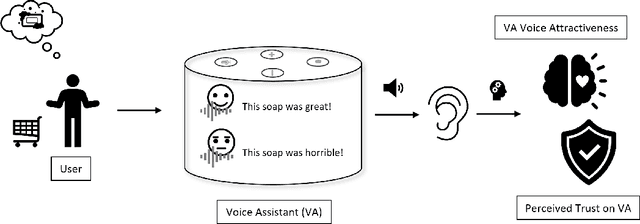
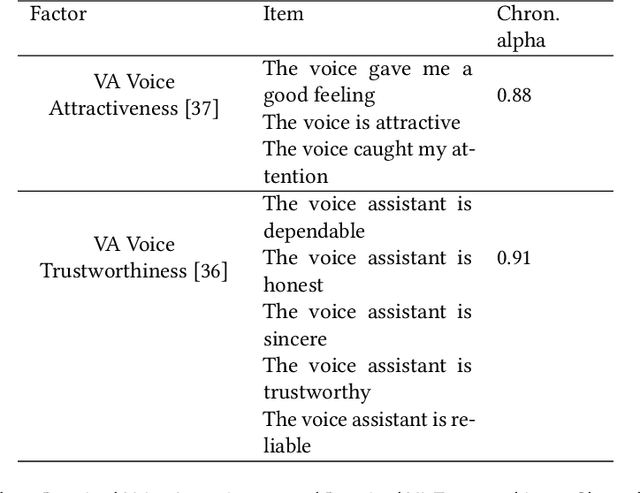
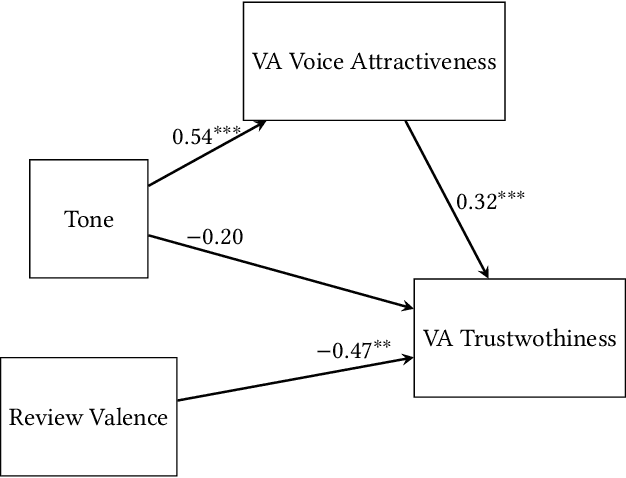
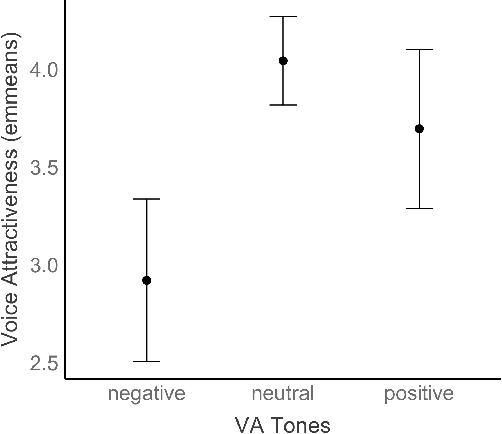
Voice Assistants (VAs) are popular for simple tasks, but users are often hesitant to use them for complex activities like online shopping. We explored whether the vocal characteristics like the VA's vocal tone, can make VAs perceived as more attractive and trustworthy to users for complex tasks. Our findings show that the tone of the VA voice significantly impacts its perceived attractiveness and trustworthiness. Participants in our experiment were more likely to be attracted to VAs with positive or neutral tones and ultimately trusted the VAs they found more attractive. We conclude that VA's perceived trustworthiness can be enhanced through thoughtful voice design, incorporating a variety of vocal tones.