 Add to Chrome
 Add to Firefox
 Add to Edge
Context Unrolling in Omni Models
Apr 23, 2026
We present Omni, a unified multimodal model natively trained on diverse modalities, including text, images, videos, 3D geometry, and hidden representations. We find that such training enables Context Unrolling, where the model explicitly reasons across multiple modal representations before producing predictions. This process enables the model to aggregate complementary information across heterogeneous modalities, facilitating a more faithful approximation of the shared multimodal knowledge manifold and improving downstream reasoning fidelity. As a result, Omni achieves strong performance on both multimodal generation and understanding benchmarks, while demonstrating advanced multimodal reasoning capabilities, including in-context generation of text, image, video, and 3D geometry.

UniGRPO: Unified Policy Optimization for Reasoning-Driven Visual Generation
Mar 24, 2026Unified models capable of interleaved generation have emerged as a promising paradigm, with the community increasingly converging on autoregressive modeling for text and flow matching for image generation. To advance this direction, we propose a unified reinforcement learning framework tailored for interleaved generation. We validate our approach on its fundamental unit: a single round of reasoning-driven image generation, where the model first expands the user prompt through reasoning, followed by image synthesis. Formulating this multimodal generation process as a Markov Decision Process with sparse terminal rewards, we introduce UniGRPO to jointly optimize text and image generation policies using GRPO. Adopting a minimalist methodology to avoid over-design, we leverage established training recipes for both modalities by seamlessly integrating standard GRPO for reasoning and FlowGRPO for visual synthesis. To ensure scalability to multi-round interleaved generation, we introduce two critical modifications to the original FlowGRPO: (1) eliminating classifier-free guidance to maintain linear, unbranched rollouts, which is essential for scaling to complex scenarios involving multi-turn interactions and multi-condition generation (e.g., editing); and (2) replacing the standard latent KL penalty with an MSE penalty directly on the velocity fields, providing a more robust and direct regularization signal to mitigate reward hacking effectively. Our experiments demonstrate that this unified training recipe significantly enhances image generation quality through reasoning, providing a robust and scalable baseline for the future post-training of fully interleaved models.
Seedance 1.5 pro: A Native Audio-Visual Joint Generation Foundation Model
Dec 23, 2025Recent strides in video generation have paved the way for unified audio-visual generation. In this work, we present Seedance 1.5 pro, a foundational model engineered specifically for native, joint audio-video generation. Leveraging a dual-branch Diffusion Transformer architecture, the model integrates a cross-modal joint module with a specialized multi-stage data pipeline, achieving exceptional audio-visual synchronization and superior generation quality. To ensure practical utility, we implement meticulous post-training optimizations, including Supervised Fine-Tuning (SFT) on high-quality datasets and Reinforcement Learning from Human Feedback (RLHF) with multi-dimensional reward models. Furthermore, we introduce an acceleration framework that boosts inference speed by over 10X. Seedance 1.5 pro distinguishes itself through precise multilingual and dialect lip-syncing, dynamic cinematic camera control, and enhanced narrative coherence, positioning it as a robust engine for professional-grade content creation. Seedance 1.5 pro is now accessible on Volcano Engine at https://console.volcengine.com/ark/region:ark+cn-beijing/experience/vision?type=GenVideo.
Galvatron: An Automatic Distributed System for Efficient Foundation Model Training
Apr 30, 2025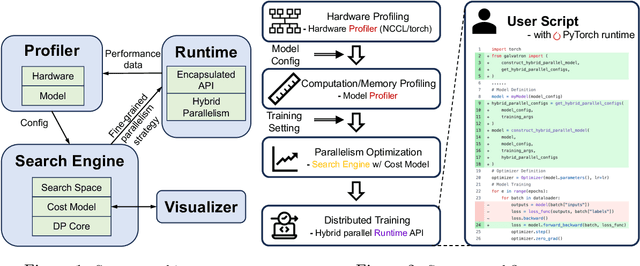
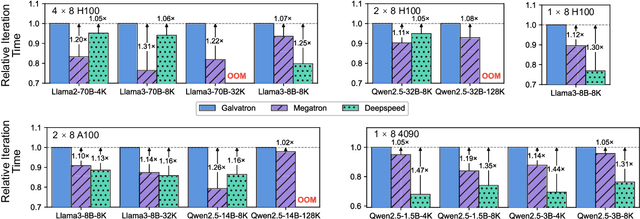
Galvatron is a distributed system for efficiently training large-scale Foundation Models. It overcomes the complexities of selecting optimal parallelism strategies by automatically identifying the most efficient hybrid strategy, incorporating data, tensor, pipeline, sharded data, and sequence parallelism, along with recomputation. The system's architecture includes a profiler for hardware and model analysis, a search engine for strategy optimization using decision trees and dynamic programming, and a runtime for executing these strategies efficiently. Benchmarking on various clusters demonstrates Galvatron's superior throughput compared to existing frameworks. This open-source system offers user-friendly interfaces and comprehensive documentation, making complex distributed training accessible and efficient. The source code of Galvatron is available at https://github.com/PKU-DAIR/Hetu-Galvatron.
Data-Centric and Heterogeneity-Adaptive Sequence Parallelism for Efficient LLM Training
Dec 02, 2024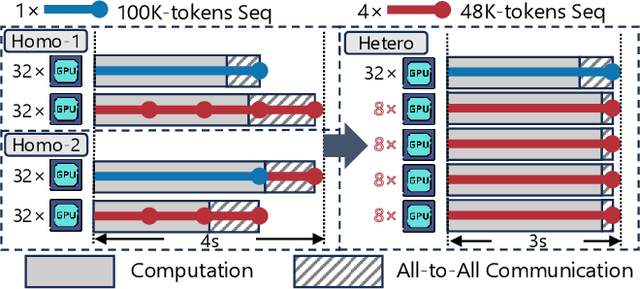
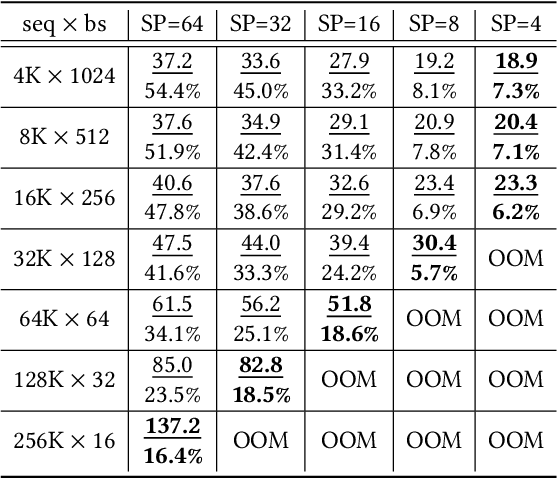
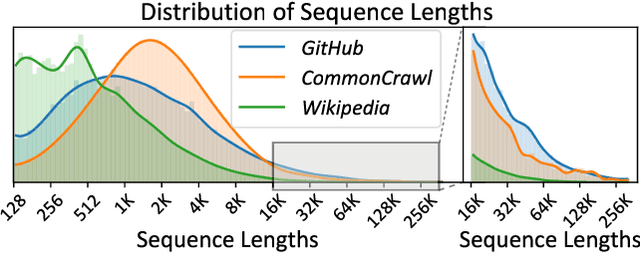

Extending the context length (i.e., the maximum supported sequence length) of LLMs is of paramount significance. To facilitate long context training of LLMs, sequence parallelism has emerged as an essential technique, which scatters each input sequence across multiple devices and necessitates communication to process the sequence. In essence, existing sequence parallelism methods assume homogeneous sequence lengths (i.e., all input sequences are equal in length) and therefore leverages a single, static scattering strategy for all input sequences. However, in reality, the sequence lengths in LLM training corpora exhibit substantial variability, often following a long-tail distribution, which leads to workload heterogeneity. In this paper, we show that employing a single, static strategy results in inefficiency and resource under-utilization, highlighting the need for adaptive approaches to handle the heterogeneous workloads across sequences. To address this, we propose a heterogeneity-adaptive sequence parallelism method. For each training step, our approach captures the variability in sequence lengths and assigns the optimal combination of scattering strategies based on workload characteristics. We model this problem as a linear programming optimization and design an efficient and effective solver to find the optimal solution. Furthermore, we implement our method in a high-performance system that supports adaptive parallelization in distributed LLM training. Experimental results demonstrate that our system outperforms state-of-the-art training frameworks by up to 1.98x.
Efficient Multi-Task Large Model Training via Data Heterogeneity-aware Model Management
Sep 05, 2024


Recent foundation models are capable of handling multiple machine learning (ML) tasks and multiple data modalities with the unified base model structure and several specialized model components. However, the development of such multi-task (MT) multi-modal (MM) models poses significant model management challenges to existing training systems. Due to the sophisticated model architecture and the heterogeneous workloads of different ML tasks and data modalities, training these models usually requires massive GPU resources and suffers from sub-optimal system efficiency. In this paper, we investigate how to achieve high-performance training of large-scale MT MM models through data heterogeneity-aware model management optimization. The key idea is to decompose the model execution into stages and address the joint optimization problem sequentially, including both heterogeneity-aware workload parallelization and dependency-driven execution scheduling. Based on this, we build a prototype system and evaluate it on various large MT MM models. Experiments demonstrate the superior performance and efficiency of our system, with speedup ratio up to 71% compared to state-of-the-art training systems.