 Add to Chrome
 Add to Firefox
 Add to Edge
TAGA: Terrain-aware Active Gaze Learning for Generalizable Agile Humanoid Locomotion
Jun 04, 2026
Agile humanoid locomotion across diverse challenging terrain demands both wide perceptual coverage and precise local geometry understanding. Motivated by the way humans selectively look at relevant terrain during locomotion, we introduce TAGA, a Terrain-aware Active Gaze learning framework for Attention-based humanoid control. By fusing vision, proprioception, and motion commands, our framework guides the model to learn anticipatory cues and actively attend to specific areas of the height scan, selectively using these informative regions for the downstream network. This adaptively increases the information density of observations under tight onboard computational constraints, thus enabling fine-grained perceptive locomotion over larger-scale terrains. We find that such gaze behaviors can naturally emerge through reinforcement learning alone, without requiring additional supervision or explicit guidance, significantly improve training efficiency. As a result, the trained policy demonstrates robust and generalizable locomotion in simulation and on hardware, including reliable terrain-aware foothold selection, elevated-platform traversal, competitive sparse-foothold traversal, and the largest reported real-world gap traversal distance of 1.2m among perceptive humanoid locomotion systems, while maintaining stability under severe perceptual disturbances and environmental interference.

CoordLight: Learning Decentralized Coordination for Network-Wide Traffic Signal Control
Mar 25, 2026Adaptive traffic signal control (ATSC) is crucial in alleviating congestion, maximizing throughput and promoting sustainable mobility in ever-expanding cities. Multi-Agent Reinforcement Learning (MARL) has recently shown significant potential in addressing complex traffic dynamics, but the intricacies of partial observability and coordination in decentralized environments still remain key challenges in formulating scalable and efficient control strategies. To address these challenges, we present CoordLight, a MARL-based framework designed to improve intra-neighborhood traffic by enhancing decision-making at individual junctions (agents), as well as coordination with neighboring agents, thereby scaling up to network-level traffic optimization. Specifically, we introduce the Queue Dynamic State Encoding (QDSE), a novel state representation based on vehicle queuing models, which strengthens the agents' capability to analyze, predict, and respond to local traffic dynamics. We further propose an advanced MARL algorithm, named Neighbor-aware Policy Optimization (NAPO). It integrates an attention mechanism that discerns the state and action dependencies among adjacent agents, aiming to facilitate more coordinated decision-making, and to improve policy learning updates through robust advantage calculation. This enables agents to identify and prioritize crucial interactions with influential neighbors, thus enhancing the targeted coordination and collaboration among agents. Through comprehensive evaluations against state-of-the-art traffic signal control methods over three real-world traffic datasets composed of up to 196 intersections, we empirically show that CoordLight consistently exhibits superior performance across diverse traffic networks with varying traffic flows. The code is available at https://github.com/marmotlab/CoordLight
LATS: Large Language Model Assisted Teacher-Student Framework for Multi-Agent Reinforcement Learning in Traffic Signal Control
Mar 25, 2026Adaptive Traffic Signal Control (ATSC) aims to optimize traffic flow and minimize delays by adjusting traffic lights in real time. Recent advances in Multi-agent Reinforcement Learning (MARL) have shown promise for ATSC, yet existing approaches still suffer from limited representational capacity, often leading to suboptimal performance and poor generalization in complex and dynamic traffic environments. On the other hand, Large Language Models (LLMs) excel at semantic representation, reasoning, and analysis, yet their propensity for hallucination and slow inference speeds often hinder their direct application to decision-making tasks. To address these challenges, we propose a novel learning paradigm named LATS that integrates LLMs and MARL, leveraging the former's strong prior knowledge and inductive abilities to enhance the latter's decision-making process. Specifically, we introduce a plug-and-play teacher-student learning module, where a trained embedding LLM serves as a teacher to generate rich semantic features that capture each intersection's topology structures and traffic dynamics. A much simpler (student) neural network then learns to emulate these features through knowledge distillation in the latent space, enabling the final model to operate independently from the LLM for downstream use in the RL decision-making process. This integration significantly enhances the overall model's representational capacity across diverse traffic scenarios, thus leading to more efficient and generalizable control strategies. Extensive experiments across diverse traffic datasets empirically demonstrate that our method enhances the representation learning capability of RL models, thereby leading to improved overall performance and generalization over both traditional RL and LLM-only approaches. [...]
GPO: Growing Policy Optimization for Legged Robot Locomotion and Whole-Body Control
Jan 28, 2026Training reinforcement learning (RL) policies for legged robots remains challenging due to high-dimensional continuous actions, hardware constraints, and limited exploration. Existing methods for locomotion and whole-body control work well for position-based control with environment-specific heuristics (e.g., reward shaping, curriculum design, and manual initialization), but are less effective for torque-based control, where sufficiently exploring the action space and obtaining informative gradient signals for training is significantly more difficult. We introduce Growing Policy Optimization (GPO), a training framework that applies a time-varying action transformation to restrict the effective action space in the early stage, thereby encouraging more effective data collection and policy learning, and then progressively expands it to enhance exploration and achieve higher expected return. We prove that this transformation preserves the PPO update rule and introduces only bounded, vanishing gradient distortion, thereby ensuring stable training. We evaluate GPO on both quadruped and hexapod robots, including zero-shot deployment of simulation-trained policies on hardware. Policies trained with GPO consistently achieve better performance. These results suggest that GPO provides a general, environment-agnostic optimization framework for learning legged locomotion.
FARE: Fast-Slow Agentic Robotic Exploration
Jan 21, 2026This work advances autonomous robot exploration by integrating agent-level semantic reasoning with fast local control. We introduce FARE, a hierarchical autonomous exploration framework that integrates a large language model (LLM) for global reasoning with a reinforcement learning (RL) policy for local decision making. FARE follows a fast-slow thinking paradigm. The slow-thinking LLM module interprets a concise textual description of the unknown environment and synthesizes an agent-level exploration strategy, which is then grounded into a sequence of global waypoints through a topological graph. To further improve reasoning efficiency, this module employs a modularity-based pruning mechanism that reduces redundant graph structures. The fast-thinking RL module executes exploration by reacting to local observations while being guided by the LLM-generated global waypoints. The RL policy is additionally shaped by a reward term that encourages adherence to the global waypoints, enabling coherent and robust closed-loop behavior. This architecture decouples semantic reasoning from geometric decision, allowing each module to operate in its appropriate temporal and spatial scale. In challenging simulated environments, our results show that FARE achieves substantial improvements in exploration efficiency over state-of-the-art baselines. We further deploy FARE on hardware and validate it in complex, large scale $200m\times130m$ building environment.
Dancing Points: Synthesizing Ballroom Dancing with Three-Point Inputs
Jan 05, 2026Ballroom dancing is a structured yet expressive motion category. Its highly diverse movement and complex interactions between leader and follower dancers make the understanding and synthesis challenging. We demonstrate that the three-point trajectory available from a virtual reality (VR) device can effectively serve as a dancer's motion descriptor, simplifying the modeling and synthesis of interplay between dancers' full-body motions down to sparse trajectories. Thanks to the low dimensionality, we can employ an efficient MLP network to predict the follower's three-point trajectory directly from the leader's three-point input for certain types of ballroom dancing, addressing the challenge of modeling high-dimensional full-body interaction. It also prevents our method from overfitting thanks to its compact yet explicit representation. By leveraging the inherent structure of the movements and carefully planning the autoregressive procedure, we show a deterministic neural network is able to translate three-point trajectories into a virtual embodied avatar, which is typically considered under-constrained and requires generative models for common motions. In addition, we demonstrate this deterministic approach generalizes beyond small, structured datasets like ballroom dancing, and performs robustly on larger, more diverse datasets such as LaFAN. Our method provides a computationally- and data-efficient solution, opening new possibilities for immersive paired dancing applications. Code and pre-trained models for this paper are available at https://peizhuoli.github.io/dancing-points.
Unicorn: A Universal and Collaborative Reinforcement Learning Approach Towards Generalizable Network-Wide Traffic Signal Control
Mar 14, 2025Adaptive traffic signal control (ATSC) is crucial in reducing congestion, maximizing throughput, and improving mobility in rapidly growing urban areas. Recent advancements in parameter-sharing multi-agent reinforcement learning (MARL) have greatly enhanced the scalable and adaptive optimization of complex, dynamic flows in large-scale homogeneous networks. However, the inherent heterogeneity of real-world traffic networks, with their varied intersection topologies and interaction dynamics, poses substantial challenges to achieving scalable and effective ATSC across different traffic scenarios. To address these challenges, we present Unicorn, a universal and collaborative MARL framework designed for efficient and adaptable network-wide ATSC. Specifically, we first propose a unified approach to map the states and actions of intersections with varying topologies into a common structure based on traffic movements. Next, we design a Universal Traffic Representation (UTR) module with a decoder-only network for general feature extraction, enhancing the model's adaptability to diverse traffic scenarios. Additionally, we incorporate an Intersection Specifics Representation (ISR) module, designed to identify key latent vectors that represent the unique intersection's topology and traffic dynamics through variational inference techniques. To further refine these latent representations, we employ a contrastive learning approach in a self-supervised manner, which enables better differentiation of intersection-specific features. Moreover, we integrate the state-action dependencies of neighboring agents into policy optimization, which effectively captures dynamic agent interactions and facilitates efficient regional collaboration. Our results show that Unicorn outperforms other methods across various evaluation metrics, highlighting its potential in complex, dynamic traffic networks.
SATA: Safe and Adaptive Torque-Based Locomotion Policies Inspired by Animal Learning
Feb 18, 2025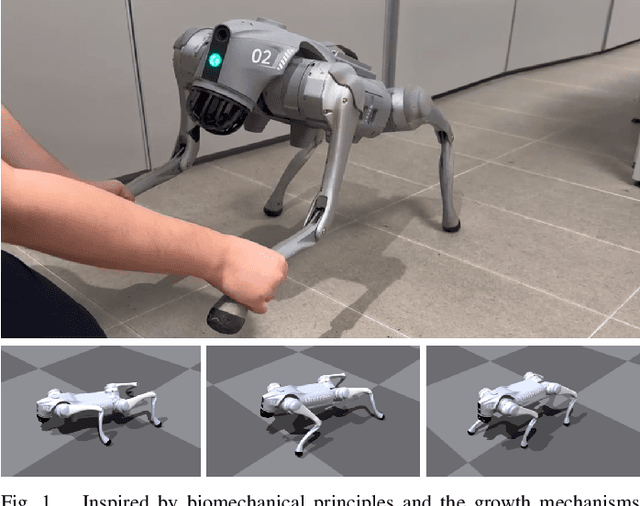
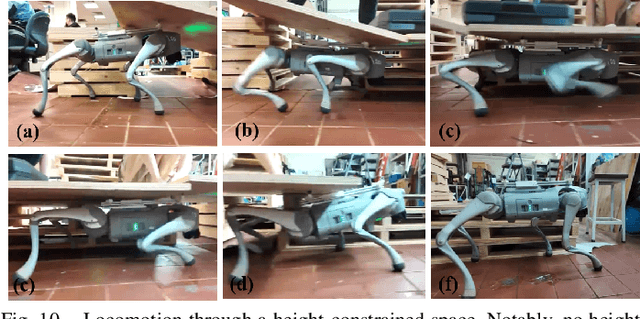
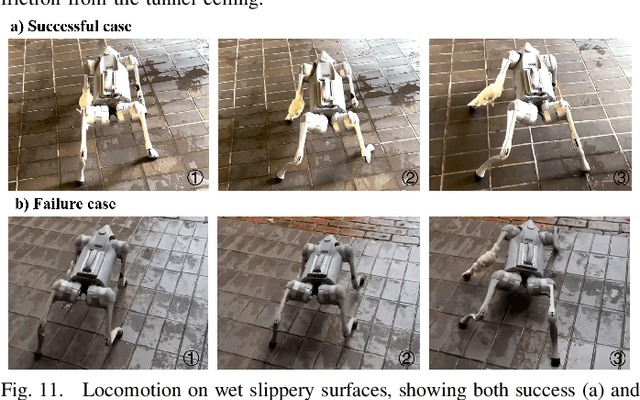
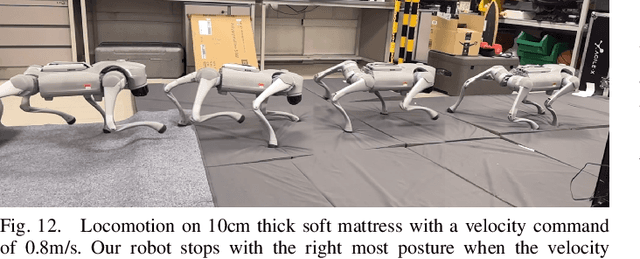
Despite recent advances in learning-based controllers for legged robots, deployments in human-centric environments remain limited by safety concerns. Most of these approaches use position-based control, where policies output target joint angles that must be processed by a low-level controller (e.g., PD or impedance controllers) to compute joint torques. Although impressive results have been achieved in controlled real-world scenarios, these methods often struggle with compliance and adaptability when encountering environments or disturbances unseen during training, potentially resulting in extreme or unsafe behaviors. Inspired by how animals achieve smooth and adaptive movements by controlling muscle extension and contraction, torque-based policies offer a promising alternative by enabling precise and direct control of the actuators in torque space. In principle, this approach facilitates more effective interactions with the environment, resulting in safer and more adaptable behaviors. However, challenges such as a highly nonlinear state space and inefficient exploration during training have hindered their broader adoption. To address these limitations, we propose SATA, a bio-inspired framework that mimics key biomechanical principles and adaptive learning mechanisms observed in animal locomotion. Our approach effectively addresses the inherent challenges of learning torque-based policies by significantly improving early-stage exploration, leading to high-performance final policies. Remarkably, our method achieves zero-shot sim-to-real transfer. Our experimental results indicate that SATA demonstrates remarkable compliance and safety, even in challenging environments such as soft/slippery terrain or narrow passages, and under significant external disturbances, highlighting its potential for practical deployments in human-centric and safety-critical scenarios.
Learning-based Hierarchical Control: Emulating the Central Nervous System for Bio-Inspired Legged Robot Locomotion
Apr 27, 2024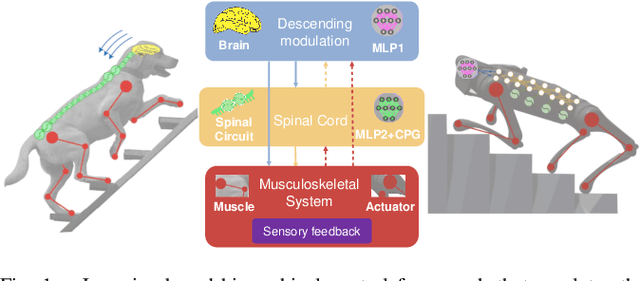
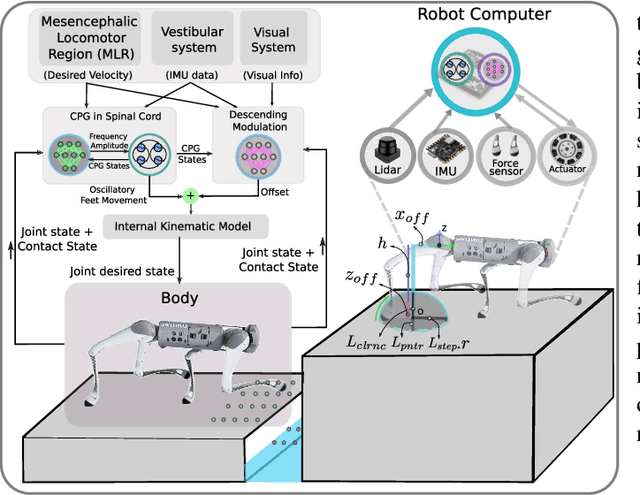
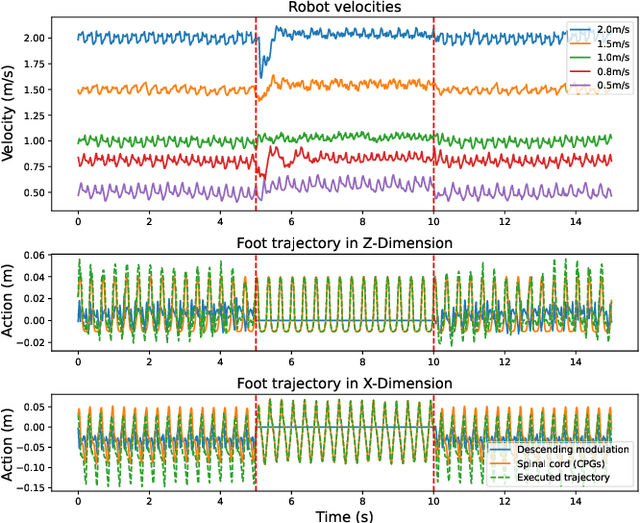
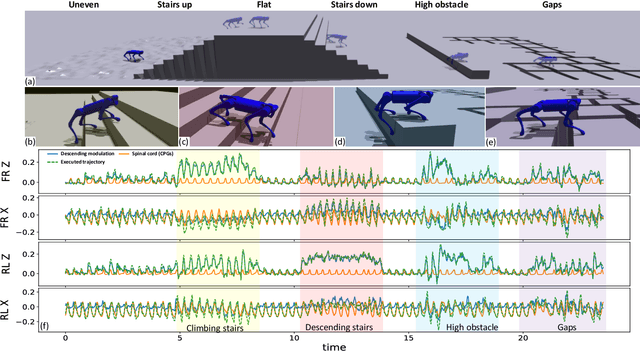
Animals possess a remarkable ability to navigate challenging terrains, achieved through the interplay of various pathways between the brain, central pattern generators (CPGs) in the spinal cord, and musculoskeletal system. Traditional bioinspired control frameworks often rely on a singular control policy that models both higher (supraspinal) and spinal cord functions. In this work, we build upon our previous research by introducing two distinct neural networks: one tasked with modulating the frequency and amplitude of CPGs to generate the basic locomotor rhythm (referred to as the spinal policy, SCP), and the other responsible for receiving environmental perception data and directly modulating the rhythmic output from the SCP to execute precise movements on challenging terrains (referred to as the descending modulation policy). This division of labor more closely mimics the hierarchical locomotor control systems observed in legged animals, thereby enhancing the robot's ability to navigate various uneven surfaces, including steps, high obstacles, and terrains with gaps. Additionally, we investigate the impact of sensorimotor delays within our framework, validating several biological assumptions about animal locomotion systems. Specifically, we demonstrate that spinal circuits play a crucial role in generating the basic locomotor rhythm, while descending pathways are essential for enabling appropriate gait modifications to accommodate uneven terrain. Notably, our findings also reveal that the multi-layered control inherent in animals exhibits remarkable robustness against time delays. Through these investigations, this paper contributes to a deeper understanding of the fundamental principles of interplay between spinal and supraspinal mechanisms in biological locomotion. It also supports the development of locomotion controllers in parallel to biological structures which are ...
Pose-to-Motion: Cross-Domain Motion Retargeting with Pose Prior
Oct 31, 2023

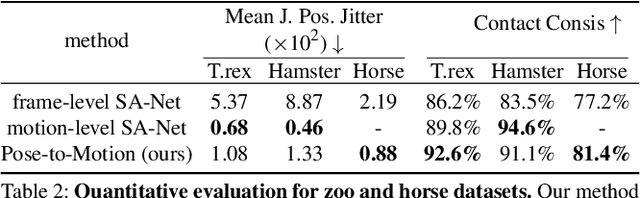

Creating believable motions for various characters has long been a goal in computer graphics. Current learning-based motion synthesis methods depend on extensive motion datasets, which are often challenging, if not impossible, to obtain. On the other hand, pose data is more accessible, since static posed characters are easier to create and can even be extracted from images using recent advancements in computer vision. In this paper, we utilize this alternative data source and introduce a neural motion synthesis approach through retargeting. Our method generates plausible motions for characters that have only pose data by transferring motion from an existing motion capture dataset of another character, which can have drastically different skeletons. Our experiments show that our method effectively combines the motion features of the source character with the pose features of the target character, and performs robustly with small or noisy pose data sets, ranging from a few artist-created poses to noisy poses estimated directly from images. Additionally, a conducted user study indicated that a majority of participants found our retargeted motion to be more enjoyable to watch, more lifelike in appearance, and exhibiting fewer artifacts. Project page: https://cyanzhao42.github.io/pose2motion