 Add to Chrome
 Add to Firefox
 Add to Edge
Trajectory Divergence Horizon Decision for Reliable Dual-Arm Surgical Subtask Manipulation
Aug 10, 2026
Surgical robotic systems are increasingly being adopted as clinical workload rises, motivating autonomous solutions for repetitive manipulation subtasks. Learning-based controllers improve generalization compared with rule-based and analytic approaches, but most are trained for individual tasks and remain difficult to reuse across procedures. Vision-Language-Action (VLA) models provide a unified framework that integrates visual perception, language grounding, and action generation, offering a promising path toward more composable surgical autonomy. However, existing VLA policies rely on fixed-length open-loop action sequences, where changing scene conditions can lead to accumulated errors and potential risks in surgical manipulation. To mitigate this issue, we formulate surgical VLA deployment as an adaptive execution-horizon decision problem and propose Trajectory Divergence Horizon Decision (TDHD), a test-time mechanism that estimates step-wise action reliability by measuring the divergence between two flow-matching-generated trajectories under small noise perturbations and truncates execution using a dual-threshold rule to trigger timely replanning. We further establish a real-world da Vinci-like dual-arm benchmark with synchronized multi-view perception and language instructions, and collect 600 teleoperated demonstrations across needle (reach, pick, regrasp) and tissue (reach, lift, resection) manipulation suites. On real hardware with 20 trials per task setting, TDHD consistently improves performance over the latest VLA baselines: success increases from 55\% to 60\% for needle manipulation and from 55\% to 80\% for tissue manipulation, with the largest gains observed in the final manipulation stages. These results highlight the importance of adaptive execution control for reliable deployment of VLA models in surgical robotic manipulation.

SurgLAT: Surgical Latent Attention Tracking for Depth-Aware Robotic Laparoscope Control
Aug 08, 2026Autonomous laparoscopic camera control requires continuous understanding of the surgeon's operative intent in dynamic surgical scenes, where the target operative region is not a stable physical object but a latent and temporally evolving attention state. In this work, we present Surgical Latent Attention Tracking (SurgLAT), a causal online framework for latent surgical attention modeling and autonomous laparoscopic view control. SurgLAT uses a frozen DINOv3 encoder and a state-conditioned spatial token mixer to extract operative evidence under a memory-guided spatial prior, while a selective causal latent memory module jointly models short-term motion continuity and long-horizon surgical intent evolution through dynamic retrieval of current, recent, and historical latent states. The learned latent surgical attention state is decoded into a probabilistic attention heatmap and operative region for downstream endoscope guidance. Beyond perception, we further introduce a robotic deployment framework with explicit laparoscopic Remote Center of Motion (RCM) constrained control based on virtual-axis formulation, together with redundancy-aware null-space initialization for stable and smooth manipulator motion. We validate the full system on real laparoscopic surgical videos and a physical robotic laparoscope platform. Experimental results demonstrate robust online operative-region tracking and stable autonomous endoscopy adjustment under occlusion, rapid motion, and target transitions, highlighting the effectiveness of latent surgical intent modeling for surgical autonomy.
Surg-UniWorld: A Unified Surgical World Model with Multimodal Control Experts
Aug 07, 2026Controllable surgical world models can provide a generative foundation for surgical artificial intelligence and simulation by synthesizing realistic instrument--tissue interactions. However, existing methods lack a unified multimodal control paradigm, while direct fusion of heterogeneous visual conditions often causes anatomical distortion, instrument appearance drift, and temporally inconsistent interactions. In this work, we propose {Surg-UniWorld}, a unified surgical world model with multimodal control experts. Surg-UniWorld first constructs a {Hierarchical Surgical Anchor} from first-frame appearance and hierarchical semantic masks to preserve persistent scene identity, anatomical organization, and interaction boundaries. {Anchor-Relative Modality Experts} then interpret edge, depth, and optical-flow evidence relative to the shared anchor, capturing complementary boundary, geometric, and motion information. A {Multimodal Control Expert} further performs contribution-preserving stage-wise composition of the activated modality increments and generates control hints for the Wan2.2 video diffusion backbone. To support multimodal surgical world modeling, we further construct Cholec80-SurgWAM, a benchmark for controllable surgical video generation. Extensive experiments demonstrate that Surg-UniWorld consistently outperforms existing controllable video generation methods and surgical world-model baselines in generation quality, temporal consistency, and multimodal controllability.
CrossScope: A Role-Asymmetric World Model for Joint Dual-Scope Surgical Video Prediction
Aug 04, 2026Visual world models typically learn future dynamics from a single observation stream, limiting their ability to model cooperative systems with multiple independently moving observers. We investigate this challenge in Mother--Child endoscopic retrograde cholangiopancreatography (ERCP), where two flexible scopes provide complementary yet role-dependent views without a calibrated stereo relationship. Unlike conventional multi-view fusion that assumes symmetric information exchange, we formulate \textbf{role-asymmetric dual-scope future prediction}, where cross-view evidence is selectively transferred according to the prediction target and its underlying spatial requirements. We propose \textbf{CrossScope}, a dual-stream surgical world model that preserves view-specific experts while enabling target-specific evidence routing through geometry-guided residual interactions. CrossScope learns two complementary communication directions: geometric motion cues from the Mother view guide Child-view future dynamics, while pose-aligned Child appearance supports Mother-view prediction only when valid spatial correspondence is established. This design allows each scope to contribute task-relevant evidence without compromising its view-specific representation. To evaluate this problem, we establish a paired dual-scope benchmark comprising synchronized phantom and real-world ERCP episodes, with evaluations assessing visual fidelity, structural preservation, target localization, and motion consistency. Experiments demonstrate that CrossScope consistently outperforms strong surgical video generation baselines, validating the importance of role-aware evidence routing for multi-observer visual world modeling.
Project Imaging-X: A Survey of 1000+ Open-Access Medical Imaging Datasets for Foundation Model Development
Mar 29, 2026Foundation models have demonstrated remarkable success across diverse domains and tasks, primarily due to the thrive of large-scale, diverse, and high-quality datasets. However, in the field of medical imaging, the curation and assembling of such medical datasets are highly challenging due to the reliance on clinical expertise and strict ethical and privacy constraints, resulting in a scarcity of large-scale unified medical datasets and hindering the development of powerful medical foundation models. In this work, we present the largest survey to date of medical image datasets, covering over 1,000 open-access datasets with a systematic catalog of their modalities, tasks, anatomies, annotations, limitations, and potential for integration. Our analysis exposes a landscape that is modest in scale, fragmented across narrowly scoped tasks, and unevenly distributed across organs and modalities, which in turn limits the utility of existing medical image datasets for developing versatile and robust medical foundation models. To turn fragmentation into scale, we propose a metadata-driven fusion paradigm (MDFP) that integrates public datasets with shared modalities or tasks, thereby transforming multiple small data silos into larger, more coherent resources. Building on MDFP, we release an interactive discovery portal that enables end-to-end, automated medical image dataset integration, and compile all surveyed datasets into a unified, structured table that clearly summarizes their key characteristics and provides reference links, offering the community an accessible and comprehensive repository. By charting the current terrain and offering a principled path to dataset consolidation, our survey provides a practical roadmap for scaling medical imaging corpora, supporting faster data discovery, more principled dataset creation, and more capable medical foundation models.
SurgAtt-Tracker: Online Surgical Attention Tracking via Temporal Proposal Reranking and Motion-Aware Refinement
Feb 24, 2026Accurate and stable field-of-view (FoV) guidance is critical for safe and efficient minimally invasive surgery, yet existing approaches often conflate visual attention estimation with downstream camera control or rely on direct object-centric assumptions. In this work, we formulate surgical attention tracking as a spatio-temporal learning problem and model surgeon focus as a dense attention heatmap, enabling continuous and interpretable frame-wise FoV guidance. We propose SurgAtt-Tracker, a holistic framework that robustly tracks surgical attention by exploiting temporal coherence through proposal-level reranking and motion-aware refinement, rather than direct regression. To support systematic training and evaluation, we introduce SurgAtt-1.16M, a large-scale benchmark with a clinically grounded annotation protocol that enables comprehensive heatmap-based attention analysis across procedures and institutions. Extensive experiments on multiple surgical datasets demonstrate that SurgAtt-Tracker consistently achieves state-of-the-art performance and strong robustness under occlusion, multi-instrument interference, and cross-domain settings. Beyond attention tracking, our approach provides a frame-wise FoV guidance signal that can directly support downstream robotic FoV planning and automatic camera control.
Bridging Vision and Language for Robust Context-Aware Surgical Point Tracking: The VL-SurgPT Dataset and Benchmark
Nov 15, 2025Accurate point tracking in surgical environments remains challenging due to complex visual conditions, including smoke occlusion, specular reflections, and tissue deformation. While existing surgical tracking datasets provide coordinate information, they lack the semantic context necessary to understand tracking failure mechanisms. We introduce VL-SurgPT, the first large-scale multimodal dataset that bridges visual tracking with textual descriptions of point status in surgical scenes. The dataset comprises 908 in vivo video clips, including 754 for tissue tracking (17,171 annotated points across five challenging scenarios) and 154 for instrument tracking (covering seven instrument types with detailed keypoint annotations). We establish comprehensive benchmarks using eight state-of-the-art tracking methods and propose TG-SurgPT, a text-guided tracking approach that leverages semantic descriptions to improve robustness in visually challenging conditions. Experimental results demonstrate that incorporating point status information significantly improves tracking accuracy and reliability, particularly in adverse visual scenarios where conventional vision-only methods struggle. By bridging visual and linguistic modalities, VL-SurgPT enables the development of context-aware tracking systems crucial for advancing computer-assisted surgery applications that can maintain performance even under challenging intraoperative conditions.
Point Tracking in Surgery--The 2024 Surgical Tattoos in Infrared (STIR) Challenge
Mar 31, 2025Understanding tissue motion in surgery is crucial to enable applications in downstream tasks such as segmentation, 3D reconstruction, virtual tissue landmarking, autonomous probe-based scanning, and subtask autonomy. Labeled data are essential to enabling algorithms in these downstream tasks since they allow us to quantify and train algorithms. This paper introduces a point tracking challenge to address this, wherein participants can submit their algorithms for quantification. The submitted algorithms are evaluated using a dataset named surgical tattoos in infrared (STIR), with the challenge aptly named the STIR Challenge 2024. The STIR Challenge 2024 comprises two quantitative components: accuracy and efficiency. The accuracy component tests the accuracy of algorithms on in vivo and ex vivo sequences. The efficiency component tests the latency of algorithm inference. The challenge was conducted as a part of MICCAI EndoVis 2024. In this challenge, we had 8 total teams, with 4 teams submitting before and 4 submitting after challenge day. This paper details the STIR Challenge 2024, which serves to move the field towards more accurate and efficient algorithms for spatial understanding in surgery. In this paper we summarize the design, submissions, and results from the challenge. The challenge dataset is available here: https://zenodo.org/records/14803158 , and the code for baseline models and metric calculation is available here: https://github.com/athaddius/STIRMetrics
Endo-TTAP: Robust Endoscopic Tissue Tracking via Multi-Facet Guided Attention and Hybrid Flow-point Supervision
Mar 28, 2025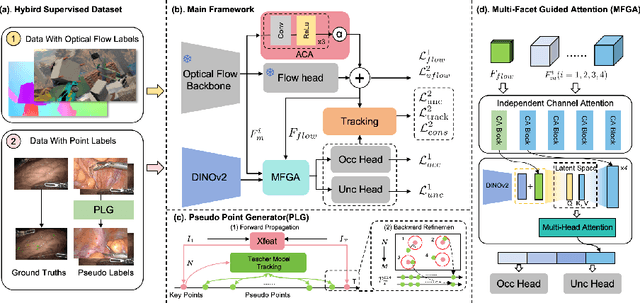
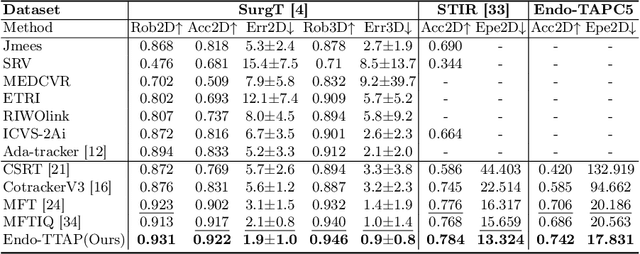
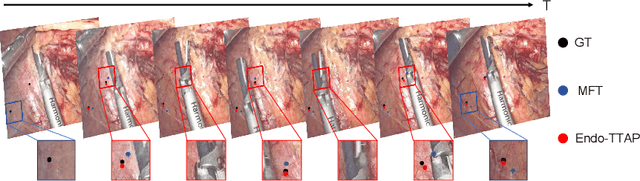

Accurate tissue point tracking in endoscopic videos is critical for robotic-assisted surgical navigation and scene understanding, but remains challenging due to complex deformations, instrument occlusion, and the scarcity of dense trajectory annotations. Existing methods struggle with long-term tracking under these conditions due to limited feature utilization and annotation dependence. We present Endo-TTAP, a novel framework addressing these challenges through: (1) A Multi-Facet Guided Attention (MFGA) module that synergizes multi-scale flow dynamics, DINOv2 semantic embeddings, and explicit motion patterns to jointly predict point positions with uncertainty and occlusion awareness; (2) A two-stage curriculum learning strategy employing an Auxiliary Curriculum Adapter (ACA) for progressive initialization and hybrid supervision. Stage I utilizes synthetic data with optical flow ground truth for uncertainty-occlusion regularization, while Stage II combines unsupervised flow consistency and semi-supervised learning with refined pseudo-labels from off-the-shelf trackers. Extensive validation on two MICCAI Challenge datasets and our collected dataset demonstrates that Endo-TTAP achieves state-of-the-art performance in tissue point tracking, particularly in scenarios characterized by complex endoscopic conditions. The source code and dataset will be available at https://anonymous.4open.science/r/Endo-TTAP-36E5.
TSUBF-Net: Trans-Spatial UNet-like Network with Bi-direction Fusion for Segmentation of Adenoid Hypertrophy in CT
Dec 01, 2024Adenoid hypertrophy stands as a common cause of obstructive sleep apnea-hypopnea syndrome in children. It is characterized by snoring, nasal congestion, and growth disorders. Computed Tomography (CT) emerges as a pivotal medical imaging modality, utilizing X-rays and advanced computational techniques to generate detailed cross-sectional images. Within the realm of pediatric airway assessments, CT imaging provides an insightful perspective on the shape and volume of enlarged adenoids. Despite the advances of deep learning methods for medical imaging analysis, there remains an emptiness in the segmentation of adenoid hypertrophy in CT scans. To address this research gap, we introduce TSUBF-Nett (Trans-Spatial UNet-like Network based on Bi-direction Fusion), a 3D medical image segmentation framework. TSUBF-Net is engineered to effectively discern intricate 3D spatial interlayer features in CT scans and enhance the extraction of boundary-blurring features. Notably, we propose two innovative modules within the U-shaped network architecture:the Trans-Spatial Perception module (TSP) and the Bi-directional Sampling Collaborated Fusion module (BSCF).These two modules are in charge of operating during the sampling process and strategically fusing down-sampled and up-sampled features, respectively. Furthermore, we introduce the Sobel loss term, which optimizes the smoothness of the segmentation results and enhances model accuracy. Extensive 3D segmentation experiments are conducted on several datasets. TSUBF-Net is superior to the state-of-the-art methods with the lowest HD95: 7.03, IoU:85.63, and DSC: 92.26 on our own AHSD dataset. The results in the other two public datasets also demonstrate that our methods can robustly and effectively address the challenges of 3D segmentation in CT scans.