 Add to Chrome
 Add to Firefox
 Add to Edge
CrossScope: A Role-Asymmetric World Model for Joint Dual-Scope Surgical Video Prediction
Aug 04, 2026
Visual world models typically learn future dynamics from a single observation stream, limiting their ability to model cooperative systems with multiple independently moving observers. We investigate this challenge in Mother--Child endoscopic retrograde cholangiopancreatography (ERCP), where two flexible scopes provide complementary yet role-dependent views without a calibrated stereo relationship. Unlike conventional multi-view fusion that assumes symmetric information exchange, we formulate \textbf{role-asymmetric dual-scope future prediction}, where cross-view evidence is selectively transferred according to the prediction target and its underlying spatial requirements. We propose \textbf{CrossScope}, a dual-stream surgical world model that preserves view-specific experts while enabling target-specific evidence routing through geometry-guided residual interactions. CrossScope learns two complementary communication directions: geometric motion cues from the Mother view guide Child-view future dynamics, while pose-aligned Child appearance supports Mother-view prediction only when valid spatial correspondence is established. This design allows each scope to contribute task-relevant evidence without compromising its view-specific representation. To evaluate this problem, we establish a paired dual-scope benchmark comprising synchronized phantom and real-world ERCP episodes, with evaluations assessing visual fidelity, structural preservation, target localization, and motion consistency. Experiments demonstrate that CrossScope consistently outperforms strong surgical video generation baselines, validating the importance of role-aware evidence routing for multi-observer visual world modeling.

NCGR: Noise-Conditional Gated Rectification for Camera Extrinsic Perturbations in BEV 3D Object Detection
Aug 04, 2026Camera-based bird's-eye-view (BEV) 3D detection typically assumes accurate and fixed camera extrinsics. In detectors using spatial cross-attention (SCA), extrinsic perturbations displace the image-plane projections of BEV reference points, causing queries to sample features from incorrect regions and degrading detection performance. To address this failure mode, Noise-Conditional Gated Rectification (NCGR) is proposed to compensate for projection errors without explicitly estimating a full six-degree-of-freedom extrinsic correction. For each query-camera pair, a 2D rectification offset is predicted and modulated by a camera-level gate to rectify the base projection before native deformable sampling. During training, the perturbation-derived quantities used to construct the condition and gate are gradually replaced through scheduled interpolation by counterparts generated from an auxiliary scalar predicted from camera features. This transition enables blind inference without perturbation metadata. During training, a weight-shared clean-teacher/perturbed-student pair is used, and the rectification module is supervised by a BEV-consistency objective between the two branches. NCGR is evaluated on nuScenes with simulated dynamic and static extrinsic perturbations. In a five-camera dynamic stress test, NCGR achieves 39.69% NDS, compared with 28.00% for BEVFormer and 33.23% for CAPE. Under clean extrinsics, NCGR maintains performance comparable to that of BEVFormer.
"Pass the butter": A study on desktop-classic multitasking robotic arm based on advanced YOLOv7 and BERT
May 27, 2024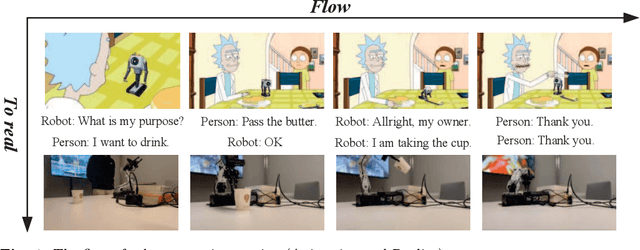
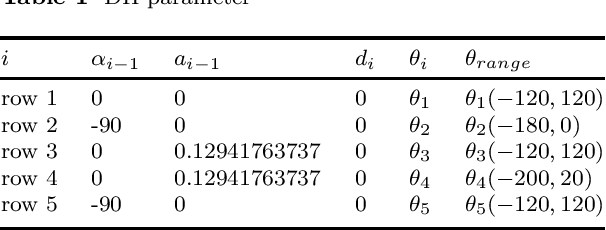
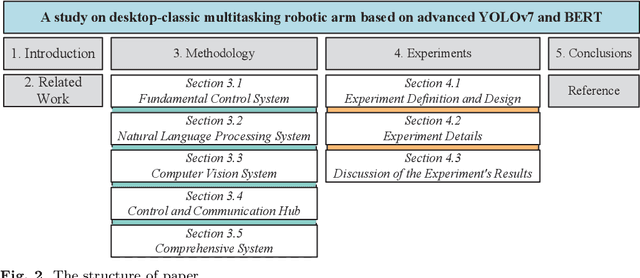
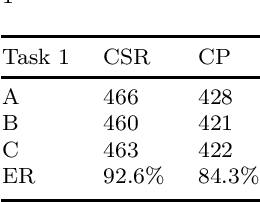
In recent years, various intelligent autonomous robots have begun to appear in daily life and production. Desktop-level robots are characterized by their flexible deployment, rapid response, and suitability for light workload environments. In order to meet the current societal demand for service robot technology, this study proposes using a miniaturized desktop-level robot (by ROS) as a carrier, locally deploying a natural language model (NLP-BERT), and integrating visual recognition (CV-YOLO) and speech recognition technology (ASR-Whisper) as inputs to achieve autonomous decision-making and rational action by the desktop robot. Three comprehensive experiments were designed to validate the robotic arm, and the results demonstrate excellent performance using this approach across all three experiments. In Task 1, the execution rates for speech recognition and action performance were 92.6% and 84.3%, respectively. In Task 2, the highest execution rates under the given conditions reached 92.1% and 84.6%, while in Task 3, the highest execution rates were 95.2% and 80.8%, respectively. Therefore, it can be concluded that the proposed solution integrating ASR, NLP, and other technologies on edge devices is feasible and provides a technical and engineering foundation for realizing multimodal desktop-level robots.