 Add to Chrome
 Add to Firefox
 Add to Edge
Absolute State-wise Constrained Policy Optimization: High-Probability State-wise Constraints Satisfaction
Oct 02, 2024
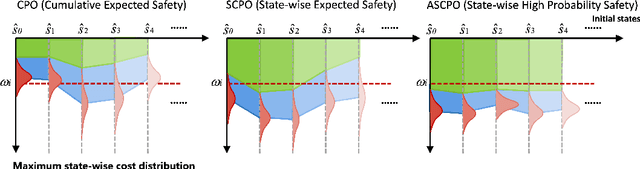

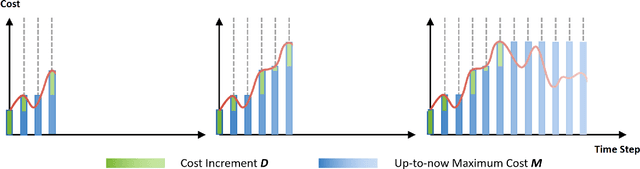

Enforcing state-wise safety constraints is critical for the application of reinforcement learning (RL) in real-world problems, such as autonomous driving and robot manipulation. However, existing safe RL methods only enforce state-wise constraints in expectation or enforce hard state-wise constraints with strong assumptions. The former does not exclude the probability of safety violations, while the latter is impractical. Our insight is that although it is intractable to guarantee hard state-wise constraints in a model-free setting, we can enforce state-wise safety with high probability while excluding strong assumptions. To accomplish the goal, we propose Absolute State-wise Constrained Policy Optimization (ASCPO), a novel general-purpose policy search algorithm that guarantees high-probability state-wise constraint satisfaction for stochastic systems. We demonstrate the effectiveness of our approach by training neural network policies for extensive robot locomotion tasks, where the agent must adhere to various state-wise safety constraints. Our results show that ASCPO significantly outperforms existing methods in handling state-wise constraints across challenging continuous control tasks, highlighting its potential for real-world applications.

ManiSkill3: GPU Parallelized Robotics Simulation and Rendering for Generalizable Embodied AI
Oct 01, 2024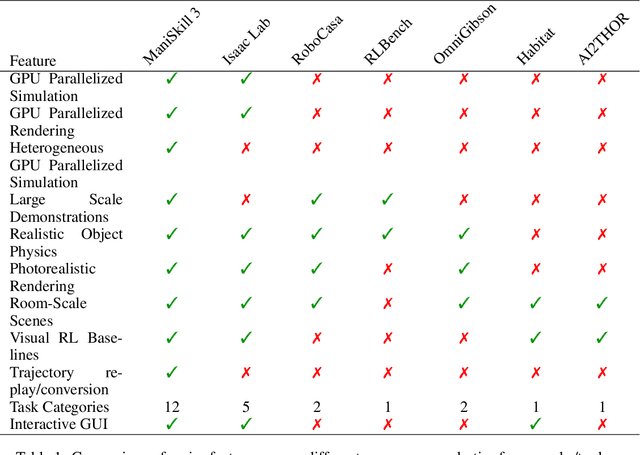
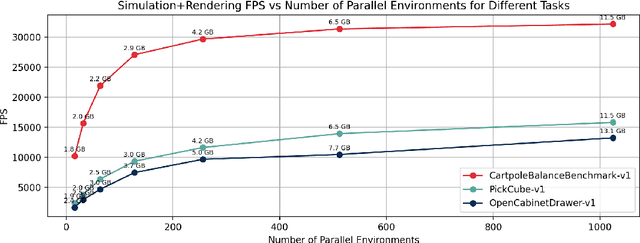
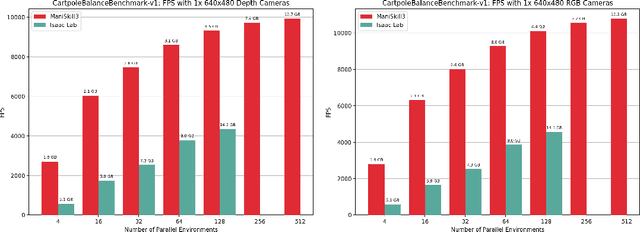
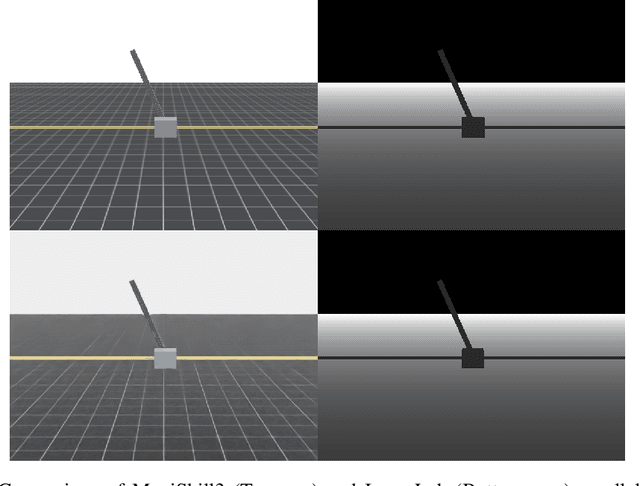
Simulation has enabled unprecedented compute-scalable approaches to robot learning. However, many existing simulation frameworks typically support a narrow range of scenes/tasks and lack features critical for scaling generalizable robotics and sim2real. We introduce and open source ManiSkill3, the fastest state-visual GPU parallelized robotics simulator with contact-rich physics targeting generalizable manipulation. ManiSkill3 supports GPU parallelization of many aspects including simulation+rendering, heterogeneous simulation, pointclouds/voxels visual input, and more. Simulation with rendering on ManiSkill3 can run 10-1000x faster with 2-3x less GPU memory usage than other platforms, achieving up to 30,000+ FPS in benchmarked environments due to minimal python/pytorch overhead in the system, simulation on the GPU, and the use of the SAPIEN parallel rendering system. Tasks that used to take hours to train can now take minutes. We further provide the most comprehensive range of GPU parallelized environments/tasks spanning 12 distinct domains including but not limited to mobile manipulation for tasks such as drawing, humanoids, and dextrous manipulation in realistic scenes designed by artists or real-world digital twins. In addition, millions of demonstration frames are provided from motion planning, RL, and teleoperation. ManiSkill3 also provides a comprehensive set of baselines that span popular RL and learning-from-demonstrations algorithms.
Constrained Bandwidth Observation Sharing for Multi-Robot Navigation in Dynamic Environments via Intelligent Knapsack
Sep 16, 2024
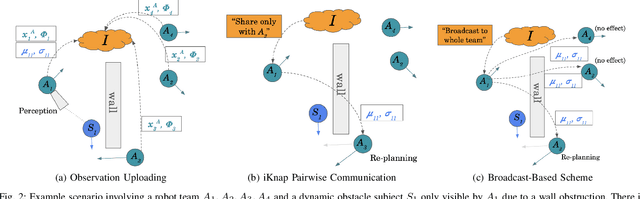


Multi-robot navigation is increasingly crucial in various domains, including disaster response, autonomous vehicles, and warehouse and manufacturing automation. Robot teams often must operate in highly dynamic environments and under strict bandwidth constraints imposed by communication infrastructure, rendering effective observation sharing within the system a challenging problem. This paper presents a novel optimal communication scheme, Intelligent Knapsack (iKnap), for multi-robot navigation in dynamic environments under bandwidth constraints. We model multi-robot communication as belief propagation in a graph of inferential agents. We then formulate the combinatorial optimization for observation sharing as a 0/1 knapsack problem, where each potential pairwise communication between robots is assigned a decision-making utility to be weighed against its bandwidth cost, and the system has some cumulative bandwidth limit. Compared to state-of-the-art broadcast-based optimal communication schemes, iKnap yields significant improvements in navigation performance with respect to scenario complexity while maintaining a similar runtime. Furthermore, iKnap utilizes allocated bandwidth and observational resources more efficiently than existing approaches, especially in very low-resource and high-uncertainty settings. Based on these results, we claim that the proposed method enables more robust collaboration for multi-robot teams in real-world navigation problems.
Safe Control of Quadruped in Varying Dynamics via Safety Index Adaptation
Sep 15, 2024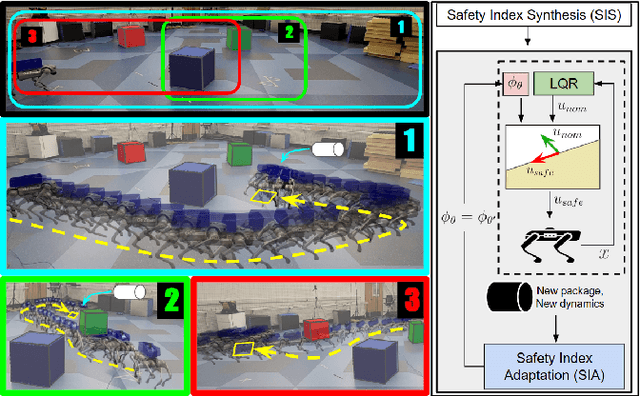
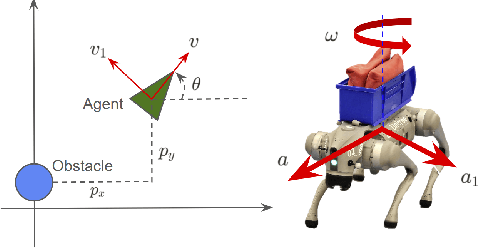
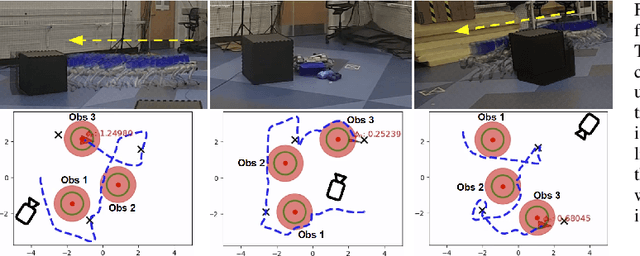
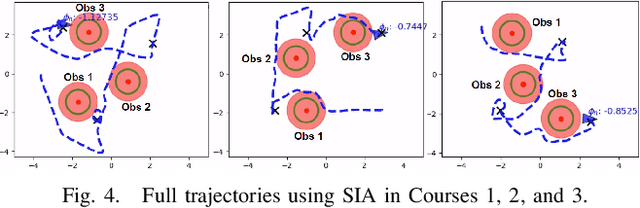
Varying dynamics pose a fundamental difficulty when deploying safe control laws in the real world. Safety Index Synthesis (SIS) deeply relies on the system dynamics and once the dynamics change, the previously synthesized safety index becomes invalid. In this work, we show the real-time efficacy of Safety Index Adaptation (SIA) in varying dynamics. SIA enables real-time adaptation to the changing dynamics so that the adapted safe control law can still guarantee 1) forward invariance within a safe region and 2) finite time convergence to that safe region. This work employs SIA on a package-carrying quadruped robot, where the payload weight changes in real-time. SIA updates the safety index when the dynamics change, e.g., a change in payload weight, so that the quadruped can avoid obstacles while achieving its performance objectives. Numerical study provides theoretical guarantees for SIA and a series of hardware experiments demonstrate the effectiveness of SIA in real-world deployment in avoiding obstacles under varying dynamics.
DexSim2Real$^{2}$: Building Explicit World Model for Precise Articulated Object Dexterous Manipulation
Sep 13, 2024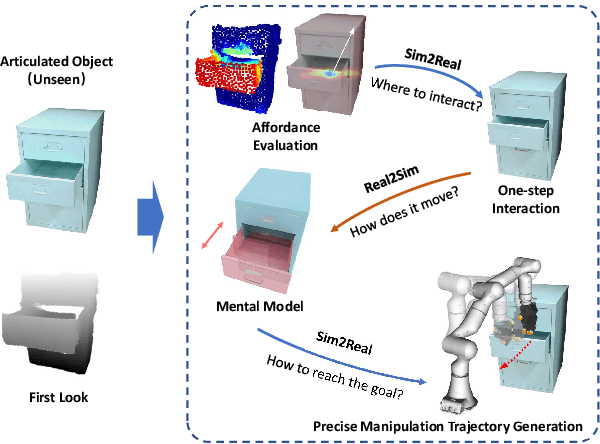
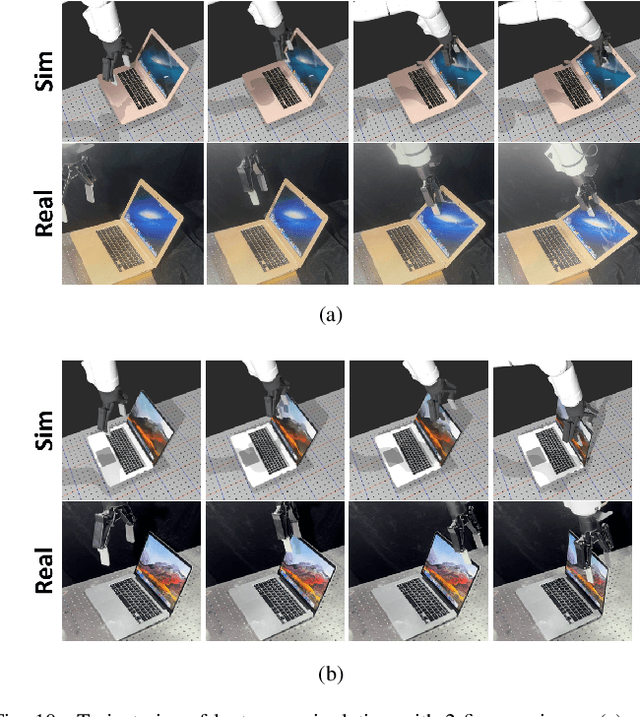
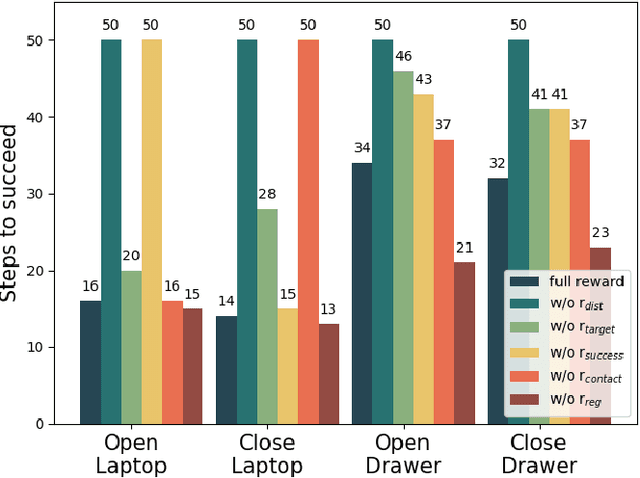
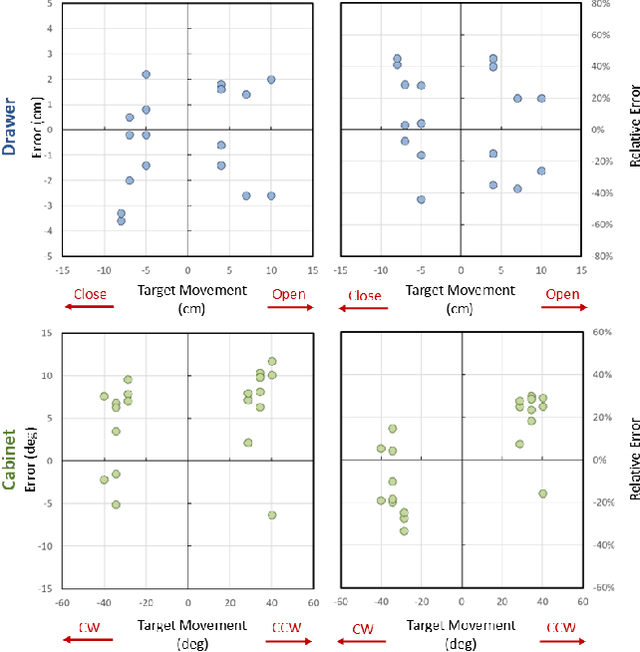
Articulated object manipulation is ubiquitous in daily life. In this paper, we present DexSim2Real$^{2}$, a novel robot learning framework for goal-conditioned articulated object manipulation using both two-finger grippers and multi-finger dexterous hands. The key of our framework is constructing an explicit world model of unseen articulated objects through active one-step interactions. This explicit world model enables sampling-based model predictive control to plan trajectories achieving different manipulation goals without needing human demonstrations or reinforcement learning. It first predicts an interaction motion using an affordance estimation network trained on self-supervised interaction data or videos of human manipulation from the internet. After executing this interaction on the real robot, the framework constructs a digital twin of the articulated object in simulation based on the two point clouds before and after the interaction. For dexterous multi-finger manipulation, we propose to utilize eigengrasp to reduce the high-dimensional action space, enabling more efficient trajectory searching. Extensive experiments validate the framework's effectiveness for precise articulated object manipulation in both simulation and the real world using a two-finger gripper and a 16-DoF dexterous hand. The robust generalizability of the explicit world model also enables advanced manipulation strategies, such as manipulating with different tools.
KOALA: Enhancing Speculative Decoding for LLM via Multi-Layer Draft Heads with Adversarial Learning
Aug 15, 2024Large Language Models (LLMs) exhibit high inference latency due to their autoregressive decoding nature. While the draft head in speculative decoding mitigates this issue, its full potential remains unexplored. In this paper, we introduce KOALA (K-layer Optimized Adversarial Learning Architecture), an orthogonal approach to the draft head. By transforming the conventional single-layer draft head into a multi-layer architecture and incorporating adversarial learning into the traditional supervised training, KOALA significantly improves the accuracy of the draft head in predicting subsequent tokens, thus more closely mirroring the functionality of LLMs. Although this improvement comes at the cost of slightly increased drafting overhead, KOALA substantially unlocks the draft head's potential, greatly enhancing speculative decoding. We conducted comprehensive evaluations of KOALA, including both autoregressive and non-autoregressive draft heads across various tasks, demonstrating a latency speedup ratio improvement of 0.24x-0.41x, which is 10.57%-14.09% faster than the original draft heads.
ActiveNeRF: Learning Accurate 3D Geometry by Active Pattern Projection
Aug 13, 2024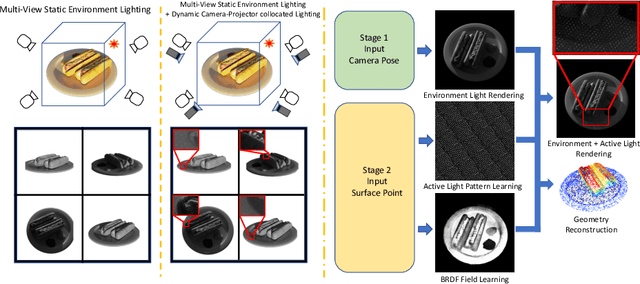
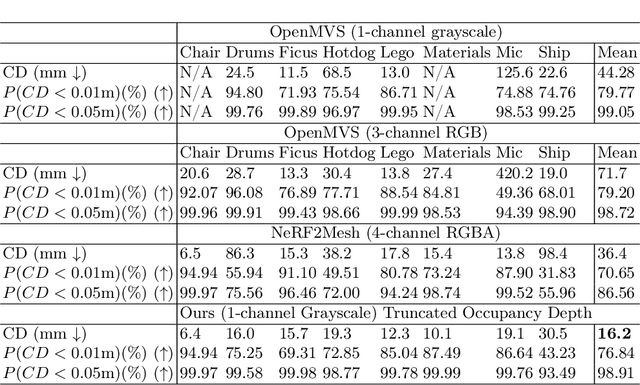
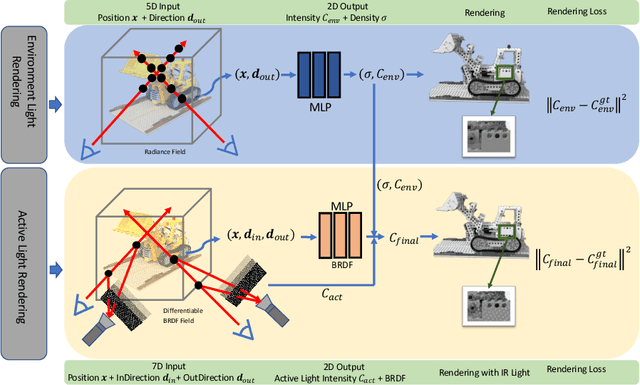

NeRFs have achieved incredible success in novel view synthesis. However, the accuracy of the implicit geometry is unsatisfactory because the passive static environmental illumination has low spatial frequency and cannot provide enough information for accurate geometry reconstruction. In this work, we propose ActiveNeRF, a 3D geometry reconstruction framework, which improves the geometry quality of NeRF by actively projecting patterns of high spatial frequency onto the scene using a projector which has a constant relative pose to the camera. We design a learnable active pattern rendering pipeline which jointly learns the scene geometry and the active pattern. We find that, by adding the active pattern and imposing its consistency across different views, our proposed method outperforms state of the art geometry reconstruction methods qualitatively and quantitatively in both simulation and real experiments. Code is avaliable at https://github.com/hcp16/active_nerf
Topology Optimization of Random Memristors for Input-Aware Dynamic SNN
Jul 26, 2024
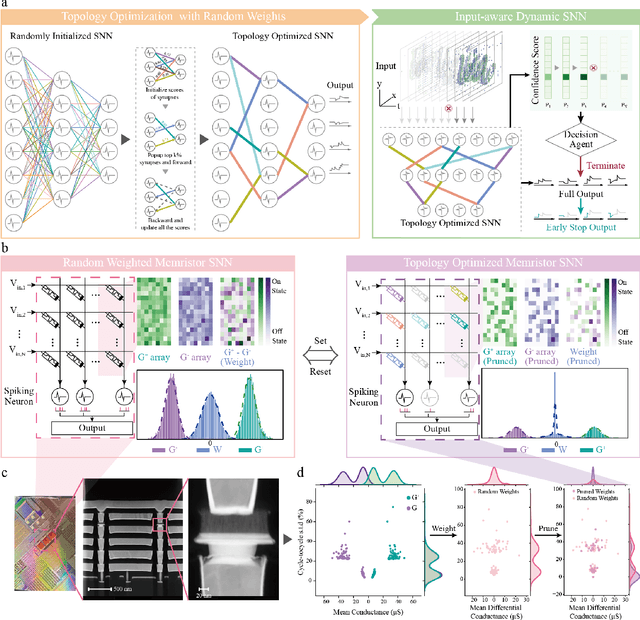
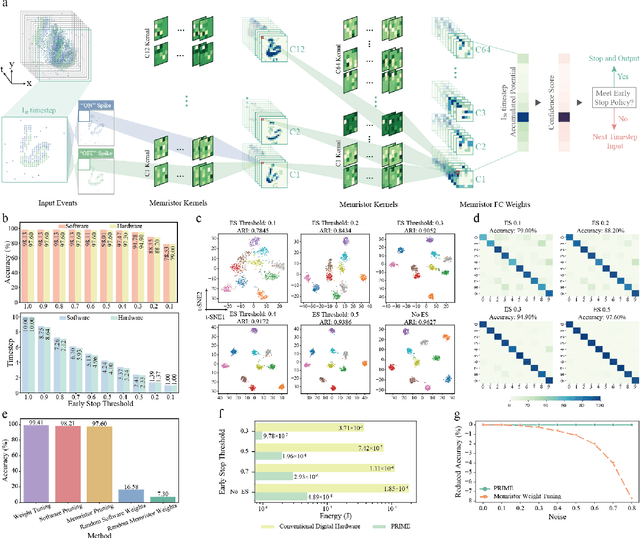
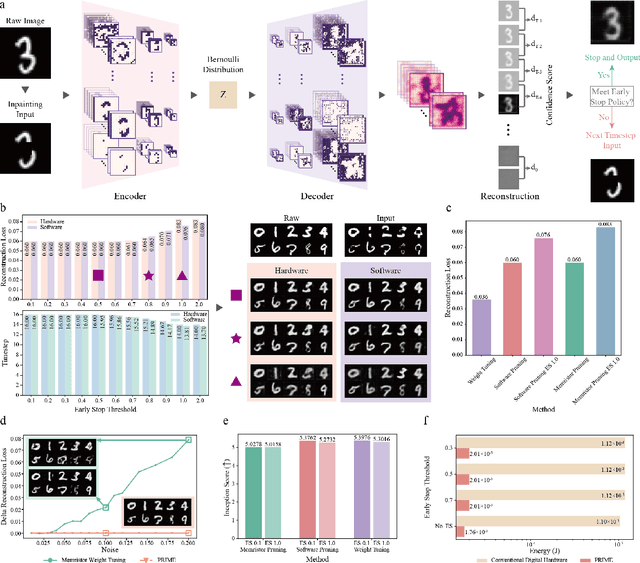
There is unprecedented development in machine learning, exemplified by recent large language models and world simulators, which are artificial neural networks running on digital computers. However, they still cannot parallel human brains in terms of energy efficiency and the streamlined adaptability to inputs of different difficulties, due to differences in signal representation, optimization, run-time reconfigurability, and hardware architecture. To address these fundamental challenges, we introduce pruning optimization for input-aware dynamic memristive spiking neural network (PRIME). Signal representation-wise, PRIME employs leaky integrate-and-fire neurons to emulate the brain's inherent spiking mechanism. Drawing inspiration from the brain's structural plasticity, PRIME optimizes the topology of a random memristive spiking neural network without expensive memristor conductance fine-tuning. For runtime reconfigurability, inspired by the brain's dynamic adjustment of computational depth, PRIME employs an input-aware dynamic early stop policy to minimize latency during inference, thereby boosting energy efficiency without compromising performance. Architecture-wise, PRIME leverages memristive in-memory computing, mirroring the brain and mitigating the von Neumann bottleneck. We validated our system using a 40 nm 256 Kb memristor-based in-memory computing macro on neuromorphic image classification and image inpainting. Our results demonstrate the classification accuracy and Inception Score are comparable to the software baseline, while achieving maximal 62.50-fold improvements in energy efficiency, and maximal 77.0% computational load savings. The system also exhibits robustness against stochastic synaptic noise of analogue memristors. Our software-hardware co-designed model paves the way to future brain-inspired neuromorphic computing with brain-like energy efficiency and adaptivity.
RAD: A Comprehensive Dataset for Benchmarking the Robustness of Image Anomaly Detection
Jun 11, 2024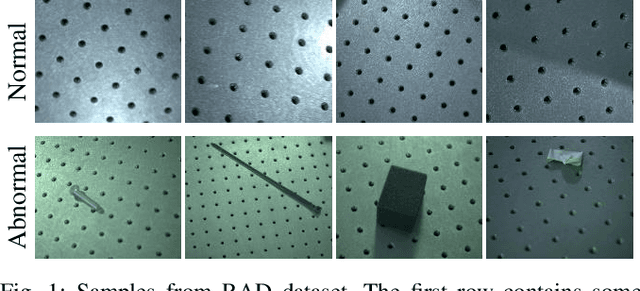
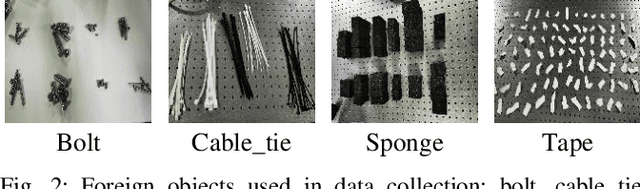
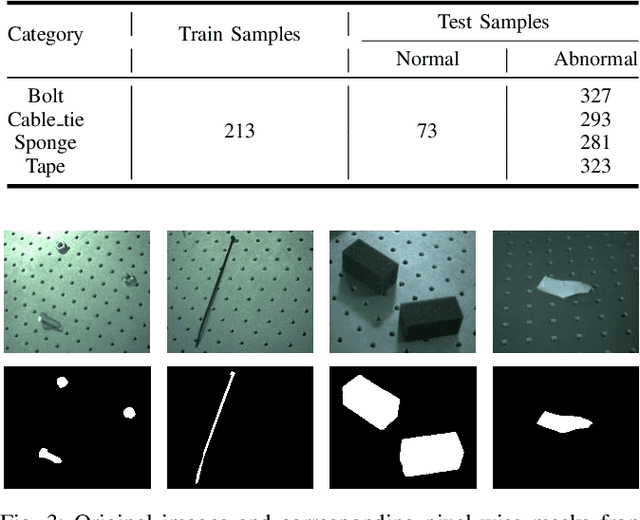
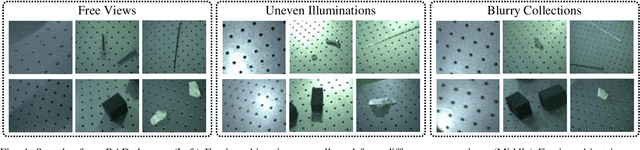
Robustness against noisy imaging is crucial for practical image anomaly detection systems. This study introduces a Robust Anomaly Detection (RAD) dataset with free views, uneven illuminations, and blurry collections to systematically evaluate the robustness of current anomaly detection methods. Specifically, RAD aims to identify foreign objects on working platforms as anomalies. The collection process incorporates various sources of imaging noise, such as viewpoint changes, uneven illuminations, and blurry collections, to replicate real-world inspection scenarios. Subsequently, we assess and analyze 11 state-of-the-art unsupervised and zero-shot methods on RAD. Our findings indicate that: 1) Variations in viewpoint, illumination, and blurring affect anomaly detection methods to varying degrees; 2) Methods relying on memory banks and assisted by synthetic anomalies demonstrate stronger robustness; 3) Effectively leveraging the general knowledge of foundational models is a promising avenue for enhancing the robustness of anomaly detection methods.
Matryoshka Representation Learning for Recommendation
Jun 11, 2024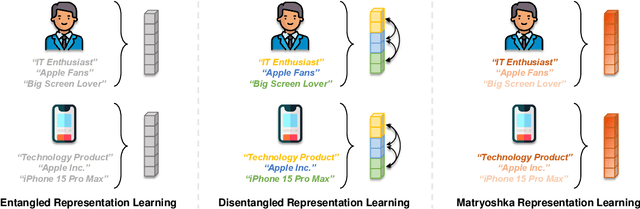
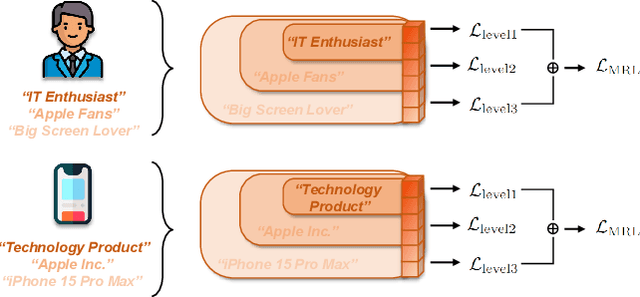
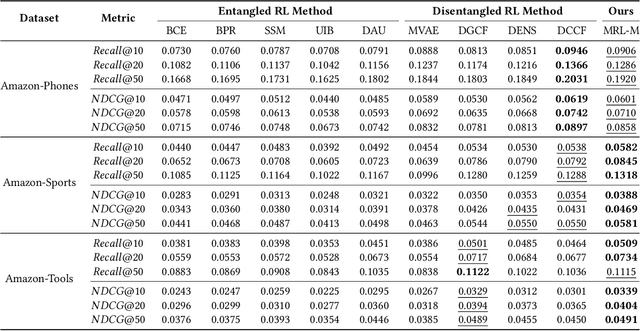
Representation learning is essential for deep-neural-network-based recommender systems to capture user preferences and item features within fixed-dimensional user and item vectors. Unlike existing representation learning methods that either treat each user preference and item feature uniformly or categorize them into discrete clusters, we argue that in the real world, user preferences and item features are naturally expressed and organized in a hierarchical manner, leading to a new direction for representation learning. In this paper, we introduce a novel matryoshka representation learning method for recommendation (MRL4Rec), by which we restructure user and item vectors into matryoshka representations with incrementally dimensional and overlapping vector spaces to explicitly represent user preferences and item features at different hierarchical levels. We theoretically establish that constructing training triplets specific to each level is pivotal in guaranteeing accurate matryoshka representation learning. Subsequently, we propose the matryoshka negative sampling mechanism to construct training triplets, which further ensures the effectiveness of the matryoshka representation learning in capturing hierarchical user preferences and item features. The experiments demonstrate that MRL4Rec can consistently and substantially outperform a number of state-of-the-art competitors on several real-life datasets. Our code is publicly available at https://github.com/Riwei-HEU/MRL.