 Add to Chrome
 Add to Firefox
 Add to Edge
AI Organizations are More Effective but Less Aligned than Individual Agents
Apr 11, 2026
AI is increasingly deployed in multi-agent systems; however, most research considers only the behavior of individual models. We experimentally show that multi-agent "AI organizations" are simultaneously more effective at achieving business goals, but less aligned, than individual AI agents. We examine 12 tasks across two practical settings: an AI consultancy providing solutions to business problems and an AI software team developing software products. Across all settings, AI Organizations composed of aligned models produce solutions with higher utility but greater misalignment compared to a single aligned model. Our work demonstrates the importance of considering interacting systems of AI agents when doing both capabilities and safety research.

Investigating Data Interventions for Subgroup Fairness: An ICU Case Study
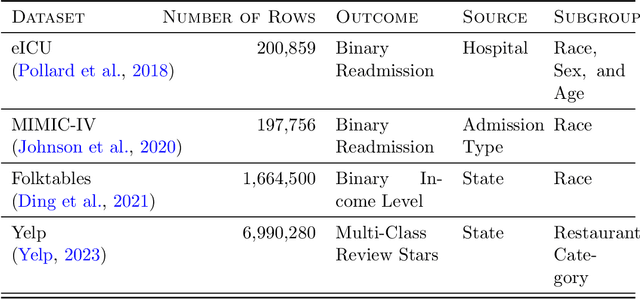
Apr 03, 2026In high-stakes settings where machine learning models are used to automate decision-making about individuals, the presence of algorithmic bias can exacerbate systemic harm to certain subgroups of people. These biases often stem from the underlying training data. In practice, interventions to "fix the data" depend on the actual additional data sources available -- where many are less than ideal. In these cases, the effects of data scaling on subgroup performance become volatile, as the improvements from increased sample size are counteracted by the introduction of distribution shifts in the training set. In this paper, we investigate the limitations of combining data sources to improve subgroup performance within the context of healthcare. Clinical models are commonly trained on datasets comprised of patient electronic health record (EHR) data from different hospitals or admission departments. Across two such datasets, the eICU Collaborative Research Database and the MIMIC-IV dataset, we find that data addition can both help and hurt model fairness and performance, and many intuitive strategies for data selection are unreliable. We compare model-based post-hoc calibration and data-centric addition strategies to find that the combination of both is important to improve subgroup performance. Our work questions the traditional dogma of "better data" for overcoming fairness challenges by comparing and combining data- and model-based approaches.
How AI Impacts Skill Formation
Jan 28, 2026AI assistance produces significant productivity gains across professional domains, particularly for novice workers. Yet how this assistance affects the development of skills required to effectively supervise AI remains unclear. Novice workers who rely heavily on AI to complete unfamiliar tasks may compromise their own skill acquisition in the process. We conduct randomized experiments to study how developers gained mastery of a new asynchronous programming library with and without the assistance of AI. We find that AI use impairs conceptual understanding, code reading, and debugging abilities, without delivering significant efficiency gains on average. Participants who fully delegated coding tasks showed some productivity improvements, but at the cost of learning the library. We identify six distinct AI interaction patterns, three of which involve cognitive engagement and preserve learning outcomes even when participants receive AI assistance. Our findings suggest that AI-enhanced productivity is not a shortcut to competence and AI assistance should be carefully adopted into workflows to preserve skill formation -- particularly in safety-critical domains.
The Limits of AI Data Transparency Policy: Three Disclosure Fallacies
Jan 26, 2026Data transparency has emerged as a rallying cry for addressing concerns about AI: data quality, privacy, and copyright chief among them. Yet while these calls are crucial for accountability, current transparency policies often fall short of their intended aims. Similar to nutrition facts for food, policies aimed at nutrition facts for AI currently suffer from a limited consideration of research on effective disclosures. We offer an institutional perspective and identify three common fallacies in policy implementations of data disclosures for AI. First, many data transparency proposals exhibit a specification gap between the stated goals of data transparency and the actual disclosures necessary to achieve such goals. Second, reform attempts exhibit an enforcement gap between required disclosures on paper and enforcement to ensure compliance in fact. Third, policy proposals manifest an impact gap between disclosed information and meaningful changes in developer practices and public understanding. Informed by the social science on transparency, our analysis identifies affirmative paths for transparency that are effective rather than merely symbolic.
Societal Impacts Research Requires Benchmarks for Creative Composition Tasks
Apr 09, 2025Foundation models that are capable of automating cognitive tasks represent a pivotal technological shift, yet their societal implications remain unclear. These systems promise exciting advances, yet they also risk flooding our information ecosystem with formulaic, homogeneous, and potentially misleading synthetic content. Developing benchmarks grounded in real use cases where these risks are most significant is therefore critical. Through a thematic analysis using 2 million language model user prompts, we identify creative composition tasks as a prevalent usage category where users seek help with personal tasks that require everyday creativity. Our fine-grained analysis identifies mismatches between current benchmarks and usage patterns among these tasks. Crucially, we argue that the same use cases that currently lack thorough evaluations can lead to negative downstream impacts. This position paper argues that benchmarks focused on creative composition tasks is a necessary step towards understanding the societal harms of AI-generated content. We call for greater transparency in usage patterns to inform the development of new benchmarks that can effectively measure both the progress and the impacts of models with creative capabilities.
Two Tickets are Better than One: Fair and Accurate Hiring Under Strategic LLM Manipulations
Feb 18, 2025In an era of increasingly capable foundation models, job seekers are turning to generative AI tools to enhance their application materials. However, unequal access to and knowledge about generative AI tools can harm both employers and candidates by reducing the accuracy of hiring decisions and giving some candidates an unfair advantage. To address these challenges, we introduce a new variant of the strategic classification framework tailored to manipulations performed using large language models, accommodating varying levels of manipulations and stochastic outcomes. We propose a ``two-ticket'' scheme, where the hiring algorithm applies an additional manipulation to each submitted resume and considers this manipulated version together with the original submitted resume. We establish theoretical guarantees for this scheme, showing improvements for both the fairness and accuracy of hiring decisions when the true positive rate is maximized subject to a no false positives constraint. We further generalize this approach to an $n$-ticket scheme and prove that hiring outcomes converge to a fixed, group-independent decision, eliminating disparities arising from differential LLM access. Finally, we empirically validate our framework and the performance of our two-ticket scheme on real resumes using an open-source resume screening tool.
Towards Data-Centric RLHF: Simple Metrics for Preference Dataset Comparison
Sep 15, 2024The goal of aligning language models to human preferences requires data that reveal these preferences. Ideally, time and money can be spent carefully collecting and tailoring bespoke preference data to each downstream application. However, in practice, a select few publicly available preference datasets are often used to train reward models for reinforcement learning from human feedback (RLHF). While new preference datasets are being introduced with increasing frequency, there are currently no existing efforts to measure and compare these datasets. In this paper, we systematically study preference datasets through three perspectives: scale, label noise, and information content. We propose specific metrics for each of these perspectives and uncover different axes of comparison for a better understanding of preference datasets. Our work is a first step towards a data-centric approach to alignment by providing perspectives that aid in training efficiency and iterative data collection for RLHF.
The Data Addition Dilemma
Aug 08, 2024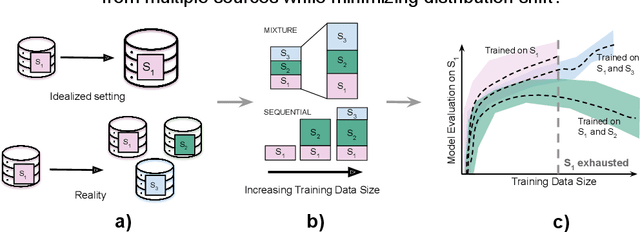
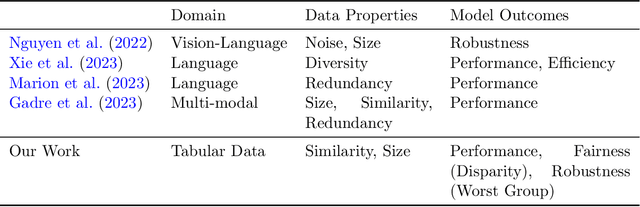
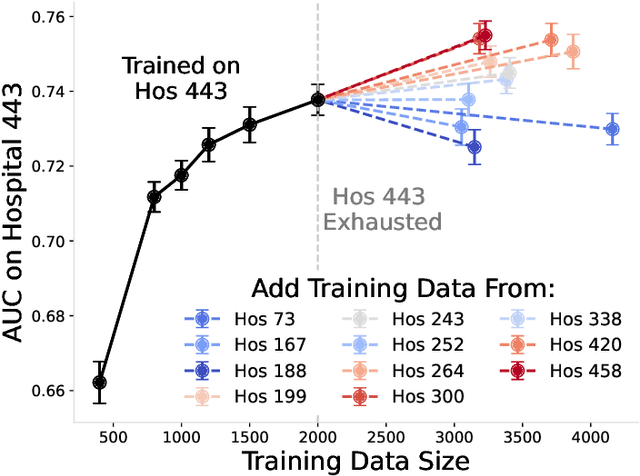
In many machine learning for healthcare tasks, standard datasets are constructed by amassing data across many, often fundamentally dissimilar, sources. But when does adding more data help, and when does it hinder progress on desired model outcomes in real-world settings? We identify this situation as the \textit{Data Addition Dilemma}, demonstrating that adding training data in this multi-source scaling context can at times result in reduced overall accuracy, uncertain fairness outcomes, and reduced worst-subgroup performance. We find that this possibly arises from an empirically observed trade-off between model performance improvements due to data scaling and model deterioration from distribution shift. We thus establish baseline strategies for navigating this dilemma, introducing distribution shift heuristics to guide decision-making on which data sources to add in data scaling, in order to yield the expected model performance improvements. We conclude with a discussion of the required considerations for data collection and suggestions for studying data composition and scale in the age of increasingly larger models.
Multigroup Robustness
May 01, 2024To address the shortcomings of real-world datasets, robust learning algorithms have been designed to overcome arbitrary and indiscriminate data corruption. However, practical processes of gathering data may lead to patterns of data corruption that are localized to specific partitions of the training dataset. Motivated by critical applications where the learned model is deployed to make predictions about people from a rich collection of overlapping subpopulations, we initiate the study of multigroup robust algorithms whose robustness guarantees for each subpopulation only degrade with the amount of data corruption inside that subpopulation. When the data corruption is not distributed uniformly over subpopulations, our algorithms provide more meaningful robustness guarantees than standard guarantees that are oblivious to how the data corruption and the affected subpopulations are related. Our techniques establish a new connection between multigroup fairness and robustness.
Unifying Corroborative and Contributive Attributions in Large Language Models
Nov 20, 2023As businesses, products, and services spring up around large language models, the trustworthiness of these models hinges on the verifiability of their outputs. However, methods for explaining language model outputs largely fall across two distinct fields of study which both use the term "attribution" to refer to entirely separate techniques: citation generation and training data attribution. In many modern applications, such as legal document generation and medical question answering, both types of attributions are important. In this work, we argue for and present a unified framework of large language model attributions. We show how existing methods of different types of attribution fall under the unified framework. We also use the framework to discuss real-world use cases where one or both types of attributions are required. We believe that this unified framework will guide the use case driven development of systems that leverage both types of attribution, as well as the standardization of their evaluation.