 Add to Chrome
 Add to Firefox
 Add to Edge
Artiverse: A Diverse and Physically Grounded Dataset for Articulated Objects
May 23, 2026
We present Artiverse, a diverse and physically grounded dataset of high-quality articulated 3D objects designed for realistic functional modeling and simulation. Artiverse contains 5.4K human-authored objects across a broad range of 88 categories, aggregated from multiple 3D static repositories. Objects are annotated with functional parts, interior structures, realistic kinematic relationships and articulated joints including multi-DoF joints, and physical attributes such as metric scale, material, and mass. We develop a semi-automated annotation pipeline that combines few-shot segmentation, geometric reasoning, and multi-stage human verification to achieve high-quality and efficient annotation, reducing manual annotation time by over 30%. We demonstrate the value of Artiverse on tasks of part mobility analysis, articulated object generation, and physics-based interaction. Artiverse provides a data resource to advance functional understanding for articulated objects.

JRM: Joint Reconstruction Model for Multiple Objects without Alignment
Mar 27, 2026Object-centric reconstruction seeks to recover the 3D structure of a scene through composition of independent objects. While this independence can simplify modeling, it discards strong signals that could improve reconstruction, notably repetition where the same object model is seen multiple times in a scene, or across scans. We propose the Joint Reconstruction Model (JRM) to leverage repetition by framing object reconstruction as one of personalized generation: multiple observations share a common subject that should be consistent for all observations, while still adhering to the specific pose and state from each. Prior methods in this direction rely on explicit matching and rigid alignment across observations, making them sensitive to errors and difficult to extend to non-rigid transformations. In contrast, JRM is a 3D flow-matching generative model that implicitly aggregates unaligned observations in its latent space, learning to produce consistent and faithful reconstructions in a data-driven manner without explicit constraints. Evaluations on synthetic and real-world data show that JRM's implicit aggregation removes the need for explicit alignment, improves robustness to incorrect associations, and naturally handles non-rigid changes such as articulation. Overall, JRM outperforms both independent and alignment-based baselines in reconstruction quality.
Octopus-inspired Distributed Control for Soft Robotic Arms: A Graph Neural Network-Based Attention Policy with Environmental Interaction
Mar 10, 2026This paper proposes SoftGM, an octopus-inspired distributed control architecture for segmented soft robotic arms that learn to reach targets in contact-rich environments using online obstacle discovery without relying on global obstacle geometry. SoftGM formulates each arm section as a cooperative agent and represents the arm-environment interaction as a graph. SoftGM uses a two-stage graph attention message passing scheme following a Centralised Training Decentralised Execution (CTDE) paradigm with a centralised critic and decentralised actor. We evaluate SoftGM in a Cosserat-rod simulator (PyElastica) across three tasks that increase the complexity of the environment: obstacle-free, structured obstacles, and a wall-with-hole scenario. Compared with six widely used MARL baselines (IDDPG, IPPO, ISAC, MADDPG, MAPPO, MASAC) under identical information content and training conditions, SoftGM matches strong CTDE methods in simpler settings and achieves the best performance in the wall-with-hole task. Robustness tests with observation noise, single-section actuation failure, and transient disturbances show that SoftGM preserves success while keeping control effort bounded, indicating resilient coordination driven by selective contact-relevant information routing.
Better Matching, Less Forgetting: A Quality-Guided Matcher for Transformer-based Incremental Object Detection
Mar 02, 2026Incremental Object Detection (IOD) aims to continuously learn new object classes without forgetting previously learned ones. A persistent challenge is catastrophic forgetting, primarily attributed to background shift in conventional detectors. While pseudo-labeling mitigates this in dense detectors, we identify a novel, distinct source of forgetting specific to DETR-like architectures: background foregrounding. This arises from the exhaustiveness constraint of the Hungarian matcher, which forcibly assigns every ground truth target to one prediction, even when predictions primarily cover background regions (i.e., low IoU). This erroneous supervision compels the model to misclassify background features as specific foreground classes, disrupting learned representations and accelerating forgetting. To address this, we propose a Quality-guided Min-Cost Max-Flow (Q-MCMF) matcher. To avoid forced assignments, Q-MCMF builds a flow graph and prunes implausible matches based on geometric quality. It then optimizes for the final matching that minimizes cost and maximizes valid assignments. This strategy eliminates harmful supervision from background foregrounding while maximizing foreground learning signals. Extensive experiments on the COCO dataset under various incremental settings demonstrate that our method consistently outperforms existing state-of-the-art approaches.
ShapeR: Robust Conditional 3D Shape Generation from Casual Captures
Jan 16, 2026Recent advances in 3D shape generation have achieved impressive results, but most existing methods rely on clean, unoccluded, and well-segmented inputs. Such conditions are rarely met in real-world scenarios. We present ShapeR, a novel approach for conditional 3D object shape generation from casually captured sequences. Given an image sequence, we leverage off-the-shelf visual-inertial SLAM, 3D detection algorithms, and vision-language models to extract, for each object, a set of sparse SLAM points, posed multi-view images, and machine-generated captions. A rectified flow transformer trained to effectively condition on these modalities then generates high-fidelity metric 3D shapes. To ensure robustness to the challenges of casually captured data, we employ a range of techniques including on-the-fly compositional augmentations, a curriculum training scheme spanning object- and scene-level datasets, and strategies to handle background clutter. Additionally, we introduce a new evaluation benchmark comprising 178 in-the-wild objects across 7 real-world scenes with geometry annotations. Experiments show that ShapeR significantly outperforms existing approaches in this challenging setting, achieving an improvement of 2.7x in Chamfer distance compared to state of the art.
YOLO-IOD: Towards Real Time Incremental Object Detection
Dec 28, 2025Current methods for incremental object detection (IOD) primarily rely on Faster R-CNN or DETR series detectors; however, these approaches do not accommodate the real-time YOLO detection frameworks. In this paper, we first identify three primary types of knowledge conflicts that contribute to catastrophic forgetting in YOLO-based incremental detectors: foreground-background confusion, parameter interference, and misaligned knowledge distillation. Subsequently, we introduce YOLO-IOD, a real-time Incremental Object Detection (IOD) framework that is constructed upon the pretrained YOLO-World model, facilitating incremental learning via a stage-wise parameter-efficient fine-tuning process. Specifically, YOLO-IOD encompasses three principal components: 1) Conflict-Aware Pseudo-Label Refinement (CPR), which mitigates the foreground-background confusion by leveraging the confidence levels of pseudo labels and identifying potential objects relevant to future tasks. 2) Importancebased Kernel Selection (IKS), which identifies and updates the pivotal convolution kernels pertinent to the current task during the current learning stage. 3) Cross-Stage Asymmetric Knowledge Distillation (CAKD), which addresses the misaligned knowledge distillation conflict by transmitting the features of the student target detector through the detection heads of both the previous and current teacher detectors, thereby facilitating asymmetric distillation between existing and newly introduced categories. We further introduce LoCo COCO, a more realistic benchmark that eliminates data leakage across stages. Experiments on both conventional and LoCo COCO benchmarks show that YOLO-IOD achieves superior performance with minimal forgetting.
Digital Twin Generation from Visual Data: A Survey
Apr 17, 2025This survey explores recent developments in generating digital twins from videos. Such digital twins can be used for robotics application, media content creation, or design and construction works. We analyze various approaches, including 3D Gaussian Splatting, generative in-painting, semantic segmentation, and foundation models highlighting their advantages and limitations. Additionally, we discuss challenges such as occlusions, lighting variations, and scalability, as well as potential future research directions. This survey aims to provide a comprehensive overview of state-of-the-art methodologies and their implications for real-world applications. Awesome list: https://github.com/ndrwmlnk/awesome-digital-twins
Demystifying Catastrophic Forgetting in Two-Stage Incremental Object Detector
Feb 08, 2025Catastrophic forgetting is a critical chanllenge for incremental object detection (IOD). Most existing methods treat the detector monolithically, relying on instance replay or knowledge distillation without analyzing component-specific forgetting. Through dissection of Faster R-CNN, we reveal a key insight: Catastrophic forgetting is predominantly localized to the RoI Head classifier, while regressors retain robustness across incremental stages. This finding challenges conventional assumptions, motivating us to develop a framework termed NSGP-RePRE. Regional Prototype Replay (RePRE) mitigates classifier forgetting via replay of two types of prototypes: coarse prototypes represent class-wise semantic centers of RoI features, while fine-grained prototypes model intra-class variations. Null Space Gradient Projection (NSGP) is further introduced to eliminate prototype-feature misalignment by updating the feature extractor in directions orthogonal to subspace of old inputs via gradient projection, aligning RePRE with incremental learning dynamics. Our simple yet effective design allows NSGP-RePRE to achieve state-of-the-art performance on the Pascal VOC and MS COCO datasets under various settings. Our work not only advances IOD methodology but also provide pivotal insights for catastrophic forgetting mitigation in IOD. Code will be available soon.
Diorama: Unleashing Zero-shot Single-view 3D Scene Modeling
Nov 29, 2024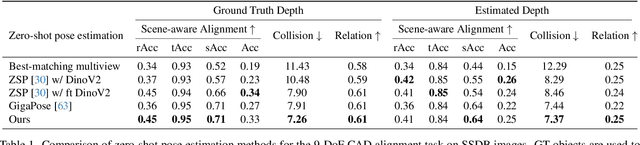
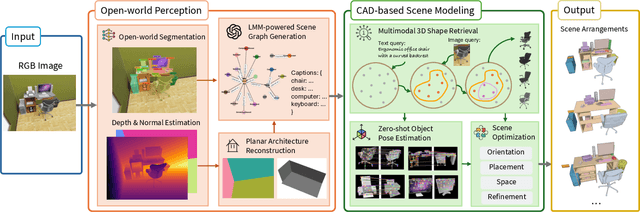
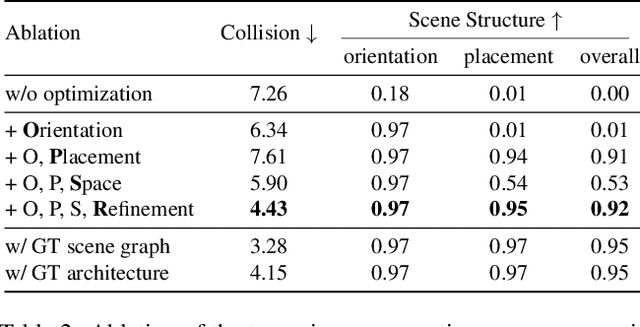
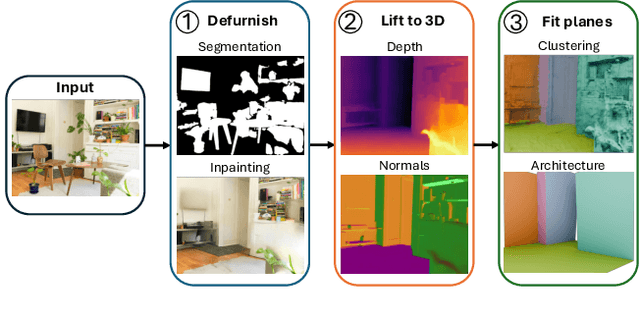
Reconstructing structured 3D scenes from RGB images using CAD objects unlocks efficient and compact scene representations that maintain compositionality and interactability. Existing works propose training-heavy methods relying on either expensive yet inaccurate real-world annotations or controllable yet monotonous synthetic data that do not generalize well to unseen objects or domains. We present Diorama, the first zero-shot open-world system that holistically models 3D scenes from single-view RGB observations without requiring end-to-end training or human annotations. We show the feasibility of our approach by decomposing the problem into subtasks and introduce robust, generalizable solutions to each: architecture reconstruction, 3D shape retrieval, object pose estimation, and scene layout optimization. We evaluate our system on both synthetic and real-world data to show we significantly outperform baselines from prior work. We also demonstrate generalization to internet images and the text-to-scene task.
R3DS: Reality-linked 3D Scenes for Panoramic Scene Understanding
Mar 18, 2024
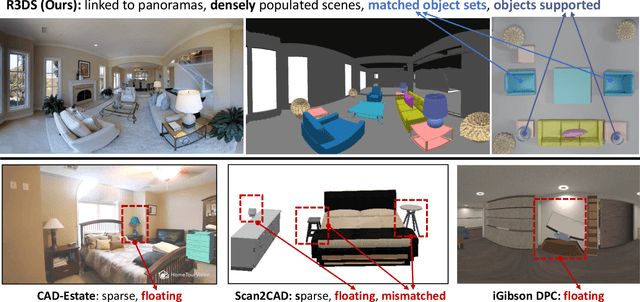

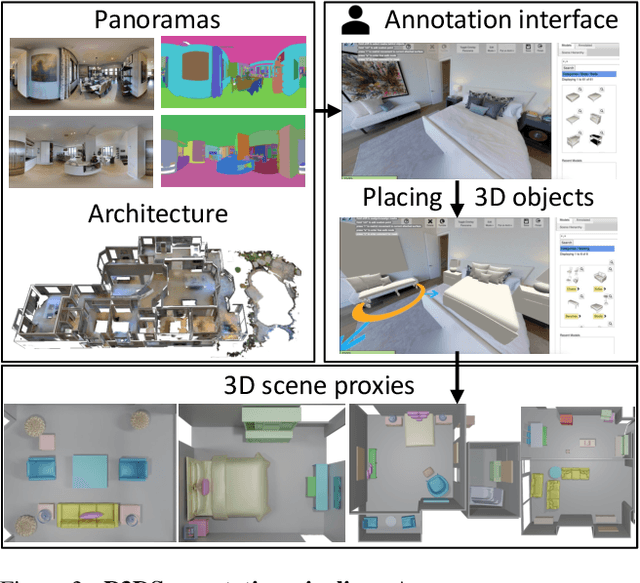
We introduce the Reality-linked 3D Scenes (R3DS) dataset of synthetic 3D scenes mirroring the real-world scene arrangements from Matterport3D panoramas. Compared to prior work, R3DS has more complete and densely populated scenes with objects linked to real-world observations in panoramas. R3DS also provides an object support hierarchy, and matching object sets (e.g., same chairs around a dining table) for each scene. Overall, R3DS contains 19K objects represented by 3,784 distinct CAD models from over 100 object categories. We demonstrate the effectiveness of R3DS on the Panoramic Scene Understanding task. We find that: 1) training on R3DS enables better generalization; 2) support relation prediction trained with R3DS improves performance compared to heuristically calculated support; and 3) R3DS offers a challenging benchmark for future work on panoramic scene understanding.