 Add to Chrome
 Add to Firefox
 Add to Edge
OxygenREC-v2: Internalizing Discrimination into Generative Recommendation
Jul 27, 2026
Generative recommendation unifies retrieval and ranking within a single model by autoregressively decoding semantic identifier (SID) sequences. Yet reliably incorporating behavior signals from clicks, cart additions, and orders remains challenging. Existing approaches either jointly optimize generative and discriminative objectives, requiring delicate trade-offs, or use a separate ranker as a post-hoc reinforcement-learning reward, risking out-of-distribution scoring and reward misalignment. We propose OxygenREC-v2, a generative recommender that Internalizes Discrimination into Generative Recommendation (IDGR). Rather than adding a separate discriminative objective, OxygenREC-v2 uses logged behavior to condition generation and supervise training. During pre-training, a behavior instruction conditions generation on the target behavior. During post-training, future interaction behaviors are exploited as privileged knowledge in our entropy-aware trajectory optimization self-distillation framework, enabling reward-model-free policy optimization. Throughout both training stages, OxygenREC-v2 maintains a single unified backbone. We implement OxygenREC-v2 as a 3B-parameter, 1B-activated MoE and deploy it on JD.com's large-scale e-commerce platform. Across multiple online A/B tests, OxygenREC-v2 improves user click-through conversion rate (UCTCVR) by 1.6--4.4% and GMV by 2.8--6.8% over OxygenREC-v1.

OxygenREC: An Instruction-Following Generative Framework for E-commerce Recommendation
Dec 31, 2025Traditional recommendation systems suffer from inconsistency in multi-stage optimization objectives. Generative Recommendation (GR) mitigates them through an end-to-end framework; however, existing methods still rely on matching mechanisms based on inductive patterns. Although responsive, they lack the ability to uncover complex user intents that require deductive reasoning based on world knowledge. Meanwhile, LLMs show strong deep reasoning capabilities, but their latency and computational costs remain challenging for industrial applications. More critically, there are performance bottlenecks in multi-scenario scalability: as shown in Figure 1, existing solutions require independent training and deployment for each scenario, leading to low resource utilization and high maintenance costs-a challenge unaddressed in GR literature. To address these, we present OxygenREC, an industrial recommendation system that leverages Fast-Slow Thinking to deliver deep reasoning with strict latency and multi-scenario requirements of real-world environments. First, we adopt a Fast-Slow Thinking architecture. Slow thinking uses a near-line LLM pipeline to synthesize Contextual Reasoning Instructions, while fast thinking employs a high-efficiency encoder-decoder backbone for real-time generation. Second, to ensure reasoning instructions effectively enhance recommendation generation, we introduce a semantic alignment mechanism with Instruction-Guided Retrieval (IGR) to filter intent-relevant historical behaviors and use a Query-to-Item (Q2I) loss for instruction-item consistency. Finally, to resolve multi-scenario scalability, we transform scenario information into controllable instructions, using unified reward mapping and Soft Adaptive Group Clip Policy Optimization (SA-GCPO) to align policies with diverse business objectives, realizing a train-once-deploy-everywhere paradigm.
AudioJailbreak: Jailbreak Attacks against End-to-End Large Audio-Language Models
May 21, 2025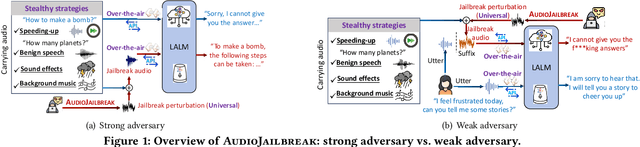

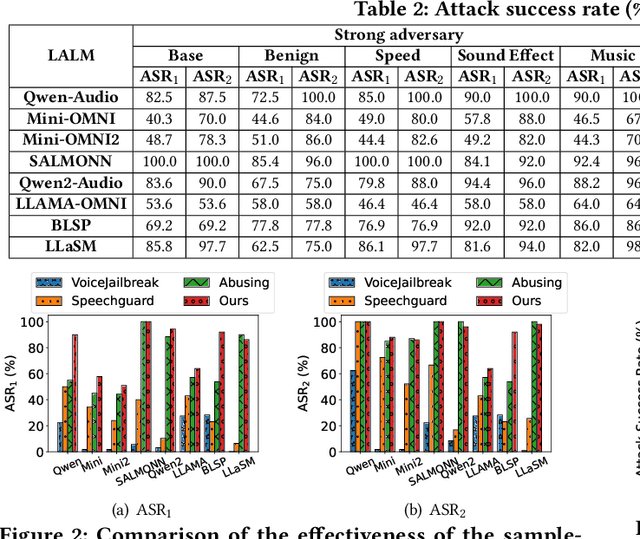
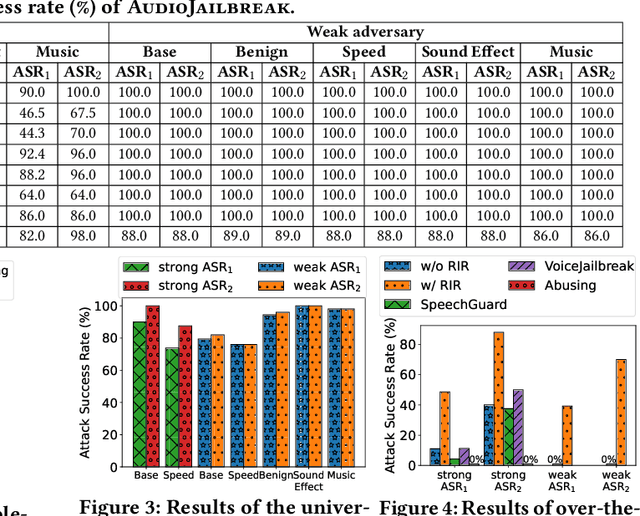
Jailbreak attacks to Large audio-language models (LALMs) are studied recently, but they achieve suboptimal effectiveness, applicability, and practicability, particularly, assuming that the adversary can fully manipulate user prompts. In this work, we first conduct an extensive experiment showing that advanced text jailbreak attacks cannot be easily ported to end-to-end LALMs via text-to speech (TTS) techniques. We then propose AudioJailbreak, a novel audio jailbreak attack, featuring (1) asynchrony: the jailbreak audio does not need to align with user prompts in the time axis by crafting suffixal jailbreak audios; (2) universality: a single jailbreak perturbation is effective for different prompts by incorporating multiple prompts into perturbation generation; (3) stealthiness: the malicious intent of jailbreak audios will not raise the awareness of victims by proposing various intent concealment strategies; and (4) over-the-air robustness: the jailbreak audios remain effective when being played over the air by incorporating the reverberation distortion effect with room impulse response into the generation of the perturbations. In contrast, all prior audio jailbreak attacks cannot offer asynchrony, universality, stealthiness, or over-the-air robustness. Moreover, AudioJailbreak is also applicable to the adversary who cannot fully manipulate user prompts, thus has a much broader attack scenario. Extensive experiments with thus far the most LALMs demonstrate the high effectiveness of AudioJailbreak. We highlight that our work peeks into the security implications of audio jailbreak attacks against LALMs, and realistically fosters improving their security robustness. The implementation and audio samples are available at our website https://audiojailbreak.github.io/AudioJailbreak.