 Add to Chrome
 Add to Firefox
 Add to Edge
MalMoE: Mixture-of-Experts Enhanced Encrypted Malicious Traffic Detection Under Graph Drift
Feb 10, 2026
Encryption has been commonly used in network traffic to secure transmission, but it also brings challenges for malicious traffic detection, due to the invisibility of the packet payload. Graph-based methods are emerging as promising solutions by leveraging multi-host interactions to promote detection accuracy. But most of them face a critical problem: Graph Drift, where the flow statistics or topological information of a graph change over time. To overcome these drawbacks, we propose a graph-assisted encrypted traffic detection system, MalMoE, which applies Mixture of Experts (MoE) to select the best expert model for drift-aware classification. Particularly, we design 1-hop-GNN-like expert models that handle different graph drifts by analyzing graphs with different features. Then, the redesigned gate model conducts expert selection according to the actual drift. MalMoE is trained with a stable two-stage training strategy with data augmentation, which effectively guides the gate on how to perform routing. Experiments on open-source, synthetic, and real-world datasets show that MalMoE can perform precise and real-time detection.

MCBlock: Boosting Neural Radiance Field Training Speed by MCTS-based Dynamic-Resolution Ray Sampling
Apr 14, 2025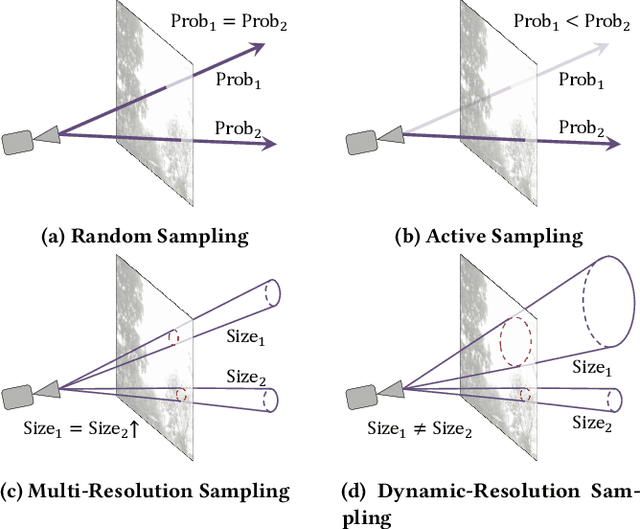
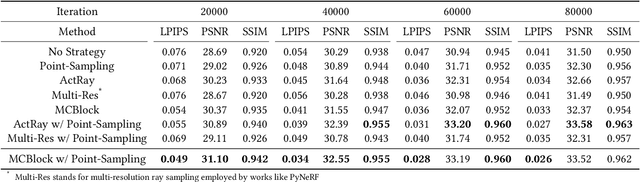


Neural Radiance Field (NeRF) is widely known for high-fidelity novel view synthesis. However, even the state-of-the-art NeRF model, Gaussian Splatting, requires minutes for training, far from the real-time performance required by multimedia scenarios like telemedicine. One of the obstacles is its inefficient sampling, which is only partially addressed by existing works. Existing point-sampling algorithms uniformly sample simple-texture regions (easy to fit) and complex-texture regions (hard to fit), while existing ray-sampling algorithms sample these regions all in the finest granularity (i.e. the pixel level), both wasting GPU training resources. Actually, regions with different texture intensities require different sampling granularities. To this end, we propose a novel dynamic-resolution ray-sampling algorithm, MCBlock, which employs Monte Carlo Tree Search (MCTS) to partition each training image into pixel blocks with different sizes for active block-wise training. Specifically, the trees are initialized according to the texture of training images to boost the initialization speed, and an expansion/pruning module dynamically optimizes the block partition. MCBlock is implemented in Nerfstudio, an open-source toolset, and achieves a training acceleration of up to 2.33x, surpassing other ray-sampling algorithms. We believe MCBlock can apply to any cone-tracing NeRF model and contribute to the multimedia community.
Promptus: Can Prompts Streaming Replace Video Streaming with Stable Diffusion
May 30, 2024


With the exponential growth of video traffic, traditional video streaming systems are approaching their limits in compression efficiency and communication capacity. To further reduce bitrate while maintaining quality, we propose Promptus, a disruptive novel system that streaming prompts instead of video content with Stable Diffusion, which converts video frames into a series of "prompts" for delivery. To ensure pixel alignment, a gradient descent-based prompt fitting framework is proposed. To achieve adaptive bitrate for prompts, a low-rank decomposition-based bitrate control algorithm is introduced. For inter-frame compression of prompts, a temporal smoothing-based prompt interpolation algorithm is proposed. Evaluations across various video domains and real network traces demonstrate Promptus can enhance the perceptual quality by 0.111 and 0.092 (in LPIPS) compared to VAE and H.265, respectively, and decreases the ratio of severely distorted frames by 89.3% and 91.7%. Moreover, Promptus achieves real-time video generation from prompts at over 150 FPS. To the best of our knowledge, Promptus is the first attempt to replace video codecs with prompt inversion and the first to use prompt streaming instead of video streaming. Our work opens up a new paradigm for efficient video communication beyond the Shannon limit.