 Add to Chrome
 Add to Firefox
 Add to Edge
Restoring Collaborative Signals in Semantic-ID Generative Recommendation via Personalized Natural Language
Jul 30, 2026
Making LLM-based generative recommendation models stronger and more personalized through natural language and explicit reasoning is a widely anticipated yet still unsolved goal. Such models cast recommendation as autoregressively generating an item's semantic-ID (SID), a short tuple of discrete codes, so that recommending well reduces to emitting the right SID. In this setting the model verbalizes its knowledge poorly, and text and SID tokens live in misaligned embedding spaces. Deep reasoning therefore rarely turns into a correct SID, and enabling explicit "thinking" often gives no gain or even hurts. The deeper cause is that a compact SID cannot hold content and collaborative signal at once: the two compete, and collaboration loses. Because a mis-predicted SID is a wrong recommendation, this caps accuracy directly. Costly multi-round training barely helps, and few methods try to supply the missing signal at inference time. What is missing is a reliable channel that carries collaborative signal into SID generation. We therefore propose a framework, guided by personalized natural language, that adds hierarchical collaborative cues as the model generates, without altering the backbone or retraining the SIDs. Rather than mapping language onto SIDs directly, it uses language to attach analyzable links between collaborative patterns and their audiences, restoring the collaborative signal that SIDs miss. The result is consistent gains in recommendation accuracy, grounding generation in collaborative structure at inference time rather than relying on explicit reasoning or retraining.

Discrete Diffusion Models: A Unified Framework from Tokenization to Generation
Jul 15, 2026Discrete denoising diffusion models (DDMs) have recently emerged as a compelling alternative to autoregressive (AR) modeling for discrete data, offering parallel generation and iterative global refinement capabilities. Unlike continuous diffusion, where the state space is fixed, DDMs are fundamentally shaped by how the discrete state space is constructed: the tokenization scheme, the vocabulary topology, and domain-specific structural alphabets. This work introduces a unified conceptual framework that views discrete diffusion models through the construction of the underlying discrete state space. Within this framework, existing formulations, including transition-matrix, masking/absorbing-state, and score/ratio-based approaches, emerge as different instantiations of a common design space. The framework further exposes common design trade-offs across training objectives, inference algorithms, scaling behavior, systems optimization, and evaluation protocols, suggesting several promising directions for future research.
QUACK: Questioning, Understanding, and Auditing Communicated Knowledge in Multimodal Social Deduction Agents
May 26, 2026Social deduction games have become a popular testbed for probing reasoning, deception, coordination, and belief modeling in Large Language Model (LLM) agents. However, most environments are scored only by game outcomes such as win rates and largely remain to text-only interaction, making it difficult to tell whether an agent's language is actually grounded in what it perceived and did, or to identify the failure modes underlying its behavior. To address this gap, we introduce QUACK, an open-source environment and evaluation framework for auditing the grounding of agent language in multimodal social reasoning. QUACK evaluates agents at three levels: game outcomes, behavioral trajectories, and utterance-level consistency. Its core Statement Verification Pipeline reconstructs each agent's ground-truth trajectory from engine logs and checks every discussion claim against it, automatically flagging spatial hallucination, unsupported accusation, deception collapse, and language-action inconsistency. Evaluating three frontier VLMs in both homogeneous and cross-model adversarial settings, we find that even the strongest agent hallucinates 15.1% of its verifiable spatial claims and makes over half of its accusations without grounded evidence. We release the full engine, evaluation framework, toolkit, and logs at https://github.com/AAAAA-Academia-Attractions/QUACK.
Preference Heads in Large Language Models: A Mechanistic Framework for Interpretable Personalization
Apr 24, 2026Large Language Models (LLMs) exhibit strong implicit personalization ability, yet most existing approaches treat this behavior as a black box, relying on prompt engineering or fine tuning on user data. In this work, we adopt a mechanistic interpretability perspective and hypothesize the existence of a sparse set of Preference Heads, attention heads that encode user specific stylistic and topical preferences and exert a causal influence on generation. We introduce Differential Preference Steering (DPS), a training free framework that (1) identifies Preference Heads through causal masking analysis and (2) leverages them for controllable and interpretable personalization at inference time. DPS computes a Preference Contribution Score (PCS) for each attention head, directly measuring its causal impact on user aligned outputs. During decoding, we contrast model predictions with and without Preference Heads, amplifying the difference between personalized and generic logits to selectively strengthen preference aligned continuations. Experiments on widely used personalization benchmarks across multiple LLMs demonstrate consistent gains in personalization fidelity while preserving content coherence and low computational overhead. Beyond empirical improvements, DPS provides a mechanistic explanation of where and how personalization emerges within transformer architectures. Our implementation is publicly available.
Optimizing User Profiles via Contextual Bandits for Retrieval-Augmented LLM Personalization
Jan 17, 2026Large Language Models (LLMs) excel at general-purpose tasks, yet adapting their responses to individual users remains challenging. Retrieval augmentation provides a lightweight alternative to fine-tuning by conditioning LLMs on user history records, and existing approaches typically select these records based on semantic relevance. We argue that relevance serves as an unreliable proxy for utility: a record may be semantically similar to a query yet fail to improve generation quality or even degrade it due to redundancy or conflicting information. To bridge this gap, we propose PURPLE, a contextual bandit framework that oPtimizes UseR Profiles for Llm pErsonalization. In contrast to a greedy selection of the most relevant records, PURPLE treats profile construction as a set generation process and utilizes a Plackett-Luce ranking model to capture complex inter-record dependencies. By training with dense feedback provided by the likelihood of the reference response, our method aligns retrieval directly with generation quality. Extensive experiments on nine personalization tasks demonstrate that PURPLE consistently outperforms strong heuristic and retrieval-augmented baselines in both effectiveness and efficiency, establishing a principled and scalable solution for optimizing user profiles.
WebGames: Challenging General-Purpose Web-Browsing AI Agents
Feb 25, 2025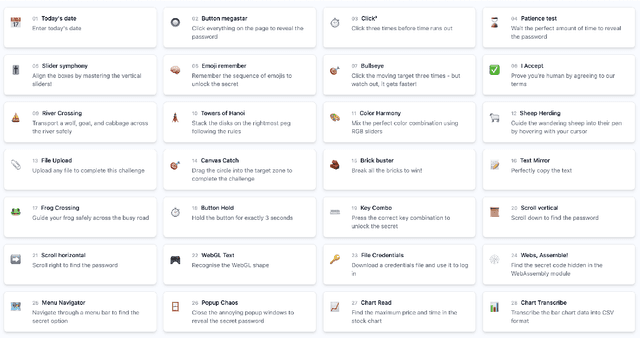
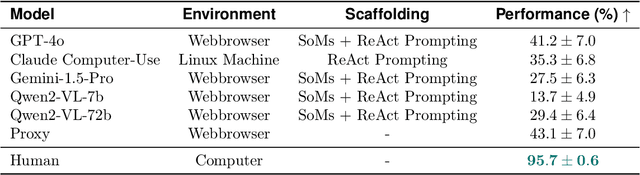
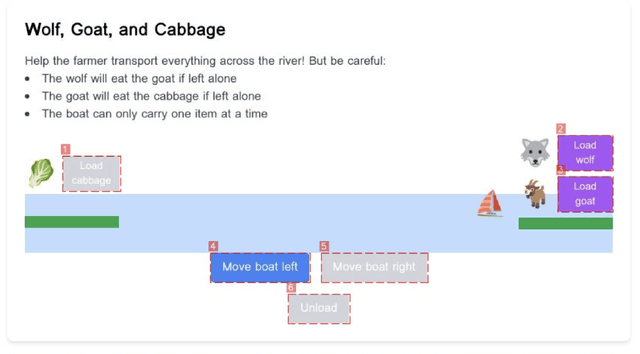
We introduce WebGames, a comprehensive benchmark suite designed to evaluate general-purpose web-browsing AI agents through a collection of 50+ interactive challenges. These challenges are specifically crafted to be straightforward for humans while systematically testing the limitations of current AI systems across fundamental browser interactions, advanced input processing, cognitive tasks, workflow automation, and interactive entertainment. Our framework eliminates external dependencies through a hermetic testing environment, ensuring reproducible evaluation with verifiable ground-truth solutions. We evaluate leading vision-language models including GPT-4o, Claude Computer-Use, Gemini-1.5-Pro, and Qwen2-VL against human performance. Results reveal a substantial capability gap, with the best AI system achieving only 43.1% success rate compared to human performance of 95.7%, highlighting fundamental limitations in current AI systems' ability to handle common web interaction patterns that humans find intuitive. The benchmark is publicly available at webgames.convergence.ai, offering a lightweight, client-side implementation that facilitates rapid evaluation cycles. Through its modular architecture and standardized challenge specifications, WebGames provides a robust foundation for measuring progress in development of more capable web-browsing agents.
LM2: Large Memory Models
Feb 09, 2025This paper introduces the Large Memory Model (LM2), a decoder-only Transformer architecture enhanced with an auxiliary memory module that aims to address the limitations of standard Transformers in multi-step reasoning, relational argumentation, and synthesizing information distributed over long contexts. The proposed LM2 incorporates a memory module that acts as a contextual representation repository, interacting with input tokens via cross attention and updating through gating mechanisms. To preserve the Transformers general-purpose capabilities, LM2 maintains the original information flow while integrating a complementary memory pathway. Experimental results on the BABILong benchmark demonstrate that the LM2model outperforms both the memory-augmented RMT model by 37.1% and the baseline Llama-3.2 model by 86.3% on average across tasks. LM2 exhibits exceptional capabilities in multi-hop inference, numerical reasoning, and large-context question-answering. On the MMLU dataset, it achieves a 5.0% improvement over a pre-trained vanilla model, demonstrating that its memory module does not degrade performance on general tasks. Further, in our analysis, we explore the memory interpretability, effectiveness of memory modules, and test-time behavior. Our findings emphasize the importance of explicit memory in enhancing Transformer architectures.
MindStar: Enhancing Math Reasoning in Pre-trained LLMs at Inference Time
May 25, 2024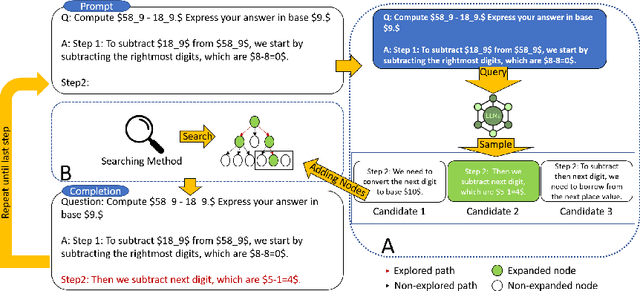
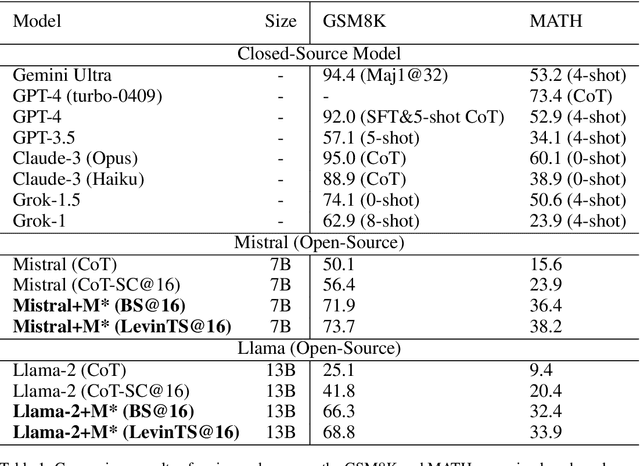
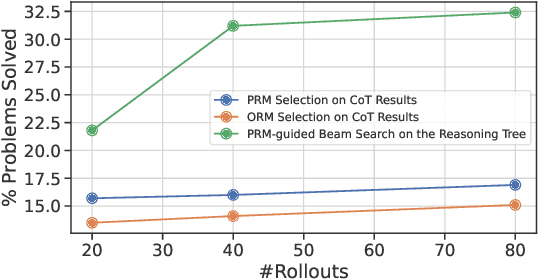

Although Large Language Models (LLMs) achieve remarkable performance across various tasks, they often struggle with complex reasoning tasks, such as answering mathematical questions. Recent efforts to address this issue have primarily focused on leveraging mathematical datasets through supervised fine-tuning or self-improvement techniques. However, these methods often depend on high-quality datasets that are difficult to prepare, or they require substantial computational resources for fine-tuning. Inspired by findings that LLMs know how to produce right answer but struggle to select the correct reasoning path, we propose a purely inference-based searching method called MindStar (M*), which treats reasoning tasks as search problems. This method utilizes a step-wise reasoning approach to navigate the tree space. To enhance search efficiency, we propose two tree-search ideas to identify the optimal reasoning paths. We evaluate the M* framework on both the GSM8K and MATH datasets, comparing its performance with existing open and closed-source LLMs. Our results demonstrate that M* significantly enhances the reasoning abilities of open-source models, such as Llama-2-13B and Mistral-7B, and achieves comparable performance to GPT-3.5 and Grok-1, but with substantially reduced model size and computational costs.
LaFFi: Leveraging Hybrid Natural Language Feedback for Fine-tuning Language Models
Dec 31, 2023Fine-tuning Large Language Models (LLMs) adapts a trained model to specific downstream tasks, significantly improving task-specific performance. Supervised Fine-Tuning (SFT) is a common approach, where an LLM is trained to produce desired answers. However, LLMs trained with SFT sometimes make simple mistakes and result in hallucinations on reasoning tasks such as question-answering. Without external feedback, it is difficult for SFT to learn a good mapping between the question and the desired answer, especially with a small dataset. This paper introduces an alternative to SFT called Natural Language Feedback for Finetuning LLMs (LaFFi). LaFFi has LLMs directly predict the feedback they will receive from an annotator. We find that requiring such reflection can significantly improve the accuracy in in-domain question-answering tasks, providing a promising direction for the application of natural language feedback in the realm of SFT LLMs. Additional ablation studies show that the portion of human-annotated data in the annotated datasets affects the fine-tuning performance.
Think Before You Act: Decision Transformers with Internal Working Memory
May 24, 2023Large language model (LLM)-based decision-making agents have shown the ability to generalize across multiple tasks. However, their performance relies on massive data and compute. We argue that this inefficiency stems from the forgetting phenomenon, in which a model memorizes its behaviors in parameters throughout training. As a result, training on a new task may deteriorate the model's performance on previous tasks. In contrast to LLMs' implicit memory mechanism, the human brain utilizes distributed memory storage, which helps manage and organize multiple skills efficiently, mitigating the forgetting phenomenon. Thus inspired, we propose an internal working memory module to store, blend, and retrieve information for different downstream tasks. Evaluation results show that the proposed method improves training efficiency and generalization in both Atari games and meta-world object manipulation tasks. Moreover, we demonstrate that memory fine-tuning further enhances the adaptability of the proposed architecture.