 Add to Chrome
 Add to Firefox
 Add to Edge
OCP: Orthogonal Constrained Projection for Sparse Scaling in Industrial Commodity Recommendation
Mar 19, 2026
In industrial commodity recommendation systems, the representation quality of Item-Id vocabularies directly impacts the scalability and generalization ability of recommendation models. A key challenge is that traditional Item-Id vocabularies, when subjected to sparse scaling, suffer from low-frequency information interference, which restricts their expressive power for massive item sets and leads to representation collapse. To address this issue, we propose an Orthogonal Constrained Projection method to optimize embedding representation. By enforcing orthogonality, the projection constrains the backpropagation manifold, aligning the singular value spectrum of the learned embeddings with the orthogonal basis. This alignment ensures high singular entropy, thereby preserving isotropic generalized features while suppressing spurious correlations and overfitting to rare items. Empirical results demonstrate that OCP accelerates loss convergence and enhances the model's scalability; notably, it enables consistent performance gains when scaling up dense layers. Large-scale industrial deployment on JD.com further confirms its efficacy, yielding a 12.97% increase in UCXR and an 8.9% uplift in GMV, highlighting its robust utility for scaling up both sparse vocabularies and dense architectures.

MARM: Unlocking the Future of Recommendation Systems through Memory Augmentation and Scalable Complexity
Nov 14, 2024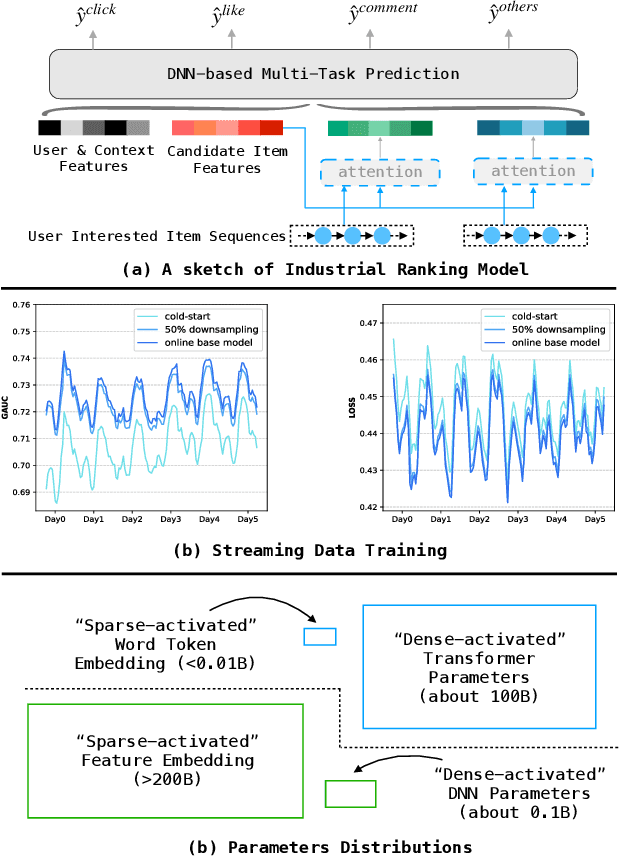
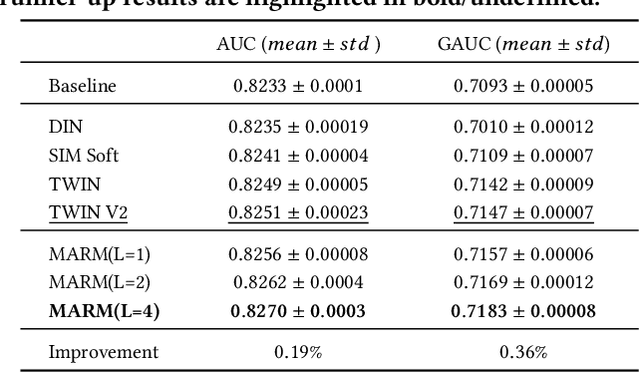
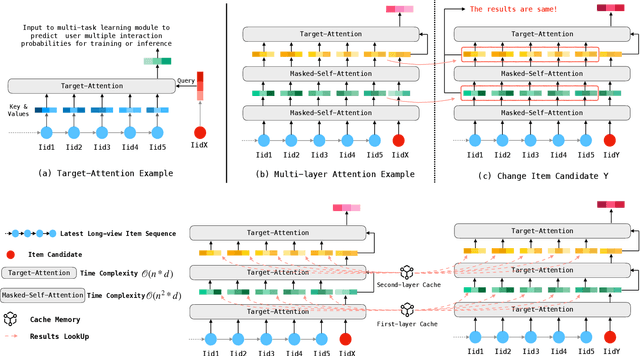

Scaling-law has guided the language model designing for past years, however, it is worth noting that the scaling laws of NLP cannot be directly applied to RecSys due to the following reasons: (1) The amount of training samples and model parameters is typically not the bottleneck for the model. Our recommendation system can generate over 50 billion user samples daily, and such a massive amount of training data can easily allow our model parameters to exceed 200 billion, surpassing many LLMs (about 100B). (2) To ensure the stability and robustness of the recommendation system, it is essential to control computational complexity FLOPs carefully. Considering the above differences with LLM, we can draw a conclusion that: for a RecSys model, compared to model parameters, the computational complexity FLOPs is a more expensive factor that requires careful control. In this paper, we propose our milestone work, MARM (Memory Augmented Recommendation Model), which explores a new cache scaling-laws successfully.