 Add to Chrome
 Add to Firefox
 Add to Edge
Accelerating Large-scale Bundle Adjustment for LiDAR Mapping via Parallel Computing
Aug 14, 2026
LiDAR bundle adjustment is widely utilized in mapping to construct globally consistent point cloud maps. In this paper, we propose the first fully parallel computing framework to accelerate LiDAR bundle adjustment for large-scale mapping, incorporating three key techniques. First, we design an adaptive, asynchronous data loading strategy to efficiently process large-scale point cloud datasets on memory-constrained GPUs. Secondly, we present a novel bottom-up voxelization method for extracting planar features, enabling fully parallelized pre-processing. Thirdly, we build upon a majorization-minimization formulation to accelerate compute-intensive tasks in the optimization via parallel computation, including the computation of residuals, Jacobian and Hessian matrices, and a parallel increment solver. To support our design, we provide both theoretical and experimental analysis of the time complexity of our approach. Extensive benchmarking on large-scale public datasets across various computational platforms validates the robustness and adaptability of our approach, achieving up to a tenfold improvement in computational efficiency while preserving mapping accuracy comparable to state-of-the-art methods. To benefit future research, the implementation code is available on GitHub.

GESTO: Human-Centric Spatio-Temporal Memory for Reasoning in Dynamic Scenes
Aug 11, 2026Robots operating in human environments need memories that capture not only what objects exist and where, but also how people use them over time and how individual interactions compose into goal-directed activities. Existing 4D scene graphs preserve object and place histories but omit activity structure, whereas activity representations are either not grounded in persistent 3D scenes or rely on externally provided event boundaries and object associations. We present GESTO (Grounded Event and Spatio-Temporal memOry), a spatio-temporal memory that couples a persistent 4D scene graph with a two-level hierarchy of atomic human--object interactions and goal-driven events. From an RGB-D observation stream, GESTO automatically extracts timestamped interactions, grounds them to persistent scene entities, groups them into events, and uses event context to refine uncertain object associations. A relation-aware tool-calling agent queries the resulting memory for activity-centric spatio-temporal reasoning. We evaluate GESTO on the reproducible text, binary, and time categories of an existing benchmark, together with 40 new Space2Event and Event2Space queries. GESTO achieves scores of 0.71, 0.75, and 0.70 on the standard categories, approaching a method supplied with ground-truth event and object grounding, while substantially outperforming the same reasoning framework when these inputs are removed. It further achieves 0.73 and 0.75 on Space2Event and Event2Space queries. Ablations show that hierarchical event structure and context-aware grounding refinement provide complementary benefits, supporting activity-grounded hierarchical memory for retrospective reasoning in dynamic human environments.
Risk-Aware Belief Control Barrier Functions over Random Finite Sets
Jul 16, 2026Ensuring robot safety in unknown, dynamic environments is a fundamental requirement. It involves inferring the states of an unknown and time-varying number of moving objects from noisy, incomplete measurements. We address safe control under the induced multi-object state uncertainty with a risk-aware belief control barrier function (BCBF) framework. The uncertainty is captured by a random finite set (RFS) belief, estimated by a sequential Monte Carlo probability hypothesis density (SMC-PHD) filter that represents it with a set of particles. Building directly on these particles, we construct a nonsmooth BCBF, establish forward invariance of the safe set under continuous prediction, and derive an explicit condition under which discrete updates preserve safety. Simulation and real-world underwater experiments demonstrate the effectiveness and efficiency of the proposed approach.
HilDA: Hierarchical Distillation with Diffusion for Advancing Self-Supervised LiDAR Pre-trainin
Jun 18, 2026Leveraging Vision Foundation Models (VFMs) for camera-to-LiDAR knowledge distillation offers a promising solution to the scarcity of annotated data needed to represent the immense geometric and kinematic diversity of real-world autonomous driving (AD). However, current approaches typically treat VFMs as black-box teachers, relying exclusively on frame-wise feature similarity. Consequently, they do not fully exploit the teacher's layer-wise semantic structure and global context, as well as the rich spatiotemporal information inherent in LiDAR sequences. We propose HilDA, a self-supervised pretraining framework for LiDAR backbones that better captures the semantic what and geometric where needed for driving tasks. HilDA combines hierarchical distillation comprising multi-layer distillation for progressive semantic alignment and global context distillation for scene-level semantics, with a temporal occupancy diffusion objective promoting spatiotemporal consistency. Models pre-trained with HilDA achieve state-of-the-art results on cross-modal distillation benchmarks and outperform models trained via prior distillation approaches on 3D object detection, scene flow, and semantic occupancy prediction. Code available at: https://maxiuw.github.io/hilda.
Radar-Informed 3D Multi-Object Tracking under Adverse Conditions
Apr 15, 2026The challenge of 3D multi-object tracking (3D MOT) is achieving robustness in real-world applications, for example under adverse conditions and maintaining consistency as distance increases. To overcome these challenges, sensor fusion approaches that combine LiDAR, cameras, and radar have emerged. However, existing multi-modal fusion methods usually treat radar as another learned feature inside the network. When the overall model degrades in difficult environmental conditions, the robustness advantages that radar could provide are also reduced. We propose RadarMOT, a radar-informed 3D MOT framework that explicitly uses radar point cloud data as additional observation to refine state estimation and recover detector misses at long ranges. Evaluations on the MAN-TruckScenes dataset show that RadarMOT consistently improves the Average Multi-Object Tracking Accuracy (AMOTA) with absolute 12.7% at long range and 10.3% in adverse weather. The code will be available at https://github.com/bingxue-xu/radarmot
SynFlow: Scaling Up LiDAR Scene Flow Estimation with Synthetic Data
Apr 10, 2026Reliable 3D dynamic perception requires models that can anticipate motion beyond predefined categories, yet progress is hindered by the scarcity of dense, high-quality motion annotations. While self-supervision on unlabeled real data offers a path forward, empirical evidence suggests that scaling unlabeled data fails to close the performance gap due to noisy proxy signals. In this paper, we propose a shift in paradigm: learning robust real-world motion priors entirely from scalable simulation. We introduce SynFlow, a data generation pipeline that generates large-scale synthetic dataset specifically designed for LiDAR scene flow. Unlike prior works that prioritize sensor-specific realism, SynFlow employs a motion-oriented strategy to synthesize diverse kinematic patterns across 4,000 sequences ($\sim$940k frames), termed SynFlow-4k. This represents a 34x scale-up in annotated volume over existing real-world benchmarks. Our experiments demonstrate that SynFlow-4k provides a highly domain-invariant motion prior. In a zero-shot regime, models trained exclusively on our synthetic data generalize across multiple real-world benchmarks, rivaling in-domain supervised baselines on nuScenes and outperforming state-of-the-art methods on TruckScenes by 31.8%. Furthermore, SynFlow-4k serves as a label-efficient foundation: fine-tuning with only 5% of real-world labels surpasses models trained from scratch on the full available budget. We open-source the pipeline and dataset to facilitate research in generalizable 3D motion estimation. More detail can be found at https://kin-zhang.github.io/SynFlow.
TeFlow: Enabling Multi-frame Supervision for Self-Supervised Feed-forward Scene Flow Estimation
Feb 22, 2026Self-supervised feed-forward methods for scene flow estimation offer real-time efficiency, but their supervision from two-frame point correspondences is unreliable and often breaks down under occlusions. Multi-frame supervision has the potential to provide more stable guidance by incorporating motion cues from past frames, yet naive extensions of two-frame objectives are ineffective because point correspondences vary abruptly across frames, producing inconsistent signals. In the paper, we present TeFlow, enabling multi-frame supervision for feed-forward models by mining temporally consistent supervision. TeFlow introduces a temporal ensembling strategy that forms reliable supervisory signals by aggregating the most temporally consistent motion cues from a candidate pool built across multiple frames. Extensive evaluations demonstrate that TeFlow establishes a new state-of-the-art for self-supervised feed-forward methods, achieving performance gains of up to 33\% on the challenging Argoverse 2 and nuScenes datasets. Our method performs on par with leading optimization-based methods, yet speeds up 150 times. The code is open-sourced at https://github.com/KTH-RPL/OpenSceneFlow along with trained model weights.
Visible Structure Retrieval for Lightweight Image-Based Relocalisation
Nov 16, 2025Accurate camera pose estimation from an image observation in a previously mapped environment is commonly done through structure-based methods: by finding correspondences between 2D keypoints on the image and 3D structure points in the map. In order to make this correspondence search tractable in large scenes, existing pipelines either rely on search heuristics, or perform image retrieval to reduce the search space by comparing the current image to a database of past observations. However, these approaches result in elaborate pipelines or storage requirements that grow with the number of past observations. In this work, we propose a new paradigm for making structure-based relocalisation tractable. Instead of relying on image retrieval or search heuristics, we learn a direct mapping from image observations to the visible scene structure in a compact neural network. Given a query image, a forward pass through our novel visible structure retrieval network allows obtaining the subset of 3D structure points in the map that the image views, thus reducing the search space of 2D-3D correspondences. We show that our proposed method enables performing localisation with an accuracy comparable to the state of the art, while requiring lower computational and storage footprint.
ArgoTweak: Towards Self-Updating HD Maps through Structured Priors
Sep 10, 2025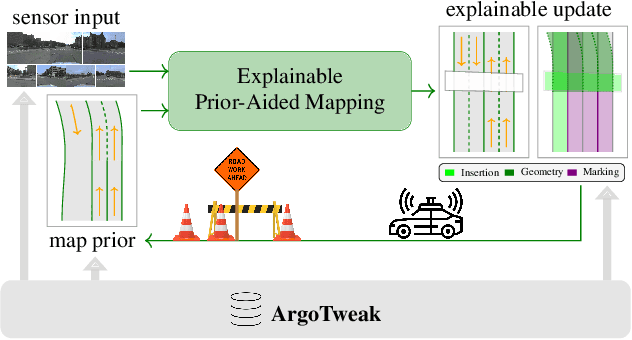
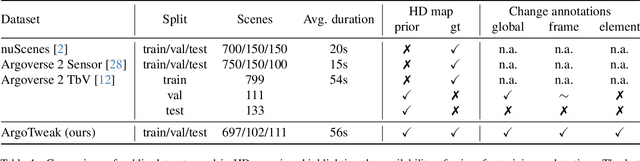
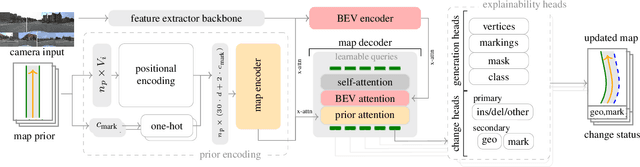
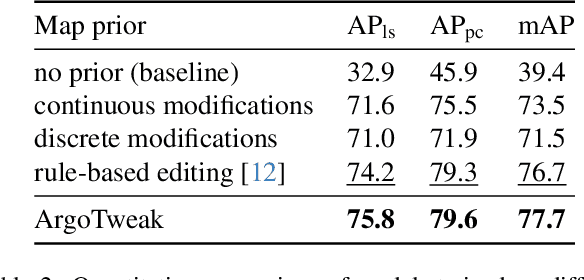
Reliable integration of prior information is crucial for self-verifying and self-updating HD maps. However, no public dataset includes the required triplet of prior maps, current maps, and sensor data. As a result, existing methods must rely on synthetic priors, which create inconsistencies and lead to a significant sim2real gap. To address this, we introduce ArgoTweak, the first dataset to complete the triplet with realistic map priors. At its core, ArgoTweak employs a bijective mapping framework, breaking down large-scale modifications into fine-grained atomic changes at the map element level, thus ensuring interpretability. This paradigm shift enables accurate change detection and integration while preserving unchanged elements with high fidelity. Experiments show that training models on ArgoTweak significantly reduces the sim2real gap compared to synthetic priors. Extensive ablations further highlight the impact of structured priors and detailed change annotations. By establishing a benchmark for explainable, prior-aided HD mapping, ArgoTweak advances scalable, self-improving mapping solutions. The dataset, baselines, map modification toolbox, and further resources are available at https://kth-rpl.github.io/ArgoTweak/.
DeltaFlow: An Efficient Multi-frame Scene Flow Estimation Method
Aug 23, 2025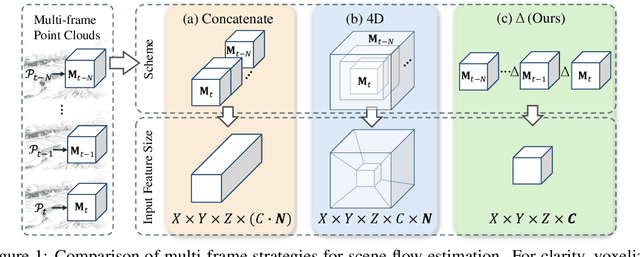
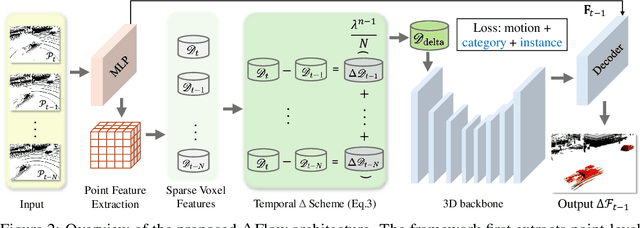
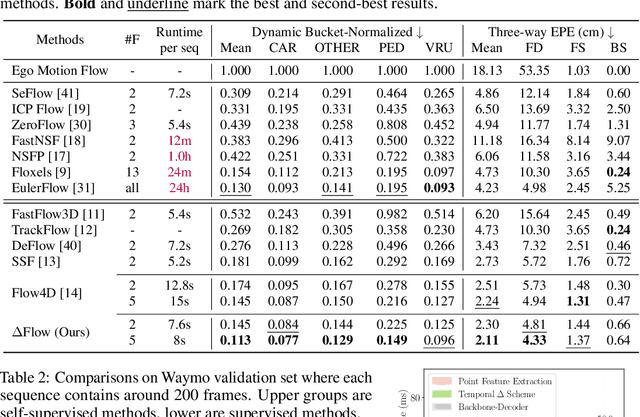
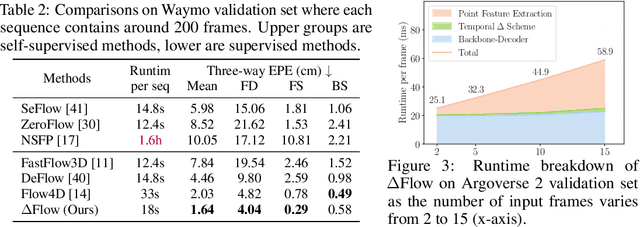
Previous dominant methods for scene flow estimation focus mainly on input from two consecutive frames, neglecting valuable information in the temporal domain. While recent trends shift towards multi-frame reasoning, they suffer from rapidly escalating computational costs as the number of frames grows. To leverage temporal information more efficiently, we propose DeltaFlow ($\Delta$Flow), a lightweight 3D framework that captures motion cues via a $\Delta$ scheme, extracting temporal features with minimal computational cost, regardless of the number of frames. Additionally, scene flow estimation faces challenges such as imbalanced object class distributions and motion inconsistency. To tackle these issues, we introduce a Category-Balanced Loss to enhance learning across underrepresented classes and an Instance Consistency Loss to enforce coherent object motion, improving flow accuracy. Extensive evaluations on the Argoverse 2 and Waymo datasets show that $\Delta$Flow achieves state-of-the-art performance with up to 22% lower error and $2\times$ faster inference compared to the next-best multi-frame supervised method, while also demonstrating a strong cross-domain generalization ability. The code is open-sourced at https://github.com/Kin-Zhang/DeltaFlow along with trained model weights.