 Add to Chrome
 Add to Firefox
 Add to Edge
Modelling the 5G Energy Consumption using Real-world Data: Energy Fingerprint is All You Need
Jun 13, 2024
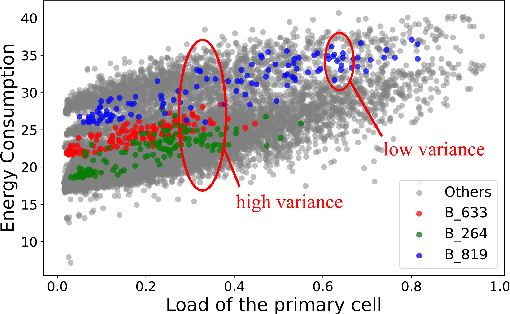
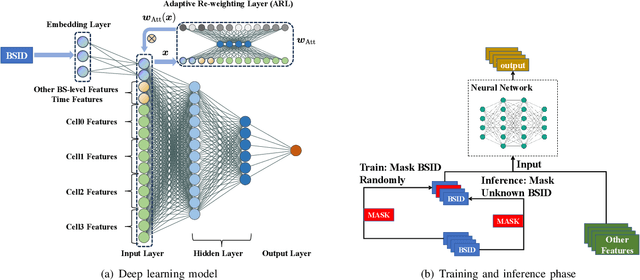
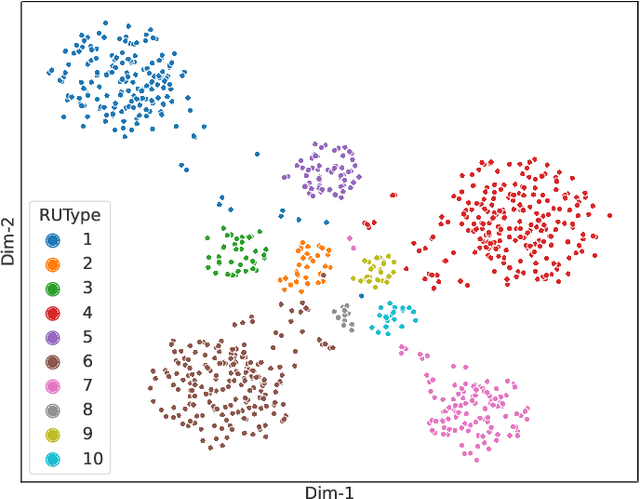
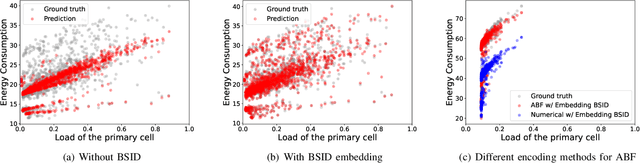
The introduction of fifth-generation (5G) radio technology has revolutionized communications, bringing unprecedented automation, capacity, connectivity, and ultra-fast, reliable communications. However, this technological leap comes with a substantial increase in energy consumption, presenting a significant challenge. To improve the energy efficiency of 5G networks, it is imperative to develop sophisticated models that accurately reflect the influence of base station (BS) attributes and operational conditions on energy usage.Importantly, addressing the complexity and interdependencies of these diverse features is particularly challenging, both in terms of data processing and model architecture design. This paper proposes a novel 5G base stations energy consumption modelling method by learning from a real-world dataset used in the ITU 5G Base Station Energy Consumption Modelling Challenge in which our model ranked second. Unlike existing methods that omit the Base Station Identifier (BSID) information and thus fail to capture the unique energy fingerprint in different base stations, we incorporate the BSID into the input features and encoding it with an embedding layer for precise representation. Additionally, we introduce a novel masked training method alongside an attention mechanism to further boost the model's generalization capabilities and accuracy. After evaluation, our method demonstrates significant improvements over existing models, reducing Mean Absolute Percentage Error (MAPE) from 12.75% to 4.98%, leading to a performance gain of more than 60%.

Joint Node Selection and Resource Allocation Optimization for Cooperative Sensing with a Shared Wireless Backhaul
May 27, 2024


In this paper, we consider a cooperative sensing framework in the context of future multi-functional network with both communication and sensing ability, where one base station (BS) serves as a sensing transmitter and several nearby BSs serve as sensing receivers. Each receiver receives the sensing signal reflected by the target and communicates with the fusion center (FC) through a wireless multiple access channel (MAC) for cooperative target localization. To improve the localization performance, we present a hybrid information-signal domain cooperative sensing (HISDCS) design, where each sensing receiver transmits both the estimated time delay/effective reflecting coefficient and the received sensing signal sampled around the estimated time delay to the FC. Then, we propose to minimize the number of channel uses by utilizing an efficient Karhunen-Lo\'eve transformation (KLT) encoding scheme for signal quantization and proper node selection, under the Cram\'er-Rao lower bound (CRLB) constraint and the capacity limits of MAC. A novel matrix-inequality constrained successive convex approximation (MCSCA) algorithm is proposed to optimize the wireless backhaul resource allocation, together with a greedy strategy for node selection. Despite the high non-convexness of the considered problem, we prove that the proposed MCSCA algorithm is able to converge to the set of Karush-Kuhn-Tucker (KKT) solutions of a relaxed problem obtained by relaxing the discrete variables. Besides, a low-complexity quantization bit reallocation algorithm is designed, which does not perform explicit node selection, and is able to harvest most of the performance gain brought by HISDCS. Finally, numerical simulations are presented to show that the proposed HISDCS design is able to significantly outperform the baseline schemes.
A Lightweight Neural Architecture Search Model for Medical Image Classification
May 06, 2024

Accurate classification of medical images is essential for modern diagnostics. Deep learning advancements led clinicians to increasingly use sophisticated models to make faster and more accurate decisions, sometimes replacing human judgment. However, model development is costly and repetitive. Neural Architecture Search (NAS) provides solutions by automating the design of deep learning architectures. This paper presents ZO-DARTS+, a differentiable NAS algorithm that improves search efficiency through a novel method of generating sparse probabilities by bi-level optimization. Experiments on five public medical datasets show that ZO-DARTS+ matches the accuracy of state-of-the-art solutions while reducing search times by up to three times.
Beamforming Design for Semantic-Bit Coexisting Communication System
Mar 22, 2024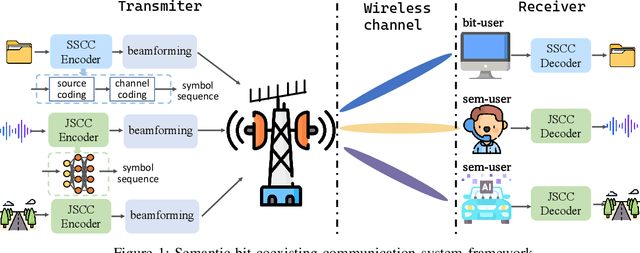
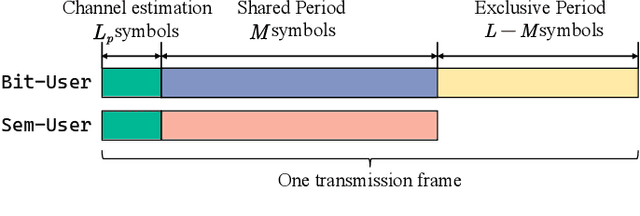
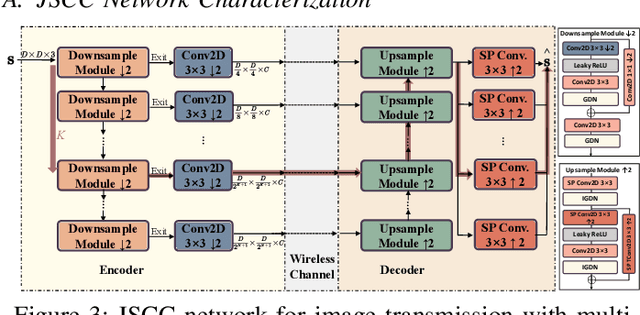
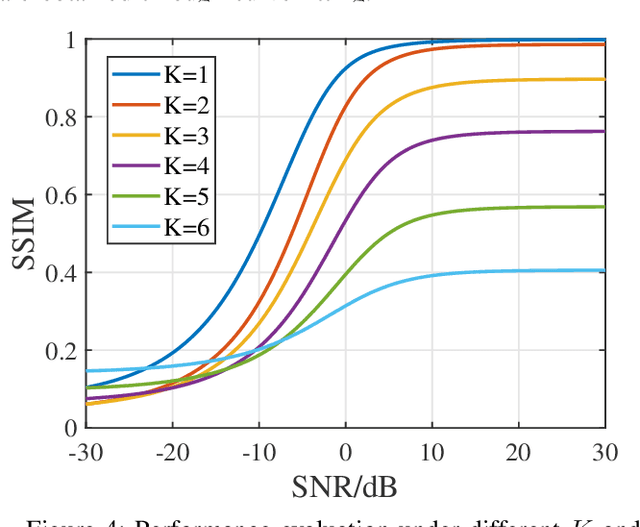
Semantic communication (SemCom) is emerging as a key technology for future sixth-generation (6G) systems. Unlike traditional bit-level communication (BitCom), SemCom directly optimizes performance at the semantic level, leading to superior communication efficiency. Nevertheless, the task-oriented nature of SemCom renders it challenging to completely replace BitCom. Consequently, it is desired to consider a semantic-bit coexisting communication system, where a base station (BS) serves SemCom users (sem-users) and BitCom users (bit-users) simultaneously. Such a system faces severe and heterogeneous inter-user interference. In this context, this paper provides a new semantic-bit coexisting communication framework and proposes a spatial beamforming scheme to accommodate both types of users. Specifically, we consider maximizing the semantic rate for semantic users while ensuring the quality-of-service (QoS) requirements for bit-users. Due to the intractability of obtaining the exact closed-form expression of the semantic rate, a data driven method is first applied to attain an approximated expression via data fitting. With the resulting complex transcendental function, majorization minimization (MM) is adopted to convert the original formulated problem into a multiple-ratio problem, which allows fractional programming (FP) to be used to further transform the problem into an inhomogeneous quadratically constrained quadratic programs (QCQP) problem. Solving the problem leads to a semi-closed form solution with undetermined Lagrangian factors that can be updated by a fixed point algorithm. Extensive simulation results demonstrate that the proposed beamforming scheme significantly outperforms conventional beamforming algorithms such as zero-forcing (ZF), maximum ratio transmission (MRT), and weighted minimum mean-square error (WMMSE).
Joint Beamforming Design and Stream Allocation for Non-Coherent Joint Transmission in Cell-Free MIMO Networks
Feb 28, 2024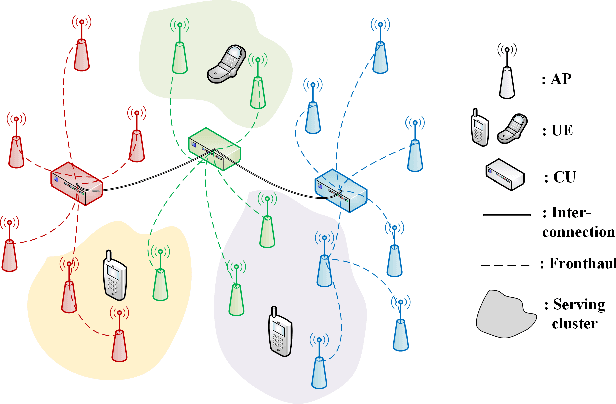
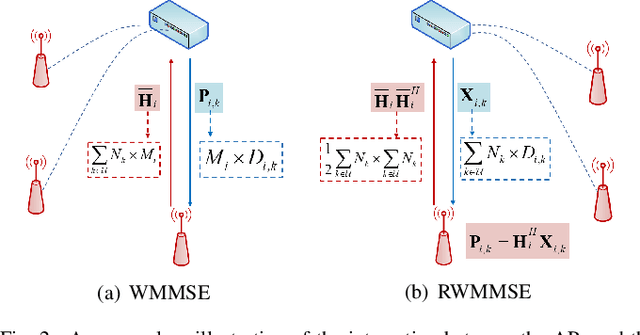
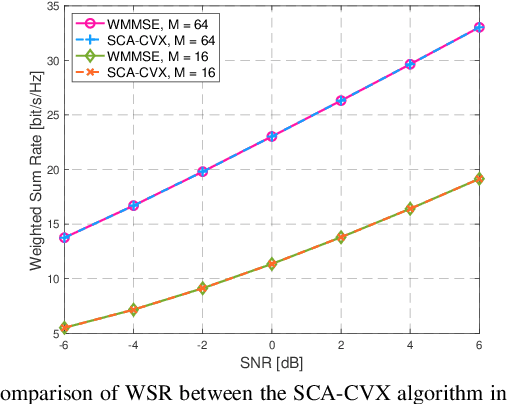
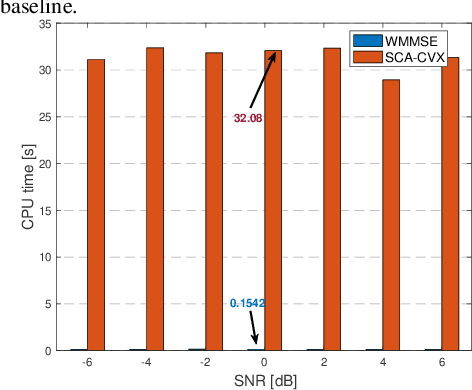
We consider joint beamforming and stream allocation to maximize the weighted sum rate (WSR) for non-coherent joint transmission (NCJT) in user-centric cell-free MIMO networks, where distributed access points (APs) are organized in clusters to transmit different signals to serve each user equipment (UE). We for the first time consider the common limits of maximum number of receive streams at UEs in practical networks, and formulate a joint beamforming and transmit stream allocation problem for WSR maximization under per-AP transmit power constraints. Since the integer number of transmit streams determines the dimension of the beamformer, the joint optimization problem is mixed-integer and nonconvex with coupled decision variables that is inherently NP-hard. In this paper, we first propose a distributed low-interaction reduced weighted minimum mean square error (RWMMSE) beamforming algorithm for WSR maximization with fixed streams. Our proposed RWMMSE algorithm requires significantly less interaction across the network and has the current lowest computational complexity that scales linearly with the number of transmit antennas, without any compromise on WSR. We draw insights on the joint beamforming and stream allocation problem to decouple the decision variables and relax the mixed-integer constraints. We then propose a joint beamforming and linear stream allocation algorithm, termed as RWMMSE-LSA, which yields closed-form updates with linear stream allocation complexity and is guaranteed to converge to the stationary points of the original joint optimization problem. Simulation results demonstrate substantial performance gain of our proposed algorithms over the current best alternatives in both WSR performance and convergence time.
Frame Structure and Protocol Design for Sensing-Assisted NR-V2X Communications
Dec 27, 2023The emergence of the fifth-generation (5G) New Radio (NR) technology has provided unprecedented opportunities for vehicle-to-everything (V2X) networks, enabling enhanced quality of services. However, high-mobility V2X networks require frequent handovers and acquiring accurate channel state information (CSI) necessitates the utilization of pilot signals, leading to increased overhead and reduced communication throughput. To address this challenge, integrated sensing and communications (ISAC) techniques have been employed at the base station (gNB) within vehicle-to-infrastructure (V2I) networks, aiming to minimize overhead and improve spectral efficiency. In this study, we propose novel frame structures that incorporate ISAC signals for three crucial stages in the NR-V2X system: initial access, connected mode, and beam failure and recovery. These new frame structures employ 75% fewer pilots and reduce reference signals by 43.24%, capitalizing on the sensing capability of ISAC signals. Through extensive link-level simulations, we demonstrate that our proposed approach enables faster beam establishment during initial access, higher throughput and more precise beam tracking in connected mode with reduced overhead, and expedited detection and recovery from beam failures. Furthermore, the numerical results obtained from our simulations showcase enhanced spectrum efficiency, improved communication performance and minimal overhead, validating the effectiveness of the proposed ISAC-based techniques in NR V2I networks.
Towards Structural Sparse Precoding: Dynamic Time, Frequency, Space, and Power Multistage Resource Programming
Oct 15, 2023In last decades, dynamic resource programming in partial resource domains has been extensively investigated for single time slot optimizations. However, with the emerging real-time media applications in fifth-generation communications, their new quality of service requirements are often measured in temporal dimension. This requires multistage optimization for full resource domain dynamic programming. Taking experience rate as a typical temporal multistage metric, we jointly optimize time, frequency, space and power domains resource for multistage optimization. To strike a good tradeoff between system performance and computational complexity, we first transform the formulated mixed integer non-linear constraints into equivalent convex second order cone constraints, by exploiting the coupling effect among the resources. Leveraging the concept of structural sparsity, the objective of max-min experience rate is given as a weighted 1-norm term associated with the precoding matrix. Finally, a low-complexity iterative algorithm is proposed for full resource domain programming, aided by another simple conic optimization for obtaining its feasible initial result. Simulation verifies that our design significantly outperform the benchmarks while maintaining a fast convergence rate, shedding light on full domain dynamic resource programming of multistage optimizations.
Joint Beamforming for RIS Aided Full-Duplex Integrated Sensing and Uplink Communication
Sep 21, 2023This paper studies integrated sensing and communication (ISAC) technology in a full-duplex (FD) uplink communication system. As opposed to the half-duplex system, where sensing is conducted in a first-emit-then-listen manner, FD ISAC system emits and listens simultaneously and hence conducts uninterrupted target sensing. Besides, impressed by the recently emerging reconfigurable intelligent surface (RIS) technology, we also employ RIS to improve the self-interference (SI) suppression and signal processing gain. As will be seen, the joint beamforming, RIS configuration and mobile users' power allocation is a difficult optimization problem. To resolve this challenge, via leveraging the cutting-the-edge majorization-minimization (MM) and penalty-dual-decomposition (PDD) methods, we develop an iterative solution that optimizes all variables via using convex optimization techniques. Numerical results demonstrate the effectiveness of our proposed solution and the great benefit of employing RIS in the FD ISAC system.
Joint Beamforming and Power Allocation for RIS Aided Full-Duplex Integrated Sensing and Uplink Communication System
Sep 07, 2023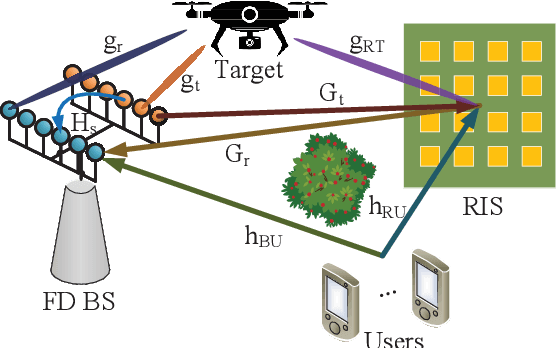
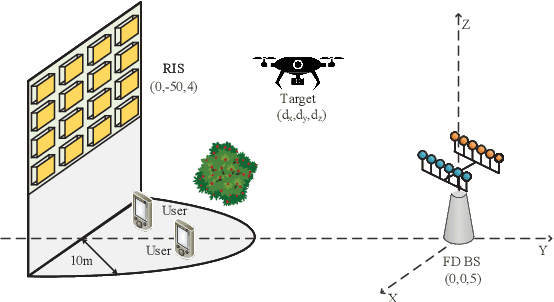
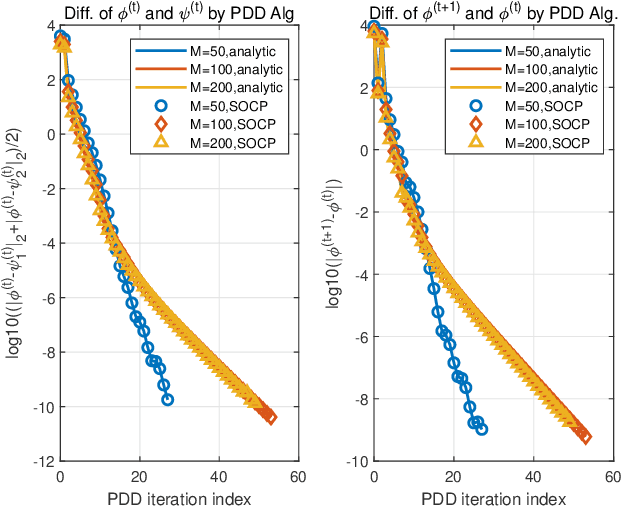
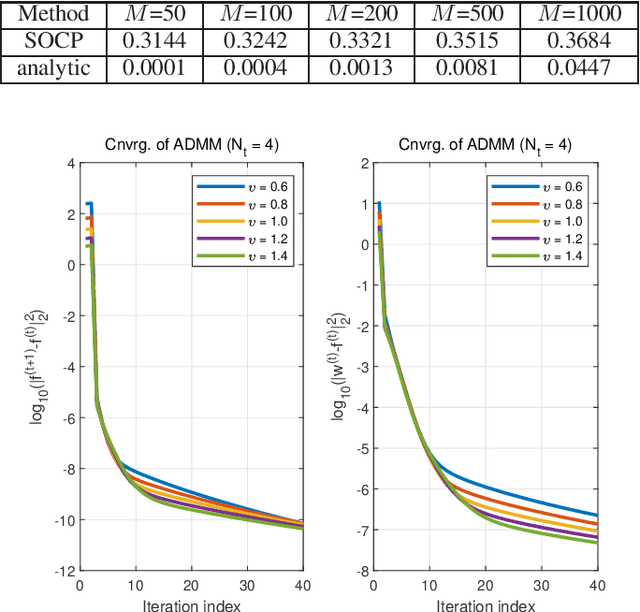
Integrated sensing and communication (ISAC) capability is envisioned as one key feature for future cellular networks. Classical half-duplex (HD) radar sensing is conducted in a "first-emit-then-listen" manner. One challenge to realize HD ISAC lies in the discrepancy of the two systems' time scheduling for transmitting and receiving. This difficulty can be overcome by full-duplex (FD) transceivers. Besides, ISAC generally has to comprise its communication rate due to realizing sensing functionality. This loss can be compensated by the emerging reconfigurable intelligent surface (RIS) technology. This paper considers the joint design of beamforming, power allocation and signal processing in a FD uplink communication system aided by RIS, which is a highly nonconvex problem. To resolve this challenge, via leveraging the cutting-the-edge majorization-minimization (MM) and penalty-dual-decomposition (PDD) methods, we develop an iterative solution that optimizes all variables via using convex optimization techniques. Besides, by wisely exploiting alternative direction method of multipliers (ADMM) and optimality analysis, we further develop a low complexity solution that updates all variables analytically and runs highly efficiently. Numerical results are provided to verify the effectiveness and efficiency of our proposed algorithms and demonstrate the significant performance boosting by employing RIS in the FD ISAC system.
Joint Activity Detection and Channel Estimation in Massive Machine-Type Communications with Low-Resolution ADC
Jun 04, 2023In massive machine-type communications, data transmission is usually considered sporadic, and thus inherently has a sparse structure. This paper focuses on the joint activity detection (AD) and channel estimation (CE) problems in massive-connected communication systems with low-resolution analog-to-digital converters. To further exploit the sparse structure in transmission, we propose a maximum posterior probability (MAP) estimation problem based on both sporadic activity and sparse channels for joint AD and CE. Moreover, a majorization-minimization-based method is proposed for solving the MAP problem. Finally, various numerical experiments verify that the proposed scheme outperforms state-of-the-art methods.