 Add to Chrome
 Add to Firefox
 Add to Edge
One Brain, Omni Modalities: Towards Unified Non-Invasive Brain Decoding with Large Language Models
Feb 25, 2026
Deciphering brain function through non-invasive recordings requires synthesizing complementary high-frequency electromagnetic (EEG/MEG) and low-frequency metabolic (fMRI) signals. However, despite their shared neural origins, extreme discrepancies have traditionally confined these modalities to isolated analysis pipelines, hindering a holistic interpretation of brain activity. To bridge this fragmentation, we introduce \textbf{NOBEL}, a \textbf{n}euro-\textbf{o}mni-modal \textbf{b}rain-\textbf{e}ncoding \textbf{l}arge language model (LLM) that unifies these heterogeneous signals within the LLM's semantic embedding space. Our architecture integrates a unified encoder for EEG and MEG with a novel dual-path strategy for fMRI, aligning non-invasive brain signals and external sensory stimuli into a shared token space, then leverages an LLM as a universal backbone. Extensive evaluations demonstrate that NOBEL serves as a robust generalist across standard single-modal tasks. We also show that the synergistic fusion of electromagnetic and metabolic signals yields higher decoding accuracy than unimodal baselines, validating the complementary nature of multiple neural modalities. Furthermore, NOBEL exhibits strong capabilities in stimulus-aware decoding, effectively interpreting visual semantics from multi-subject fMRI data on the NSD and HAD datasets while uniquely leveraging direct stimulus inputs to verify causal links between sensory signals and neural responses. NOBEL thus takes a step towards unifying non-invasive brain decoding, demonstrating the promising potential of omni-modal brain understanding.

Utilizing Autoregressive Networks for Full Lifecycle Data Generation of Rolling Bearings for RUL Prediction
Jan 02, 2024The prediction of rolling bearing lifespan is of significant importance in industrial production. However, the scarcity of high-quality, full lifecycle data has been a major constraint in achieving precise predictions. To address this challenge, this paper introduces the CVGAN model, a novel framework capable of generating one-dimensional vibration signals in both horizontal and vertical directions, conditioned on historical vibration data and remaining useful life. In addition, we propose an autoregressive generation method that can iteratively utilize previously generated vibration information to guide the generation of current signals. The effectiveness of the CVGAN model is validated through experiments conducted on the PHM 2012 dataset. Our findings demonstrate that the CVGAN model, in terms of both MMD and FID metrics, outperforms many advanced methods in both autoregressive and non-autoregressive generation modes. Notably, training using the full lifecycle data generated by the CVGAN model significantly improves the performance of the predictive model. This result highlights the effectiveness of the data generated by CVGans in enhancing the predictive power of these models.
Utilizing Multiple Inputs Autoregressive Models for Bearing Remaining Useful Life Prediction
Nov 26, 2023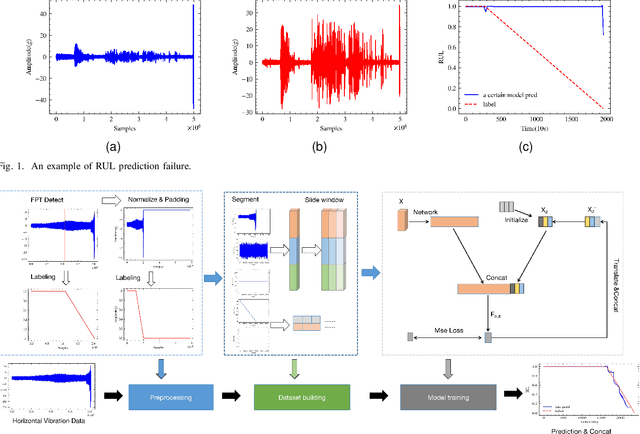
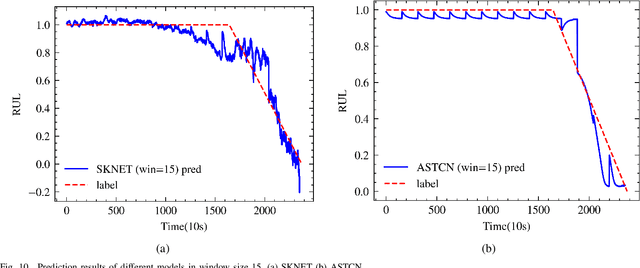
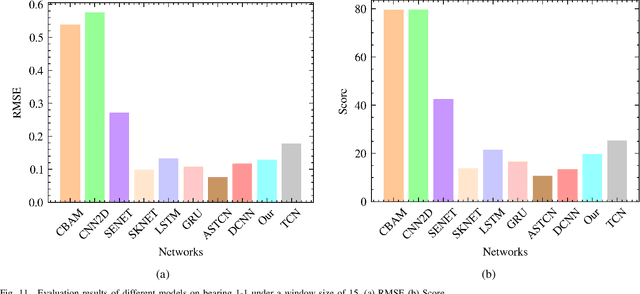
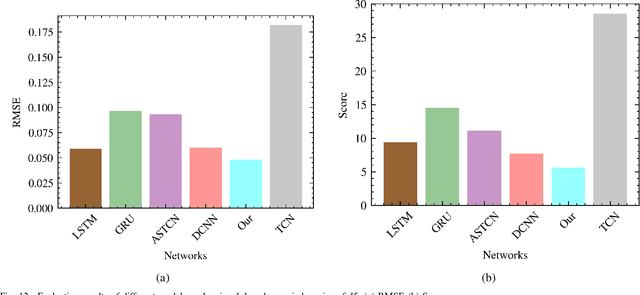
Accurate prediction of the Remaining Useful Life (RUL) of rolling bearings is crucial in industrial production, yet existing models often struggle with limited generalization capabilities due to their inability to fully process all vibration signal patterns. We introduce a novel multi-input autoregressive model to address this challenge in RUL prediction for bearings. Our approach uniquely integrates vibration signals with previously predicted Health Indicator (HI) values, employing feature fusion to output current window HI values. Through autoregressive iterations, the model attains a global receptive field, effectively overcoming the limitations in generalization. Furthermore, we innovatively incorporate a segmentation method and multiple training iterations to mitigate error accumulation in autoregressive models. Empirical evaluation on the PMH2012 dataset demonstrates that our model, compared to other backbone networks using similar autoregressive approaches, achieves significantly lower Root Mean Square Error (RMSE) and Score. Notably, it outperforms traditional autoregressive models that use label values as inputs and non-autoregressive networks, showing superior generalization abilities with a marked lead in RMSE and Score metrics.
Utilizing VQ-VAE for End-to-End Health Indicator Generation in Predicting Rolling Bearing RUL
Nov 17, 2023The prediction of the remaining useful life (RUL) of rolling bearings is a pivotal issue in industrial production. A crucial approach to tackling this issue involves transforming vibration signals into health indicators (HI) to aid model training. This paper presents an end-to-end HI construction method, vector quantised variational autoencoder (VQ-VAE), which addresses the need for dimensionality reduction of latent variables in traditional unsupervised learning methods such as autoencoder. Moreover, concerning the inadequacy of traditional statistical metrics in reflecting curve fluctuations accurately, two novel statistical metrics, mean absolute distance (MAD) and mean variance (MV), are introduced. These metrics accurately depict the fluctuation patterns in the curves, thereby indicating the model's accuracy in discerning similar features. On the PMH2012 dataset, methods employing VQ-VAE for label construction achieved lower values for MAD and MV. Furthermore, the ASTCN prediction model trained with VQ-VAE labels demonstrated commendable performance, attaining the lowest values for MAD and MV.