 Add to Chrome
 Add to Firefox
 Add to Edge
Speed by Simplicity: A Single-Stream Architecture for Fast Audio-Video Generative Foundation Model
Mar 23, 2026
We present daVinci-MagiHuman, an open-source audio-video generative foundation model for human-centric generation. daVinci-MagiHuman jointly generates synchronized video and audio using a single-stream Transformer that processes text, video, and audio within a unified token sequence via self-attention only. This single-stream design avoids the complexity of multi-stream or cross-attention architectures while remaining easy to optimize with standard training and inference infrastructure. The model is particularly strong in human-centric scenarios, producing expressive facial performance, natural speech-expression coordination, realistic body motion, and precise audio-video synchronization. It supports multilingual spoken generation across Chinese (Mandarin and Cantonese), English, Japanese, Korean, German, and French. For efficient inference, we combine the single-stream backbone with model distillation, latent-space super-resolution, and a Turbo VAE decoder, enabling generation of a 5-second 256p video in 2 seconds on a single H100 GPU. In automatic evaluation, daVinci-MagiHuman achieves the highest visual quality and text alignment among leading open models, along with the lowest word error rate (14.60%) for speech intelligibility. In pairwise human evaluation, it achieves win rates of 80.0% against Ovi 1.1 and 60.9% against LTX 2.3 over 2000 comparisons. We open-source the complete model stack, including the base model, the distilled model, the super-resolution model, and the inference codebase.

WinMamba: Multi-Scale Shifted Windows in State Space Model for 3D Object Detection
Nov 17, 2025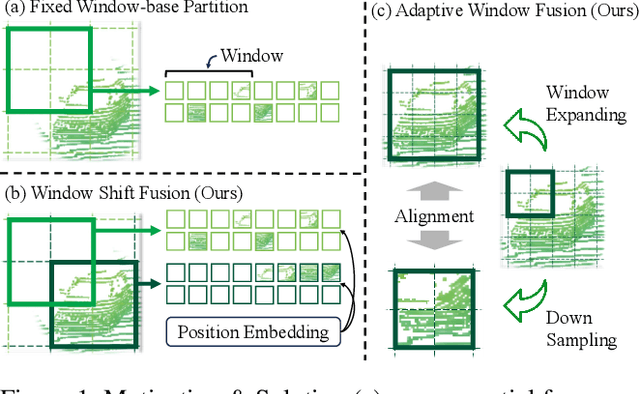
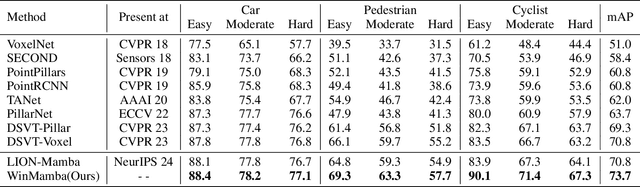
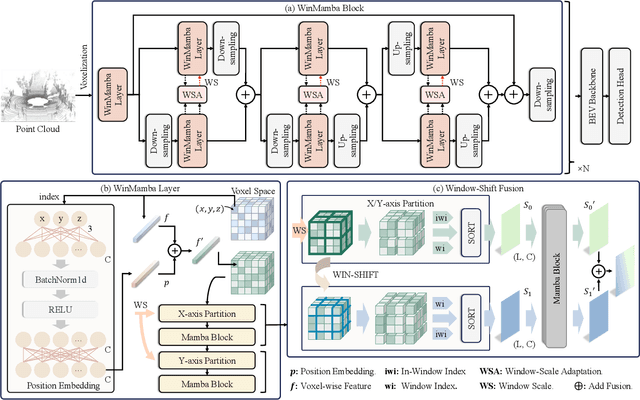
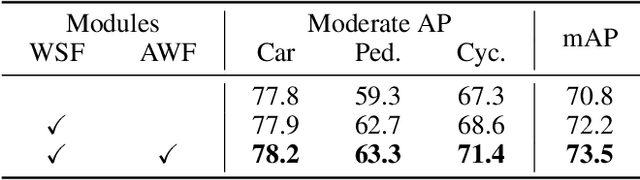
3D object detection is critical for autonomous driving, yet it remains fundamentally challenging to simultaneously maximize computational efficiency and capture long-range spatial dependencies. We observed that Mamba-based models, with their linear state-space design, capture long-range dependencies at lower cost, offering a promising balance between efficiency and accuracy. However, existing methods rely on axis-aligned scanning within a fixed window, inevitably discarding spatial information. To address this problem, we propose WinMamba, a novel Mamba-based 3D feature-encoding backbone composed of stacked WinMamba blocks. To enhance the backbone with robust multi-scale representation, the WinMamba block incorporates a window-scale-adaptive module that compensates voxel features across varying resolutions during sampling. Meanwhile, to obtain rich contextual cues within the linear state space, we equip the WinMamba layer with a learnable positional encoding and a window-shift strategy. Extensive experiments on the KITTI and Waymo datasets demonstrate that WinMamba significantly outperforms the baseline. Ablation studies further validate the individual contributions of the WSF and AWF modules in improving detection accuracy. The code will be made publicly available.