 Add to Chrome
 Add to Firefox
 Add to Edge
PRISM: Prompt Refinement via Image-grounded Self-rewarding Mechanism for Text-to-Image Generation
Jul 27, 2026
Text-to-image generation models can synthesize high-quality images from natural language descriptions, but their performance remains highly sensitive to prompt formulation. Existing prompt optimization methods mainly rely on text-side rewriting, prompt expansion, or external reward signals, offering limited image-grounded diagnosis and weak support for learning reusable optimisation policies. In this paper, we propose PRISM, a Prompt Refinement framework via Image-grounded Self-rewarding Mechanism. PRISM closes the prompt-image-feedback loop by interpreting generated images with structured visual diagnosis and scoring them along semantic consistency, aesthetic quality, and human preference alignment. It first initializes a unified VLM through multi-task supervised fine-tuning, and then improves the prompt policy via self-rewarding optimization with a hybrid ideal-point and Chebyshev reward. Extensive experiments show that PRISM improves holistic image quality and fine-grained semantic alignment, while providing interpretable feedback for targeted prompt refinement. The code is available at https://anonymous.4open.science/r/PRISM-FF81.

UniLM-Nav: A Unified Framework for Zero-Shot Last-Mile Navigation
Jul 07, 2026Mobile manipulation requires a robot to navigate to a target object or receptacle and then perform intended manipulation. However, reaching the vicinity of the target does not guarantee a manipulation-ready base pose, a problem known as last-mile navigation. Prior methods for last-mile navigation either rely on manual pose annotation or task-specific training, limiting their scalability to open-vocabulary settings with fine-grained spatial constraints. We propose UniLM-Nav, a unified framework for zero-shot open-vocabulary last-mile navigation. UniLM-Nav decomposes last-mile navigation into view selection, task-conditioned affordance grounding, and geometry-aware base-pose reasoning, all resolved with a shared multimodal large language model (MLLM) backend. Specifically, UniLM-Nav first selects a reference view that best captures the target object or receptacle from recently collected observations. It then grounds task-relevant affordance point in the selected view and lifts the result into the robot-centric coordinate frame. Finally, conditioned on the grounded affordance, task context, and robot geometry, it infers a manipulation-ready base pose for the robot. We evaluate UniLM-Nav on the OVMM benchmark, where it outperforms the previous state-of-the-art method, MoTo, by 3.13 percentage points. Analyses show that the components of our method are crucial to final performance, and that the choice of MLLM also has a substantial effect. We further deploy UniLM-Nav on a Unitree B2 quadruped robot with a 6-DoF Unitree Z1 manipulator, validating its applicability to real-world mobile manipulation tasks.
V2U4Real: A Real-world Large-scale Dataset for Vehicle-to-UAV Cooperative Perception
Mar 26, 2026Modern autonomous vehicle perception systems are often constrained by occlusions, blind spots, and limited sensing range. While existing cooperative perception paradigms, such as Vehicle-to-Vehicle (V2V) and Vehicle-to-Infrastructure (V2I), have demonstrated their effectiveness in mitigating these challenges, they remain limited to ground-level collaboration and cannot fully address large-scale occlusions or long-range perception in complex environments. To advance research in cross-view cooperative perception, we present V2U4Real, the first large-scale real-world multi-modal dataset for Vehicle-to-UAV (V2U) cooperative object perception. V2U4Real is collected by a ground vehicle and a UAV equipped with multi-view LiDARs and RGB cameras. The dataset covers urban streets, university campuses, and rural roads under diverse traffic scenarios, comprising over 56K LiDAR frames, 56K multi-view camera images, and 700K annotated 3D bounding boxes across four classes. To support a wide range of research tasks, we establish benchmarks for single-agent 3D object detection, cooperative 3D object detection, and object tracking. Comprehensive evaluations of several state-of-the-art models demonstrate the effectiveness of V2U cooperation in enhancing perception robustness and long-range awareness. The V2U4Real dataset and codebase is available at https://github.com/VjiaLi/V2U4Real.
From Objects to Anywhere: A Holistic Benchmark for Multi-level Visual Grounding in 3D Scenes
Jun 05, 2025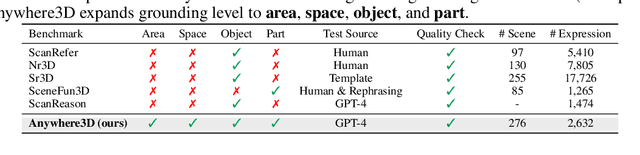
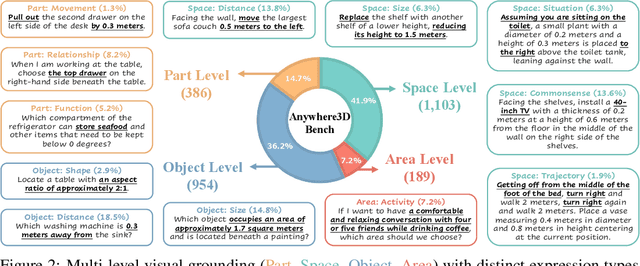

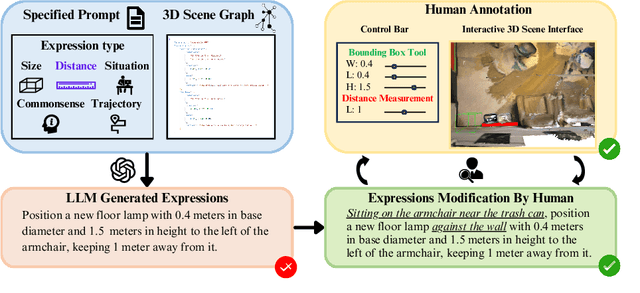
3D visual grounding has made notable progress in localizing objects within complex 3D scenes. However, grounding referring expressions beyond objects in 3D scenes remains unexplored. In this paper, we introduce Anywhere3D-Bench, a holistic 3D visual grounding benchmark consisting of 2,632 referring expression-3D bounding box pairs spanning four different grounding levels: human-activity areas, unoccupied space beyond objects, objects in the scene, and fine-grained object parts. We assess a range of state-of-the-art 3D visual grounding methods alongside large language models (LLMs) and multimodal LLMs (MLLMs) on Anywhere3D-Bench. Experimental results reveal that space-level and part-level visual grounding pose the greatest challenges: space-level tasks require a more comprehensive spatial reasoning ability, for example, modeling distances and spatial relations within 3D space, while part-level tasks demand fine-grained perception of object composition. Even the best performance model, OpenAI o4-mini, achieves only 23.57% accuracy on space-level tasks and 33.94% on part-level tasks, significantly lower than its performance on area-level and object-level tasks. These findings underscore a critical gap in current models' capacity to understand and reason about 3D scene beyond object-level semantics.