 Add to Chrome
 Add to Firefox
 Add to Edge
Reward as An Agent for Embodied World Models
Jun 18, 2026
While RL has become a promising tool for refining world models, existing methods largely rely on conservative rollouts near the training distribution, limiting exploration, behavioral diversity, and richer dynamic discovery. In this work, we challenge this conservative paradigm. We argue that the core limitation is not exploration itself, but the lack of reliable verification strategies to support broader exploration. Without reliable verification, expanded exploration becomes highly susceptible to reward hacking, where policies exploit imperfect rewards without achieving genuine improvement. To evaluate this motivation, we instantiate our method in embodied world models, where physical plausibility, and task completion provide a rigorous testbed for scalable RL under complex dynamics. On the verification side, we introduce Reward as an Agent, an agentic reward framework that actively evaluates generated behaviors to provide robust reward signals and mitigate reward hacking under distribution shifts. On the exploration side, we introduce Dynamic-Aware Rollout Diversification through DynDiff-GRPO, which explicitly expands action-space exploration to diversify trajectories, broaden state-action coverage, and encourage richer embodied behaviors beyond conservative rollout regimes. By unifying Reward as an Agent with DynDiff-GRPO, we enable RL on a more reliable reward foundation with substantially diversified sampling, effectively mitigating reward hacking while yielding significant accuracy gains across multiple open-source world models, thereby demonstrating that broader exploration can scale successfully when grounded in robust verification.

Kairos: A Native World Model Stack for Physical AI
Jun 16, 2026World models are transitioning from passive visual generators to foundational, operational infrastructure for Physical AI: they must natively acquire world knowledge from heterogeneous experience, maintain persistent states over long horizons, and execute efficiently within real deployment constraints. We introduce Kairos, a native world model stack designed around these requirements. (1) Kairos learns the world by pioneering a Native Pre-training Paradigm governed by a Cross-Embodiment Data Curriculum, which organizes open-world videos, human behavioral data, and robot interactions into a progressive developmental pathway. (2) Kairos maintains the world by unified world understanding, generation, and prediction within a Native Unified Architecture equipped with Hybrid Linear Temporal Attention, where sliding-window attention captures local dynamics, dilated sliding windows capture mid-range dependencies, and gated linear attention maintains persistent global memory. We establish formal theoretical bounds demonstrating that this temporal factorization strictly limits error accumulation, mathematically guaranteeing state propagation across extended horizons. (3) Kairos runs the world by incorporating a Deployment-Aware System Co-Design to support low-latency rollout generation on server and consumer-grade hardware for real-world observation-action-feedback loops. Experiments on embodied world-model, long-horizon, and action-policy benchmarks show that Kairos achieves top level performance while offering a strong efficiency-capability trade-off. Together, these results position Kairos as a cohesive operational foundation for future self-evolving physical intelligence.
When NPUs Are Not Always Faster: A Stage-Level Analysis of Mobile LLM Inference
May 22, 2026Deploying large language models (LLMs) on mobile devices increasingly relies on heterogeneous execution, yet no prior study has systematically characterized NPU effectiveness at the operator and pipeline level. We present the first stage-aware, multi-level benchmarking study of mobile LLM inference on a CPU-NPU heterogeneous SoC. We introduce an OPMASK-based controlled pipeline decomposition methodology that isolates communication, quantization, and computation overheads within the NPU execution path. Our results reveal a counter-intuitive stage-level performance reversal: CPUs outperform NPUs in the compute-intensive Prefill stage (up to 1.6x), while NPUs provide only limited acceleration in the memory-bound Decode stage (1.05-1.2x). We further show that scheduling overhead and cross-backend fallback reduce the practical benefits of NPU offloading. For the energy trend, increasing NPU offloading leads to higher energy consumption (up to 51%). Based on these findings, we derive design guidelines for NPU architects targeting on-device LLM inference.
Breaking Degradation Coupling: A Structural Entropy Guided Decoupled Framework and Benchmark for Infrared Enhancement
Apr 24, 2026Thermal infrared image enhancement aims to restore high-quality images from complex compound degradations. Existing all-in-one approaches typically employ a single shared backbone to handle diverse degradations, which causes gradient interference and parameter competition. To address this, we propose a Structural Entropy-Guided Decoupled (SEGD) Framework. Unlike unified modeling paradigms, SEGD decomposes compound degradations into independent sub-processes and models them in a divide-and-conquer manner through Degradation-Specific Residual Modules (DRMs). Each DRM focuses on residual estimation for a specific degradation, enabling task decoupling while remaining jointly trainable, which mitigates parameter contention. A Degradation-Aware Evidential Network further estimates degradation type and intensity, providing priors that adaptively regulate DRM restoration strength. To handle compound cases, DRMs are composed in varying orders to form multiple restoration paths, from which the most informative features are aggregated under a structural-entropy criterion, yielding decoder-ready representations with structural fidelity and degradation awareness. Integrating divide-and-conquer restoration, evidential perception, and entropy-guided adaptation, SEGD achieves fine-grained and interpretable enhancement. We also construct a nighttime TIR benchmark for evaluation under real low-light conditions. Experimental results demonstrate that SEGD surpasses state-of-the-art methods while achieving higher efficiency with fewer parameters.
Revisiting CAD Model Generation by Learning Raster Sketch
Mar 02, 2025The integration of deep generative networks into generating Computer-Aided Design (CAD) models has garnered increasing attention over recent years. Traditional methods often rely on discrete sequences of parametric line/curve segments to represent sketches. Differently, we introduce RECAD, a novel framework that generates Raster sketches and 3D Extrusions for CAD models. Representing sketches as raster images offers several advantages over discrete sequences: 1) it breaks the limitations on the types and numbers of lines/curves, providing enhanced geometric representation capabilities; 2) it enables interpolation within a continuous latent space; and 3) it allows for more intuitive user control over the output. Technically, RECAD employs two diffusion networks: the first network generates extrusion boxes conditioned on the number and types of extrusions, while the second network produces sketch images conditioned on these extrusion boxes. By combining these two networks, RECAD effectively generates sketch-and-extrude CAD models, offering a more robust and intuitive approach to CAD model generation. Experimental results indicate that RECAD achieves strong performance in unconditional generation, while also demonstrating effectiveness in conditional generation and output editing.
Hierarchical Superpixel Segmentation via Structural Information Theory
Jan 13, 2025Superpixel segmentation is a foundation for many higher-level computer vision tasks, such as image segmentation, object recognition, and scene understanding. Existing graph-based superpixel segmentation methods typically concentrate on the relationships between a given pixel and its directly adjacent pixels while overlooking the influence of non-adjacent pixels. These approaches do not fully leverage the global information in the graph, leading to suboptimal segmentation quality. To address this limitation, we present SIT-HSS, a hierarchical superpixel segmentation method based on structural information theory. Specifically, we first design a novel graph construction strategy that incrementally explores the pixel neighborhood to add edges based on 1-dimensional structural entropy (1D SE). This strategy maximizes the retention of graph information while avoiding an overly complex graph structure. Then, we design a new 2D SE-guided hierarchical graph partitioning method, which iteratively merges pixel clusters layer by layer to reduce the graph's 2D SE until a predefined segmentation scale is achieved. Experimental results on three benchmark datasets demonstrate that the SIT-HSS performs better than state-of-the-art unsupervised superpixel segmentation algorithms. The source code is available at \url{https://github.com/SELGroup/SIT-HSS}.
SocialED: A Python Library for Social Event Detection
Dec 18, 2024

SocialED is a comprehensive, open-source Python library designed to support social event detection (SED) tasks, integrating 19 detection algorithms and 14 diverse datasets. It provides a unified API with detailed documentation, offering researchers and practitioners a complete solution for event detection in social media. The library is designed with modularity in mind, allowing users to easily adapt and extend components for various use cases. SocialED supports a wide range of preprocessing techniques, such as graph construction and tokenization, and includes standardized interfaces for training models and making predictions. By integrating popular deep learning frameworks, SocialED ensures high efficiency and scalability across both CPU and GPU environments. The library is built adhering to high code quality standards, including unit testing, continuous integration, and code coverage, ensuring that SocialED delivers robust, maintainable software. SocialED is publicly available at \url{https://github.com/RingBDStack/SocialED} and can be installed via PyPI.
Refining Translations with LLMs: A Constraint-Aware Iterative Prompting Approach
Nov 13, 2024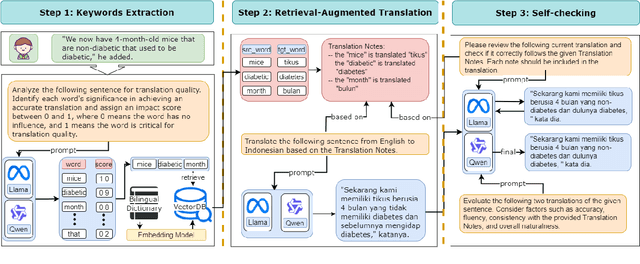
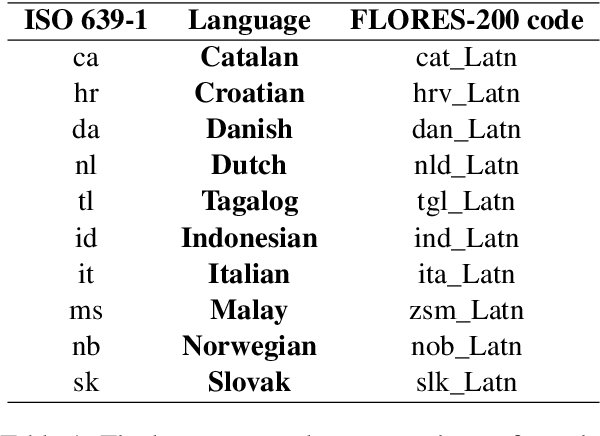
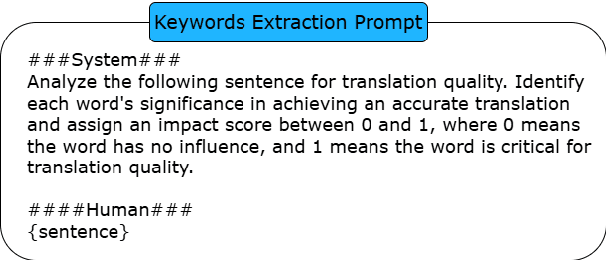
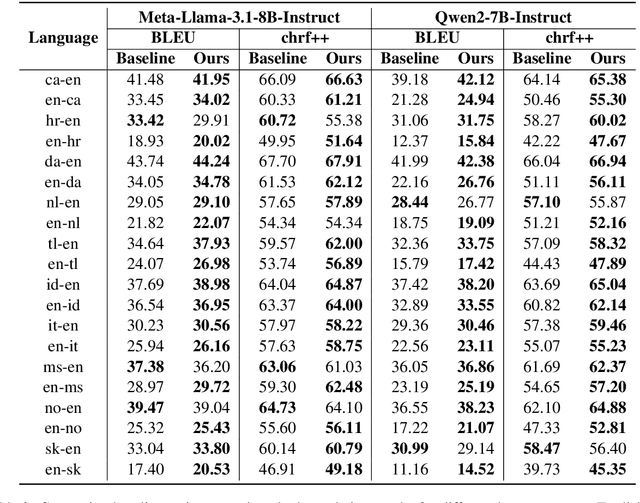
Large language models (LLMs) have demonstrated remarkable proficiency in machine translation (MT), even without specific training on the languages in question. However, translating rare words in low-resource or domain-specific contexts remains challenging for LLMs. To address this issue, we propose a multi-step prompt chain that enhances translation faithfulness by prioritizing key terms crucial for semantic accuracy. Our method first identifies these keywords and retrieves their translations from a bilingual dictionary, integrating them into the LLM's context using Retrieval-Augmented Generation (RAG). We further mitigate potential output hallucinations caused by long prompts through an iterative self-checking mechanism, where the LLM refines its translations based on lexical and semantic constraints. Experiments using Llama and Qwen as base models on the FLORES-200 and WMT datasets demonstrate significant improvements over baselines, highlighting the effectiveness of our approach in enhancing translation faithfulness and robustness, particularly in low-resource scenarios.
DAMe: Personalized Federated Social Event Detection with Dual Aggregation Mechanism
Sep 01, 2024


Training social event detection models through federated learning (FedSED) aims to improve participants' performance on the task. However, existing federated learning paradigms are inadequate for achieving FedSED's objective and exhibit limitations in handling the inherent heterogeneity in social data. This paper proposes a personalized federated learning framework with a dual aggregation mechanism for social event detection, namely DAMe. We present a novel local aggregation strategy utilizing Bayesian optimization to incorporate global knowledge while retaining local characteristics. Moreover, we introduce a global aggregation strategy to provide clients with maximum external knowledge of their preferences. In addition, we incorporate a global-local event-centric constraint to prevent local overfitting and ``client-drift''. Experiments within a realistic simulation of a natural federated setting, utilizing six social event datasets spanning six languages and two social media platforms, along with an ablation study, have demonstrated the effectiveness of the proposed framework. Further robustness analyses have shown that DAMe is resistant to injection attacks.
Relational Prompt-based Pre-trained Language Models for Social Event Detection
Apr 12, 2024Social Event Detection (SED) aims to identify significant events from social streams, and has a wide application ranging from public opinion analysis to risk management. In recent years, Graph Neural Network (GNN) based solutions have achieved state-of-the-art performance. However, GNN-based methods often struggle with noisy and missing edges between messages, affecting the quality of learned message embedding. Moreover, these methods statically initialize node embedding before training, which, in turn, limits the ability to learn from message texts and relations simultaneously. In this paper, we approach social event detection from a new perspective based on Pre-trained Language Models (PLMs), and present RPLM_SED (Relational prompt-based Pre-trained Language Models for Social Event Detection). We first propose a new pairwise message modeling strategy to construct social messages into message pairs with multi-relational sequences. Secondly, a new multi-relational prompt-based pairwise message learning mechanism is proposed to learn more comprehensive message representation from message pairs with multi-relational prompts using PLMs. Thirdly, we design a new clustering constraint to optimize the encoding process by enhancing intra-cluster compactness and inter-cluster dispersion, making the message representation more distinguishable. We evaluate the RPLM_SED on three real-world datasets, demonstrating that the RPLM_SED model achieves state-of-the-art performance in offline, online, low-resource, and long-tail distribution scenarios for social event detection tasks.