 Add to Chrome
 Add to Firefox
 Add to Edge
Ground4D: Consistency-Aware 4D Reconstruction from Monocular Video
Jun 27, 2026
Learning a 4D scene representation from a single monocular video that supports dynamic novel-view synthesis while maintaining faithful geometry over time remains challenging. Dynamic Gaussian Splatting achieves strong rendering performance through photometric optimization, yet does not explicitly enforce multi-view geometric consistency. In contrast, 3D foundation models recover coherent scene geometry and camera motion, but their point-based outputs are not designed for photorealistic rendering. We propose Ground4D, a geometry-grounded framework built on two stages. First, we perform geometry initialization via 3D foundation models, leveraging VGGT in a training-free manner to reconstruct multi-view-consistent 3D geometry and camera poses from monocular video. The recovered geometry provides a structured and reliable initialization for dynamic Gaussian representations. Second, we conduct geometry-consistency-aware refinement via dynamic Gaussian Splatting, optimizing the representation through differentiable rendering while maintaining multi-view geometric consistency across both observed and synthesized viewpoints. Furthermore, Ground4D inherently models the continuous 4D dynamics of the scene, naturally supporting rendering at arbitrary timestamps. By integrating foundation-level geometric priors into dynamic Gaussian optimization, Ground4D achieves stronger reconstruction fidelity and rendering performance, underscoring the role of geometry-grounded constraints in robust 4D scene modeling.

Where Detectors Fail: Probing Generative Space for Generalizable AI-Generated Image Detection
May 27, 2026Detecting AI-generated images (AIGI) remains challenging because detectors often fail to generalize to unseen generators. Although existing methods are trained on large datasets, their performance still degrades when generation settings change, indicating that data scale alone is insufficient and that limited coverage of generative variations during training is a key factor. Studies on generative model editing show that small changes in internal representations can produce diverse and meaningful image variations, many of which are not explored under standard sampling. Leveraging this insight, we propose PROBE (Probing Robustness via Boundary Exploration), a framework that improves detector generalization by actively exploring challenging regions of the generative process. Instead of treating the generator as a fixed data source, PROBE uses the detector as a critic to steer the generator through manifold-level modifications, producing realistic samples that are difficult to classify. These samples expose failure cases that are uncommon under standard data sampling strategies and are used to refine the detector. Experimental results across multiple benchmarks indicate that PROBE enhances generalization to unseen generators, resulting in more generalizable AIGI detection performance. Code and models are available at https://github.com/Amamiya-C/PROBE-AIGI-Detection
When Preference Labels Fall Short: Aligning Diffusion Models from Real Data
May 19, 2026Preference alignment aims to guide generative models by learning from comparisons between preferred and non-preferred samples. In practice, most existing approaches rely on preference pairs constructed from model-generated images. Such supervision is inherently relative and can be ambiguous when both samples exhibit artifacts or limited visual quality, making it difficult to infer what constitutes a truly desirable output. In this work, we investigate whether real data can serve as an alternative source of supervision for preference alignment. We adopt a data-centric perspective and study a curation strategy that treats real images as reference points and constructs preference signals by contrasting them with generated or perturbed samples, without requiring manually annotated preference pairs. Through empirical analysis, we show that real-data-based supervision provides effective guidance for aligning diffusion models and achieves performance comparable to existing preference-based methods. Our results suggest that real data offers a practical and complementary source of supervision for preference alignment and highlight directions of label-efficient alignment strategies. Code and models are available at https://cwyxx.github.io/RealAlign.
Language Generation as Optimal Control: Closed-Loop Diffusion in Latent Control Space
May 14, 2026This work reformulates language generation as a stochastic optimal control problem, providing a unified theoretical perspective to analyze autoregressive and diffusion models and explain their limitations (Efficiency-Fidelity Paradox, Irreversibility Error Propagation, Optimization Tractability and Fidelity) in terms of combination of trajectory singularity, adjoint state vanishing, and gradient absence. To address these issues, we approximate the solution to the Hamilton-Jacobi-Bellman (HJB) equation, yielding an optimal policy that acts as a closed-loop controller. To bypass the intractability of directly solving the HJB PDE, we employ Flow Matching as the optimal trajectory solver within the rectified latent control space. This allows our Manta-LM with Global Integral Operator to approximate the global vector field, effectively realizing a model that simultaneously achieves high-fidelity text generation and efficient, low-cost parallel sampling. Empirically, our method achieves strong performance on language modeling and conditional generation tasks, while exhibiting improved stability, efficiency, and controllability.
Unveiling Perceptual Artifacts: A Fine-Grained Benchmark for Interpretable AI-Generated Image Detection
Jan 27, 2026Current AI-Generated Image (AIGI) detection approaches predominantly rely on binary classification to distinguish real from synthetic images, often lacking interpretable or convincing evidence to substantiate their decisions. This limitation stems from existing AIGI detection benchmarks, which, despite featuring a broad collection of synthetic images, remain restricted in their coverage of artifact diversity and lack detailed, localized annotations. To bridge this gap, we introduce a fine-grained benchmark towards eXplainable AI-Generated image Detection, named X-AIGD, which provides pixel-level, categorized annotations of perceptual artifacts, spanning low-level distortions, high-level semantics, and cognitive-level counterfactuals. These comprehensive annotations facilitate fine-grained interpretability evaluation and deeper insight into model decision-making processes. Our extensive investigation using X-AIGD provides several key insights: (1) Existing AIGI detectors demonstrate negligible reliance on perceptual artifacts, even at the most basic distortion level. (2) While AIGI detectors can be trained to identify specific artifacts, they still substantially base their judgment on uninterpretable features. (3) Explicitly aligning model attention with artifact regions can increase the interpretability and generalization of detectors. The data and code are available at: https://github.com/Coxy7/X-AIGD.
Thinking Before You Speak: A Proactive Test-time Scaling Approach
Aug 27, 2025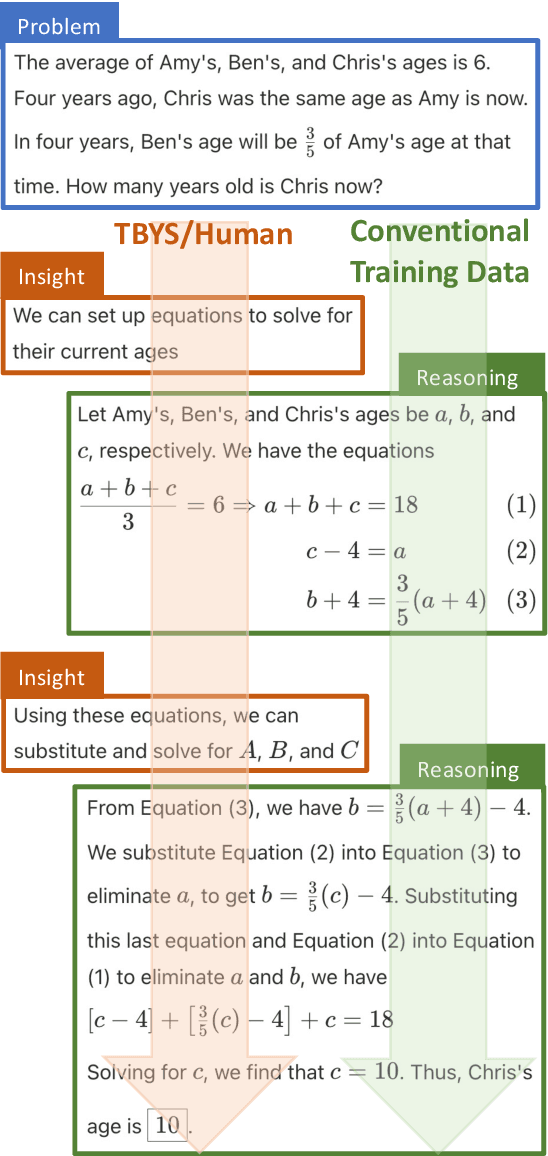
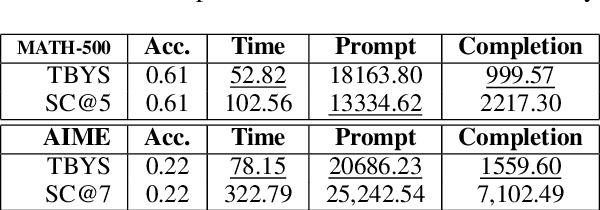
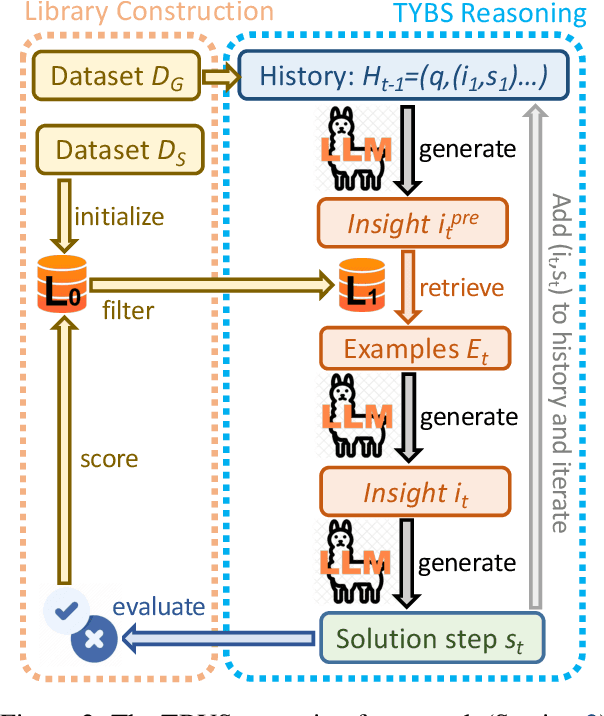
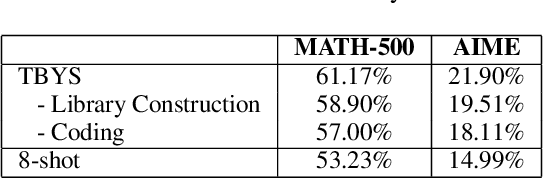
Large Language Models (LLMs) often exhibit deficiencies with complex reasoning tasks, such as maths, which we attribute to the discrepancy between human reasoning patterns and those presented in the LLMs' training data. When dealing with complex problems, humans tend to think carefully before expressing solutions. However, they often do not articulate their inner thoughts, including their intentions and chosen methodologies. Consequently, critical insights essential for bridging reasoning steps may be absent in training data collected from human sources. To bridge this gap, we proposes inserting \emph{insight}s between consecutive reasoning steps, which review the status and initiate the next reasoning steps. Unlike prior prompting strategies that rely on a single or a workflow of static prompts to facilitate reasoning, \emph{insight}s are \emph{proactively} generated to guide reasoning processes. We implement our idea as a reasoning framework, named \emph{Thinking Before You Speak} (TBYS), and design a pipeline for automatically collecting and filtering in-context examples for the generation of \emph{insight}s, which alleviates human labeling efforts and fine-tuning overheads. Experiments on challenging mathematical datasets verify the effectiveness of TBYS. Project website: https://gitee.com/jswrt/TBYS
Can We Achieve Efficient Diffusion without Self-Attention? Distilling Self-Attention into Convolutions
Apr 30, 2025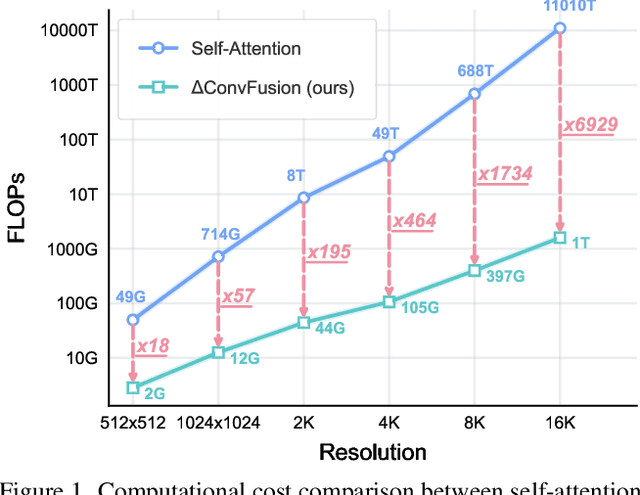
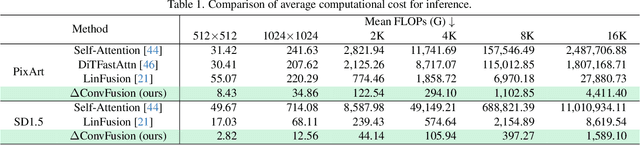

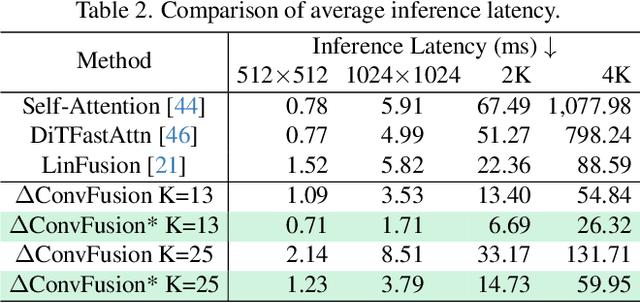
Contemporary diffusion models built upon U-Net or Diffusion Transformer (DiT) architectures have revolutionized image generation through transformer-based attention mechanisms. The prevailing paradigm has commonly employed self-attention with quadratic computational complexity to handle global spatial relationships in complex images, thereby synthesizing high-fidelity images with coherent visual semantics.Contrary to conventional wisdom, our systematic layer-wise analysis reveals an interesting discrepancy: self-attention in pre-trained diffusion models predominantly exhibits localized attention patterns, closely resembling convolutional inductive biases. This suggests that global interactions in self-attention may be less critical than commonly assumed.Driven by this, we propose \(\Delta\)ConvFusion to replace conventional self-attention modules with Pyramid Convolution Blocks (\(\Delta\)ConvBlocks).By distilling attention patterns into localized convolutional operations while keeping other components frozen, \(\Delta\)ConvFusion achieves performance comparable to transformer-based counterparts while reducing computational cost by 6929$\times$ and surpassing LinFusion by 5.42$\times$ in efficiency--all without compromising generative fidelity.
Decoder-Only LLMs are Better Controllers for Diffusion Models
Feb 06, 2025Groundbreaking advancements in text-to-image generation have recently been achieved with the emergence of diffusion models. These models exhibit a remarkable ability to generate highly artistic and intricately detailed images based on textual prompts. However, obtaining desired generation outcomes often necessitates repetitive trials of manipulating text prompts just like casting spells on a magic mirror, and the reason behind that is the limited capability of semantic understanding inherent in current image generation models. Specifically, existing diffusion models encode the text prompt input with a pre-trained encoder structure, which is usually trained on a limited number of image-caption pairs. The state-of-the-art large language models (LLMs) based on the decoder-only structure have shown a powerful semantic understanding capability as their architectures are more suitable for training on very large-scale unlabeled data. In this work, we propose to enhance text-to-image diffusion models by borrowing the strength of semantic understanding from large language models, and devise a simple yet effective adapter to allow the diffusion models to be compatible with the decoder-only structure. Meanwhile, we also provide a supporting theoretical analysis with various architectures (e.g., encoder-only, encoder-decoder, and decoder-only), and conduct extensive empirical evaluations to verify its effectiveness. The experimental results show that the enhanced models with our adapter module are superior to the stat-of-the-art models in terms of text-to-image generation quality and reliability.
SAM-COD: SAM-guided Unified Framework for Weakly-Supervised Camouflaged Object Detection
Aug 20, 2024
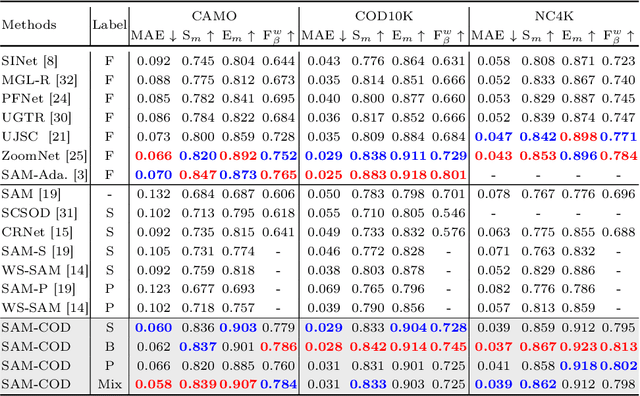
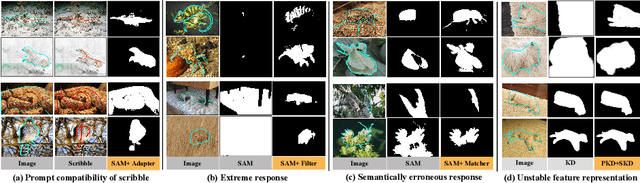
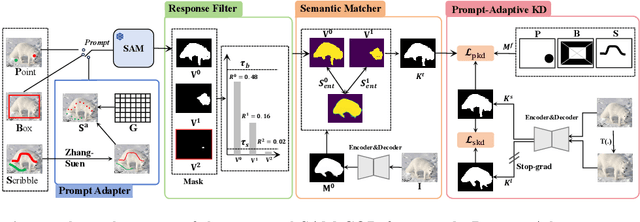
Most Camouflaged Object Detection (COD) methods heavily rely on mask annotations, which are time-consuming and labor-intensive to acquire. Existing weakly-supervised COD approaches exhibit significantly inferior performance compared to fully-supervised methods and struggle to simultaneously support all the existing types of camouflaged object labels, including scribbles, bounding boxes, and points. Even for Segment Anything Model (SAM), it is still problematic to handle the weakly-supervised COD and it typically encounters challenges of prompt compatibility of the scribble labels, extreme response, semantically erroneous response, and unstable feature representations, producing unsatisfactory results in camouflaged scenes. To mitigate these issues, we propose a unified COD framework in this paper, termed SAM-COD, which is capable of supporting arbitrary weakly-supervised labels. Our SAM-COD employs a prompt adapter to handle scribbles as prompts based on SAM. Meanwhile, we introduce response filter and semantic matcher modules to improve the quality of the masks obtained by SAM under COD prompts. To alleviate the negative impacts of inaccurate mask predictions, a new strategy of prompt-adaptive knowledge distillation is utilized to ensure a reliable feature representation. To validate the effectiveness of our approach, we have conducted extensive empirical experiments on three mainstream COD benchmarks. The results demonstrate the superiority of our method against state-of-the-art weakly-supervised and even fully-supervised methods.
Diff-Mosaic: Augmenting Realistic Representations in Infrared Small Target Detection via Diffusion Prior
Jun 02, 2024Recently, researchers have proposed various deep learning methods to accurately detect infrared targets with the characteristics of indistinct shape and texture. Due to the limited variety of infrared datasets, training deep learning models with good generalization poses a challenge. To augment the infrared dataset, researchers employ data augmentation techniques, which often involve generating new images by combining images from different datasets. However, these methods are lacking in two respects. In terms of realism, the images generated by mixup-based methods lack realism and are difficult to effectively simulate complex real-world scenarios. In terms of diversity, compared with real-world scenes, borrowing knowledge from another dataset inherently has a limited diversity. Currently, the diffusion model stands out as an innovative generative approach. Large-scale trained diffusion models have a strong generative prior that enables real-world modeling of images to generate diverse and realistic images. In this paper, we propose Diff-Mosaic, a data augmentation method based on the diffusion model. This model effectively alleviates the challenge of diversity and realism of data augmentation methods via diffusion prior. Specifically, our method consists of two stages. Firstly, we introduce an enhancement network called Pixel-Prior, which generates highly coordinated and realistic Mosaic images by harmonizing pixels. In the second stage, we propose an image enhancement strategy named Diff-Prior. This strategy utilizes diffusion priors to model images in the real-world scene, further enhancing the diversity and realism of the images. Extensive experiments have demonstrated that our approach significantly improves the performance of the detection network. The code is available at https://github.com/YupeiLin2388/Diff-Mosaic