 Add to Chrome
 Add to Firefox
 Add to Edge
RMLR: Extending Multinomial Logistic Regression into General Geometries
Sep 28, 2024
Riemannian neural networks, which extend deep learning techniques to Riemannian spaces, have gained significant attention in machine learning. To better classify the manifold-valued features, researchers have started extending Euclidean multinomial logistic regression (MLR) into Riemannian manifolds. However, existing approaches suffer from limited applicability due to their strong reliance on specific geometric properties. This paper proposes a framework for designing Riemannian MLR over general geometries, referred to as RMLR. Our framework only requires minimal geometric properties, thus exhibiting broad applicability and enabling its use with a wide range of geometries. Specifically, we showcase our framework on the Symmetric Positive Definite (SPD) manifold and special orthogonal group, i.e., the set of rotation matrices. On the SPD manifold, we develop five families of SPD MLRs under five types of power-deformed metrics. On rotation matrices we propose Lie MLR based on the popular bi-invariant metric. Extensive experiments on different Riemannian backbone networks validate the effectiveness of our framework.

Discriminative Anchor Learning for Efficient Multi-view Clustering
Sep 25, 2024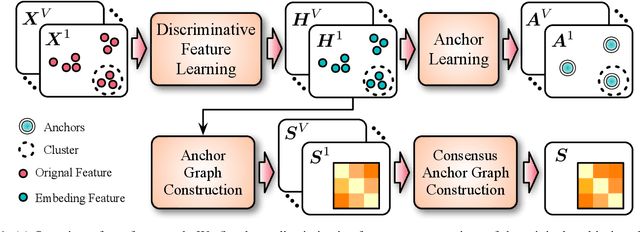
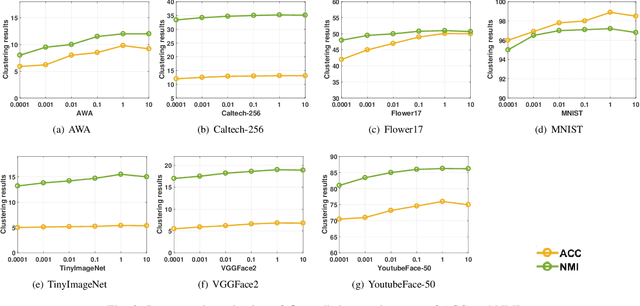
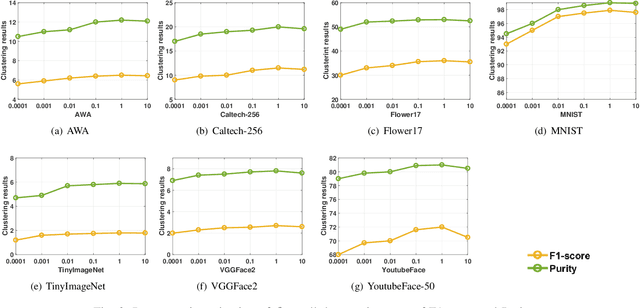

Multi-view clustering aims to study the complementary information across views and discover the underlying structure. For solving the relatively high computational cost for the existing approaches, works based on anchor have been presented recently. Even with acceptable clustering performance, these methods tend to map the original representation from multiple views into a fixed shared graph based on the original dataset. However, most studies ignore the discriminative property of the learned anchors, which ruin the representation capability of the built model. Moreover, the complementary information among anchors across views is neglected to be ensured by simply learning the shared anchor graph without considering the quality of view-specific anchors. In this paper, we propose discriminative anchor learning for multi-view clustering (DALMC) for handling the above issues. We learn discriminative view-specific feature representations according to the original dataset and build anchors from different views based on these representations, which increase the quality of the shared anchor graph. The discriminative feature learning and consensus anchor graph construction are integrated into a unified framework to improve each other for realizing the refinement. The optimal anchors from multiple views and the consensus anchor graph are learned with the orthogonal constraints. We give an iterative algorithm to deal with the formulated problem. Extensive experiments on different datasets show the effectiveness and efficiency of our method compared with other methods.
Optimizing Resource Consumption in Diffusion Models through Hallucination Early Detection
Sep 16, 2024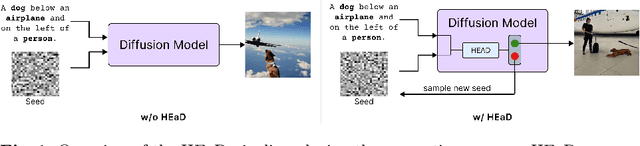
Diffusion models have significantly advanced generative AI, but they encounter difficulties when generating complex combinations of multiple objects. As the final result heavily depends on the initial seed, accurately ensuring the desired output can require multiple iterations of the generation process. This repetition not only leads to a waste of time but also increases energy consumption, echoing the challenges of efficiency and accuracy in complex generative tasks. To tackle this issue, we introduce HEaD (Hallucination Early Detection), a new paradigm designed to swiftly detect incorrect generations at the beginning of the diffusion process. The HEaD pipeline combines cross-attention maps with a new indicator, the Predicted Final Image, to forecast the final outcome by leveraging the information available at early stages of the generation process. We demonstrate that using HEaD saves computational resources and accelerates the generation process to get a complete image, i.e. an image where all requested objects are accurately depicted. Our findings reveal that HEaD can save up to 12% of the generation time on a two objects scenario and underscore the importance of early detection mechanisms in generative models.
GradBias: Unveiling Word Influence on Bias in Text-to-Image Generative Models
Aug 29, 2024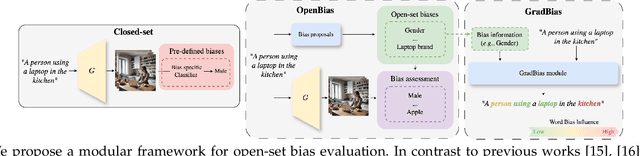
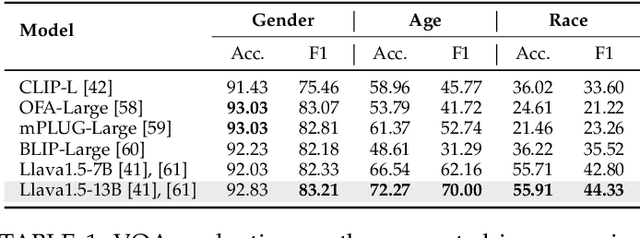
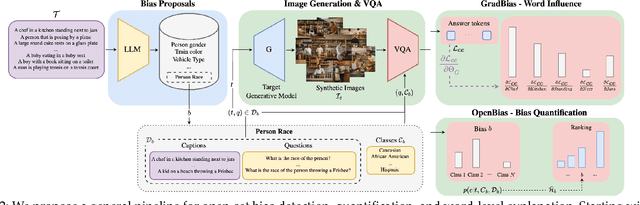
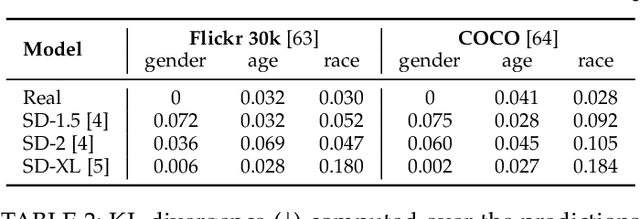
Recent progress in Text-to-Image (T2I) generative models has enabled high-quality image generation. As performance and accessibility increase, these models are gaining significant attraction and popularity: ensuring their fairness and safety is a priority to prevent the dissemination and perpetuation of biases. However, existing studies in bias detection focus on closed sets of predefined biases (e.g., gender, ethnicity). In this paper, we propose a general framework to identify, quantify, and explain biases in an open set setting, i.e. without requiring a predefined set. This pipeline leverages a Large Language Model (LLM) to propose biases starting from a set of captions. Next, these captions are used by the target generative model for generating a set of images. Finally, Vision Question Answering (VQA) is leveraged for bias evaluation. We show two variations of this framework: OpenBias and GradBias. OpenBias detects and quantifies biases, while GradBias determines the contribution of individual prompt words on biases. OpenBias effectively detects both well-known and novel biases related to people, objects, and animals and highly aligns with existing closed-set bias detection methods and human judgment. GradBias shows that neutral words can significantly influence biases and it outperforms several baselines, including state-of-the-art foundation models. Code available here: https://github.com/Moreno98/GradBias.
PVAFN: Point-Voxel Attention Fusion Network with Multi-Pooling Enhancing for 3D Object Detection
Aug 26, 2024The integration of point and voxel representations is becoming more common in LiDAR-based 3D object detection. However, this combination often struggles with capturing semantic information effectively. Moreover, relying solely on point features within regions of interest can lead to information loss and limitations in local feature representation. To tackle these challenges, we propose a novel two-stage 3D object detector, called Point-Voxel Attention Fusion Network (PVAFN). PVAFN leverages an attention mechanism to improve multi-modal feature fusion during the feature extraction phase. In the refinement stage, it utilizes a multi-pooling strategy to integrate both multi-scale and region-specific information effectively. The point-voxel attention mechanism adaptively combines point cloud and voxel-based Bird's-Eye-View (BEV) features, resulting in richer object representations that help to reduce false detections. Additionally, a multi-pooling enhancement module is introduced to boost the model's perception capabilities. This module employs cluster pooling and pyramid pooling techniques to efficiently capture key geometric details and fine-grained shape structures, thereby enhancing the integration of local and global features. Extensive experiments on the KITTI and Waymo datasets demonstrate that the proposed PVAFN achieves competitive performance. The code and models will be available.
Global-Local Distillation Network-Based Audio-Visual Speaker Tracking with Incomplete Modalities
Aug 26, 2024In speaker tracking research, integrating and complementing multi-modal data is a crucial strategy for improving the accuracy and robustness of tracking systems. However, tracking with incomplete modalities remains a challenging issue due to noisy observations caused by occlusion, acoustic noise, and sensor failures. Especially when there is missing data in multiple modalities, the performance of existing multi-modal fusion methods tends to decrease. To this end, we propose a Global-Local Distillation-based Tracker (GLDTracker) for robust audio-visual speaker tracking. GLDTracker is driven by a teacher-student distillation model, enabling the flexible fusion of incomplete information from each modality. The teacher network processes global signals captured by camera and microphone arrays, and the student network handles local information subject to visual occlusion and missing audio channels. By transferring knowledge from teacher to student, the student network can better adapt to complex dynamic scenes with incomplete observations. In the student network, a global feature reconstruction module based on the generative adversarial network is constructed to reconstruct global features from feature embedding with missing local information. Furthermore, a multi-modal multi-level fusion attention is introduced to integrate the incomplete feature and the reconstructed feature, leveraging the complementarity and consistency of audio-visual and global-local features. Experimental results on the AV16.3 dataset demonstrate that the proposed GLDTracker outperforms existing state-of-the-art audio-visual trackers and achieves leading performance on both standard and incomplete modalities datasets, highlighting its superiority and robustness in complex conditions. The code and models will be available.
ShapeSplat: A Large-scale Dataset of Gaussian Splats and Their Self-Supervised Pretraining
Aug 20, 2024
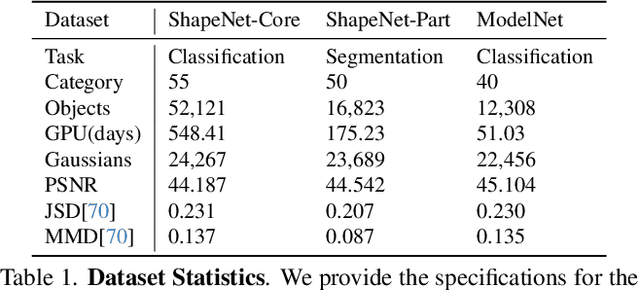
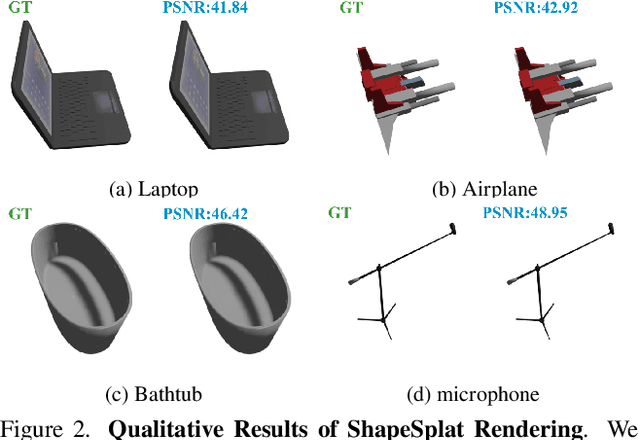
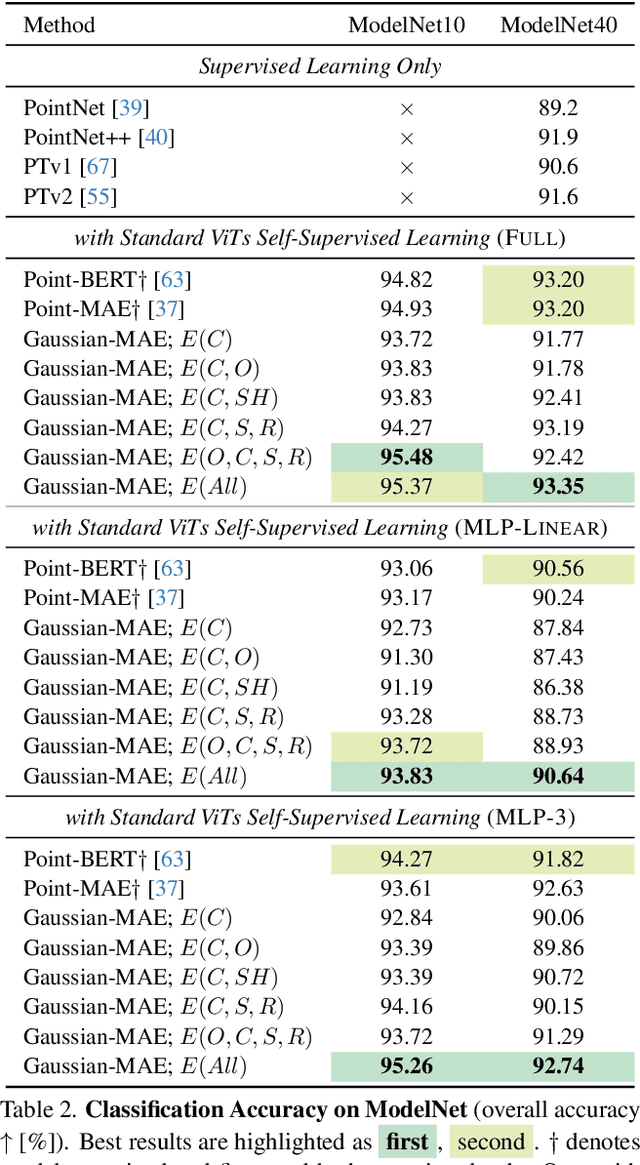
3D Gaussian Splatting (3DGS) has become the de facto method of 3D representation in many vision tasks. This calls for the 3D understanding directly in this representation space. To facilitate the research in this direction, we first build a large-scale dataset of 3DGS using the commonly used ShapeNet and ModelNet datasets. Our dataset ShapeSplat consists of 65K objects from 87 unique categories, whose labels are in accordance with the respective datasets. The creation of this dataset utilized the compute equivalent of 2 GPU years on a TITAN XP GPU. We utilize our dataset for unsupervised pretraining and supervised finetuning for classification and segmentation tasks. To this end, we introduce \textbf{\textit{Gaussian-MAE}}, which highlights the unique benefits of representation learning from Gaussian parameters. Through exhaustive experiments, we provide several valuable insights. In particular, we show that (1) the distribution of the optimized GS centroids significantly differs from the uniformly sampled point cloud (used for initialization) counterpart; (2) this change in distribution results in degradation in classification but improvement in segmentation tasks when using only the centroids; (3) to leverage additional Gaussian parameters, we propose Gaussian feature grouping in a normalized feature space, along with splats pooling layer, offering a tailored solution to effectively group and embed similar Gaussians, which leads to notable improvement in finetuning tasks.
Large Language Models for Multimodal Deformable Image Registration
Aug 20, 2024


The challenge of Multimodal Deformable Image Registration (MDIR) lies in the conversion and alignment of features between images of different modalities. Generative models (GMs) cannot retain the necessary information enough from the source modality to the target one, while non-GMs struggle to align features across these two modalities. In this paper, we propose a novel coarse-to-fine MDIR framework,LLM-Morph, which is applicable to various pre-trained Large Language Models (LLMs) to solve these concerns by aligning the deep features from different modal medical images. Specifically, we first utilize a CNN encoder to extract deep visual features from cross-modal image pairs, then we use the first adapter to adjust these tokens, and use LoRA in pre-trained LLMs to fine-tune their weights, both aimed at eliminating the domain gap between the pre-trained LLMs and the MDIR task. Third, for the alignment of tokens, we utilize other four adapters to transform the LLM-encoded tokens into multi-scale visual features, generating multi-scale deformation fields and facilitating the coarse-to-fine MDIR task. Extensive experiments in MR-CT Abdomen and SR-Reg Brain datasets demonstrate the effectiveness of our framework and the potential of pre-trained LLMs for MDIR task. Our code is availabel at: https://github.com/ninjannn/LLM-Morph.
When Video Coding Meets Multimodal Large Language Models: A Unified Paradigm for Video Coding
Aug 15, 2024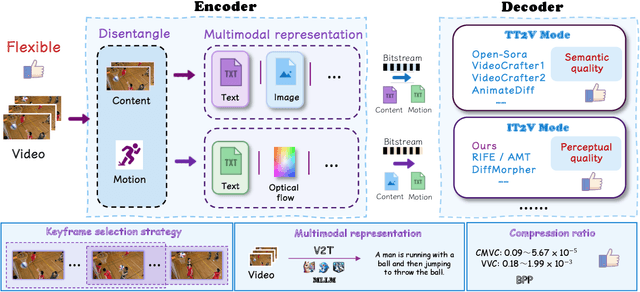

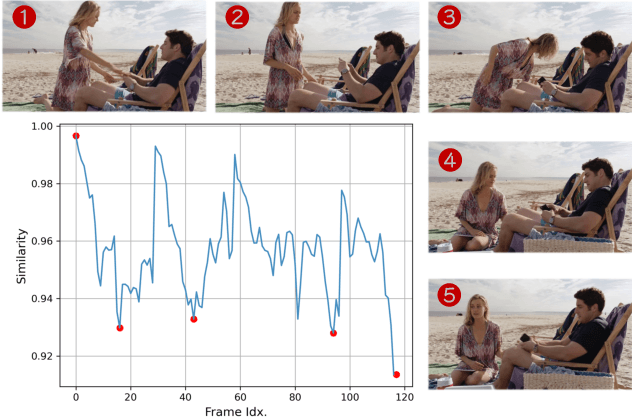
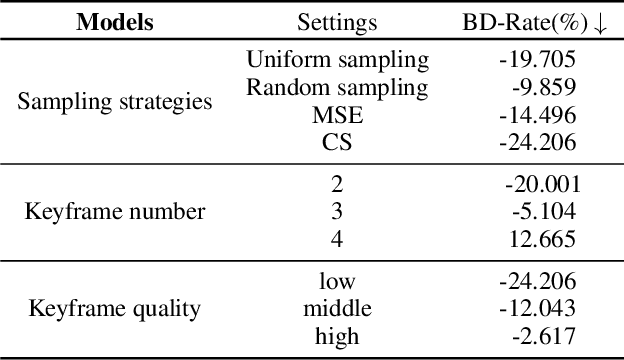
Existing codecs are designed to eliminate intrinsic redundancies to create a compact representation for compression. However, strong external priors from Multimodal Large Language Models (MLLMs) have not been explicitly explored in video compression. Herein, we introduce a unified paradigm for Cross-Modality Video Coding (CMVC), which is a pioneering approach to explore multimodality representation and video generative models in video coding. Specifically, on the encoder side, we disentangle a video into spatial content and motion components, which are subsequently transformed into distinct modalities to achieve very compact representation by leveraging MLLMs. During decoding, previously encoded components and video generation models are leveraged to create multiple encoding-decoding modes that optimize video reconstruction quality for specific decoding requirements, including Text-Text-to-Video (TT2V) mode to ensure high-quality semantic information and Image-Text-to-Video (IT2V) mode to achieve superb perceptual consistency. In addition, we propose an efficient frame interpolation model for IT2V mode via Low-Rank Adaption (LoRA) tuning to guarantee perceptual quality, which allows the generated motion cues to behave smoothly. Experiments on benchmarks indicate that TT2V achieves effective semantic reconstruction, while IT2V exhibits competitive perceptual consistency. These results highlight potential directions for future research in video coding.
Masked Image Modeling: A Survey
Aug 13, 2024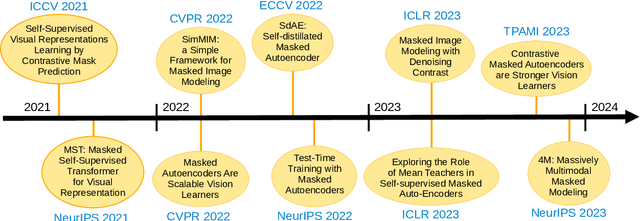

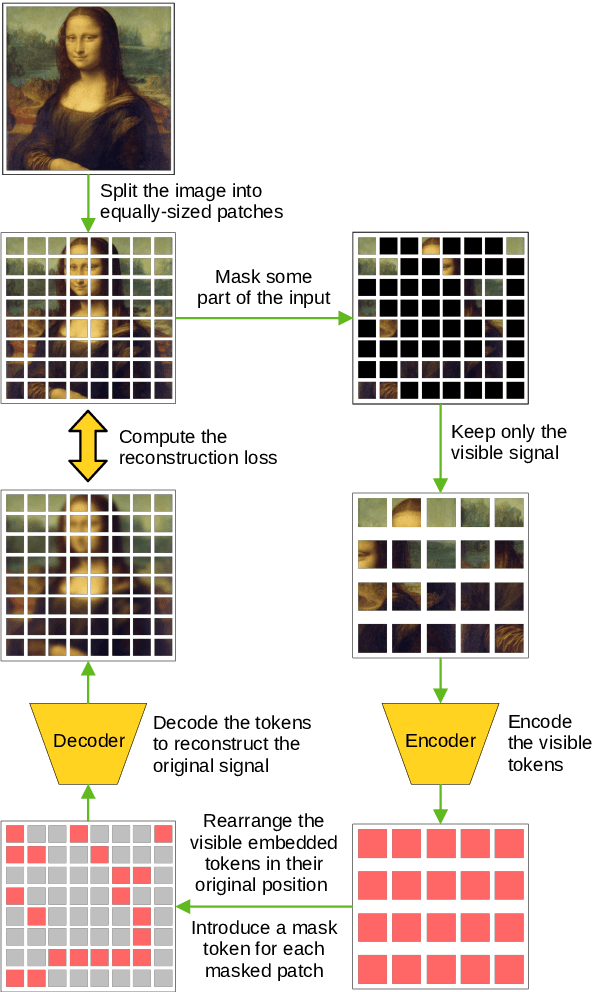

In this work, we survey recent studies on masked image modeling (MIM), an approach that emerged as a powerful self-supervised learning technique in computer vision. The MIM task involves masking some information, e.g. pixels, patches, or even latent representations, and training a model, usually an autoencoder, to predicting the missing information by using the context available in the visible part of the input. We identify and formalize two categories of approaches on how to implement MIM as a pretext task, one based on reconstruction and one based on contrastive learning. Then, we construct a taxonomy and review the most prominent papers in recent years. We complement the manually constructed taxonomy with a dendrogram obtained by applying a hierarchical clustering algorithm. We further identify relevant clusters via manually inspecting the resulting dendrogram. Our review also includes datasets that are commonly used in MIM research. We aggregate the performance results of various masked image modeling methods on the most popular datasets, to facilitate the comparison of competing methods. Finally, we identify research gaps and propose several interesting directions of future work.