 Add to Chrome
 Add to Firefox
 Add to Edge
Deploying Semantic ID-based Generative Retrieval for Large-Scale Podcast Discovery at Spotify
Mar 18, 2026
Podcast listening is often grounded in a set of favorite shows, while listener intent can evolve over time. This combination of stable preferences and changing intent motivates recommendation approaches that support both familiarity and exploration. Traditional recommender systems typically emphasize long-term interaction patterns, and are less explicitly designed to incorporate rich contextual signals or flexible, intent-aware discovery objectives. In this setting, models that can jointly reason over semantics, context, and user state offer a promising direction. Large Language Models (LLMs) provide strong semantic reasoning and contextual conditioning for discovery-oriented recommendation, but deploying them in production introduces challenges in catalog grounding, user-level personalization, and latency-critical serving. We address these challenges with GLIDE, a production-scale generative recommender for podcast discovery at Spotify. GLIDE formulates recommendation as an instruction-following task over a discretized catalog using Semantic IDs, enabling grounded generation over a large inventory. The model conditions on recent listening history and lightweight user context, while injecting long-term user embeddings as soft prompts to capture stable preferences under strict inference constraints. We evaluate GLIDE using offline retrieval metrics, human judgments, and LLM-based evaluation, and validate its impact through large-scale online A/B testing. Across experiments involving millions of users, GLIDE increases non-habitual podcast streaming on Spotify home surface by up to 5.4% and new-show discovery by up to 14.3%, while meeting production cost and latency constraints.

A Unified Language Model for Large Scale Search, Recommendation, and Reasoning
Mar 18, 2026LLMs are increasingly applied to recommendation, retrieval, and reasoning, yet deploying a single end-to-end model that can jointly support these behaviors over large, heterogeneous catalogs remains challenging. Such systems must generate unambiguous references to real items, handle multiple entity types, and operate under strict latency and reliability constraints requirements that are difficult to satisfy with text-only generation. While tool-augmented recommender systems address parts of this problem, they introduce orchestration complexity and limit end-to-end optimization. We view this setting as an instance of a broader research problem: how to adapt LLMs to reason jointly over multiple-domain entities, users, and language in a fully self-contained manner. To this end, we introduce NEO, a framework that adapts a pre-trained decoder-only LLM into a tool-free, catalog-grounded generator. NEO represents items as SIDs and trains a single model to interleave natural language and typed item identifiers within a shared sequence. Text prompts control the task, target entity type, and output format (IDs, text, or mixed), while constrained decoding guarantees catalog-valid item generation without restricting free-form text. We refer to this instruction-conditioned controllability as language-steerability. We treat SIDs as a distinct modality and study design choices for integrating discrete entity representations into LLMs via staged alignment and instruction tuning. We evaluate NEO at scale on a real-world catalog of over 10M items across multiple media types and discovery tasks, including recommendation, search, and user understanding. In offline experiments, NEO consistently outperforms strong task-specific baselines and exhibits cross-task transfer, demonstrating a practical path toward consolidating large-scale discovery capabilities into a single language-steerable generative model.
Evaluating Podcast Recommendations with Profile-Aware LLM-as-a-Judge
Aug 12, 2025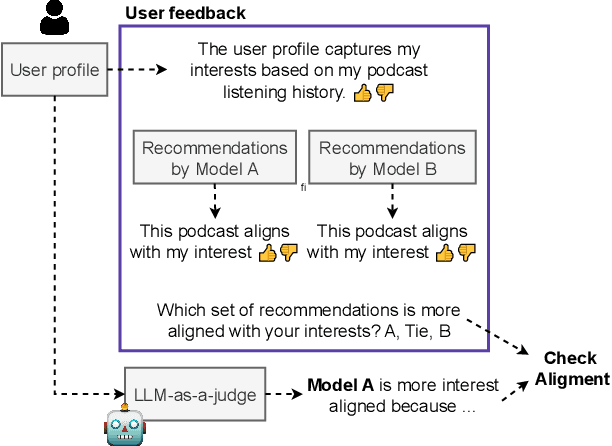
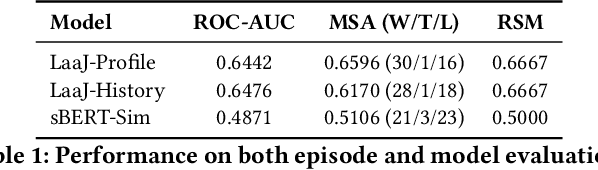
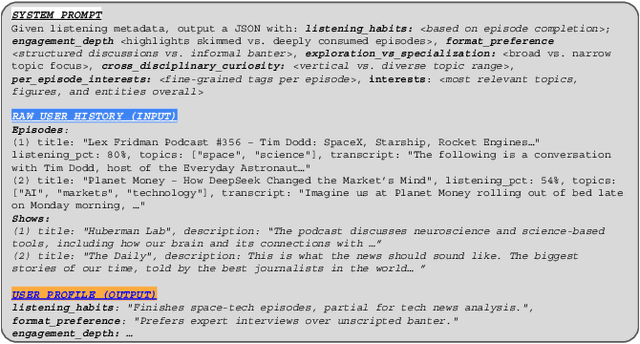
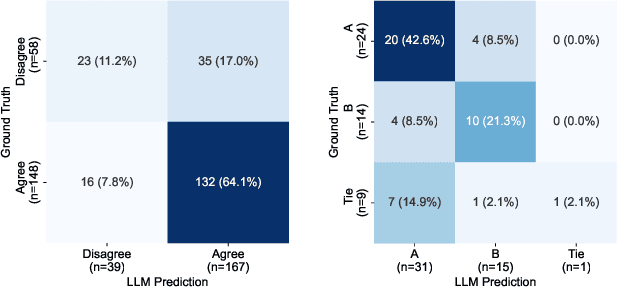
Evaluating personalized recommendations remains a central challenge, especially in long-form audio domains like podcasts, where traditional offline metrics suffer from exposure bias and online methods such as A/B testing are costly and operationally constrained. In this paper, we propose a novel framework that leverages Large Language Models (LLMs) as offline judges to assess the quality of podcast recommendations in a scalable and interpretable manner. Our two-stage profile-aware approach first constructs natural-language user profiles distilled from 90 days of listening history. These profiles summarize both topical interests and behavioral patterns, serving as compact, interpretable representations of user preferences. Rather than prompting the LLM with raw data, we use these profiles to provide high-level, semantically rich context-enabling the LLM to reason more effectively about alignment between a user's interests and recommended episodes. This reduces input complexity and improves interpretability. The LLM is then prompted to deliver fine-grained pointwise and pairwise judgments based on the profile-episode match. In a controlled study with 47 participants, our profile-aware judge matched human judgments with high fidelity and outperformed or matched a variant using raw listening histories. The framework enables efficient, profile-aware evaluation for iterative testing and model selection in recommender systems.
Towards Graph Foundation Models for Personalization
Mar 12, 2024In the realm of personalization, integrating diverse information sources such as consumption signals and content-based representations is becoming increasingly critical to build state-of-the-art solutions. In this regard, two of the biggest trends in research around this subject are Graph Neural Networks (GNNs) and Foundation Models (FMs). While GNNs emerged as a popular solution in industry for powering personalization at scale, FMs have only recently caught attention for their promising performance in personalization tasks like ranking and retrieval. In this paper, we present a graph-based foundation modeling approach tailored to personalization. Central to this approach is a Heterogeneous GNN (HGNN) designed to capture multi-hop content and consumption relationships across a range of recommendable item types. To ensure the generality required from a Foundation Model, we employ a Large Language Model (LLM) text-based featurization of nodes that accommodates all item types, and construct the graph using co-interaction signals, which inherently transcend content specificity. To facilitate practical generalization, we further couple the HGNN with an adaptation mechanism based on a two-tower (2T) architecture, which also operates agnostically to content type. This multi-stage approach ensures high scalability; while the HGNN produces general purpose embeddings, the 2T component models in a continuous space the sheer size of user-item interaction data. Our comprehensive approach has been rigorously tested and proven effective in delivering recommendations across a diverse array of products within a real-world, industrial audio streaming platform.
Personalized Audiobook Recommendations at Spotify Through Graph Neural Networks
Mar 08, 2024In the ever-evolving digital audio landscape, Spotify, well-known for its music and talk content, has recently introduced audiobooks to its vast user base. While promising, this move presents significant challenges for personalized recommendations. Unlike music and podcasts, audiobooks, initially available for a fee, cannot be easily skimmed before purchase, posing higher stakes for the relevance of recommendations. Furthermore, introducing a new content type into an existing platform confronts extreme data sparsity, as most users are unfamiliar with this new content type. Lastly, recommending content to millions of users requires the model to react fast and be scalable. To address these challenges, we leverage podcast and music user preferences and introduce 2T-HGNN, a scalable recommendation system comprising Heterogeneous Graph Neural Networks (HGNNs) and a Two Tower (2T) model. This novel approach uncovers nuanced item relationships while ensuring low latency and complexity. We decouple users from the HGNN graph and propose an innovative multi-link neighbor sampler. These choices, together with the 2T component, significantly reduce the complexity of the HGNN model. Empirical evaluations involving millions of users show significant improvement in the quality of personalized recommendations, resulting in a +46% increase in new audiobooks start rate and a +23% boost in streaming rates. Intriguingly, our model's impact extends beyond audiobooks, benefiting established products like podcasts.
Smooth image-to-image translations with latent space interpolations
Oct 03, 2022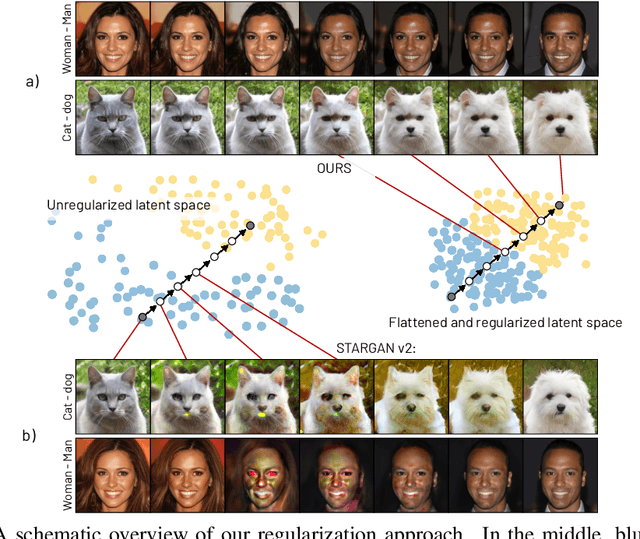
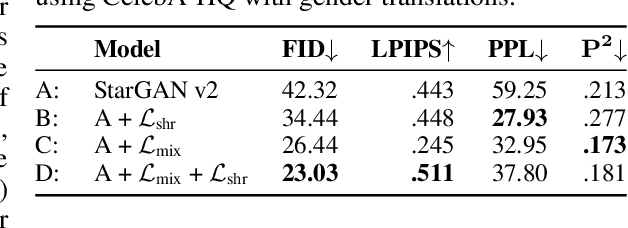
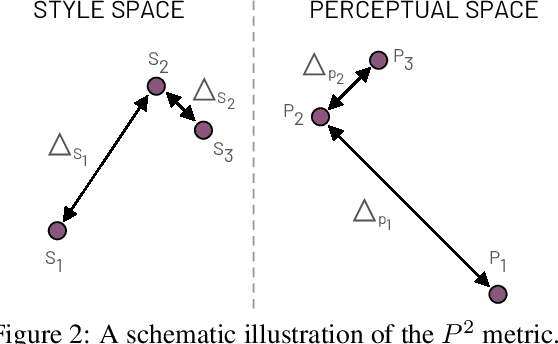
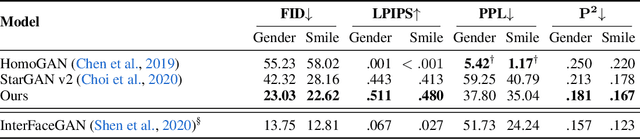
Multi-domain image-to-image (I2I) translations can transform a source image according to the style of a target domain. One important, desired characteristic of these transformations, is their graduality, which corresponds to a smooth change between the source and the target image when their respective latent-space representations are linearly interpolated. However, state-of-the-art methods usually perform poorly when evaluated using inter-domain interpolations, often producing abrupt changes in the appearance or non-realistic intermediate images. In this paper, we argue that one of the main reasons behind this problem is the lack of sufficient inter-domain training data and we propose two different regularization methods to alleviate this issue: a new shrinkage loss, which compacts the latent space, and a Mixup data-augmentation strategy, which flattens the style representations between domains. We also propose a new metric to quantitatively evaluate the degree of the interpolation smoothness, an aspect which is not sufficiently covered by the existing I2I translation metrics. Using both our proposed metric and standard evaluation protocols, we show that our regularization techniques can improve the state-of-the-art multi-domain I2I translations by a large margin. Our code will be made publicly available upon the acceptance of this article.
Spatial Entropy Regularization for Vision Transformers
Jun 09, 2022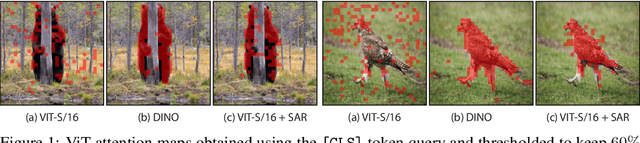
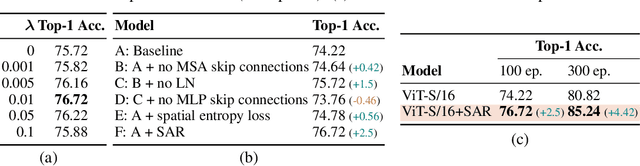
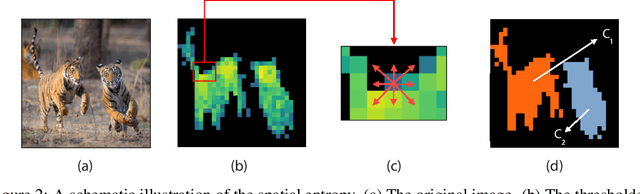
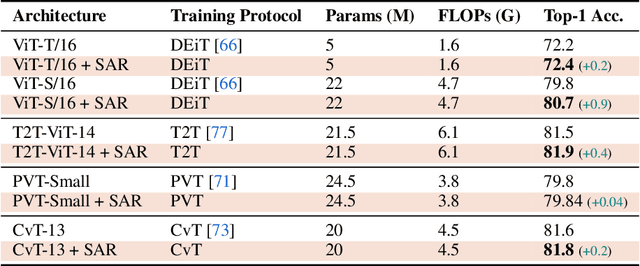
Recent work has shown that the attention maps of Vision Transformers (VTs), when trained with self-supervision, can contain a semantic segmentation structure which does not spontaneously emerge when training is supervised. In this paper, we explicitly encourage the emergence of this spatial clustering as a form of training regularization, this way including a self-supervised pretext task into the standard supervised learning. In more detail, we propose a VT regularization method based on a spatial formulation of the information entropy. By minimizing the proposed spatial entropy, we explicitly ask the VT to produce spatially ordered attention maps, this way including an object-based prior during training. Using extensive experiments, we show that the proposed regularization approach is beneficial with different training scenarios, datasets, downstream tasks and VT architectures. The code will be available upon acceptance.
ISF-GAN: An Implicit Style Function for High-Resolution Image-to-Image Translation
Sep 26, 2021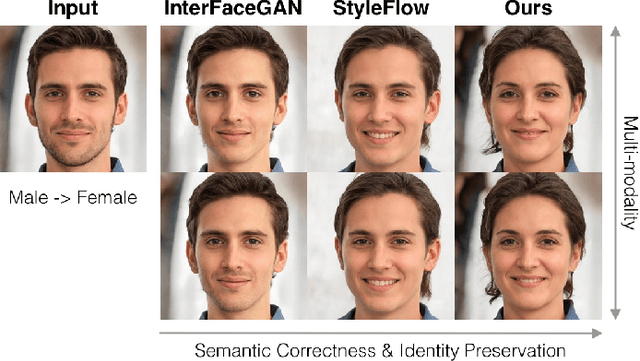
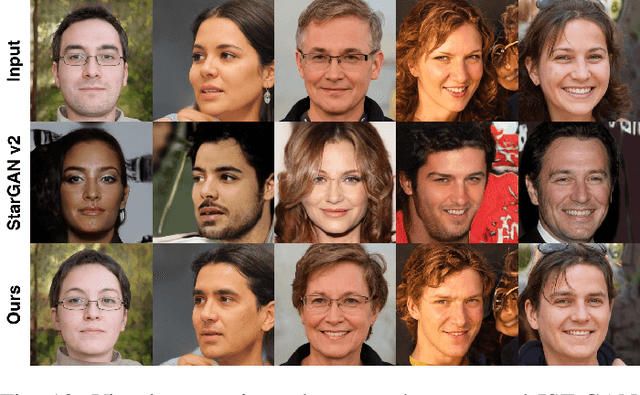
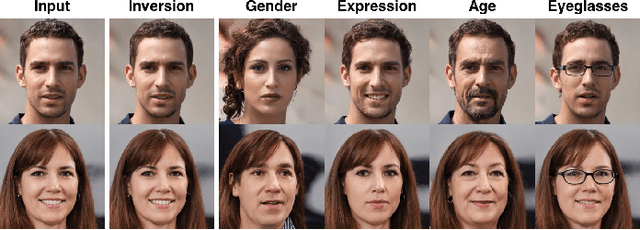
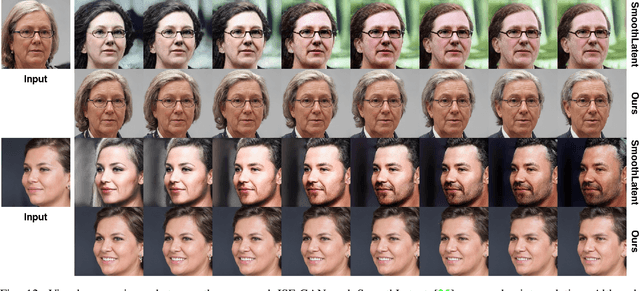
Recently, there has been an increasing interest in image editing methods that employ pre-trained unconditional image generators (e.g., StyleGAN). However, applying these methods to translate images to multiple visual domains remains challenging. Existing works do not often preserve the domain-invariant part of the image (e.g., the identity in human face translations), they do not usually handle multiple domains, or do not allow for multi-modal translations. This work proposes an implicit style function (ISF) to straightforwardly achieve multi-modal and multi-domain image-to-image translation from pre-trained unconditional generators. The ISF manipulates the semantics of an input latent code to make the image generated from it lying in the desired visual domain. Our results in human face and animal manipulations show significantly improved results over the baselines. Our model enables cost-effective multi-modal unsupervised image-to-image translations at high resolution using pre-trained unconditional GANs. The code and data are available at: \url{https://github.com/yhlleo/stylegan-mmuit}.
Click to Move: Controlling Video Generation with Sparse Motion
Aug 19, 2021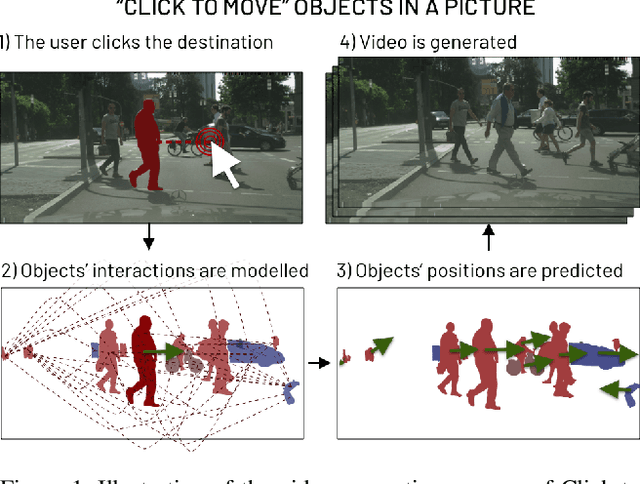
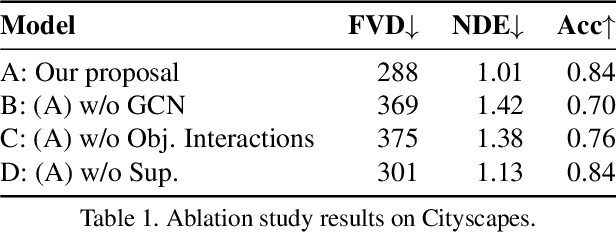
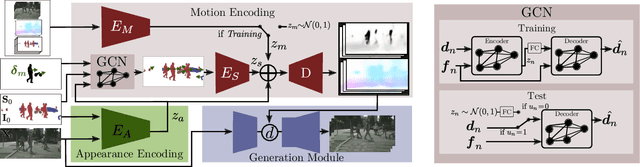
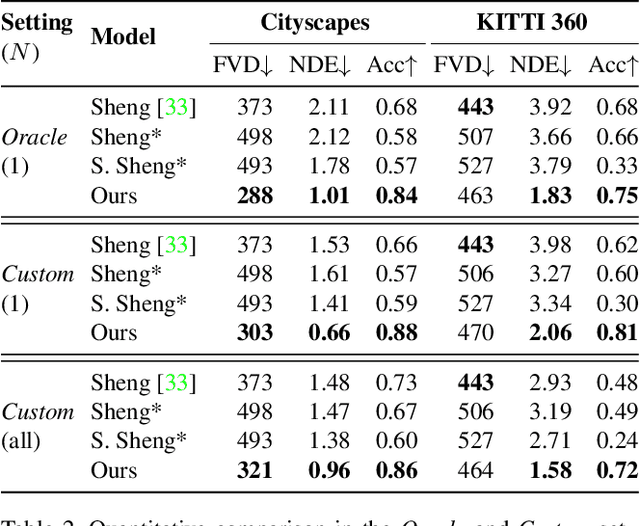
This paper introduces Click to Move (C2M), a novel framework for video generation where the user can control the motion of the synthesized video through mouse clicks specifying simple object trajectories of the key objects in the scene. Our model receives as input an initial frame, its corresponding segmentation map and the sparse motion vectors encoding the input provided by the user. It outputs a plausible video sequence starting from the given frame and with a motion that is consistent with user input. Notably, our proposed deep architecture incorporates a Graph Convolution Network (GCN) modelling the movements of all the objects in the scene in a holistic manner and effectively combining the sparse user motion information and image features. Experimental results show that C2M outperforms existing methods on two publicly available datasets, thus demonstrating the effectiveness of our GCN framework at modelling object interactions. The source code is publicly available at https://github.com/PierfrancescoArdino/C2M.
Smoothing the Disentangled Latent Style Space for Unsupervised Image-to-Image Translation
Jun 16, 2021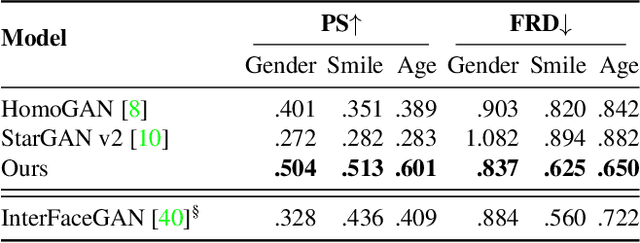
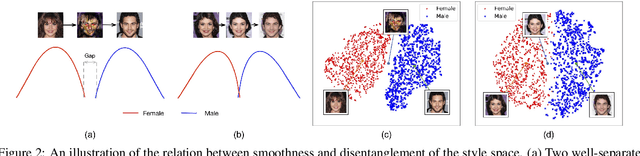
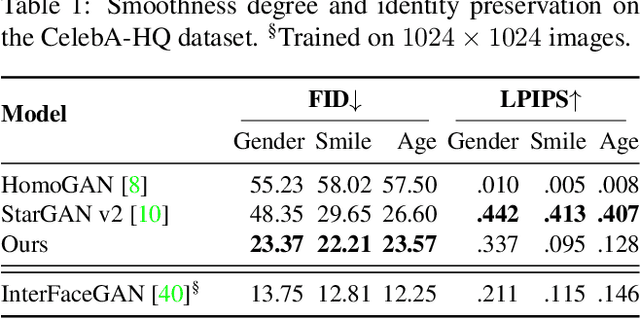
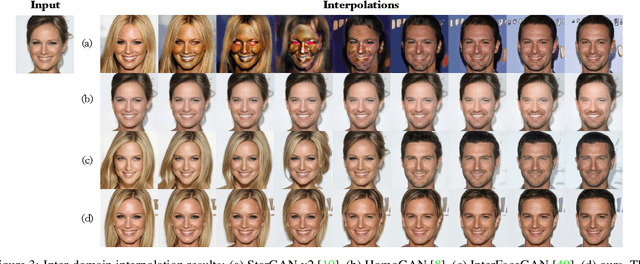
Image-to-Image (I2I) multi-domain translation models are usually evaluated also using the quality of their semantic interpolation results. However, state-of-the-art models frequently show abrupt changes in the image appearance during interpolation, and usually perform poorly in interpolations across domains. In this paper, we propose a new training protocol based on three specific losses which help a translation network to learn a smooth and disentangled latent style space in which: 1) Both intra- and inter-domain interpolations correspond to gradual changes in the generated images and 2) The content of the source image is better preserved during the translation. Moreover, we propose a novel evaluation metric to properly measure the smoothness of latent style space of I2I translation models. The proposed method can be plugged into existing translation approaches, and our extensive experiments on different datasets show that it can significantly boost the quality of the generated images and the graduality of the interpolations.