 Add to Chrome
 Add to Firefox
 Add to Edge
Seeing is Believing, but How Much? A Comprehensive Analysis of Verbalized Calibration in Vision-Language Models
May 26, 2025
Uncertainty quantification is essential for assessing the reliability and trustworthiness of modern AI systems. Among existing approaches, verbalized uncertainty, where models express their confidence through natural language, has emerged as a lightweight and interpretable solution in large language models (LLMs). However, its effectiveness in vision-language models (VLMs) remains insufficiently studied. In this work, we conduct a comprehensive evaluation of verbalized confidence in VLMs, spanning three model categories, four task domains, and three evaluation scenarios. Our results show that current VLMs often display notable miscalibration across diverse tasks and settings. Notably, visual reasoning models (i.e., thinking with images) consistently exhibit better calibration, suggesting that modality-specific reasoning is critical for reliable uncertainty estimation. To further address calibration challenges, we introduce Visual Confidence-Aware Prompting, a two-stage prompting strategy that improves confidence alignment in multimodal settings. Overall, our study highlights the inherent miscalibration in VLMs across modalities. More broadly, our findings underscore the fundamental importance of modality alignment and model faithfulness in advancing reliable multimodal systems.

Enhancing Monocular Height Estimation via Sparse LiDAR-Guided Correction
May 11, 2025Monocular height estimation (MHE) from very-high-resolution (VHR) remote sensing imagery via deep learning is notoriously challenging due to the lack of sufficient structural information. Conventional digital elevation models (DEMs), typically derived from airborne LiDAR or multi-view stereo, remain costly and geographically limited. Recently, models trained on synthetic data and refined through domain adaptation have shown remarkable performance in MHE, yet it remains unclear how these models make predictions or how reliable they truly are. In this paper, we investigate a state-of-the-art MHE model trained purely on synthetic data to explore where the model looks when making height predictions. Through systematic analyses, we find that the model relies heavily on shadow cues, a factor that can lead to overestimation or underestimation of heights when shadows deviate from expected norms. Furthermore, the inherent difficulty of evaluating regression tasks with the human eye underscores additional limitations of purely synthetic training. To address these issues, we propose a novel correction pipeline that integrates sparse, imperfect global LiDAR measurements (ICESat-2) with deep-learning outputs to improve local accuracy and achieve spatially consistent corrections. Our method comprises two stages: pre-processing raw ICESat-2 data, followed by a random forest-based approach to densely refine height estimates. Experiments in three representative urban regions -- Saint-Omer, Tokyo, and Sao Paulo -- reveal substantial error reductions, with mean absolute error (MAE) decreased by 22.8\%, 6.9\%, and 4.9\%, respectively. These findings highlight the critical role of shadow awareness in synthetic data-driven models and demonstrate how fusing imperfect real-world LiDAR data can bolster the robustness of MHE, paving the way for more reliable and scalable 3D mapping solutions.
Joint Super-Resolution and Segmentation for 1-m Impervious Surface Area Mapping in China's Yangtze River Economic Belt
May 08, 2025We propose a novel joint framework by integrating super-resolution and segmentation, called JointSeg, which enables the generation of 1-meter ISA maps directly from freely available Sentinel-2 imagery. JointSeg was trained on multimodal cross-resolution inputs, offering a scalable and affordable alternative to traditional approaches. This synergistic design enables gradual resolution enhancement from 10m to 1m while preserving fine-grained spatial textures, and ensures high classification fidelity through effective cross-scale feature fusion. This method has been successfully applied to the Yangtze River Economic Belt (YREB), a region characterized by complex urban-rural patterns and diverse topography. As a result, a comprehensive ISA mapping product for 2021, referred to as ISA-1, was generated, covering an area of over 2.2 million square kilometers. Quantitative comparisons against the 10m ESA WorldCover and other benchmark products reveal that ISA-1 achieves an F1-score of 85.71%, outperforming bilinear-interpolation-based segmentation by 9.5%, and surpassing other ISA datasets by 21.43%-61.07%. In densely urbanized areas (e.g., Suzhou, Nanjing), ISA-1 reduces ISA overestimation through improved discrimination of green spaces and water bodies. Conversely, in mountainous regions (e.g., Ganzi, Zhaotong), it identifies significantly more ISA due to its enhanced ability to detect fragmented anthropogenic features such as rural roads and sparse settlements, demonstrating its robustness across diverse landscapes. Moreover, we present biennial ISA maps from 2017 to 2023, capturing spatiotemporal urbanization dynamics across representative cities. The results highlight distinct regional growth patterns: rapid expansion in upstream cities, moderate growth in midstream regions, and saturation in downstream metropolitan areas.
SARLANG-1M: A Benchmark for Vision-Language Modeling in SAR Image Understanding
Apr 04, 2025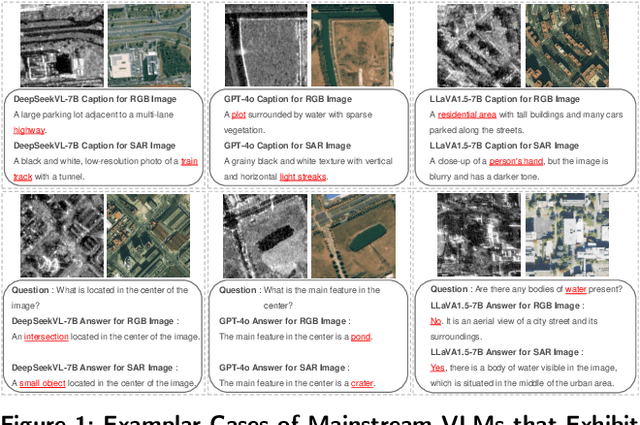
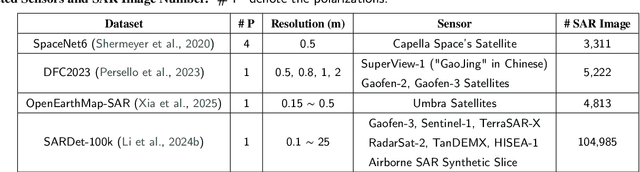
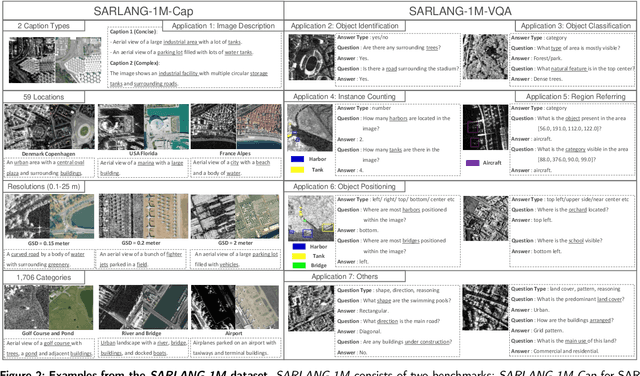
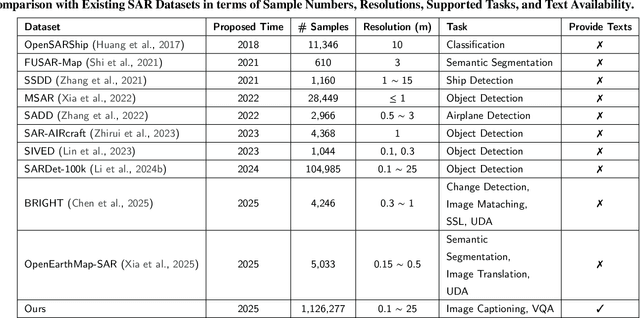
Synthetic Aperture Radar (SAR) is a crucial remote sensing technology, enabling all-weather, day-and-night observation with strong surface penetration for precise and continuous environmental monitoring and analysis. However, SAR image interpretation remains challenging due to its complex physical imaging mechanisms and significant visual disparities from human perception. Recently, Vision-Language Models (VLMs) have demonstrated remarkable success in RGB image understanding, offering powerful open-vocabulary interpretation and flexible language interaction. However, their application to SAR images is severely constrained by the absence of SAR-specific knowledge in their training distributions, leading to suboptimal performance. To address this limitation, we introduce SARLANG-1M, a large-scale benchmark tailored for multimodal SAR image understanding, with a primary focus on integrating SAR with textual modality. SARLANG-1M comprises more than 1 million high-quality SAR image-text pairs collected from over 59 cities worldwide. It features hierarchical resolutions (ranging from 0.1 to 25 meters), fine-grained semantic descriptions (including both concise and detailed captions), diverse remote sensing categories (1,696 object types and 16 land cover classes), and multi-task question-answering pairs spanning seven applications and 1,012 question types. Extensive experiments on mainstream VLMs demonstrate that fine-tuning with SARLANG-1M significantly enhances their performance in SAR image interpretation, reaching performance comparable to human experts. The dataset and code will be made publicly available at https://github.com/Jimmyxichen/SARLANG-1M.
A Vision Centric Remote Sensing Benchmark
Mar 20, 2025Multimodal Large Language Models (MLLMs) have achieved remarkable success in vision-language tasks but their remote sensing (RS) counterpart are relatively under explored. Unlike natural images, RS imagery presents unique challenges that current MLLMs struggle to handle, particularly in visual grounding and spatial reasoning. This study investigates the limitations of CLIP-based MLLMs in RS, highlighting their failure to differentiate visually distinct yet semantically similar RS images. To address this, we introduce a remote sensing multimodal visual patterns (RSMMVP) benchmark. It is designed to evaluate MLLMs in RS tasks by identifying the CLIP-blind pairs, where CLIP-based models incorrectly assign high similarity scores to visually distinct RS images. Through a visual question answering (VQA) evaluation, we analyze the performance of state-of-the-art MLLMs, revealing significant limitations in RS specific representation learning. The results provide valuable insights into the weaknesses of CLIP-based visual encoding and offer a foundation for future research to develop more effective MLLMs tailored for remote sensing applications.
MP-HSIR: A Multi-Prompt Framework for Universal Hyperspectral Image Restoration
Mar 12, 2025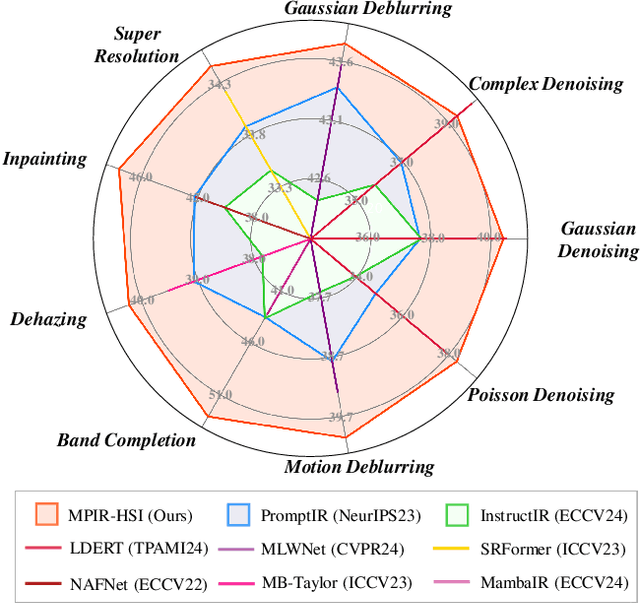
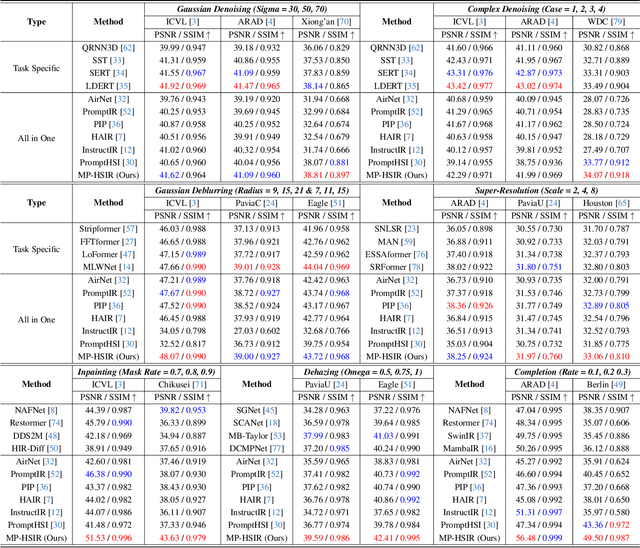
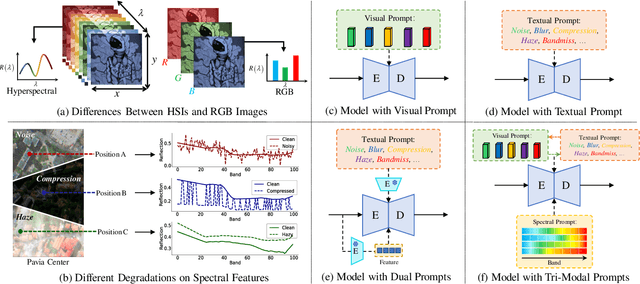
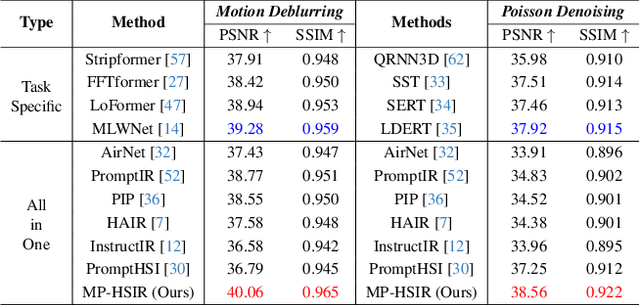
Hyperspectral images (HSIs) often suffer from diverse and unknown degradations during imaging, leading to severe spectral and spatial distortions. Existing HSI restoration methods typically rely on specific degradation assumptions, limiting their effectiveness in complex scenarios. In this paper, we propose MP-HSIR, a novel multi-prompt framework that effectively integrates spectral, textual, and visual prompts to achieve universal HSI restoration across diverse degradation types and intensities. Specifically, we develop a prompt-guided spatial-spectral transformer, which incorporates spatial self-attention and a prompt-guided dual-branch spectral self-attention. Since degradations affect spectral features differently, we introduce spectral prompts in the local spectral branch to provide universal low-rank spectral patterns as prior knowledge for enhancing spectral reconstruction. Furthermore, the text-visual synergistic prompt fuses high-level semantic representations with fine-grained visual features to encode degradation information, thereby guiding the restoration process. Extensive experiments on 9 HSI restoration tasks, including all-in-one scenarios, generalization tests, and real-world cases, demonstrate that MP-HSIR not only consistently outperforms existing all-in-one methods but also surpasses state-of-the-art task-specific approaches across multiple tasks. The code and models will be released at https://github.com/ZhehuiWu/MP-HSIR.
A Survey of Sample-Efficient Deep Learning for Change Detection in Remote Sensing: Tasks, Strategies, and Challenges
Feb 05, 2025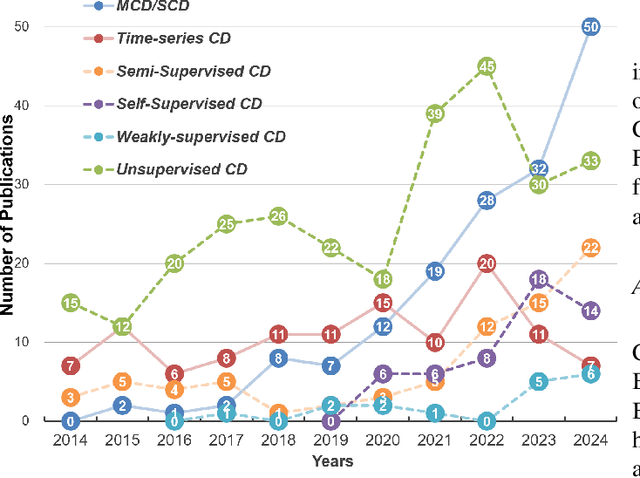
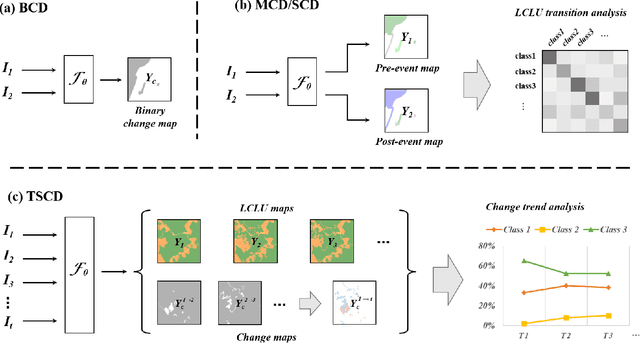
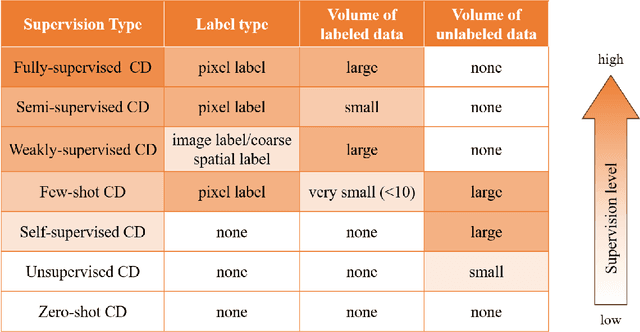
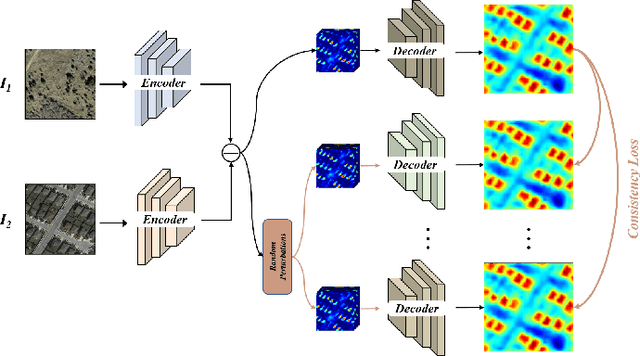
In the last decade, the rapid development of deep learning (DL) has made it possible to perform automatic, accurate, and robust Change Detection (CD) on large volumes of Remote Sensing Images (RSIs). However, despite advances in CD methods, their practical application in real-world contexts remains limited due to the diverse input data and the applicational context. For example, the collected RSIs can be time-series observations, and more informative results are required to indicate the time of change or the specific change category. Moreover, training a Deep Neural Network (DNN) requires a massive amount of training samples, whereas in many cases these samples are difficult to collect. To address these challenges, various specific CD methods have been developed considering different application scenarios and training resources. Additionally, recent advancements in image generation, self-supervision, and visual foundation models (VFMs) have opened up new approaches to address the 'data-hungry' issue of DL-based CD. The development of these methods in broader application scenarios requires further investigation and discussion. Therefore, this article summarizes the literature methods for different CD tasks and the available strategies and techniques to train and deploy DL-based CD methods in sample-limited scenarios. We expect that this survey can provide new insights and inspiration for researchers in this field to develop more effective CD methods that can be applied in a wider range of contexts.
OpenEarthMap-SAR: A Benchmark Synthetic Aperture Radar Dataset for Global High-Resolution Land Cover Mapping
Jan 18, 2025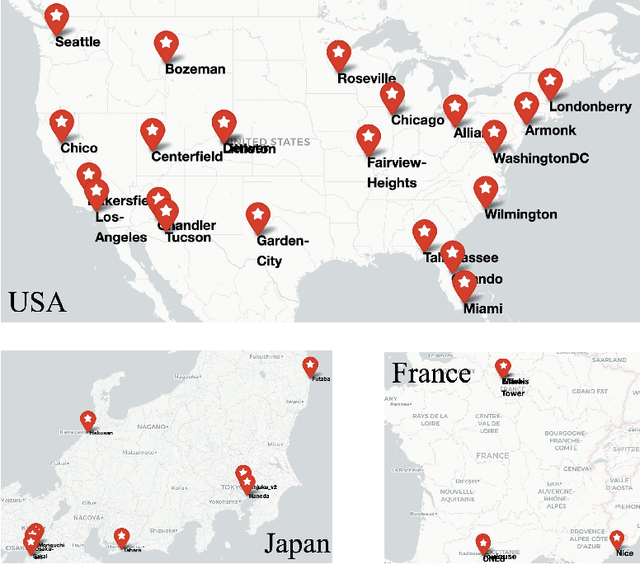


High-resolution land cover mapping plays a crucial role in addressing a wide range of global challenges, including urban planning, environmental monitoring, disaster response, and sustainable development. However, creating accurate, large-scale land cover datasets remains a significant challenge due to the inherent complexities of geospatial data, such as diverse terrain, varying sensor modalities, and atmospheric conditions. Synthetic Aperture Radar (SAR) imagery, with its ability to penetrate clouds and capture data in all-weather, day-and-night conditions, offers unique advantages for land cover mapping. Despite these strengths, the lack of benchmark datasets tailored for SAR imagery has limited the development of robust models specifically designed for this data modality. To bridge this gap and facilitate advancements in SAR-based geospatial analysis, we introduce OpenEarthMap-SAR, a benchmark SAR dataset, for global high-resolution land cover mapping. OpenEarthMap-SAR consists of 1.5 million segments of 5033 aerial and satellite images with the size of 1024$\times$1024 pixels, covering 35 regions from Japan, France, and the USA, with partially manually annotated and fully pseudo 8-class land cover labels at a ground sampling distance of 0.15--0.5 m. We evaluated the performance of state-of-the-art methods for semantic segmentation and present challenging problem settings suitable for further technical development. The dataset also serves the official dataset for IEEE GRSS Data Fusion Contest Track I. The dataset has been made publicly available at https://zenodo.org/records/14622048.
BRIGHT: A globally distributed multimodal building damage assessment dataset with very-high-resolution for all-weather disaster response
Jan 10, 2025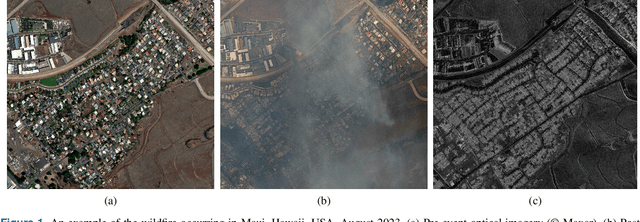
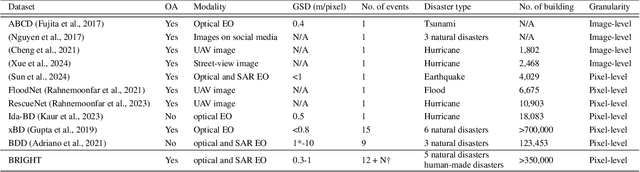


Disaster events occur around the world and cause significant damage to human life and property. Earth observation (EO) data enables rapid and comprehensive building damage assessment (BDA), an essential capability in the aftermath of a disaster to reduce human casualties and to inform disaster relief efforts. Recent research focuses on the development of AI models to achieve accurate mapping of unseen disaster events, mostly using optical EO data. However, solutions based on optical data are limited to clear skies and daylight hours, preventing a prompt response to disasters. Integrating multimodal (MM) EO data, particularly the combination of optical and SAR imagery, makes it possible to provide all-weather, day-and-night disaster responses. Despite this potential, the development of robust multimodal AI models has been constrained by the lack of suitable benchmark datasets. In this paper, we present a BDA dataset using veRy-hIGH-resoluTion optical and SAR imagery (BRIGHT) to support AI-based all-weather disaster response. To the best of our knowledge, BRIGHT is the first open-access, globally distributed, event-diverse MM dataset specifically curated to support AI-based disaster response. It covers five types of natural disasters and two types of man-made disasters across 12 regions worldwide, with a particular focus on developing countries where external assistance is most needed. The optical and SAR imagery in BRIGHT, with a spatial resolution between 0.3-1 meters, provides detailed representations of individual buildings, making it ideal for precise BDA. In our experiments, we have tested seven advanced AI models trained with our BRIGHT to validate the transferability and robustness. The dataset and code are available at https://github.com/ChenHongruixuan/BRIGHT. BRIGHT also serves as the official dataset for the 2025 IEEE GRSS Data Fusion Contest.
CrossEarth: Geospatial Vision Foundation Model for Domain Generalizable Remote Sensing Semantic Segmentation
Oct 31, 2024
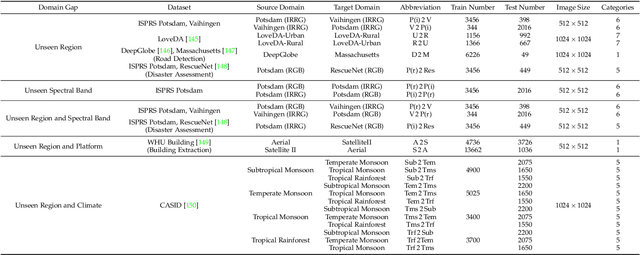

The field of Remote Sensing Domain Generalization (RSDG) has emerged as a critical and valuable research frontier, focusing on developing models that generalize effectively across diverse scenarios. Despite the substantial domain gaps in RS images that are characterized by variabilities such as location, wavelength, and sensor type, research in this area remains underexplored: (1) Current cross-domain methods primarily focus on Domain Adaptation (DA), which adapts models to predefined domains rather than to unseen ones; (2) Few studies targeting the RSDG issue, especially for semantic segmentation tasks, where existing models are developed for specific unknown domains, struggling with issues of underfitting on other unknown scenarios; (3) Existing RS foundation models tend to prioritize in-domain performance over cross-domain generalization. To this end, we introduce the first vision foundation model for RSDG semantic segmentation, CrossEarth. CrossEarth demonstrates strong cross-domain generalization through a specially designed data-level Earth-Style Injection pipeline and a model-level Multi-Task Training pipeline. In addition, for the semantic segmentation task, we have curated an RSDG benchmark comprising 28 cross-domain settings across various regions, spectral bands, platforms, and climates, providing a comprehensive framework for testing the generalizability of future RSDG models. Extensive experiments on this benchmark demonstrate the superiority of CrossEarth over existing state-of-the-art methods.