 Add to Chrome
 Add to Firefox
 Add to Edge
GeoMMBench and GeoMMAgent: Toward Expert-Level Multimodal Intelligence in Geoscience and Remote Sensing
Apr 10, 2026
Recent advances in multimodal large language models (MLLMs) have accelerated progress in domain-oriented AI, yet their development in geoscience and remote sensing (RS) remains constrained by distinctive challenges: wide-ranging disciplinary knowledge, heterogeneous sensor modalities, and a fragmented spectrum of tasks. To bridge these gaps, we introduce GeoMMBench, a comprehensive multimodal question-answering benchmark covering diverse RS disciplines, sensors, and tasks, enabling broader and more rigorous evaluation than prior benchmarks. Using GeoMMBench, we assess 36 open-source and proprietary large language models, uncovering systematic deficiencies in domain knowledge, perceptual grounding, and reasoning--capabilities essential for expert-level geospatial interpretation. Beyond evaluation, we propose GeoMMAgent, a multi-agent framework that strategically integrates retrieval, perception, and reasoning through domain-specific RS models and tools. Extensive experimental results demonstrate that GeoMMAgent significantly outperforms standalone LLMs, underscoring the importance of tool-augmented agents for dynamically tackling complex geoscience and RS challenges.

SARLANG-1M: A Benchmark for Vision-Language Modeling in SAR Image Understanding
Apr 04, 2025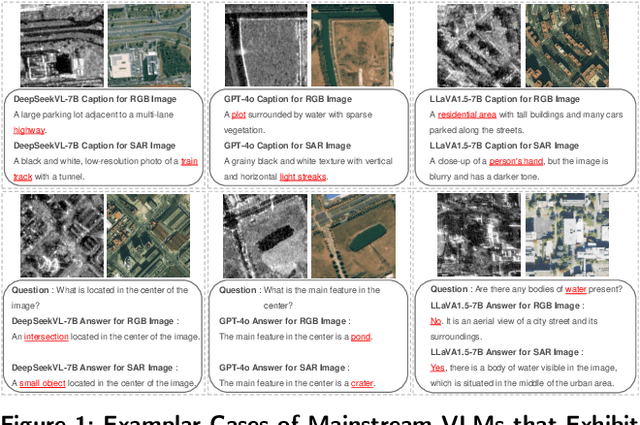
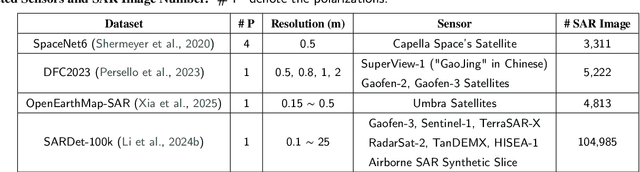
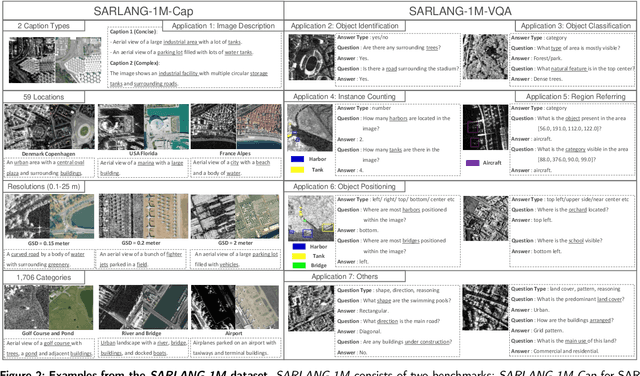
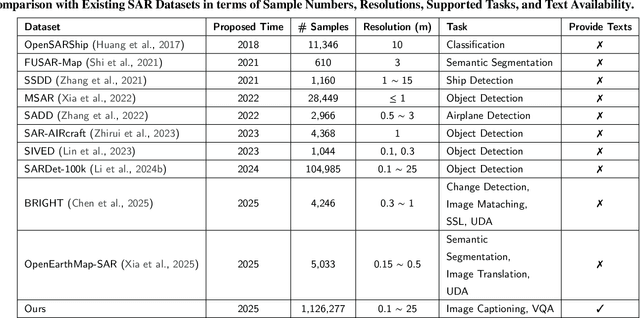
Synthetic Aperture Radar (SAR) is a crucial remote sensing technology, enabling all-weather, day-and-night observation with strong surface penetration for precise and continuous environmental monitoring and analysis. However, SAR image interpretation remains challenging due to its complex physical imaging mechanisms and significant visual disparities from human perception. Recently, Vision-Language Models (VLMs) have demonstrated remarkable success in RGB image understanding, offering powerful open-vocabulary interpretation and flexible language interaction. However, their application to SAR images is severely constrained by the absence of SAR-specific knowledge in their training distributions, leading to suboptimal performance. To address this limitation, we introduce SARLANG-1M, a large-scale benchmark tailored for multimodal SAR image understanding, with a primary focus on integrating SAR with textual modality. SARLANG-1M comprises more than 1 million high-quality SAR image-text pairs collected from over 59 cities worldwide. It features hierarchical resolutions (ranging from 0.1 to 25 meters), fine-grained semantic descriptions (including both concise and detailed captions), diverse remote sensing categories (1,696 object types and 16 land cover classes), and multi-task question-answering pairs spanning seven applications and 1,012 question types. Extensive experiments on mainstream VLMs demonstrate that fine-tuning with SARLANG-1M significantly enhances their performance in SAR image interpretation, reaching performance comparable to human experts. The dataset and code will be made publicly available at https://github.com/Jimmyxichen/SARLANG-1M.