 Add to Chrome
 Add to Firefox
 Add to Edge
Hyperspectral Calibration Detection: A Novel Concept For Change Detection With Unsupervised Incremental Safe Pseudo-Labeling Implementation
Aug 06, 2026
Hyperspectral change detection (HCD) has found numerous key applications, such as land cover monitoring. The majority of benchmark HCD algorithms are semi-supervised methods, and some of them can even achieve very low sample labeling rates. However, in some practical scenarios, such as those requiring immediate detection responses for onboard edge computing, we need to achieve the zero-label requirement as ground-truth labeling would not be available onboard for newly acquired images. In this work, we propose a fully unsupervised HCD algorithm, together with a lightweight model, quite suitable for onboard detection missions. Based on an iteratively augmented training set that safely collects some unchanged pixel samples, we learn an iteratively refined spectrum calibration function that eventually compensates the variability of acquisition conditions (often observed in bitemporal images), thereby making the changed pixels easily detectable by analyzing the calibrated spectra. The proposed hyperspectral looping unsupervised calibration and incremental detection (HyperLUCID) algorithm is not only computationally efficient (around 1 to 2 orders of magnitude faster than most benchmark HCD methods), but has also achieved state-of-the-art results (around 93.6% to 97.9% overall accuracy) on several real benchmark HCD datasets. Source codes: https://github.com/IHCLab/HyperLUCID.

Descriptor: LYNRED Mobility Dataset Multimodal Detection Subset (LYNRED-MDS)
Jul 02, 2026Current road safety systems primarily focus on minimizing post-collision damage. However, advances in algorithmic perception are shifting focus toward early collision prediction, especially in lowvisibility conditions like nighttime or fog, where thermal infrared sensing outperforms both human vision and RGB imaging. While available RGB-infrared datasets such as FLIR ADAS and LLVIP are good benchmarks, they mostly consist of clear weather and overly simple scenarios. In this article, we introduce the LYNRED-MDS: Multimodal Detection Subset, a subset of the LYNRED Mobility Dataset, comprised of 4000 RGB-infrared image pairs captured under diverse weather, lighting, and road conditions around Grenoble, France. Our dataset spans varied driving contexts (urban, rural, mountainous, etc.) and a vehicle fleet compliant with Western European standards. Thermal cross-dataset evaluation using a YOLOv8n baseline suggests that our dataset offers strong generalization potential for pedestrian detection in driving scenarios. By covering critical edge cases, our dataset supports the development of more reliable and deployable vision systems for advanced driver-assistance systems.
SpectralEarth-FM: Bringing Hyperspectral Imagery into Multimodal Earth Observation Pretraining
May 20, 2026Earth observation (EO) foundation models (FMs) are increasingly trained on multisensor data, spanning multispectral imagery (MSI), synthetic aperture radar (SAR), and derived geospatial layers, but hyperspectral imagery (HSI) remains underrepresented. Conversely, existing hyperspectral FMs are trained on HSI alone, leaving joint pretraining and fusion of HSI with co-located EO sensors unexplored. We introduce SpectralEarth-FM, a hierarchical transformer for multisensor EO input with heterogeneous spectral dimensionality. The architecture combines spectral tokenization for hyperspectral inputs, sensor-specific encoders, a cross-sensor fusion module, and a shared hierarchical encoder, enabling joint processing of HSI and lower-channel observations. To pretrain SpectralEarth-FM, we curate SpectralEarth-MM, a dataset that co-locates HSI from three spaceborne sensors (EnMAP, EMIT, DESIS) with Sentinel-2, Landsat-8/9 optical imagery, Landsat land surface temperature (LST), and Sentinel-1 SAR, over common geographic footprints. It comprises approximately 2M globally distributed locations, 25M georeferenced patches, and over 40TB of data. Pretraining uses a Joint-Embedding Predictive Architecture (JEPA)-style objective that matches representations between global views and single-sensor local views from the same location. We evaluate SpectralEarth-FM on hyperspectral downstream tasks and standard EO benchmarks following the PANGAEA protocol, achieving state-of-the-art results across both evaluation settings.
The data heat island effect: quantifying the impact of AI data centers in a warming world
Mar 21, 2026The strong and continuous increase of AI-based services leads to the steady proliferation of AI data centres worldwide with the unavoidable escalation of their power consumption. It is unknown how this energy demand for computational purposes will impact the surrounding environment. Here, we focus our attention on the heat dissipation of AI hyperscalers. Taking advantage of land surface temperature measurements acquired by remote sensing platforms over the last decades, we are able to obtain a robust assessment of the temperature increase recorded in the areas surrounding AI data centres globally. We estimate that the land surface temperature increases by 2°C on average after the start of operations of an AI data centre, inducing local microclimate zones, which we call the data heat island effect. We assess the impact on the communities, quantifying that more than 340 million people could be affected by this temperature increase. Our results show that the data heat island effect could have a remarkable influence on communities and regional welfare in the future, hence becoming part of the conversation around environmentally sustainable AI worldwide.
Foundation Models in Remote Sensing: Evolving from Unimodality to Multimodality
Mar 01, 2026Remote sensing (RS) techniques are increasingly crucial for deepening our understanding of the planet. As the volume and diversity of RS data continue to grow exponentially, there is an urgent need for advanced data modeling and understanding capabilities to manage and interpret these vast datasets effectively. Foundation models present significant new growth opportunities and immense potential to revolutionize the RS field. In this paper, we conduct a comprehensive technical survey on foundation models in RS, offering a brand-new perspective by exploring their evolution from unimodality to multimodality. We hope this work serves as a valuable entry point for researchers interested in both foundation models and RS and helps them launch new projects or explore new research topics in this rapidly evolving area. This survey addresses the following three key questions: What are foundation models in RS? Why are foundation models needed in RS? How can we effectively guide junior researchers in gaining a comprehensive and practical understanding of foundation models in RS applications? More specifically, we begin by outlining the background and motivation, emphasizing the importance of foundation models in RS. We then review existing foundation models in RS, systematically categorizing them into unimodal and multimodal approaches. Additionally, we provide a tutorial-like section to guide researchers, especially beginners, on how to train foundation models in RS and apply them to real-world tasks. The survey aims to equip researchers in RS with a deeper and more efficient understanding of foundation models, enabling them to get started easily and effectively apply these models across various RS applications.
KANO: Kolmogorov-Arnold Neural Operator for Image Super-Resolution
Dec 28, 2025The highly nonlinear degradation process, complex physical interactions, and various sources of uncertainty render single-image Super-resolution (SR) a particularly challenging task. Existing interpretable SR approaches, whether based on prior learning or deep unfolding optimization frameworks, typically rely on black-box deep networks to model latent variables, which leaves the degradation process largely unknown and uncontrollable. Inspired by the Kolmogorov-Arnold theorem (KAT), we for the first time propose a novel interpretable operator, termed Kolmogorov-Arnold Neural Operator (KANO), with the application to image SR. KANO provides a transparent and structured representation of the latent degradation fitting process. Specifically, we employ an additive structure composed of a finite number of B-spline functions to approximate continuous spectral curves in a piecewise fashion. By learning and optimizing the shape parameters of these spline functions within defined intervals, our KANO accurately captures key spectral characteristics, such as local linear trends and the peak-valley structures at nonlinear inflection points, thereby endowing SR results with physical interpretability. Furthermore, through theoretical modeling and experimental evaluations across natural images, aerial photographs, and satellite remote sensing data, we systematically compare multilayer perceptrons (MLPs) and Kolmogorov-Arnold networks (KANs) in handling complex sequence fitting tasks. This comparative study elucidates the respective advantages and limitations of these models in characterizing intricate degradation mechanisms, offering valuable insights for the development of interpretable SR techniques.
Hyperspectral Imaging
Aug 11, 2025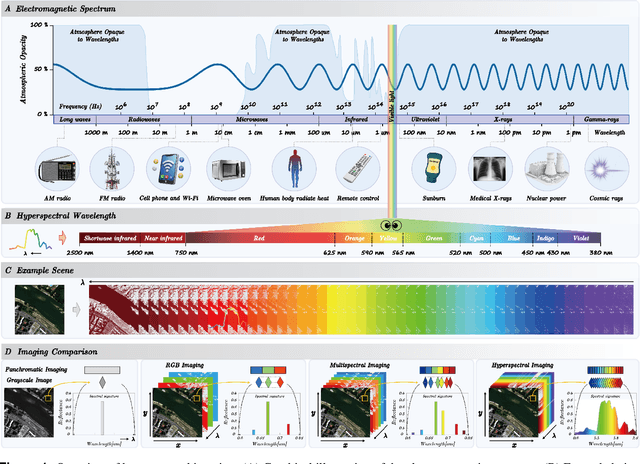
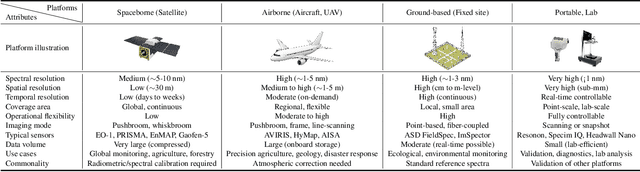
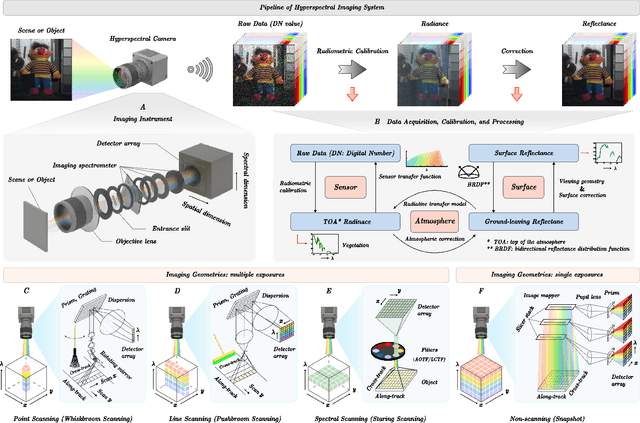

Hyperspectral imaging (HSI) is an advanced sensing modality that simultaneously captures spatial and spectral information, enabling non-invasive, label-free analysis of material, chemical, and biological properties. This Primer presents a comprehensive overview of HSI, from the underlying physical principles and sensor architectures to key steps in data acquisition, calibration, and correction. We summarize common data structures and highlight classical and modern analysis methods, including dimensionality reduction, classification, spectral unmixing, and AI-driven techniques such as deep learning. Representative applications across Earth observation, precision agriculture, biomedicine, industrial inspection, cultural heritage, and security are also discussed, emphasizing HSI's ability to uncover sub-visual features for advanced monitoring, diagnostics, and decision-making. Persistent challenges, such as hardware trade-offs, acquisition variability, and the complexity of high-dimensional data, are examined alongside emerging solutions, including computational imaging, physics-informed modeling, cross-modal fusion, and self-supervised learning. Best practices for dataset sharing, reproducibility, and metadata documentation are further highlighted to support transparency and reuse. Looking ahead, we explore future directions toward scalable, real-time, and embedded HSI systems, driven by sensor miniaturization, self-supervised learning, and foundation models. As HSI evolves into a general-purpose, cross-disciplinary platform, it holds promise for transformative applications in science, technology, and society.
Prospects for Mitigating Spectral Variability in Tropical Species Classification Using Self-Supervised Learning
Mar 17, 2025Airborne hyperspectral imaging is a promising method for identifying tropical species, but spectral variability between acquisitions hinders consistent results. This paper proposes using Self-Supervised Learning (SSL) to encode spectral features that are robust to abiotic variability and relevant for species identification. By employing the state-of-the-art Barlow-Twins approach on repeated spectral acquisitions, we demonstrate the ability to develop stable features. For the classification of 40 tropical species, experiments show that these features can outperform typical reflectance products in terms of robustness to spectral variability by 10 points of accuracy across dates.
* 5 pages, 3 figures, published as proceeding of the "2024 14th Workshop on Hyperspectral Imaging and Signal Processing: Evolution in Remote Sensing (WHISPERS)"
UrbanSAM: Learning Invariance-Inspired Adapters for Segment Anything Models in Urban Construction
Feb 21, 2025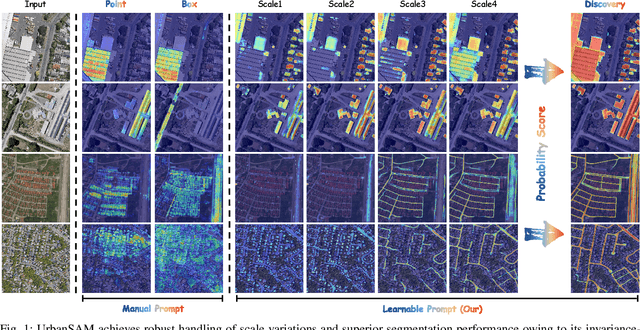
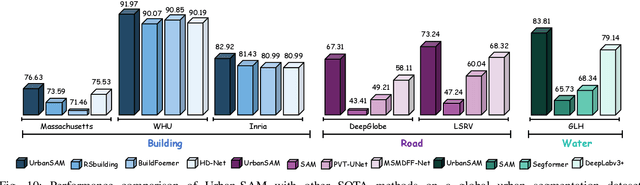
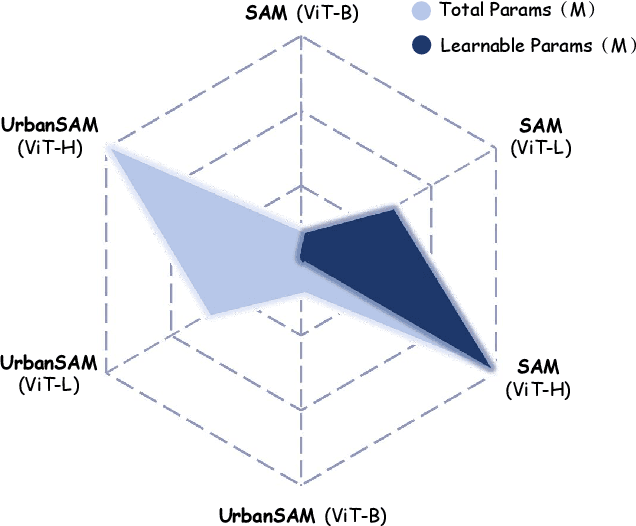
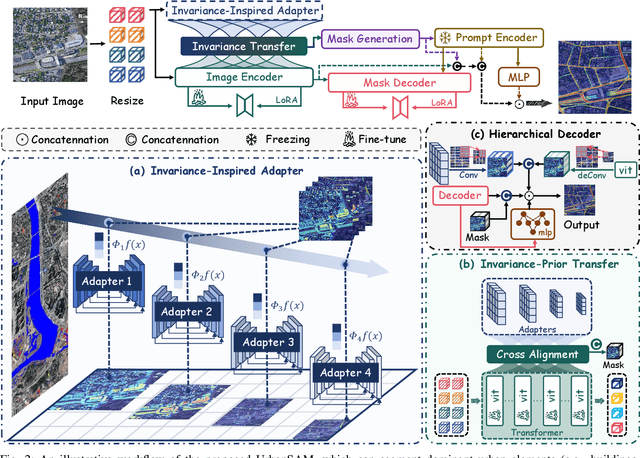
Object extraction and segmentation from remote sensing (RS) images is a critical yet challenging task in urban environment monitoring. Urban morphology is inherently complex, with irregular objects of diverse shapes and varying scales. These challenges are amplified by heterogeneity and scale disparities across RS data sources, including sensors, platforms, and modalities, making accurate object segmentation particularly demanding. While the Segment Anything Model (SAM) has shown significant potential in segmenting complex scenes, its performance in handling form-varying objects remains limited due to manual-interactive prompting. To this end, we propose UrbanSAM, a customized version of SAM specifically designed to analyze complex urban environments while tackling scaling effects from remotely sensed observations. Inspired by multi-resolution analysis (MRA) theory, UrbanSAM incorporates a novel learnable prompter equipped with a Uscaling-Adapter that adheres to the invariance criterion, enabling the model to capture multiscale contextual information of objects and adapt to arbitrary scale variations with theoretical guarantees. Furthermore, features from the Uscaling-Adapter and the trunk encoder are aligned through a masked cross-attention operation, allowing the trunk encoder to inherit the adapter's multiscale aggregation capability. This synergy enhances the segmentation performance, resulting in more powerful and accurate outputs, supported by the learned adapter. Extensive experimental results demonstrate the flexibility and superior segmentation performance of the proposed UrbanSAM on a global-scale dataset, encompassing scale-varying urban objects such as buildings, roads, and water.
A Survey of Sample-Efficient Deep Learning for Change Detection in Remote Sensing: Tasks, Strategies, and Challenges
Feb 05, 2025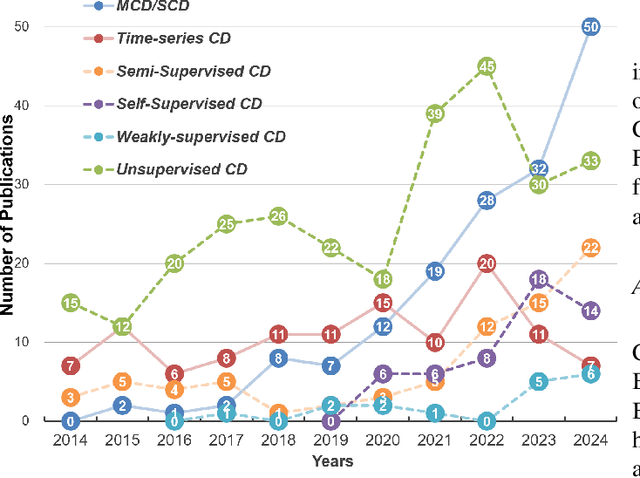
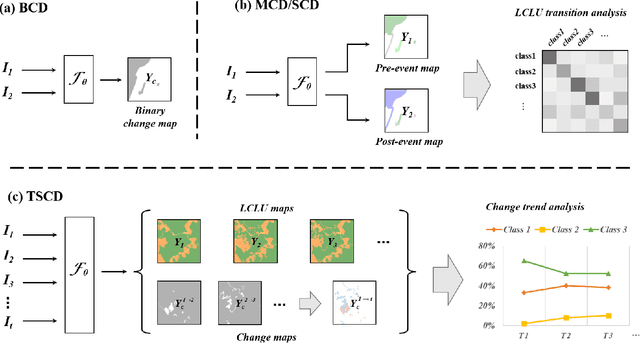
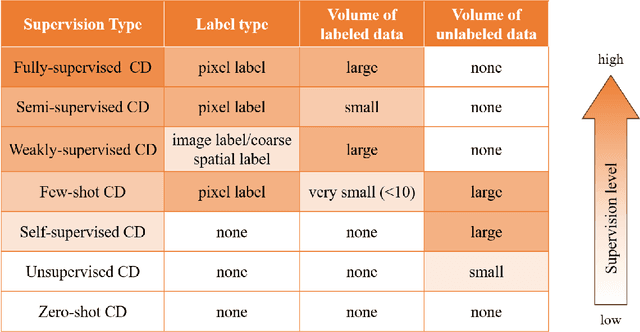
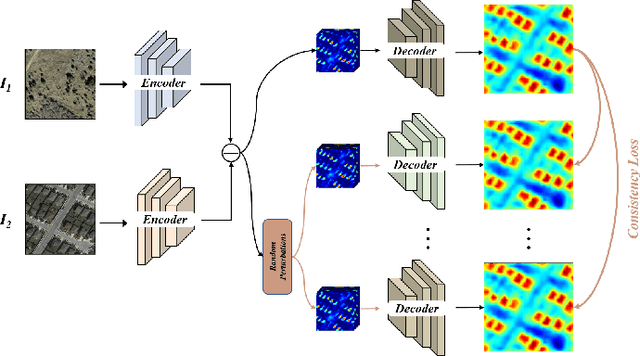
In the last decade, the rapid development of deep learning (DL) has made it possible to perform automatic, accurate, and robust Change Detection (CD) on large volumes of Remote Sensing Images (RSIs). However, despite advances in CD methods, their practical application in real-world contexts remains limited due to the diverse input data and the applicational context. For example, the collected RSIs can be time-series observations, and more informative results are required to indicate the time of change or the specific change category. Moreover, training a Deep Neural Network (DNN) requires a massive amount of training samples, whereas in many cases these samples are difficult to collect. To address these challenges, various specific CD methods have been developed considering different application scenarios and training resources. Additionally, recent advancements in image generation, self-supervision, and visual foundation models (VFMs) have opened up new approaches to address the 'data-hungry' issue of DL-based CD. The development of these methods in broader application scenarios requires further investigation and discussion. Therefore, this article summarizes the literature methods for different CD tasks and the available strategies and techniques to train and deploy DL-based CD methods in sample-limited scenarios. We expect that this survey can provide new insights and inspiration for researchers in this field to develop more effective CD methods that can be applied in a wider range of contexts.