 Add to Chrome
 Add to Firefox
 Add to Edge
Staying VIGILant: Mitigating Visual Laziness via Counterfactual Visual Alignment in MLLMs
Jun 24, 2026
Multimodal large language models (MLLMs) extend large language models (LLMs) with visual perception, enabling joint reasoning over images and text. Despite inheriting strong reasoning capabilities from LLMs, they remain prone to hallucinations that contradict their visual inputs. Mechanistic studies indicate that this weakness stems from visual laziness: MLLMs encode the correct visual evidence internally, but overly rely on strong language priors during response. Existing alignment methods, such as direct preference optimization, primarily optimize outcome-level rewards based on text. This introduces an optimization bias toward linguistic shortcuts, leading to responses that often contradict the visual evidence. To address this, we propose Visual Information Gain In aLignment (VIGIL), a reinforcement-learning (RL) post-training framework that shifts the focus from numerical reward fitting to causal visual grounding. VIGIL introduces a geometric constraint that explicitly maximizes the mutual information between the visual input and the generated response. We achieve this by penalizing "blind confidence" instances where the model remains improperly certain even when textual-visual attention is masked to create a counterfactual blind state. Extensive experiments show that VIGIL consistently outperforms recent alignment methods across hallucination and reasoning benchmarks without compromising text-only capabilities. Our approach matches the full-data performance of state-of-the-art methods using only 25% of the preference data and even demonstrates emergent spatial grounding capabilities without explicit bounding box supervision.

LATERN: Test-Time Context-Aware Explainable Video Anomaly Detection
May 14, 2026Vision-language models (VLMs) have recently emerged as a promising paradigm for video anomaly detection (VAD) due to their strong visual reasoning ability and natural language-based explainability. In this paper, we aim to address a key limitation of such pipelines, which perform segment-level inference independently owing to token constraints and reason without structured temporal context, allowing VLMs to interpret anomalies as deviations from evolving video dynamics rather than producing fragmented predictions and explanations. To specify, we propose a context-aware framework named LATERN, which reformulates VAD as a temporal evidence aggregation process. LATERN consists of two complementary modules: Context-Aware Anomaly Scoring (CEA) and Recursive Evidence Aggregation (REA). CEA introduces a novel image-grounded memory mechanism, which selectively chooses historical content via frame diversity and visual-textual alignment as expanded context to help generate reliable anomaly scores. Building upon these scores, REA performs recursive temporal aggregation to identify coherent anomaly intervals and produce event-level decisions and explanations grounded in visual-textual evidence. Extensive experiments on challenging benchmarks, including UCF-Crime and XD-Violence, show that LATERN enhances detection accuracy and explanation consistency for frozen VLMs during test time, while generating temporally coherent and semantically grounded event-level explanations.
EquiMem: Calibrating Shared Memory in Multi-Agent Debate via Game-Theoretic Equilibrium
May 10, 2026Multi-agent debate (MAD) systems increasingly rely on shared memory to support long-horizon reasoning, but this convenience opens a critical vulnerability: a single corrupted entry can contaminate the downstream memory-augmented reasoning, and debate alone fails to filter such errors. Existing safeguards filter entries via heuristics or LLM-based validation, yet they rely on AI judgments that share the same failure modes and overlook the cross-agent dynamics of MAD. We address this gap by formulating memory updating in MAD as a zero-trust memory game, in which no agent is assumed honest and the game's equilibrium serves as an indicator of optimal memory trust. Guided by this equilibrium, we propose EquiMem, an inference-time calibration mechanism that quantifies each update algorithmically against the shared memory state, using agents' existing retrieval queries and traversal paths as evidence rather than soliciting any LLM judgment. EquiMem instantiates calibration for both embedding- and graph-based memory, and across diverse benchmarks, MAD frameworks, and memory architectures, it consistently outperforms existing safeguards, remains robust under adversarial agents, and incurs negligible inference overhead.
ER-MIA: Black-Box Adversarial Memory Injection Attacks on Long-Term Memory-Augmented Large Language Models
Feb 17, 2026Large language models (LLMs) are increasingly augmented with long-term memory systems to overcome finite context windows and enable persistent reasoning across interactions. However, recent research finds that LLMs become more vulnerable because memory provides extra attack surfaces. In this paper, we present the first systematic study of black-box adversarial memory injection attacks that target the similarity-based retrieval mechanism in long-term memory-augmented LLMs. We introduce ER-MIA, a unified framework that exposes this vulnerability and formalizes two realistic attack settings: content-based attacks and question-targeted attacks. In these settings, ER-MIA includes an arsenal of composable attack primitives and ensemble attacks that achieve high success rates under minimal attacker assumptions. Extensive experiments across multiple LLMs and long-term memory systems demonstrate that similarity-based retrieval constitutes a fundamental and system-level vulnerability, revealing security risks that persist across memory designs and application scenarios.
Understanding Real-World Traffic Safety through RoadSafe365 Benchmark
Feb 06, 2026Although recent traffic benchmarks have advanced multimodal data analysis, they generally lack systematic evaluation aligned with official safety standards. To fill this gap, we introduce RoadSafe365, a large-scale vision-language benchmark that supports fine-grained analysis of traffic safety from extensive and diverse real-world video data collections. Unlike prior works that focus primarily on coarse accident identification, RoadSafe365 is independently curated and systematically organized using a hierarchical taxonomy that refines and extends foundational definitions of crash, incident, and violation to bridge official traffic safety standards with data-driven traffic understanding systems. RoadSafe365 provides rich attribute annotations across diverse traffic event types, environmental contexts, and interaction scenarios, yielding 36,196 annotated clips from both dashcam and surveillance cameras. Each clip is paired with multiple-choice question-answer sets, comprising 864K candidate options, 8.4K unique answers, and 36K detailed scene descriptions collectively designed for vision-language understanding and reasoning. We establish strong baselines and observe consistent gains when fine-tuning on RoadSafe365. Cross-domain experiments on both real and synthetic datasets further validate its effectiveness. Designed for large-scale training and standardized evaluation, RoadSafe365 provides a comprehensive benchmark to advance reproducible research in real-world traffic safety analysis.
The Value of Variance: Mitigating Debate Collapse in Multi-Agent Systems via Uncertainty-Driven Policy Optimization
Feb 06, 2026Multi-agent debate (MAD) systems improve LLM reasoning through iterative deliberation, but remain vulnerable to debate collapse, a failure type where final agent decisions are compromised on erroneous reasoning. Existing methods lack principled mechanisms to detect or prevent such failures. To address this gap, we first propose a hierarchical metric that quantifies behavioral uncertainty at three levels: intra-agent (individual reasoning uncertainty), inter-agent (interactive uncertainty), and system-level (output uncertainty). Empirical analysis across several benchmarks reveals that our proposed uncertainty quantification reliably indicates system failures, which demonstrates the validity of using them as diagnostic metrics to indicate the system failure. Subsequently, we propose a mitigation strategy by formulating an uncertainty-driven policy optimization to penalize self-contradiction, peer conflict, and low-confidence outputs in a dynamic debating environment. Experiments demonstrate that our proposed uncertainty-driven mitigation reliably calibrates the multi-agent system by consistently improving decision accuracy while reducing system disagreement.
SRVAU-R1: Enhancing Video Anomaly Understanding via Reflection-Aware Learning
Feb 01, 2026Multi-modal large language models (MLLMs) have demonstrated significant progress in reasoning capabilities and shown promising effectiveness in video anomaly understanding (VAU) tasks. However, existing MLLM-based approaches remain largely focused on surface-level descriptions of anomalies, lacking deep reasoning over abnormal behaviors like explicit self-reflection and self-correction. To address that, we propose Self-Reflection-Enhanced Reasoning for Video Anomaly Understanding (SRVAU-R1), a reflection-aware learning framework that incorporates reflection in MLLM reasoning. Specifically, SRVAU-R1 introduces the first reflection-oriented Chain-of-Thought dataset tailored for VAU, providing structured supervision with initial reasoning, self-reflection, and revised reasoning. Based on that, it includes a novel reflection-aware learning paradigm with supervised fine-tuning and reinforcement fine-tuning to enhance multi-modal reasoning for VAU. Extensive experiments on multiple video anomaly benchmarks demonstrate that SRVAU-R1 consistently outperforms existing methods, achieving significant improvements in both temporal anomaly localization accuracy and reasoning quality.
POLAR: Automating Cyber Threat Prioritization through LLM-Powered Assessment
Oct 02, 2025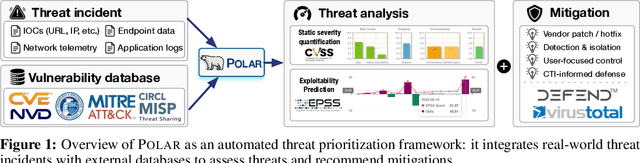
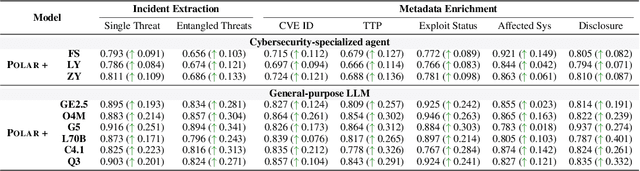
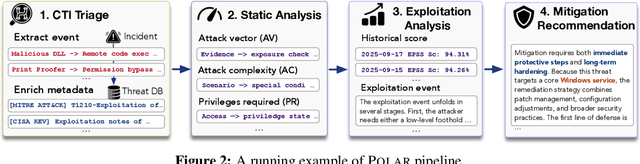
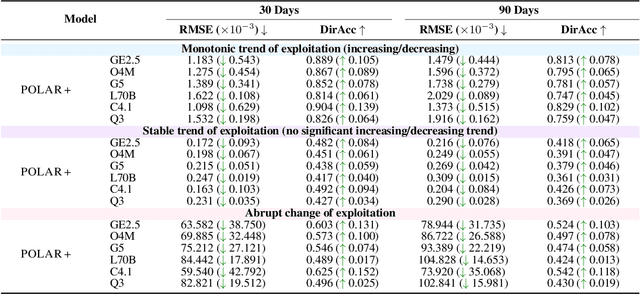
Large Language Models (LLMs) are intensively used to assist security analysts in counteracting the rapid exploitation of cyber threats, wherein LLMs offer cyber threat intelligence (CTI) to support vulnerability assessment and incident response. While recent work has shown that LLMs can support a wide range of CTI tasks such as threat analysis, vulnerability detection, and intrusion defense, significant performance gaps persist in practical deployments. In this paper, we investigate the intrinsic vulnerabilities of LLMs in CTI, focusing on challenges that arise from the nature of the threat landscape itself rather than the model architecture. Using large-scale evaluations across multiple CTI benchmarks and real-world threat reports, we introduce a novel categorization methodology that integrates stratification, autoregressive refinement, and human-in-the-loop supervision to reliably analyze failure instances. Through extensive experiments and human inspections, we reveal three fundamental vulnerabilities: spurious correlations, contradictory knowledge, and constrained generalization, that limit LLMs in effectively supporting CTI. Subsequently, we provide actionable insights for designing more robust LLM-powered CTI systems to facilitate future research.
VERA: Explainable Video Anomaly Detection via Verbalized Learning of Vision-Language Models
Dec 02, 2024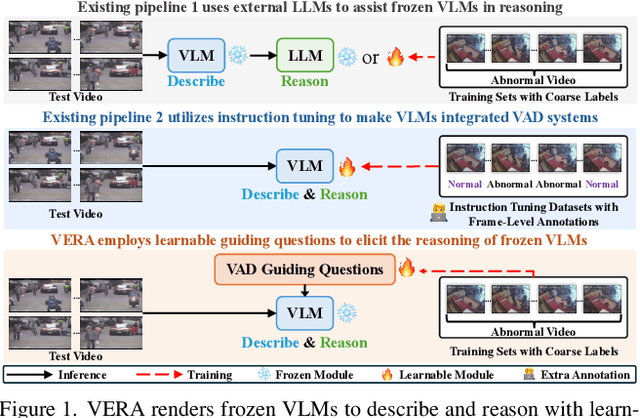
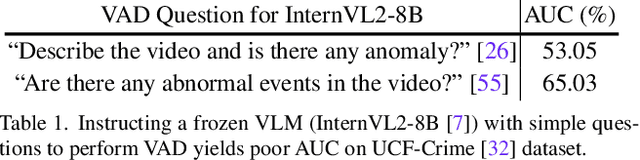
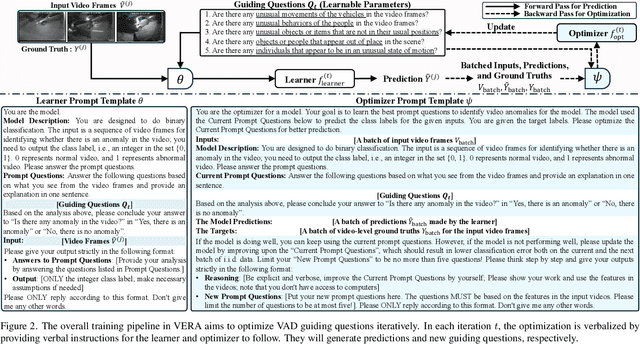
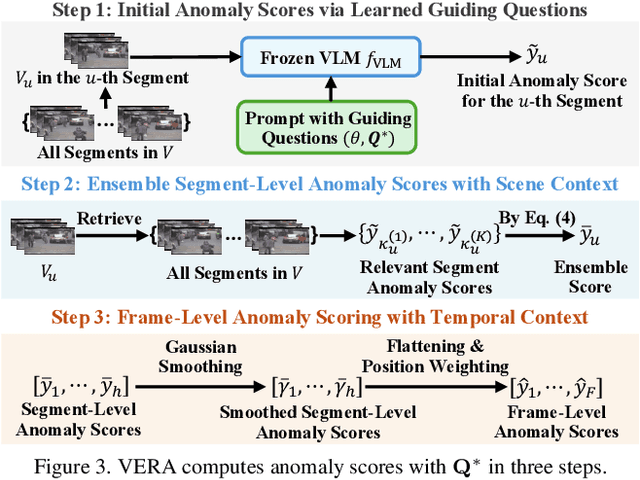
The rapid advancement of vision-language models (VLMs) has established a new paradigm in video anomaly detection (VAD): leveraging VLMs to simultaneously detect anomalies and provide comprehendible explanations for the decisions. Existing work in this direction often assumes the complex reasoning required for VAD exceeds the capabilities of pretrained VLMs. Consequently, these approaches either incorporate specialized reasoning modules during inference or rely on instruction tuning datasets through additional training to adapt VLMs for VAD. However, such strategies often incur substantial computational costs or data annotation overhead. To address these challenges in explainable VAD, we introduce a verbalized learning framework named VERA that enables VLMs to perform VAD without model parameter modifications. Specifically, VERA automatically decomposes the complex reasoning required for VAD into reflections on simpler, more focused guiding questions capturing distinct abnormal patterns. It treats these reflective questions as learnable parameters and optimizes them through data-driven verbal interactions between learner and optimizer VLMs, using coarsely labeled training data. During inference, VERA embeds the learned questions into model prompts to guide VLMs in generating segment-level anomaly scores, which are then refined into frame-level scores via the fusion of scene and temporal contexts. Experimental results on challenging benchmarks demonstrate that the learned questions of VERA are highly adaptable, significantly improving both detection performance and explainability of VLMs for VAD.
Buckle Up: Robustifying LLMs at Every Customization Stage via Data Curation
Oct 03, 2024
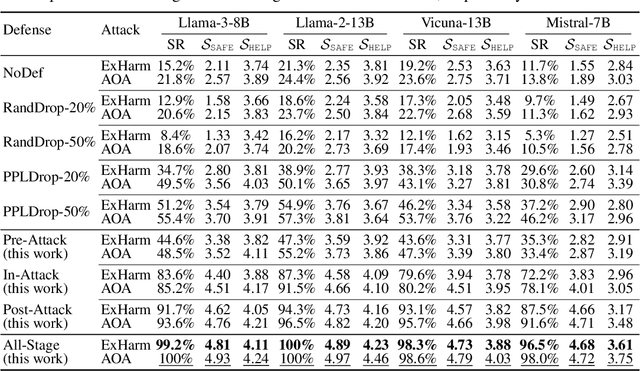
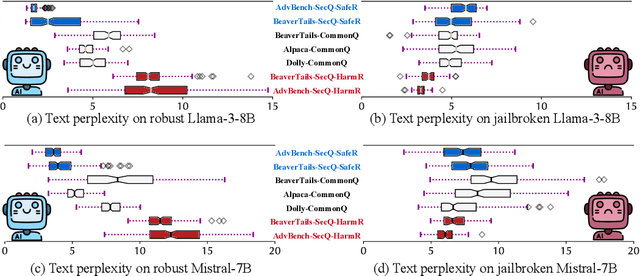

Large language models (LLMs) are extensively adapted for downstream applications through a process known as "customization," with fine-tuning being a common method for integrating domain-specific expertise. However, recent studies have revealed a vulnerability that tuning LLMs with malicious samples can compromise their robustness and amplify harmful content, an attack known as "jailbreaking." To mitigate such attack, we propose an effective defensive framework utilizing data curation to revise commonsense texts and enhance their safety implication from the perspective of LLMs. The curated texts can mitigate jailbreaking attacks at every stage of the customization process: before customization to immunize LLMs against future jailbreak attempts, during customization to neutralize jailbreaking risks, or after customization to restore the compromised models. Since the curated data strengthens LLMs through the standard fine-tuning workflow, we do not introduce additional modules during LLM inference, thereby preserving the original customization process. Experimental results demonstrate a substantial reduction in jailbreaking effects, with up to a 100% success in generating responsible responses. Notably, our method is effective even with commonsense texts, which are often more readily available than safety-relevant data. With the every-stage defensive framework and supporting experimental performance, this work represents a significant advancement in mitigating jailbreaking risks and ensuring the secure customization of LLMs.