 Add to Chrome
 Add to Firefox
 Add to Edge
OISD: On-Policy Internal Self-Distillation of Language Models
May 27, 2026
Recent reinforcement learning (RL) post-training approaches primarily optimize the final output policy using sparse outcome-level rewards, while largely overlooking predictive signals encoded in intermediate representations. In this paper, we introduce a new paradigm called on-policy internal self-distillation and propose the OISD framework, which improves reasoning by transferring on-policy predictive signals from the final layer to intermediate representations. During rollout and Group Relative Policy Optimization (GRPO) optimization, the final layer acts as both the policy and a detached internal teacher for selected intermediate layers, which are guided to align with it through two complementary mechanisms: logit alignment, which transfers high-level reasoning behaviors (how to think), and attention alignment, which enforces consistent attention patterns (where to look) from the final layer to the selected intermediate layer, both without requiring external privileged information. Our OISD, together with GRPO, employs signed advantage-weighted Jensen--Shannon alignment to distill informative intermediate representations while preserving policy consistency under a unified acting policy. Experimental results demonstrate the effectiveness of OISD, with substantial and consistent improvements over strong reasoning RL baselines across four mathematical reasoning tasks. The code will be released at https://github.com/THE-MALT-LAB/OISD

TorchUMM: A Unified Multimodal Model Codebase for Evaluation, Analysis, and Post-training
Apr 12, 2026Recent advances in unified multimodal models (UMMs) have led to a proliferation of architectures capable of understanding, generating, and editing across visual and textual modalities. However, developing a unified framework for UMMs remains challenging due to the diversity of model architectures and the heterogeneity of training paradigms and implementation details. In this paper, we present TorchUMM, the first unified codebase for comprehensive evaluation, analysis, and post-training across diverse UMM backbones, tasks, and datasets. TorchUMM supports a broad spectrum of models covering a wide range of scales and design paradigms. Our benchmark encompasses three core task dimensions: multimodal understanding, generation, and editing, and integrates both established and novel datasets to evaluate perception, reasoning, compositionality, and instruction-following abilities. By providing a unified interface and standardized evaluation protocols, TorchUMM enables fair and reproducible comparisons across heterogeneous models and fosters deeper insights into their strengths and limitations, facilitating the development of more capable unified multimodal systems. Code is available at: https://github.com/AIFrontierLab/TorchUMM.
MLE-UVAD: Minimal Latent Entropy Autoencoder for Fully Unsupervised Video Anomaly Detection
Mar 25, 2026In this paper, we address the challenging problem of single-scene, fully unsupervised video anomaly detection (VAD), where raw videos containing both normal and abnormal events are used directly for training and testing without any labels. This differs sharply from prior work that either requires extensive labeling (fully or weakly supervised) or depends on normal-only videos (one-class classification), which are vulnerable to distribution shifts and contamination. We propose an entropy-guided autoencoder that detects anomalies through reconstruction error by reconstructing normal frames well while making anomalies reconstruct poorly. The key idea is to combine the standard reconstruction loss with a novel Minimal Latent Entropy (MLE) loss in the autoencoder. Reconstruction loss alone maps normal and abnormal inputs to distinct latent clusters due to their inherent differences, but also risks reconstructing anomalies too well to detect. Therefore, MLE loss addresses this by minimizing the entropy of latent embeddings, encouraging them to concentrate around high-density regions. Since normal frames dominate the raw video, sparse anomalous embeddings are pulled into the normal cluster, so the decoder emphasizes normal patterns and produces poor reconstructions for anomalies. This dual-loss design produces a clear reconstruction gap that enables effective anomaly detection. Extensive experiments on two widely used benchmarks and a challenging self-collected driving dataset demonstrate that our method achieves robust and superior performance over baselines.
ER-MIA: Black-Box Adversarial Memory Injection Attacks on Long-Term Memory-Augmented Large Language Models
Feb 17, 2026Large language models (LLMs) are increasingly augmented with long-term memory systems to overcome finite context windows and enable persistent reasoning across interactions. However, recent research finds that LLMs become more vulnerable because memory provides extra attack surfaces. In this paper, we present the first systematic study of black-box adversarial memory injection attacks that target the similarity-based retrieval mechanism in long-term memory-augmented LLMs. We introduce ER-MIA, a unified framework that exposes this vulnerability and formalizes two realistic attack settings: content-based attacks and question-targeted attacks. In these settings, ER-MIA includes an arsenal of composable attack primitives and ensemble attacks that achieve high success rates under minimal attacker assumptions. Extensive experiments across multiple LLMs and long-term memory systems demonstrate that similarity-based retrieval constitutes a fundamental and system-level vulnerability, revealing security risks that persist across memory designs and application scenarios.
Understanding Real-World Traffic Safety through RoadSafe365 Benchmark
Feb 06, 2026Although recent traffic benchmarks have advanced multimodal data analysis, they generally lack systematic evaluation aligned with official safety standards. To fill this gap, we introduce RoadSafe365, a large-scale vision-language benchmark that supports fine-grained analysis of traffic safety from extensive and diverse real-world video data collections. Unlike prior works that focus primarily on coarse accident identification, RoadSafe365 is independently curated and systematically organized using a hierarchical taxonomy that refines and extends foundational definitions of crash, incident, and violation to bridge official traffic safety standards with data-driven traffic understanding systems. RoadSafe365 provides rich attribute annotations across diverse traffic event types, environmental contexts, and interaction scenarios, yielding 36,196 annotated clips from both dashcam and surveillance cameras. Each clip is paired with multiple-choice question-answer sets, comprising 864K candidate options, 8.4K unique answers, and 36K detailed scene descriptions collectively designed for vision-language understanding and reasoning. We establish strong baselines and observe consistent gains when fine-tuning on RoadSafe365. Cross-domain experiments on both real and synthetic datasets further validate its effectiveness. Designed for large-scale training and standardized evaluation, RoadSafe365 provides a comprehensive benchmark to advance reproducible research in real-world traffic safety analysis.
MOBA: A Material-Oriented Backdoor Attack against LiDAR-based 3D Object Detection Systems
Nov 13, 2025LiDAR-based 3D object detection is widely used in safety-critical systems. However, these systems remain vulnerable to backdoor attacks that embed hidden malicious behaviors during training. A key limitation of existing backdoor attacks is their lack of physical realizability, primarily due to the digital-to-physical domain gap. Digital triggers often fail in real-world settings because they overlook material-dependent LiDAR reflection properties. On the other hand, physically constructed triggers are often unoptimized, leading to low effectiveness or easy detectability.This paper introduces Material-Oriented Backdoor Attack (MOBA), a novel framework that bridges the digital-physical gap by explicitly modeling the material properties of real-world triggers. MOBA tackles two key challenges in physical backdoor design: 1) robustness of the trigger material under diverse environmental conditions, 2) alignment between the physical trigger's behavior and its digital simulation. First, we propose a systematic approach to selecting robust trigger materials, identifying titanium dioxide (TiO_2) for its high diffuse reflectivity and environmental resilience. Second, to ensure the digital trigger accurately mimics the physical behavior of the material-based trigger, we develop a novel simulation pipeline that features: (1) an angle-independent approximation of the Oren-Nayar BRDF model to generate realistic LiDAR intensities, and (2) a distance-aware scaling mechanism to maintain spatial consistency across varying depths. We conduct extensive experiments on state-of-the-art LiDAR-based and Camera-LiDAR fusion models, showing that MOBA achieves a 93.50% attack success rate, outperforming prior methods by over 41%. Our work reveals a new class of physically realizable threats and underscores the urgent need for defenses that account for material-level properties in real-world environments.
VERA: Explainable Video Anomaly Detection via Verbalized Learning of Vision-Language Models
Dec 02, 2024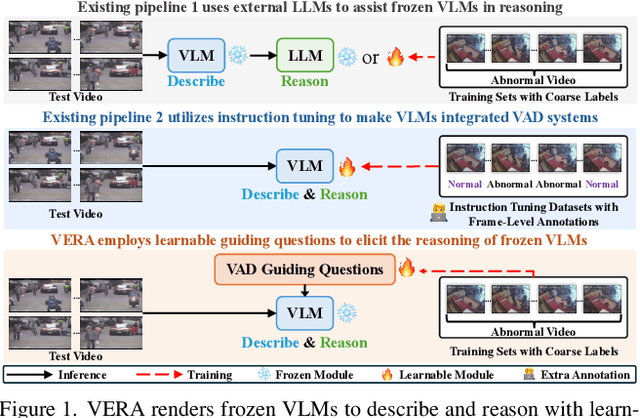
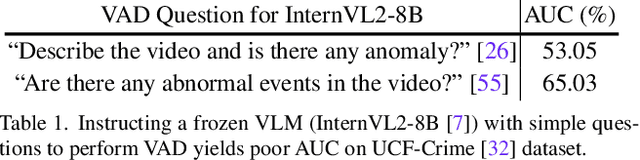
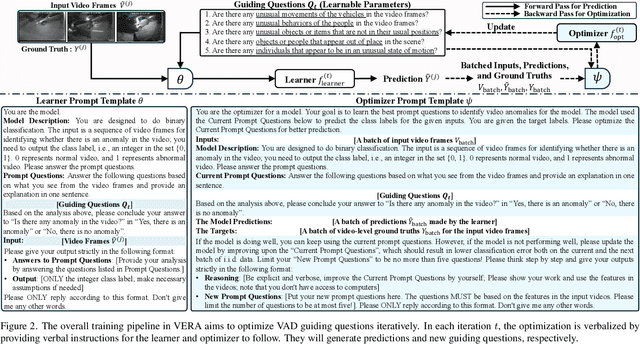
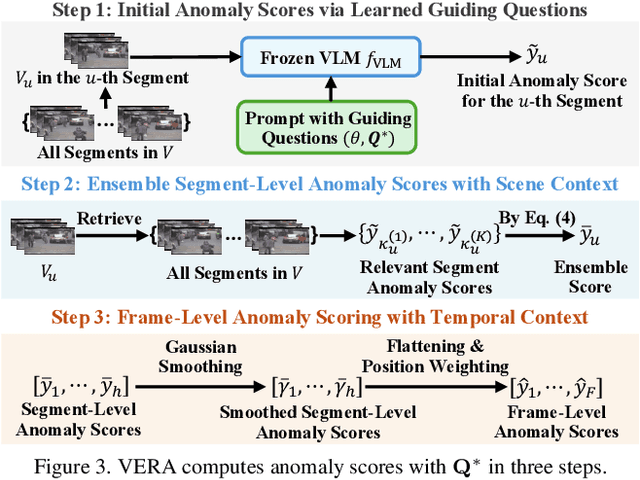
The rapid advancement of vision-language models (VLMs) has established a new paradigm in video anomaly detection (VAD): leveraging VLMs to simultaneously detect anomalies and provide comprehendible explanations for the decisions. Existing work in this direction often assumes the complex reasoning required for VAD exceeds the capabilities of pretrained VLMs. Consequently, these approaches either incorporate specialized reasoning modules during inference or rely on instruction tuning datasets through additional training to adapt VLMs for VAD. However, such strategies often incur substantial computational costs or data annotation overhead. To address these challenges in explainable VAD, we introduce a verbalized learning framework named VERA that enables VLMs to perform VAD without model parameter modifications. Specifically, VERA automatically decomposes the complex reasoning required for VAD into reflections on simpler, more focused guiding questions capturing distinct abnormal patterns. It treats these reflective questions as learnable parameters and optimizes them through data-driven verbal interactions between learner and optimizer VLMs, using coarsely labeled training data. During inference, VERA embeds the learned questions into model prompts to guide VLMs in generating segment-level anomaly scores, which are then refined into frame-level scores via the fusion of scene and temporal contexts. Experimental results on challenging benchmarks demonstrate that the learned questions of VERA are highly adaptable, significantly improving both detection performance and explainability of VLMs for VAD.
BadFusion: 2D-Oriented Backdoor Attacks against 3D Object Detection
May 06, 2024


3D object detection plays an important role in autonomous driving; however, its vulnerability to backdoor attacks has become evident. By injecting ''triggers'' to poison the training dataset, backdoor attacks manipulate the detector's prediction for inputs containing these triggers. Existing backdoor attacks against 3D object detection primarily poison 3D LiDAR signals, where large-sized 3D triggers are injected to ensure their visibility within the sparse 3D space, rendering them easy to detect and impractical in real-world scenarios. In this paper, we delve into the robustness of 3D object detection, exploring a new backdoor attack surface through 2D cameras. Given the prevalent adoption of camera and LiDAR signal fusion for high-fidelity 3D perception, we investigate the latent potential of camera signals to disrupt the process. Although the dense nature of camera signals enables the use of nearly imperceptible small-sized triggers to mislead 2D object detection, realizing 2D-oriented backdoor attacks against 3D object detection is non-trivial. The primary challenge emerges from the fusion process that transforms camera signals into a 3D space, compromising the association with the 2D trigger to the target output. To tackle this issue, we propose an innovative 2D-oriented backdoor attack against LiDAR-camera fusion methods for 3D object detection, named BadFusion, for preserving trigger effectiveness throughout the entire fusion process. The evaluation demonstrates the effectiveness of BadFusion, achieving a significantly higher attack success rate compared to existing 2D-oriented attacks.
A Holistic Framework Towards Vision-based Traffic Signal Control with Microscopic Simulation
Mar 11, 2024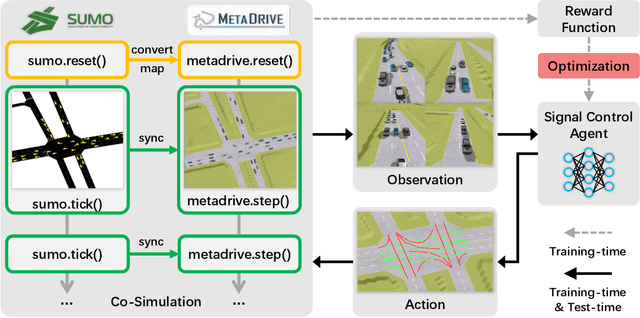
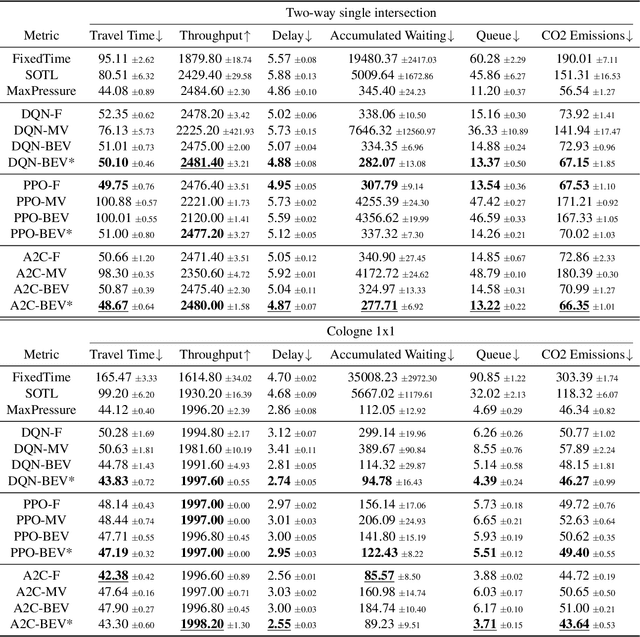
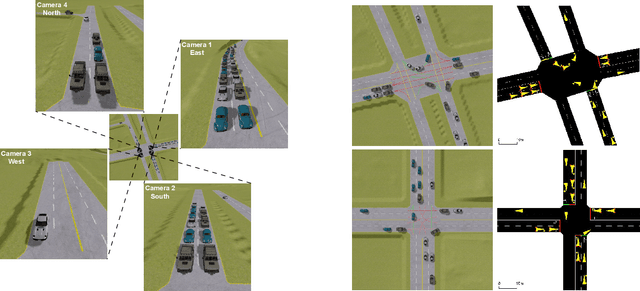
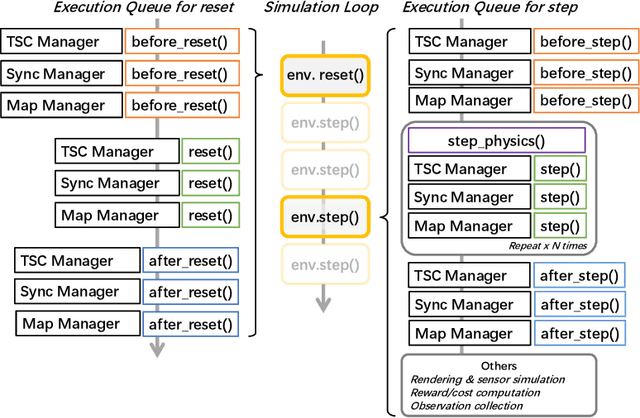
Traffic signal control (TSC) is crucial for reducing traffic congestion that leads to smoother traffic flow, reduced idling time, and mitigated CO2 emissions. In this study, we explore the computer vision approach for TSC that modulates on-road traffic flows through visual observation. Unlike traditional feature-based approaches, vision-based methods depend much less on heuristics and predefined features, bringing promising potentials for end-to-end learning and optimization of traffic signals. Thus, we introduce a holistic traffic simulation framework called TrafficDojo towards vision-based TSC and its benchmarking by integrating the microscopic traffic flow provided in SUMO into the driving simulator MetaDrive. This proposed framework offers a versatile traffic environment for in-depth analysis and comprehensive evaluation of traffic signal controllers across diverse traffic conditions and scenarios. We establish and compare baseline algorithms including both traditional and Reinforecment Learning (RL) approaches. This work sheds insights into the design and development of vision-based TSC approaches and open up new research opportunities. All the code and baselines will be made publicly available.
A Spatiotemporal Correspondence Approach to Unsupervised LiDAR Segmentation with Traffic Applications
Aug 23, 2023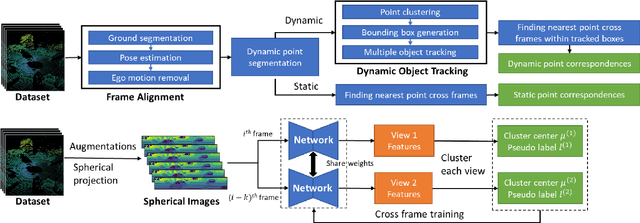


We address the problem of unsupervised semantic segmentation of outdoor LiDAR point clouds in diverse traffic scenarios. The key idea is to leverage the spatiotemporal nature of a dynamic point cloud sequence and introduce drastically stronger augmentation by establishing spatiotemporal correspondences across multiple frames. We dovetail clustering and pseudo-label learning in this work. Essentially, we alternate between clustering points into semantic groups and optimizing models using point-wise pseudo-spatiotemporal labels with a simple learning objective. Therefore, our method can learn discriminative features in an unsupervised learning fashion. We show promising segmentation performance on Semantic-KITTI, SemanticPOSS, and FLORIDA benchmark datasets covering scenarios in autonomous vehicle and intersection infrastructure, which is competitive when compared against many existing fully supervised learning methods. This general framework can lead to a unified representation learning approach for LiDAR point clouds incorporating domain knowledge.