 Add to Chrome
 Add to Firefox
 Add to Edge
Intent3D: 3D Object Detection in RGB-D Scans Based on Human Intention
May 28, 2024
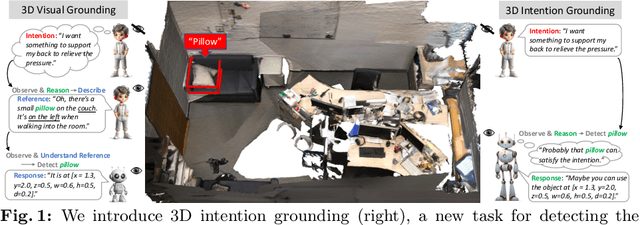
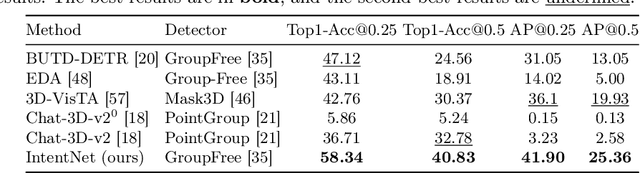
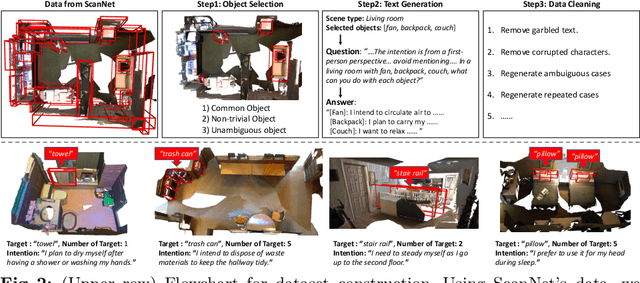
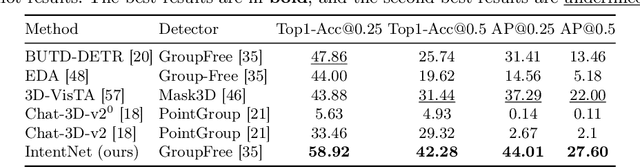
In real-life scenarios, humans seek out objects in the 3D world to fulfill their daily needs or intentions. This inspires us to introduce 3D intention grounding, a new task in 3D object detection employing RGB-D, based on human intention, such as "I want something to support my back". Closely related, 3D visual grounding focuses on understanding human reference. To achieve detection based on human intention, it relies on humans to observe the scene, reason out the target that aligns with their intention ("pillow" in this case), and finally provide a reference to the AI system, such as "A pillow on the couch". Instead, 3D intention grounding challenges AI agents to automatically observe, reason and detect the desired target solely based on human intention. To tackle this challenge, we introduce the new Intent3D dataset, consisting of 44,990 intention texts associated with 209 fine-grained classes from 1,042 scenes of the ScanNet dataset. We also establish several baselines based on different language-based 3D object detection models on our benchmark. Finally, we propose IntentNet, our unique approach, designed to tackle this intention-based detection problem. It focuses on three key aspects: intention understanding, reasoning to identify object candidates, and cascaded adaptive learning that leverages the intrinsic priority logic of different losses for multiple objective optimization.

PTQ4DiT: Post-training Quantization for Diffusion Transformers
May 25, 2024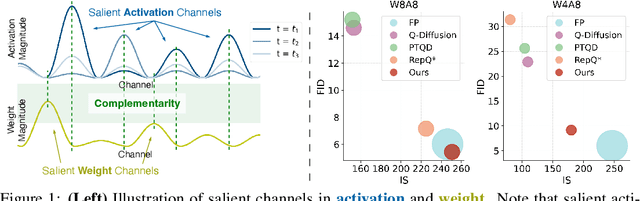
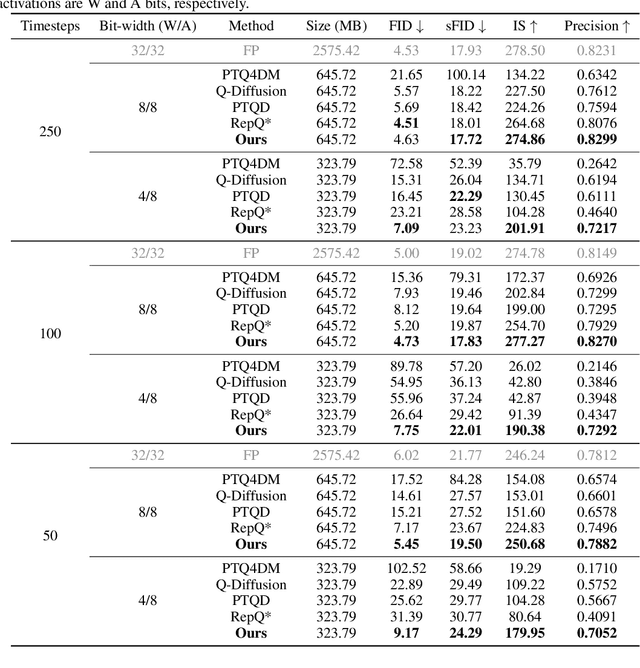
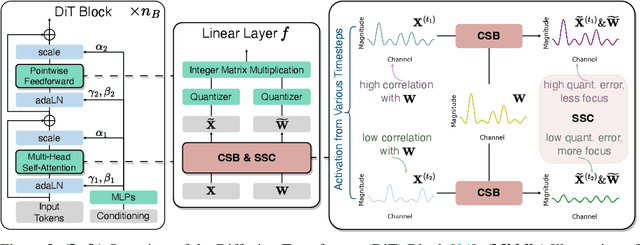
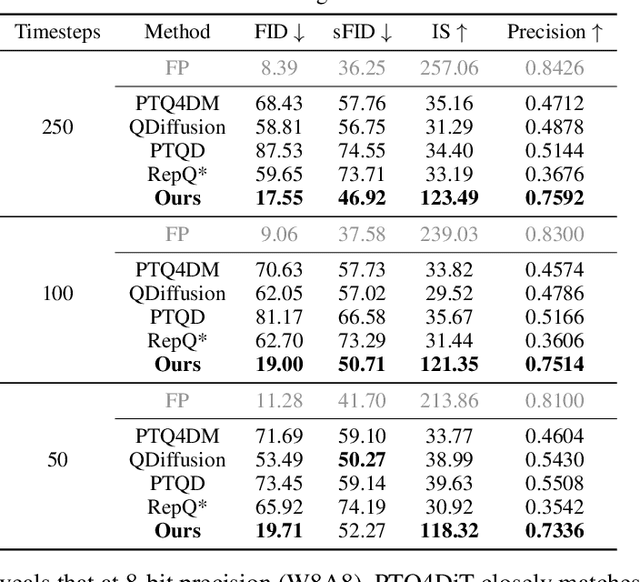
The recent introduction of Diffusion Transformers (DiTs) has demonstrated exceptional capabilities in image generation by using a different backbone architecture, departing from traditional U-Nets and embracing the scalable nature of transformers. Despite their advanced capabilities, the wide deployment of DiTs, particularly for real-time applications, is currently hampered by considerable computational demands at the inference stage. Post-training Quantization (PTQ) has emerged as a fast and data-efficient solution that can significantly reduce computation and memory footprint by using low-bit weights and activations. However, its applicability to DiTs has not yet been explored and faces non-trivial difficulties due to the unique design of DiTs. In this paper, we propose PTQ4DiT, a specifically designed PTQ method for DiTs. We discover two primary quantization challenges inherent in DiTs, notably the presence of salient channels with extreme magnitudes and the temporal variability in distributions of salient activation over multiple timesteps. To tackle these challenges, we propose Channel-wise Salience Balancing (CSB) and Spearmen's $\rho$-guided Salience Calibration (SSC). CSB leverages the complementarity property of channel magnitudes to redistribute the extremes, alleviating quantization errors for both activations and weights. SSC extends this approach by dynamically adjusting the balanced salience to capture the temporal variations in activation. Additionally, to eliminate extra computational costs caused by PTQ4DiT during inference, we design an offline re-parameterization strategy for DiTs. Experiments demonstrate that our PTQ4DiT successfully quantizes DiTs to 8-bit precision (W8A8) while preserving comparable generation ability and further enables effective quantization to 4-bit weight precision (W4A8) for the first time.
Text-guided 3D Human Motion Generation with Keyframe-based Parallel Skip Transformer
May 24, 2024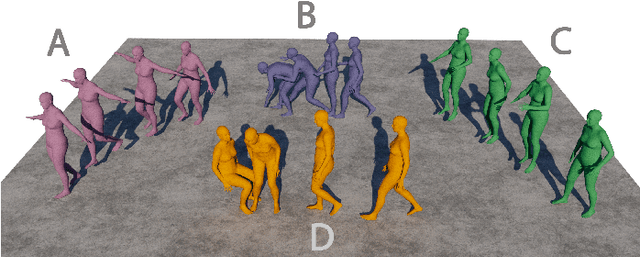
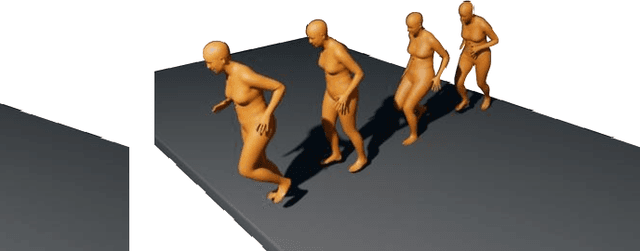
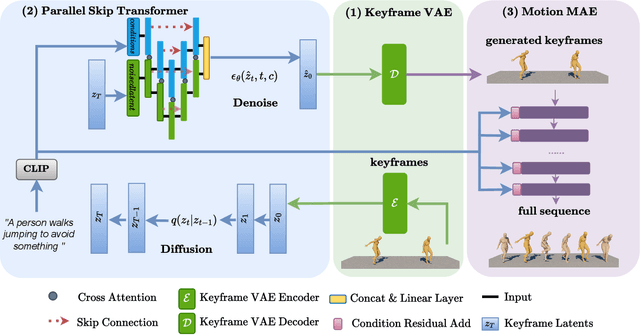
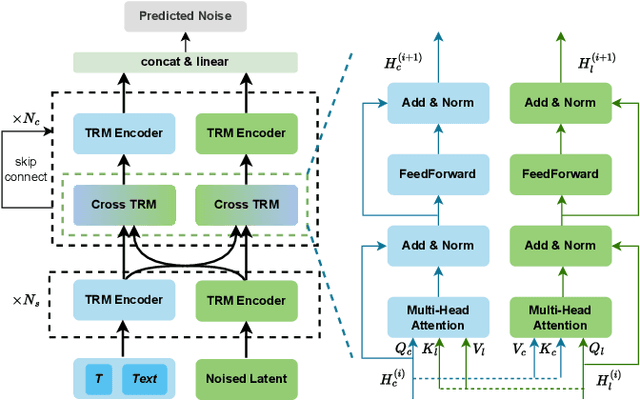
Text-driven human motion generation is an emerging task in animation and humanoid robot design. Existing algorithms directly generate the full sequence which is computationally expensive and prone to errors as it does not pay special attention to key poses, a process that has been the cornerstone of animation for decades. We propose KeyMotion, that generates plausible human motion sequences corresponding to input text by first generating keyframes followed by in-filling. We use a Variational Autoencoder (VAE) with Kullback-Leibler regularization to project the keyframes into a latent space to reduce dimensionality and further accelerate the subsequent diffusion process. For the reverse diffusion, we propose a novel Parallel Skip Transformer that performs cross-modal attention between the keyframe latents and text condition. To complete the motion sequence, we propose a text-guided Transformer designed to perform motion-in-filling, ensuring the preservation of both fidelity and adherence to the physical constraints of human motion. Experiments show that our method achieves state-of-theart results on the HumanML3D dataset outperforming others on all R-precision metrics and MultiModal Distance. KeyMotion also achieves competitive performance on the KIT dataset, achieving the best results on Top3 R-precision, FID, and Diversity metrics.
Curriculum Direct Preference Optimization for Diffusion and Consistency Models
May 22, 2024


Direct Preference Optimization (DPO) has been proposed as an effective and efficient alternative to reinforcement learning from human feedback (RLHF). In this paper, we propose a novel and enhanced version of DPO based on curriculum learning for text-to-image generation. Our method is divided into two training stages. First, a ranking of the examples generated for each prompt is obtained by employing a reward model. Then, increasingly difficult pairs of examples are sampled and provided to a text-to-image generative (diffusion or consistency) model. Generated samples that are far apart in the ranking are considered to form easy pairs, while those that are close in the ranking form hard pairs. In other words, we use the rank difference between samples as a measure of difficulty. The sampled pairs are split into batches according to their difficulty levels, which are gradually used to train the generative model. Our approach, Curriculum DPO, is compared against state-of-the-art fine-tuning approaches on three benchmarks, outperforming the competing methods in terms of text alignment, aesthetics and human preference. Our code is available at https://anonymous.4open.science/r/Curriculum-DPO-EE14.
SoccerNet-Echoes: A Soccer Game Audio Commentary Dataset
May 12, 2024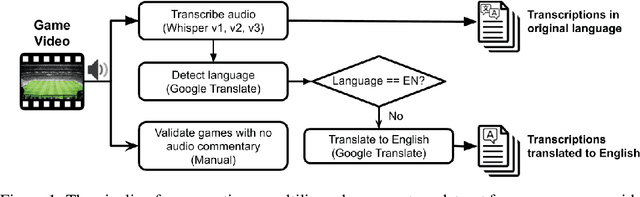
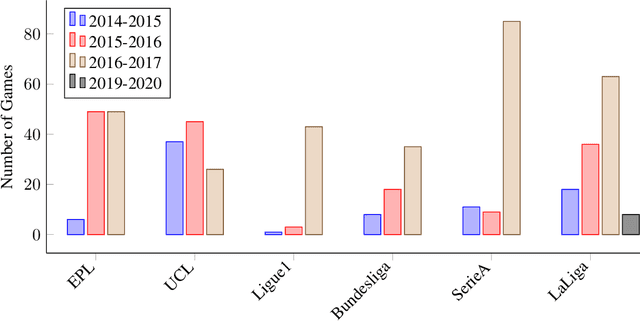

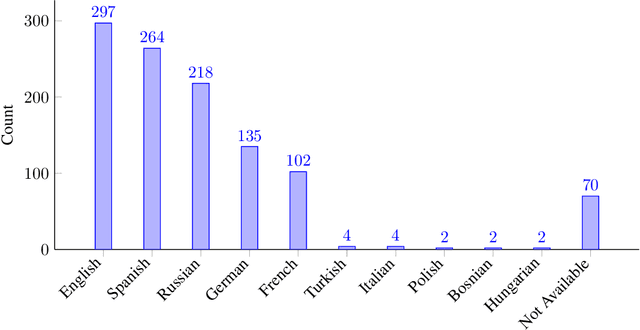
The application of Automatic Speech Recognition (ASR) technology in soccer offers numerous opportunities for sports analytics. Specifically, extracting audio commentaries with ASR provides valuable insights into the events of the game, and opens the door to several downstream applications such as automatic highlight generation. This paper presents SoccerNet-Echoes, an augmentation of the SoccerNet dataset with automatically generated transcriptions of audio commentaries from soccer game broadcasts, enhancing video content with rich layers of textual information derived from the game audio using ASR. These textual commentaries, generated using the Whisper model and translated with Google Translate, extend the usefulness of the SoccerNet dataset in diverse applications such as enhanced action spotting, automatic caption generation, and game summarization. By incorporating textual data alongside visual and auditory content, SoccerNet-Echoes aims to serve as a comprehensive resource for the development of algorithms specialized in capturing the dynamics of soccer games. We detail the methods involved in the curation of this dataset and the integration of ASR. We also highlight the implications of a multimodal approach in sports analytics, and how the enriched dataset can support diverse applications, thus broadening the scope of research and development in the field of sports analytics.
Sparse Points to Dense Clouds: Enhancing 3D Detection with Limited LiDAR Data
Apr 10, 20243D detection is a critical task that enables machines to identify and locate objects in three-dimensional space. It has a broad range of applications in several fields, including autonomous driving, robotics and augmented reality. Monocular 3D detection is attractive as it requires only a single camera, however, it lacks the accuracy and robustness required for real world applications. High resolution LiDAR on the other hand, can be expensive and lead to interference problems in heavy traffic given their active transmissions. We propose a balanced approach that combines the advantages of monocular and point cloud-based 3D detection. Our method requires only a small number of 3D points, that can be obtained from a low-cost, low-resolution sensor. Specifically, we use only 512 points, which is just 1% of a full LiDAR frame in the KITTI dataset. Our method reconstructs a complete 3D point cloud from this limited 3D information combined with a single image. The reconstructed 3D point cloud and corresponding image can be used by any multi-modal off-the-shelf detector for 3D object detection. By using the proposed network architecture with an off-the-shelf multi-modal 3D detector, the accuracy of 3D detection improves by 20% compared to the state-of-the-art monocular detection methods and 6% to 9% compare to the baseline multi-modal methods on KITTI and JackRabbot datasets.
Diffexplainer: Towards Cross-modal Global Explanations with Diffusion Models
Apr 03, 2024
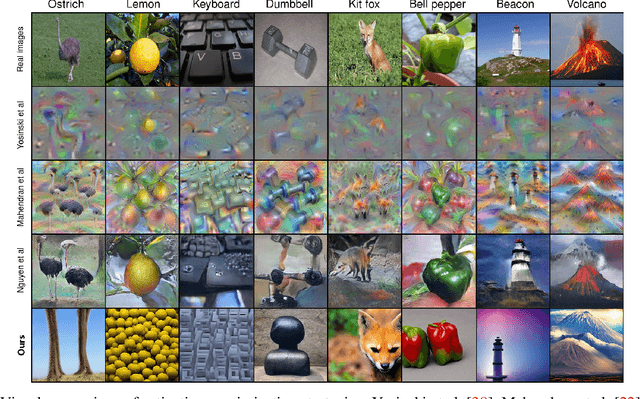
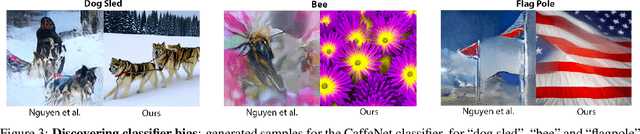

We present DiffExplainer, a novel framework that, leveraging language-vision models, enables multimodal global explainability. DiffExplainer employs diffusion models conditioned on optimized text prompts, synthesizing images that maximize class outputs and hidden features of a classifier, thus providing a visual tool for explaining decisions. Moreover, the analysis of generated visual descriptions allows for automatic identification of biases and spurious features, as opposed to traditional methods that often rely on manual intervention. The cross-modal transferability of language-vision models also enables the possibility to describe decisions in a more human-interpretable way, i.e., through text. We conduct comprehensive experiments, which include an extensive user study, demonstrating the effectiveness of DiffExplainer on 1) the generation of high-quality images explaining model decisions, surpassing existing activation maximization methods, and 2) the automated identification of biases and spurious features.
Towards Temporally Consistent Referring Video Object Segmentation
Mar 28, 2024
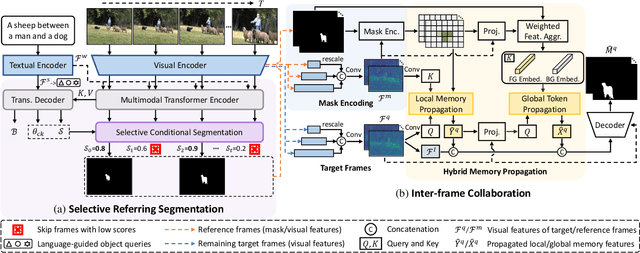
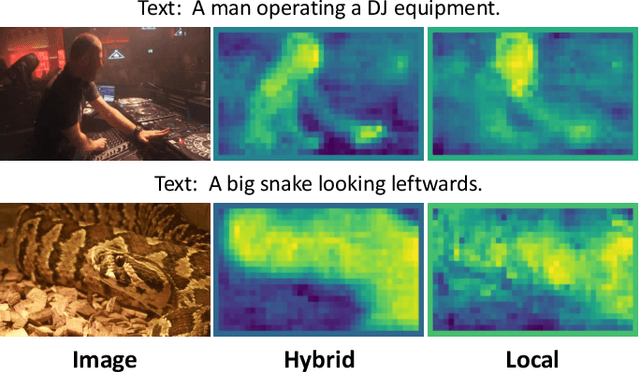
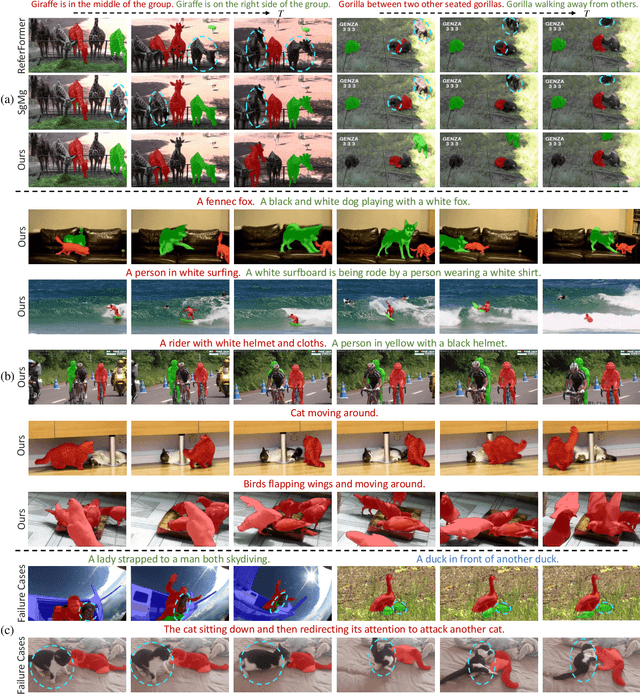
Referring Video Object Segmentation (R-VOS) methods face challenges in maintaining consistent object segmentation due to temporal context variability and the presence of other visually similar objects. We propose an end-to-end R-VOS paradigm that explicitly models temporal instance consistency alongside the referring segmentation. Specifically, we introduce a novel hybrid memory that facilitates inter-frame collaboration for robust spatio-temporal matching and propagation. Features of frames with automatically generated high-quality reference masks are propagated to segment the remaining frames based on multi-granularity association to achieve temporally consistent R-VOS. Furthermore, we propose a new Mask Consistency Score (MCS) metric to evaluate the temporal consistency of video segmentation. Extensive experiments demonstrate that our approach enhances temporal consistency by a significant margin, leading to top-ranked performance on popular R-VOS benchmarks, i.e., Ref-YouTube-VOS (67.1%) and Ref-DAVIS17 (65.6%).
Composed Video Retrieval via Enriched Context and Discriminative Embeddings
Mar 25, 2024


Composed video retrieval (CoVR) is a challenging problem in computer vision which has recently highlighted the integration of modification text with visual queries for more sophisticated video search in large databases. Existing works predominantly rely on visual queries combined with modification text to distinguish relevant videos. However, such a strategy struggles to fully preserve the rich query-specific context in retrieved target videos and only represents the target video using visual embedding. We introduce a novel CoVR framework that leverages detailed language descriptions to explicitly encode query-specific contextual information and learns discriminative embeddings of vision only, text only and vision-text for better alignment to accurately retrieve matched target videos. Our proposed framework can be flexibly employed for both composed video (CoVR) and image (CoIR) retrieval tasks. Experiments on three datasets show that our approach obtains state-of-the-art performance for both CovR and zero-shot CoIR tasks, achieving gains as high as around 7% in terms of recall@K=1 score. Our code, models, detailed language descriptions for WebViD-CoVR dataset are available at \url{https://github.com/OmkarThawakar/composed-video-retrieval}
AdaIR: Adaptive All-in-One Image Restoration via Frequency Mining and Modulation
Mar 21, 2024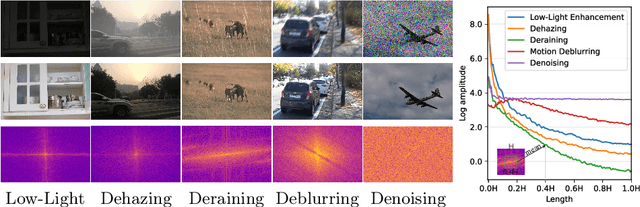
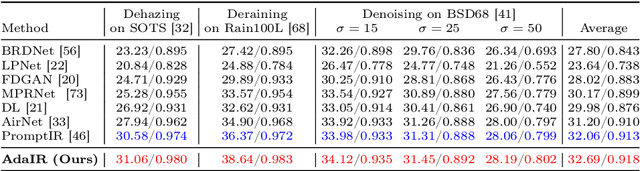
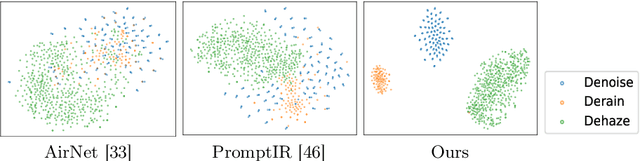

In the image acquisition process, various forms of degradation, including noise, haze, and rain, are frequently introduced. These degradations typically arise from the inherent limitations of cameras or unfavorable ambient conditions. To recover clean images from degraded versions, numerous specialized restoration methods have been developed, each targeting a specific type of degradation. Recently, all-in-one algorithms have garnered significant attention by addressing different types of degradations within a single model without requiring prior information of the input degradation type. However, these methods purely operate in the spatial domain and do not delve into the distinct frequency variations inherent to different degradation types. To address this gap, we propose an adaptive all-in-one image restoration network based on frequency mining and modulation. Our approach is motivated by the observation that different degradation types impact the image content on different frequency subbands, thereby requiring different treatments for each restoration task. Specifically, we first mine low- and high-frequency information from the input features, guided by the adaptively decoupled spectra of the degraded image. The extracted features are then modulated by a bidirectional operator to facilitate interactions between different frequency components. Finally, the modulated features are merged into the original input for a progressively guided restoration. With this approach, the model achieves adaptive reconstruction by accentuating the informative frequency subbands according to different input degradations. Extensive experiments demonstrate that the proposed method achieves state-of-the-art performance on different image restoration tasks, including denoising, dehazing, deraining, motion deblurring, and low-light image enhancement. Our code is available at https://github.com/c-yn/AdaIR.