 Add to Chrome
 Add to Firefox
 Add to Edge
A Multi-Center Benchmark for Abdominal Disease Diagnosis and Report Generation from Non-Contrast CT
Jun 15, 2026
Multiphasic contrast-enhanced CT (CECT) is widely used for abdominal lesion characterization, yet it carries inherent risks of contrast-induced nephropathy, escalates acquisition burden, and heavily contributes to radiologist workload. To address these challenges, we introduce a novel multi-center benchmark for multi-organ abdominal disease diagnosis and automated radiology report generation, which learns to synthesize contrast-enhanced findings from single-phase non-contrast CT (NCCT). To support this, we curated a large-scale dataset of paired NCCT-CECT studies and their corresponding contrast-enhanced radiology reports from two centers, partitioned into internal sets and an external validation cohort. Under a unified evaluation protocol, we benchmarked five contemporary deep learning architectures encompassing chest-specific, abdomen-specific, and general-purpose multimodal domains. Extensive experiments demonstrate that NCCT retains diagnostic signals, achieving an average multi-organ AUC of 69.1% on the internal cohort and 63.1% on the external cohort, respectively. By releasing this dataset and standardized benchmark publicly, this study aims to catalyze future research into safer, resource-efficient, and globally accessible contrast-free abdominal imaging workflows. Code is available at: https://github.com/xmed-lab/TriALS-Report.

TrustErase: Auditable Instant Machine Unlearning with Passport-Embedded Representations
Jun 15, 2026The demand for privacy-compliant AI has amplified the need for machine unlearning; yet, existing retraining or distillation-based methods remain unverifiable and computationally costly. We introduce TrustErase, a verifiable, data-free unlearning framework leveraging passport-embedded representations for instant, modular, and auditable forgetting. By treating passports as cryptographic keys within parameter-efficient adaptation layers, TrustErase enables the removal of specific classes or datasets through simple deactivation, without retraining, fine-tuning, or access to the original data. A singular value based decomposition conceals passports within model weights, ensuring that unlearning actions remain transparent and provably compliant. Evaluations on MNIST, CIFAR10 and CIFAR100 show that TrustErase matches or exceeds state-of-the-art benchmarks such as DELETE, L2UL, and Boundary Shrink, while operating in a strictly data-free regime. Ultimately, TrustErase establishes a new paradigm for trustworthy, accountable, and instantly forgettable AI systems.
PERL: Parameter Efficient Reasoning in CLIP Latent Space
May 19, 2026Contrastively trained vision-language models such as CLIP provide strong zero-shot transfer by aligning images and text in a shared embedding space. However, adapting these models to downstream tasks without degrading their open-vocabulary generalization remains challenging. Existing parameter-efficient adaptation methods typically improve task specialization through learned prompts, adapters, or multimodal transformations, where adaptation capacity is primarily expressed through additional trainable parameters. Inspired by recent latent reasoning methods in language models, we investigate a complementary perspective: can adaptation emerge from iterative reasoning on latent representations rather than from increasing parameter count alone? We introduce PERL (Parameter-Efficient Reasoning in CLIP Latent Space), a lightweight adaptation framework that augments a frozen CLIP model with a compact shared reasoning module applied recurrently across refinement steps. At each step, PERL generates a latent reasoning token conditioned on the current representation and injects it into an intermediate encoder layer, progressively refining higher-level semantic representations while preserving CLIP's pretrained multimodal structure. Across 15 benchmarks spanning base-to-novel generalization, cross-dataset transfer, and out-of-distribution ImageNet variants, PERL achieves the best parameter-performance trade-off among the compared methods under a fast-adaptation few-shot setting, combining strong novel-class accuracy and competitive transfer performance with only about 6K trainable parameters, up to 817x fewer than the largest compared approach. Overall, our results suggest that iterative latent reasoning provides a complementary adaptation mechanism to parameter scaling in discriminative vision-language models.
OCCAM: Open-set Causal Concept explAnation and Ontology induction for black-box vision Models
May 18, 2026Interpreting the decisions of deep image classifiers remains challenging, particularly in black-box settings where model internals are inaccessible. We introduce OCCAM, a framework for open-set causal concept explanation and ontology induction in vision models. OCCAM discovers visual concepts in an open-set manner, localizes them via text-guided segmentation, and performs object-level interventions by removing concepts to measure changes in class confidence, estimating each concept's causal contribution. Beyond local explanations, OCCAM aggregates interventional evidence across a dataset to induce a structured concept ontology that captures how classifiers globally organize visual concepts. Reasoning over this ontology reveals consistent dependencies between concepts, exposes latent causal relations, and uncovers systematic model biases. Experiments on Broden and ImageNet-S across multiple classifiers show that OCCAM improves explanation quality in open-set black-box settings while providing richer global insight than per-image attribution methods.
Global-Local Feature Decoding with Adapter-Guided SAMv2 for Salient Object Detection
May 04, 2026Salient Object Detection (SOD) remains an essential yet underexplored task in the era of large-scale vision models. Although foundation models like SAM exhibit strong generalization, their potential for SOD is not fully realized, and training or fully fine-tuning them is computationally expensive and prone to overfitting under limited data. To overcome these challenges, we introduce GLASSNet, a Global-Local feature decoding framework that uses SAMv2 as a frozen encoder paired with a lightweight, spatially aware convolutional adapter-reducing learnable encoder parameters by over 97%. To enhance saliency quality, GLASSNet employs a dual-decoder architecture: one decoder captures global, long-range semantics with an expanded receptive field, while the other captures fine local details such as edges and textures. Fusing these complementary cues yields saliency maps that combine global coherence with local precision, producing accurate final masks. Extensive experiments on standard SOD and camouflaged object detection benchmarks show that GLASSNet surpasses state-of-the-art methods, demonstrating the power of frozen foundation models combined with targeted adaptation and global-local decoding.
Routing without Forgetting
Mar 10, 2026Continual learning in transformers is commonly addressed through parameter-efficient adaptation: prompts, adapters, or LoRA modules are specialized per task while the backbone remains frozen. Although effective in controlled multi-epoch settings, these approaches rely on gradual gradient-based specialization and struggle in Online Continual Learning (OCL), where data arrive as a non-stationary stream and each sample may be observed only once. We recast continual learning in transformers as a routing problem: under strict online constraints, the model must dynamically select the appropriate representational subspace for each input without explicit task identifiers or repeated optimization. We thus introduce Routing without Forgetting (RwF), a transformer architecture augmented with energy-based associative retrieval layers inspired by Modern Hopfield Networks. Instead of storing or merging task-specific prompts, RwF generates dynamic prompts through single-step associative retrieval over the transformer token embeddings at each layer. Retrieval corresponds to the closed-form minimization of a strictly convex free-energy functional, enabling input-conditioned routing within each forward pass, independently of iterative gradient refinement. Across challenging class-incremental benchmarks, RwF improves over existing prompt-based methods. On Split-ImageNet-R and Split-ImageNet-S, RwF outperforms prior prompt-based approaches by a large margin, even in few-shot learning regimes. These results indicate that embedding energy-based associative routing directly within the transformer backbone provides a principled and effective foundation for OCL.
UNBOX: Unveiling Black-box visual models with Natural-language
Mar 09, 2026Ensuring trustworthiness in open-world visual recognition requires models that are interpretable, fair, and robust to distribution shifts. Yet modern vision systems are increasingly deployed as proprietary black-box APIs, exposing only output probabilities and hiding architecture, parameters, gradients, and training data. This opacity prevents meaningful auditing, bias detection, and failure analysis. Existing explanation methods assume white- or gray-box access or knowledge of the training distribution, making them unusable in these real-world settings. We introduce UNBOX, a framework for class-wise model dissection under fully data-free, gradient-free, and backpropagation-free constraints. UNBOX leverages Large Language Models and text-to-image diffusion models to recast activation maximization as a purely semantic search driven by output probabilities. The method produces human-interpretable text descriptors that maximally activate each class, revealing the concepts a model has implicitly learned, the training distribution it reflects, and potential sources of bias. We evaluate UNBOX on ImageNet-1K, Waterbirds, and CelebA through semantic fidelity tests, visual-feature correlation analyses and slice-discovery auditing. Despite operating under the strictest black-box constraints, UNBOX performs competitively with state-of-the-art white-box interpretability methods. This demonstrates that meaningful insight into a model's internal reasoning can be recovered without any internal access, enabling more trustworthy and accountable visual recognition systems.
Dream2Learn: Structured Generative Dreaming for Continual Learning
Mar 02, 2026Continual learning requires balancing plasticity and stability while mitigating catastrophic forgetting. Inspired by human dreaming as a mechanism for internal simulation and knowledge restructuring, we introduce Dream2Learn (D2L), a framework in which a model autonomously generates structured synthetic experiences from its own internal representations and uses them for self-improvement. Rather than reconstructing past data as in generative replay, D2L enables a classifier to create novel, semantically distinct dreamed classes that are coherent with its learned knowledge yet do not correspond to previously observed data. These dreamed samples are produced by conditioning a frozen diffusion model through soft prompt optimization driven by the classifier itself. The generated data are not used to replace memory, but to expand and reorganize the representation space, effectively allowing the network to self-train on internally synthesized concepts. By integrating dreamed classes into continual training, D2L proactively structures latent features to support forward knowledge transfer and adaptation to future tasks. This prospective self-training mechanism mirrors the role of sleep in consolidating and reorganizing memory, turning internal simulations into a tool for improved generalization. Experiments on Mini-ImageNet, FG-ImageNet, and ImageNet-R demonstrate that D2L consistently outperforms strong rehearsal-based baselines and achieves positive forward transfer, confirming its ability to enhance adaptability through internally generated training signals.
Zero-Shot Decentralized Federated Learning
Sep 30, 2025CLIP has revolutionized zero-shot learning by enabling task generalization without fine-tuning. While prompting techniques like CoOp and CoCoOp enhance CLIP's adaptability, their effectiveness in Federated Learning (FL) remains an open challenge. Existing federated prompt learning approaches, such as FedCoOp and FedTPG, improve performance but face generalization issues, high communication costs, and reliance on a central server, limiting scalability and privacy. We propose Zero-shot Decentralized Federated Learning (ZeroDFL), a fully decentralized framework that enables zero-shot adaptation across distributed clients without a central coordinator. ZeroDFL employs an iterative prompt-sharing mechanism, allowing clients to optimize and exchange textual prompts to enhance generalization while drastically reducing communication overhead. We validate ZeroDFL on nine diverse image classification datasets, demonstrating that it consistently outperforms--or remains on par with--state-of-the-art federated prompt learning methods. More importantly, ZeroDFL achieves this performance in a fully decentralized setting while reducing communication overhead by 118x compared to FedTPG. These results highlight that our approach not only enhances generalization in federated zero-shot learning but also improves scalability, efficiency, and privacy preservation--paving the way for decentralized adaptation of large vision-language models in real-world applications.
Cyst-X: AI-Powered Pancreatic Cancer Risk Prediction from Multicenter MRI in Centralized and Federated Learning
Jul 29, 2025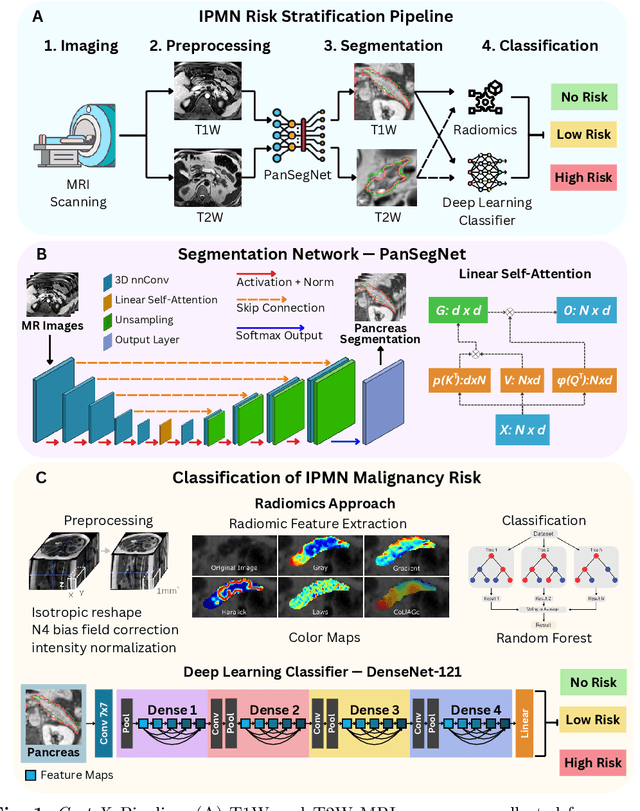
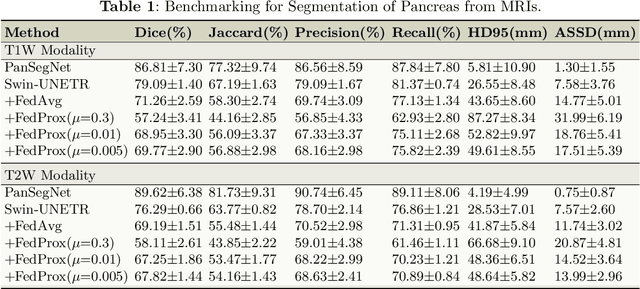
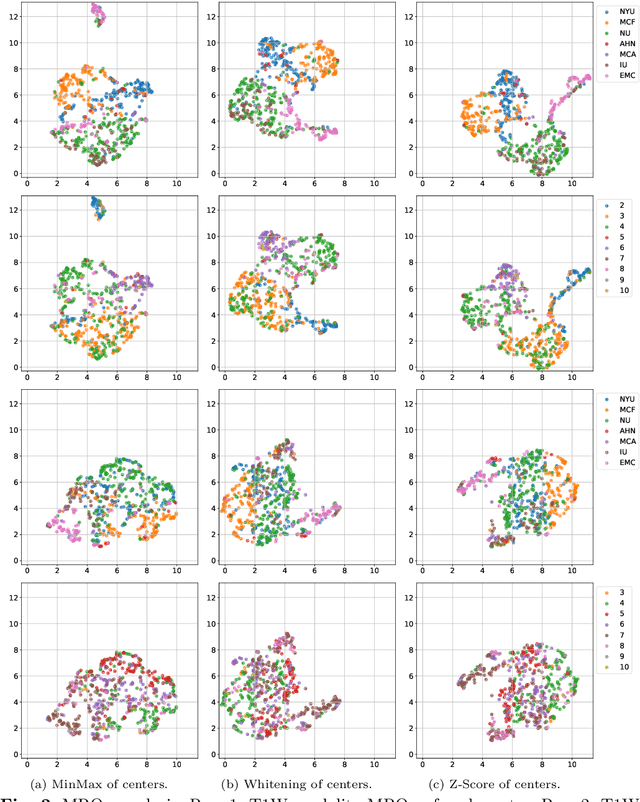
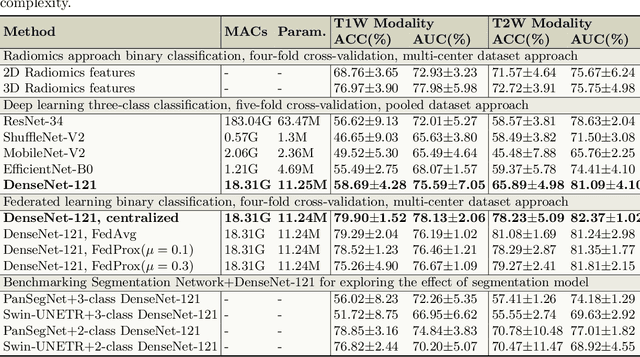
Pancreatic cancer is projected to become the second-deadliest malignancy in Western countries by 2030, highlighting the urgent need for better early detection. Intraductal papillary mucinous neoplasms (IPMNs), key precursors to pancreatic cancer, are challenging to assess with current guidelines, often leading to unnecessary surgeries or missed malignancies. We present Cyst-X, an AI framework that predicts IPMN malignancy using multicenter MRI data, leveraging MRI's superior soft tissue contrast over CT. Trained on 723 T1- and 738 T2-weighted scans from 764 patients across seven institutions, our models (AUC=0.82) significantly outperform both Kyoto guidelines (AUC=0.75) and expert radiologists. The AI-derived imaging features align with known clinical markers and offer biologically meaningful insights. We also demonstrate strong performance in a federated learning setting, enabling collaborative training without sharing patient data. To promote privacy-preserving AI development and improve IPMN risk stratification, the Cyst-X dataset is released as the first large-scale, multi-center pancreatic cysts MRI dataset.