 Add to Chrome
 Add to Firefox
 Add to Edge
ASI-Bench: At the Dawn of Artificial Superintelligence
Aug 18, 2026
Artificial superintelligence (ASI) requires AI to move beyond mastering existing knowledge toward exploring the unknown, creating new knowledge, and turning new ideas into verifiable results. However, the capabilities of today's AI systems are still largely built on learning, compressing, and applying existing human knowledge. Accordingly, existing benchmarks primarily test whether AI can produce correct answers based on learned knowledge, or whether it can complete tasks under extensive human guidance. We therefore introduce ASI-Bench, the first benchmark to jointly evaluate AI systems' capabilities of innovative exploration and autonomous scientific execution across general research domains, and the first to progressively withdraw human methodological guidance within the same research project to test how far AI can proceed on its own. Built by over 40 experts with the cost of 31,000+ human hours, ASI-Bench contains 60 project-level research tasks across 11 scientific domains and progressively reduces methodological guidance to test whether AI can independently select methods, conduct research, and produce verifiable results. All tasks undergo expert review, AI-assisted auditing, sandbox execution, and scorer validation. Across 18 state-of-the-art agent--model configurations, the average score drops from 50.91 with full methodological guidance to 29.10 with only the method specified and 26.62 when agents must determine the method themselves. This sharp decline shows that current systems remain heavily dependent on human guidance and are still far from autonomously conducting end-to-end, project-level scientific research. ASI-Bench is open to the world. We invite researchers and builders everywhere to contribute new tasks, challenge the limits of today's AI, and help accelerate humanity's collective path toward artificial superintelligence at https://asibench.apexin.ai/submit.

Delta-JEPA: Learning Action-Sensitive World Models via Latent Difference Decoding
Jun 30, 2026Learning visual world models for planning requires compact latent dynamics that remain sensitive to actions, yet reconstruction-free joint-embedding objectives can collapse to action-insensitive representations. We propose Delta-JEPA, an end-to-end reconstruction-free world model that augments latent forward prediction with a Latent Difference Action Decoder (LDAD). Unlike inverse decoders that infer actions from concatenated endpoint embeddings, LDAD reconstructs the executed action from the latent displacement between consecutive observations. This displacement-level supervision directly regularizes transition geometry: adjacent embeddings cannot collapse without losing action information, and different actions are encouraged to induce distinguishable latent changes for rollout-based planning. Delta-JEPA uses only latent prediction and action reconstruction, avoiding pixel reconstruction and distribution-matching regularizers. Across four visual continuous-control tasks, Delta-JEPA improves planning over JEPA-based and representation-learning world model baselines. Ablations show that displacement-based action decoding is consistently more effective than endpoint concatenation, and action-sensitivity analyses show clearer action-conditioned latent responses. These results indicate that supervising latent differences is a simple and effective mechanism for collapse-resistant and action-sensitive world model learning.
JuZhou 1.0 Technical Report: The First Edge-Native Text-to-Image Foundation Model Trained Entirely on China-Developed AI Accelerators
Jun 25, 2026Text-to-image (T2I) diffusion models typically require substantial computational resources and cloud infrastructure, posing significant challenges for edge deployment in terms of latency, cost, and user privacy. We present JuZhou 1.0, an ultra-lightweight T2I foundation model designed for fully offline, on-device execution. JuZhou 1.0 achieves its efficiency through four key designs: (1) a compact image-generation backbone consisting of a 0.385B-parameter denoising U-Net and a 1.90M-parameter distilled decoder, totaling approximately 0.387B parameters; (2) Rectified Flow training combined with DMD2 distillation, reducing inference to 4 sampling steps; (3) Chinese semantic alignment trained on 9M curated image-text pairs, enabling direct Chinese prompting without external translation at inference time; and (4) a training and distillation pipeline completed on domestically developed Sugon K100 AI accelerators without relying on NVIDIA GPUs for training or distillation. Despite its compact scale, the 28-step base model of JuZhou 1.0 achieves an overall GenEval score of 0.69, outperforming published baselines including SDXL (2.6B, 0.55), SD3-Medium (2B, 0.62), and IF-XL (4.3B, 0.61). We further validate the full poetry-to-image pipeline on Android and the core CLIP-U-Net-VAE generation branch on iOS. On a smartphone powered by the Snapdragon 8 Elite Gen 5 Mobile Platform, the 4-step U-Net denoising branch runs in approximately 1.6 seconds, while the full Android poetry-to-image pipeline takes 4.5 seconds with on-device prompt refinement on Xiaomi 17 Pro Max. These results position JuZhou 1.0 as a practical approach to mobile text-to-image generation and provide a concrete reference for Chinese-native generation, domestic-compute training, and fully offline on-device deployment after one-time installation.
Stable Multimodal Graph Unlearning via Feature-Dimension Aware Quantile Selection
May 05, 2026Graph unlearning remains a critical technique for supporting privacy-preserving and sustainable multimodal graph learning. However, we observe that existing unlearning strategies tend to apply uniform parameter selection and editing across all graph neural network (GNN) layers, which is especially harmful for multimodal graphs where high-dimensional input projections encode dominant cross-modal knowledge. As a result, over-editing these sensitive layers often leads to catastrophic utility degradation after forgetting, undermining both stable learning and effective privacy protection. To address this gap, we propose FDQ, a Feature-Dimension Aware Quantile framework for multimodal graph unlearning. FDQ adaptively identifies high-dimensional input projection layers and applies more conservative, FDQ-guided quantile thresholds when constructing suppression sets, while keeping the underlying importance estimation mechanism unchanged. FDQ is seamlessly integrated with diagonal sensitivity-based parameter importance analysis to enable efficient node and edge unlearning under general forget requests. Through extensive experiments on Ele-Fashion and Goodreads-NC, we demonstrate that FDQ consistently achieves strong utility preservation while maintaining effective forgetting against membership inference attacks. Overall, FDQ offers a principled and robust solution for privacy-aware unlearning in high-dimensional multimodal graph systems.
FairGU: Fairness-aware Graph Unlearning in Social Network
Jan 14, 2026Graph unlearning has emerged as a critical mechanism for supporting sustainable and privacy-preserving social networks, enabling models to remove the influence of deleted nodes and thereby better safeguard user information. However, we observe that existing graph unlearning techniques insufficiently protect sensitive attributes, often leading to degraded algorithmic fairness compared with traditional graph learning methods. To address this gap, we introduce FairGU, a fairness-aware graph unlearning framework designed to preserve both utility and fairness during the unlearning process. FairGU integrates a dedicated fairness-aware module with effective data protection strategies, ensuring that sensitive attributes are neither inadvertently amplified nor structurally exposed when nodes are removed. Through extensive experiments on multiple real-world datasets, we demonstrate that FairGU consistently outperforms state-of-the-art graph unlearning methods and fairness-enhanced graph learning baselines in terms of both accuracy and fairness metrics. Our findings highlight a previously overlooked risk in current unlearning practices and establish FairGU as a robust and equitable solution for the next generation of socially sustainable networked systems. The codes are available at https://github.com/LuoRenqiang/FairGU.
STaR: Sensitive Trajectory Regulation for Unlearning in Large Reasoning Models
Jan 14, 2026Large Reasoning Models (LRMs) have advanced automated multi-step reasoning, but their ability to generate complex Chain-of-Thought (CoT) trajectories introduces severe privacy risks, as sensitive information may be deeply embedded throughout the reasoning process. Existing Large Language Models (LLMs) unlearning approaches that typically focus on modifying only final answers are insufficient for LRMs, as they fail to remove sensitive content from intermediate steps, leading to persistent privacy leakage and degraded security. To address these challenges, we propose Sensitive Trajectory Regulation (STaR), a parameter-free, inference-time unlearning framework that achieves robust privacy protection throughout the reasoning process. Specifically, we first identify sensitive content via semantic-aware detection. Then, we inject global safety constraints through secure prompt prefix. Next, we perform trajectory-aware suppression to dynamically block sensitive content across the entire reasoning chain. Finally, we apply token-level adaptive filtering to prevent both exact and paraphrased sensitive tokens during generation. Furthermore, to overcome the inadequacies of existing evaluation protocols, we introduce two metrics: Multi-Decoding Consistency Assessment (MCS), which measures the consistency of unlearning across diverse decoding strategies, and Multi-Granularity Membership Inference Attack (MIA) Evaluation, which quantifies privacy protection at both answer and reasoning-chain levels. Experiments on the R-TOFU benchmark demonstrate that STaR achieves comprehensive and stable unlearning with minimal utility loss, setting a new standard for privacy-preserving reasoning in LRMs.
ShieldGemma 2: Robust and Tractable Image Content Moderation
Apr 01, 2025We introduce ShieldGemma 2, a 4B parameter image content moderation model built on Gemma 3. This model provides robust safety risk predictions across the following key harm categories: Sexually Explicit, Violence \& Gore, and Dangerous Content for synthetic images (e.g. output of any image generation model) and natural images (e.g. any image input to a Vision-Language Model). We evaluated on both internal and external benchmarks to demonstrate state-of-the-art performance compared to LlavaGuard \citep{helff2024llavaguard}, GPT-4o mini \citep{hurst2024gpt}, and the base Gemma 3 model \citep{gemma_2025} based on our policies. Additionally, we present a novel adversarial data generation pipeline which enables a controlled, diverse, and robust image generation. ShieldGemma 2 provides an open image moderation tool to advance multimodal safety and responsible AI development.
FSD: An Initial Chinese Dataset for Fake Song Detection
Sep 06, 2023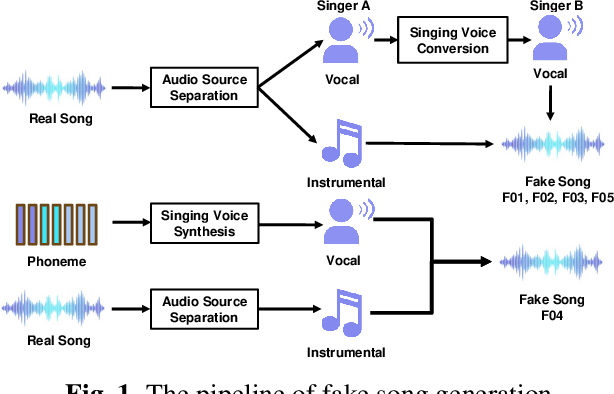


Singing voice synthesis and singing voice conversion have significantly advanced, revolutionizing musical experiences. However, the rise of "Deepfake Songs" generated by these technologies raises concerns about authenticity. Unlike Audio DeepFake Detection (ADD), the field of song deepfake detection lacks specialized datasets or methods for song authenticity verification. In this paper, we initially construct a Chinese Fake Song Detection (FSD) dataset to investigate the field of song deepfake detection. The fake songs in the FSD dataset are generated by five state-of-the-art singing voice synthesis and singing voice conversion methods. Our initial experiments on FSD revealed the ineffectiveness of existing speech-trained ADD models for the task of song deepFake detection. Thus, we employ the FSD dataset for the training of ADD models. We subsequently evaluate these models under two scenarios: one with the original songs and another with separated vocal tracks. Experiment results show that song-trained ADD models exhibit a 38.58% reduction in average equal error rate compared to speech-trained ADD models on the FSD test set.