 Add to Chrome
 Add to Firefox
 Add to Edge
Cross Domain LifeLong Sequential Modeling for Online Click-Through Rate Prediction
Dec 11, 2023
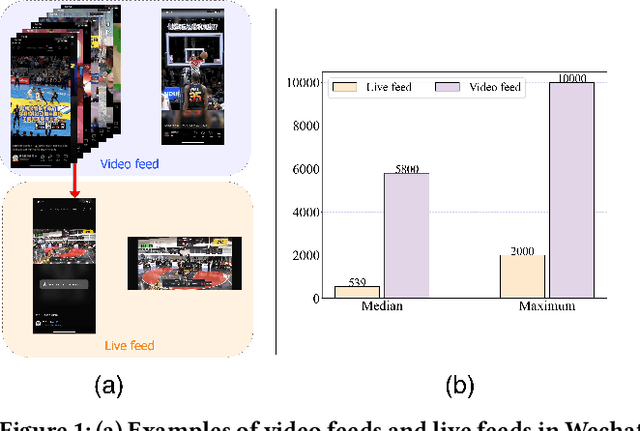

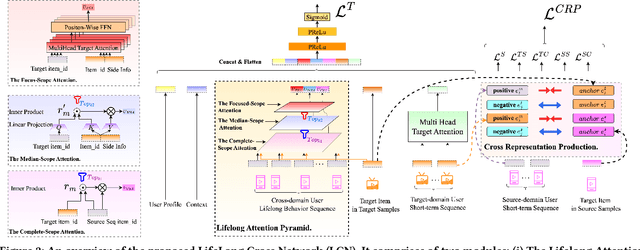
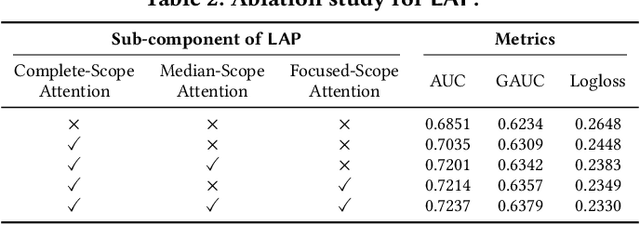
Deep neural networks (DNNs) that incorporated lifelong sequential modeling (LSM) have brought great success to recommendation systems in various social media platforms. While continuous improvements have been made in domain-specific LSM, limited work has been done in cross-domain LSM, which considers modeling of lifelong sequences of both target domain and source domain. In this paper, we propose Lifelong Cross Network (LCN) to incorporate cross-domain LSM to improve the click-through rate (CTR) prediction in the target domain. The proposed LCN contains a LifeLong Attention Pyramid (LAP) module that comprises of three levels of cascaded attentions to effectively extract interest representations with respect to the candidate item from lifelong sequences. We also propose Cross Representation Production (CRP) module to enforce additional supervision on the learning and alignment of cross-domain representations so that they can be better reused on learning of the CTR prediction in the target domain. We conducted extensive experiments on WeChat Channels industrial dataset as well as on benchmark dataset. Results have revealed that the proposed LCN outperforms existing work in terms of both prediction accuracy and online performance.

Adapting Large Language Models by Integrating Collaborative Semantics for Recommendation
Nov 28, 2023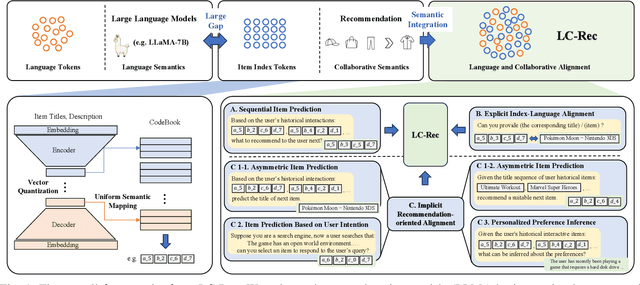
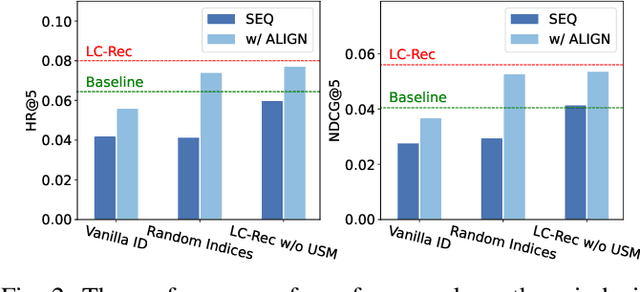
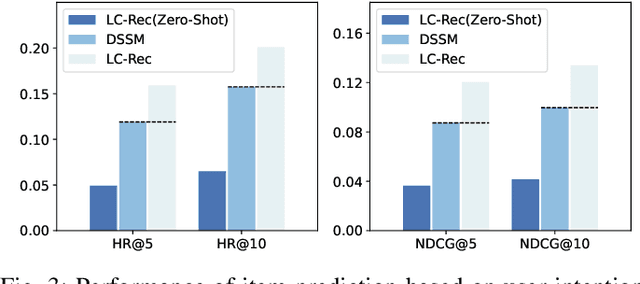
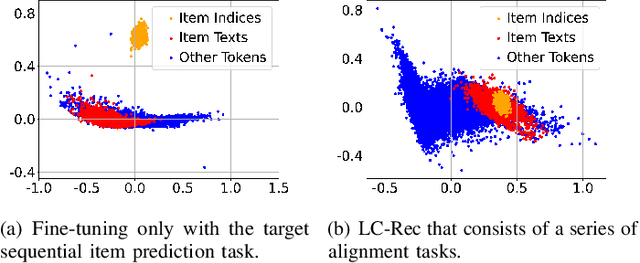
Recently, large language models (LLMs) have shown great potential in recommender systems, either improving existing recommendation models or serving as the backbone. However, there exists a large semantic gap between LLMs and recommender systems, since items to be recommended are often indexed by discrete identifiers (item ID) out of the LLM's vocabulary. In essence, LLMs capture language semantics while recommender systems imply collaborative semantics, making it difficult to sufficiently leverage the model capacity of LLMs for recommendation. To address this challenge, in this paper, we propose a new LLM-based recommendation model called LC-Rec, which can better integrate language and collaborative semantics for recommender systems. Our approach can directly generate items from the entire item set for recommendation, without relying on candidate items. Specifically, we make two major contributions in our approach. For item indexing, we design a learning-based vector quantization method with uniform semantic mapping, which can assign meaningful and non-conflicting IDs (called item indices) for items. For alignment tuning, we propose a series of specially designed tuning tasks to enhance the integration of collaborative semantics in LLMs. Our fine-tuning tasks enforce LLMs to deeply integrate language and collaborative semantics (characterized by the learned item indices), so as to achieve an effective adaptation to recommender systems. Extensive experiments demonstrate the effectiveness of our method, showing that our approach can outperform a number of competitive baselines including traditional recommenders and existing LLM-based recommenders. Our code is available at https://github.com/RUCAIBox/LC-Rec/.
Temporal-Aware Refinement for Video-based Human Pose and Shape Recovery
Nov 16, 2023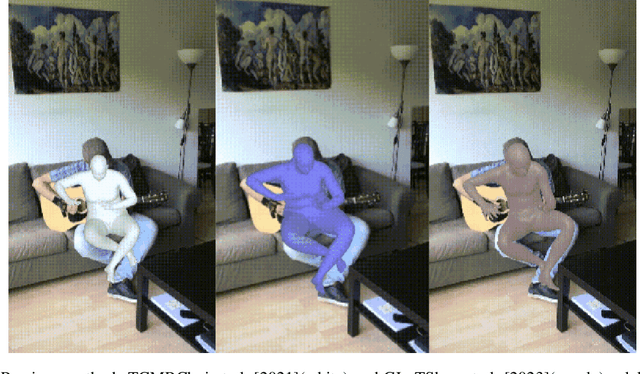
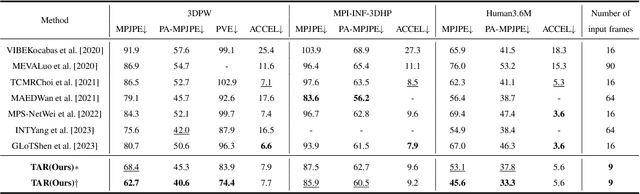
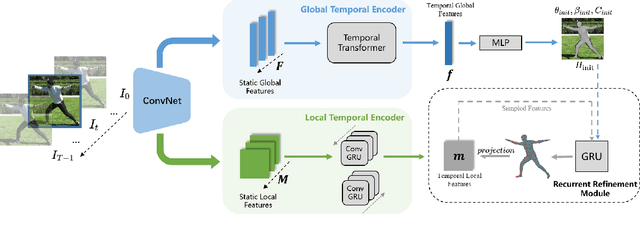
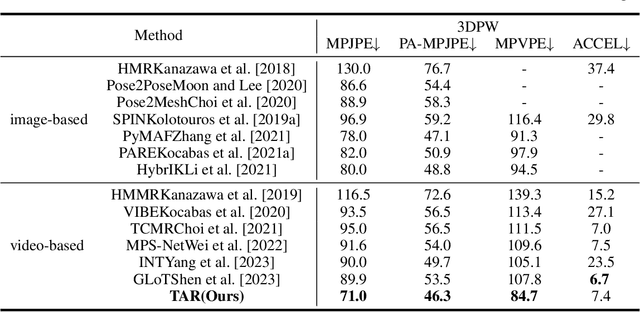
Though significant progress in human pose and shape recovery from monocular RGB images has been made in recent years, obtaining 3D human motion with high accuracy and temporal consistency from videos remains challenging. Existing video-based methods tend to reconstruct human motion from global image features, which lack detailed representation capability and limit the reconstruction accuracy. In this paper, we propose a Temporal-Aware Refining Network (TAR), to synchronously explore temporal-aware global and local image features for accurate pose and shape recovery. First, a global transformer encoder is introduced to obtain temporal global features from static feature sequences. Second, a bidirectional ConvGRU network takes the sequence of high-resolution feature maps as input, and outputs temporal local feature maps that maintain high resolution and capture the local motion of the human body. Finally, a recurrent refinement module iteratively updates estimated SMPL parameters by leveraging both global and local temporal information to achieve accurate and smooth results. Extensive experiments demonstrate that our TAR obtains more accurate results than previous state-of-the-art methods on popular benchmarks, i.e., 3DPW, MPI-INF-3DHP, and Human3.6M.
Backdiff: a diffusion model for generalized transferable protein backmapping
Oct 03, 2023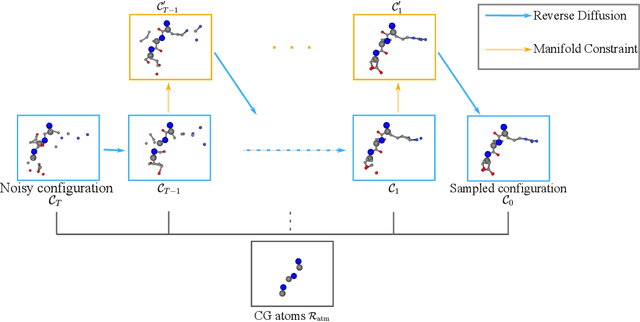
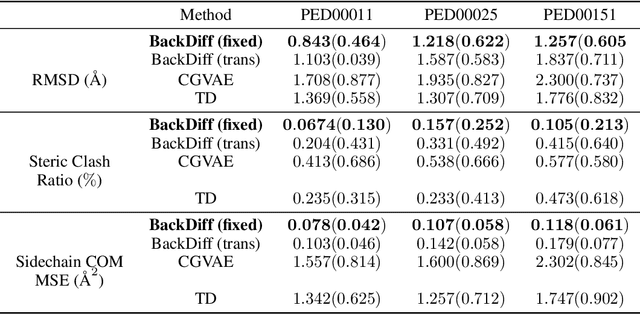
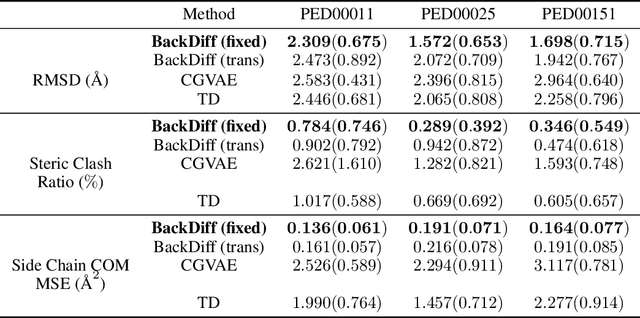
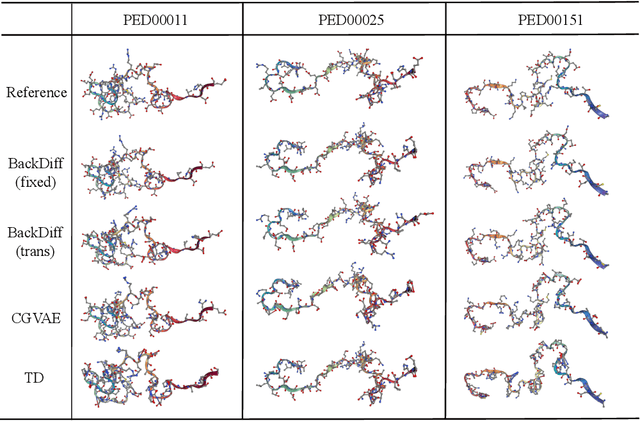
Coarse-grained (CG) models play a crucial role in the study of protein structures, protein thermodynamic properties, and protein conformation dynamics. Due to the information loss in the coarse-graining process, backmapping from CG to all-atom configurations is essential in many protein design and drug discovery applications when detailed atomic representations are needed for in-depth studies. Despite recent progress in data-driven backmapping approaches, devising a backmapping method that can be universally applied across various CG models and proteins remains unresolved. In this work, we propose BackDiff, a new generative model designed to achieve generalization and reliability in the protein backmapping problem. BackDiff leverages the conditional score-based diffusion model with geometric representations. Since different CG models can contain different coarse-grained sites which include selected atoms (CG atoms) and simple CG auxiliary functions of atomistic coordinates (CG auxiliary variables), we design a self-supervised training framework to adapt to different CG atoms, and constrain the diffusion sampling paths with arbitrary CG auxiliary variables as conditions. Our method facilitates end-to-end training and allows efficient sampling across different proteins and diverse CG models without the need for retraining. Comprehensive experiments over multiple popular CG models demonstrate BackDiff's superior performance to existing state-of-the-art approaches, and generalization and flexibility that these approaches cannot achieve. A pretrained BackDiff model can offer a convenient yet reliable plug-and-play solution for protein researchers, enabling them to investigate further from their own CG models.
Online Resource Allocation for Semantic-Aware Edge Computing Systems
Sep 25, 2023In this paper, we propose a semantic-aware joint communication and computation resource allocation framework for MEC systems. In the considered system, random tasks arrive at each terminal device (TD), which needs to be computed locally or offloaded to the MEC server. To further release the transmission burden, each TD sends the small-size extracted semantic information of tasks to the server instead of the original large-size raw data. An optimization problem of joint semanticaware division factor, communication and computation resource management is formulated. The problem aims to minimize the energy consumption of the whole system, while satisfying longterm delay and processing rate constraints. To solve this problem, an online low-complexity algorithm is proposed. In particular, Lyapunov optimization is utilized to decompose the original coupled long-term problem into a series of decoupled deterministic problems without requiring the realizations of future task arrivals and channel gains. Then, the block coordinate descent method and successive convex approximation algorithm are adopted to solve the current time slot deterministic problem by observing the current system states. Moreover, the closed-form optimal solution of each optimization variable is provided. Simulation results show that the proposed algorithm yields up to 41.8% energy reduction compared to its counterpart without semantic-aware allocation.
Resource Allocation for Semantic-Aware Mobile Edge Computing Systems
Sep 21, 2023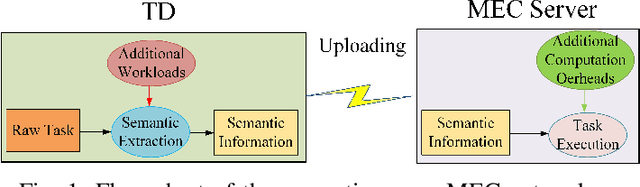
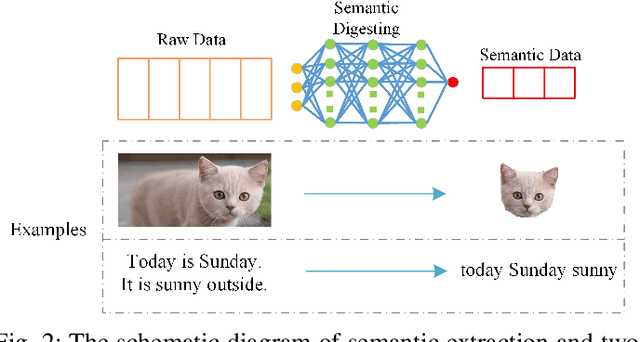
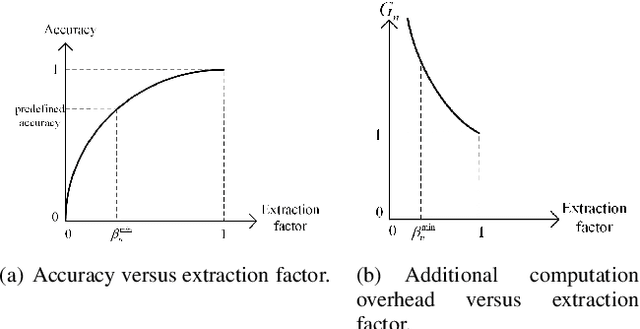
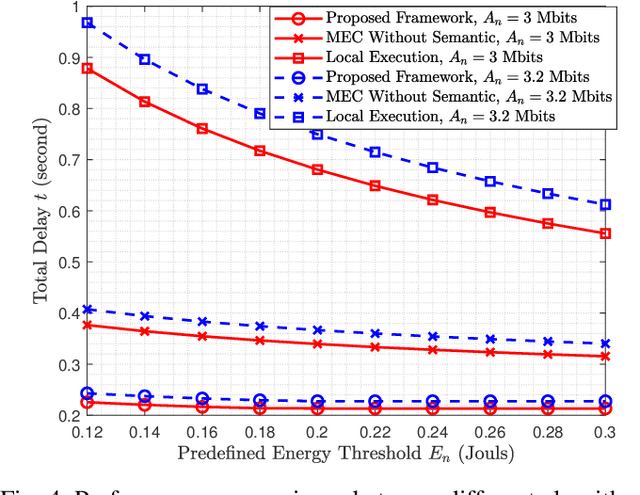
In this paper, a semantic-aware joint communication and computation resource allocation framework is proposed for mobile edge computing (MEC) systems. In the considered system, each terminal device (TD) has a computation task, which needs to be executed by offloading to the MEC server. To further decrease the transmission burden, each TD sends the small-size extracted semantic information of tasks to the server instead of the large-size raw data. An optimization problem of joint semantic-aware division factor, communication and computation resource management is formulated. The problem aims to minimize the maximum execution delay of all TDs while satisfying energy consumption constraints. The original non-convex problem is transformed into a convex one based on the geometric programming and the optimal solution is obtained by the alternating optimization algorithm. Moreover, the closed-form optimal solution of the semantic extraction factor is derived. Simulation results show that the proposed algorithm yields up to 37.10% delay reduction compared with the benchmark algorithm without semantic-aware allocation. Furthermore, small semantic extraction factors are preferred in the case of large task sizes and poor channel conditions.
Advancing Ad Auction Realism: Practical Insights & Modeling Implications
Jul 21, 2023This paper proposes a learning model of online ad auctions that allows for the following four key realistic characteristics of contemporary online auctions: (1) ad slots can have different values and click-through rates depending on users' search queries, (2) the number and identity of competing advertisers are unobserved and change with each auction, (3) advertisers only receive partial, aggregated feedback, and (4) payment rules are only partially specified. We model advertisers as agents governed by an adversarial bandit algorithm, independent of auction mechanism intricacies. Our objective is to simulate the behavior of advertisers for counterfactual analysis, prediction, and inference purposes. Our findings reveal that, in such richer environments, "soft floors" can enhance key performance metrics even when bidders are drawn from the same population. We further demonstrate how to infer advertiser value distributions from observed bids, thereby affirming the practical efficacy of our approach even in a more realistic auction setting.
Joint Batching and Scheduling for High-Throughput Multiuser Edge AI with Asynchronous Task Arrivals
Jul 15, 2023
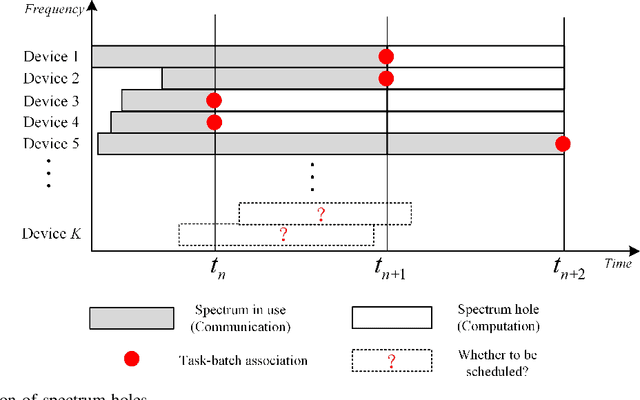
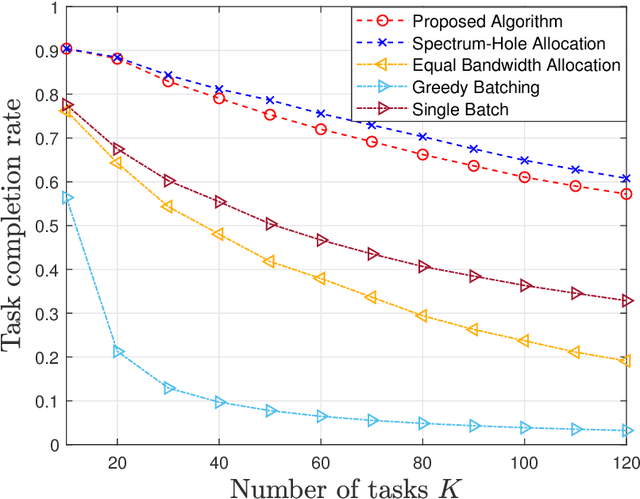
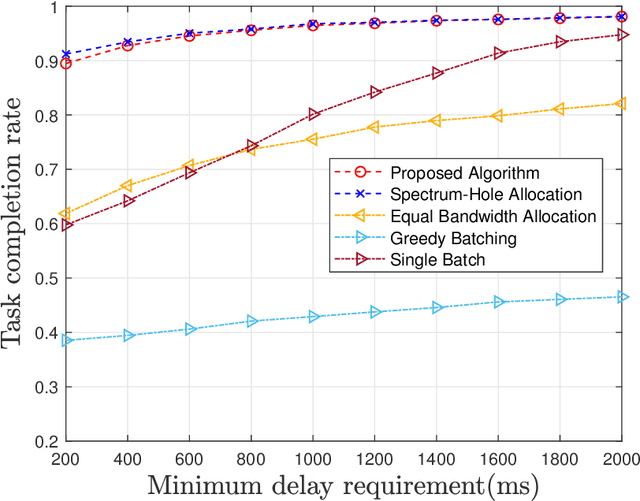
In this paper, we study joint batching and (task) scheduling to maximise the throughput (i.e., the number of completed tasks) under the practical assumptions of heterogeneous task arrivals and deadlines. The design aims to optimise the number of batches, their starting time instants, and the task-batch association that determines batch sizes. The joint optimisation problem is complex due to multiple coupled variables as mentioned and numerous constraints including heterogeneous tasks arrivals and deadlines, the causality requirements on multi-task execution, and limited radio resources. Underpinning the problem is a basic tradeoff between the size of batch and waiting time for tasks in the batch to be uploaded and executed. Our approach of solving the formulated mixed-integer problem is to transform it into a convex problem via integer relaxation method and $\ell_0$-norm approximation. This results in an efficient alternating optimization algorithm for finding a close-to-optimal solution. In addition, we also design the optimal algorithm from leveraging spectrum holes, which are caused by fixed bandwidth allocation to devices and their asynchronized multi-batch task execution, to admit unscheduled tasks so as to further enhance throughput. Simulation results demonstrate that the proposed framework of joint batching and resource allocation can substantially enhance the throughput of multiuser edge-AI as opposed to a number of simpler benchmarking schemes, e.g., equal-bandwidth allocation, greedy batching and single-batch execution.
Streaming CTR Prediction: Rethinking Recommendation Task for Real-World Streaming Data
Jul 14, 2023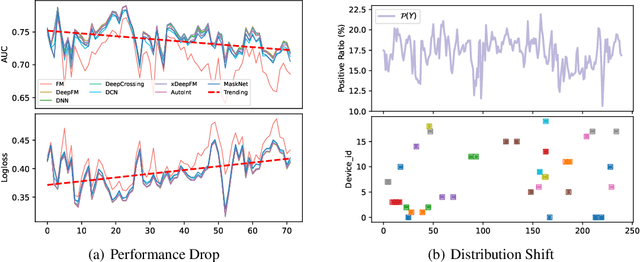

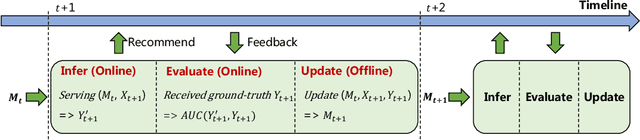
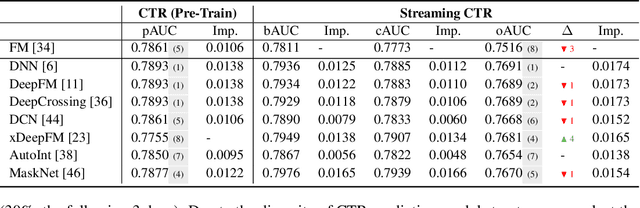
The Click-Through Rate (CTR) prediction task is critical in industrial recommender systems, where models are usually deployed on dynamic streaming data in practical applications. Such streaming data in real-world recommender systems face many challenges, such as distribution shift, temporal non-stationarity, and systematic biases, which bring difficulties to the training and utilizing of recommendation models. However, most existing studies approach the CTR prediction as a classification task on static datasets, assuming that the train and test sets are independent and identically distributed (a.k.a, i.i.d. assumption). To bridge this gap, we formulate the CTR prediction problem in streaming scenarios as a Streaming CTR Prediction task. Accordingly, we propose dedicated benchmark settings and metrics to evaluate and analyze the performance of the models in streaming data. To better understand the differences compared to traditional CTR prediction tasks, we delve into the factors that may affect the model performance, such as parameter scale, normalization, regularization, etc. The results reveal the existence of the ''streaming learning dilemma'', whereby the same factor may have different effects on model performance in the static and streaming scenarios. Based on the findings, we propose two simple but inspiring methods (i.e., tuning key parameters and exemplar replay) that significantly improve the effectiveness of the CTR models in the new streaming scenario. We hope our work will inspire further research on streaming CTR prediction and help improve the robustness and adaptability of recommender systems.
VideoXum: Cross-modal Visual and Textural Summarization of Videos
Mar 21, 2023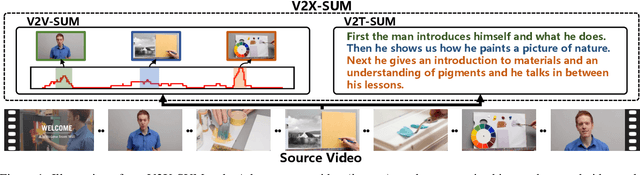
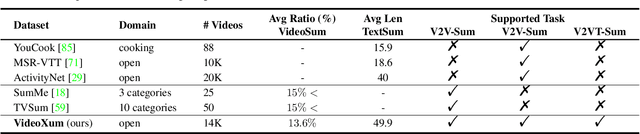
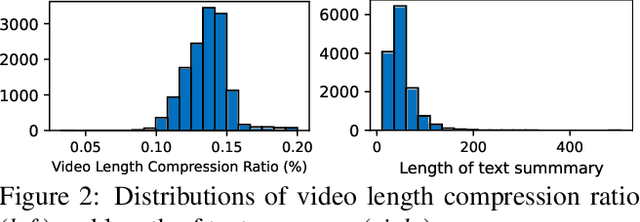

Video summarization aims to distill the most important information from a source video to produce either an abridged clip or a textual narrative. Traditionally, different methods have been proposed depending on whether the output is a video or text, thus ignoring the correlation between the two semantically related tasks of visual summarization and textual summarization. We propose a new joint video and text summarization task. The goal is to generate both a shortened video clip along with the corresponding textual summary from a long video, collectively referred to as a cross-modal summary. The generated shortened video clip and text narratives should be semantically well aligned. To this end, we first build a large-scale human-annotated dataset -- VideoXum (X refers to different modalities). The dataset is reannotated based on ActivityNet. After we filter out the videos that do not meet the length requirements, 14,001 long videos remain in our new dataset. Each video in our reannotated dataset has human-annotated video summaries and the corresponding narrative summaries. We then design a novel end-to-end model -- VTSUM-BILP to address the challenges of our proposed task. Moreover, we propose a new metric called VT-CLIPScore to help evaluate the semantic consistency of cross-modality summary. The proposed model achieves promising performance on this new task and establishes a benchmark for future research.