 Add to Chrome
 Add to Firefox
 Add to Edge
One Size does not Fit All: Heterogeneous Latent Space Alignment for Unsupervised Domain Adaptation
Jun 19, 2026
Domain shift remains a major obstacle to the reliable deployment of machine learning models in high-stakes environments such as healthcare. While Domain adaptation aims to mitigate these effects, existing approaches suffer from limited expressiveness of latent representations and a reliance on handcrafted, static augmentations. In this work, we address these limitations by proposing a novel deep learning architecture for Unsupervised Domain Adaptation (UDA), specifically optimized for medical image segmentation. Our framework, ADualVUOT, integrates a dual-encoder Variational Autoencoder (VAE) with Continuous Normalizing Flows (CNFs) to increase modeling flexibility and posterior expressiveness. To achieve domain alignment, we leverage Unbalanced Optimal Transport (UOT) through the Gaussian-Gromov-Wasserstein (GGW) distance, which handles structural and topological discrepancies between domains. Furthermore, we incorporate an adversarial augmentation scheme to synthesize worst-case compositions, thus enhancing model robustness. Extensive experiments on medical imaging benchmarks show significant gains over prior OT-based approaches.

Efficient Tail-Aware Generative Optimization via Flow Model Fine-Tuning
Feb 18, 2026Fine-tuning pre-trained diffusion and flow models to optimize downstream utilities is central to real-world deployment. Existing entropy-regularized methods primarily maximize expected reward, providing no mechanism to shape tail behavior. However, tail control is often essential: the lower tail determines reliability by limiting low-reward failures, while the upper tail enables discovery by prioritizing rare, high-reward outcomes. In this work, we present Tail-aware Flow Fine-Tuning (TFFT), a principled and efficient distributional fine-tuning algorithm based on the Conditional Value-at-Risk (CVaR). We address two distinct tail-shaping goals: right-CVaR for seeking novel samples in the high-reward tail and left-CVaR for controlling worst-case samples in the low-reward tail. Unlike prior approaches that rely on non-linear optimization, we leverage the variational dual formulation of CVaR to decompose it into a decoupled two-stage procedure: a lightweight one-dimensional threshold optimization step, and a single entropy-regularized fine-tuning process via a specific pseudo-reward. This decomposition achieves CVaR fine-tuning efficiently with computational cost comparable to standard expected fine-tuning methods. We demonstrate the effectiveness of TFFT across illustrative experiments, high-dimensional text-to-image generation, and molecular design.
An Agentic AI System for Multi-Framework Communication Coding
Dec 09, 2025Clinical communication is central to patient outcomes, yet large-scale human annotation of patient-provider conversation remains labor-intensive, inconsistent, and difficult to scale. Existing approaches based on large language models typically rely on single-task models that lack adaptability, interpretability, and reliability, especially when applied across various communication frameworks and clinical domains. In this study, we developed a Multi-framework Structured Agentic AI system for Clinical Communication (MOSAIC), built on a LangGraph-based architecture that orchestrates four core agents, including a Plan Agent for codebook selection and workflow planning, an Update Agent for maintaining up-to-date retrieval databases, a set of Annotation Agents that applies codebook-guided retrieval-augmented generation (RAG) with dynamic few-shot prompting, and a Verification Agent that provides consistency checks and feedback. To evaluate performance, we compared MOSAIC outputs against gold-standard annotations created by trained human coders. We developed and evaluated MOSAIC using 26 gold standard annotated transcripts for training and 50 transcripts for testing, spanning rheumatology and OB/GYN domains. On the test set, MOSAIC achieved an overall F1 score of 0.928. Performance was highest in the Rheumatology subset (F1 = 0.962) and strongest for Patient Behavior (e.g., patients asking questions, expressing preferences, or showing assertiveness). Ablations revealed that MOSAIC outperforms baseline benchmarking.
Wasserstein Distributionally Robust Nash Equilibrium Seeking with Heterogeneous Data: A Lagrangian Approach
Nov 18, 2025We study a class of distributionally robust games where agents are allowed to heterogeneously choose their risk aversion with respect to distributional shifts of the uncertainty. In our formulation, heterogeneous Wasserstein ball constraints on each distribution are enforced through a penalty function leveraging a Lagrangian formulation. We then formulate the distributionally robust Nash equilibrium problem and show that under certain assumptions it is equivalent to a finite-dimensional variational inequality problem with a strongly monotone mapping. We then design an approximate Nash equilibrium seeking algorithm and prove convergence of the average regret to a quantity that diminishes with the number of iterations, thus learning the desired equilibrium up to an a priori specified accuracy. Numerical simulations corroborate our theoretical findings.
Group Distributionally Robust Machine Learning under Group Level Distributional Uncertainty
Sep 10, 2025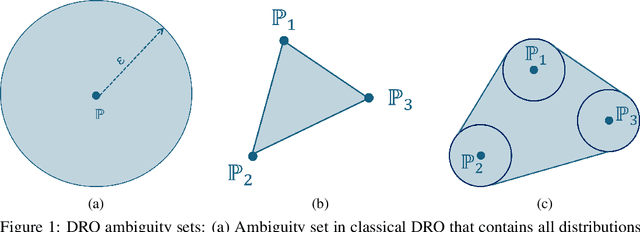

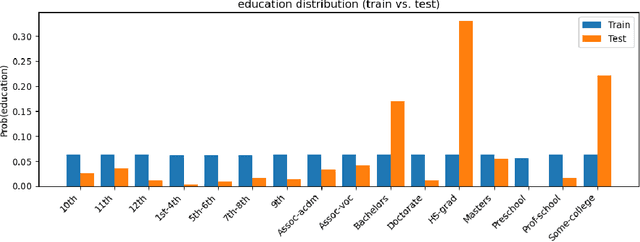
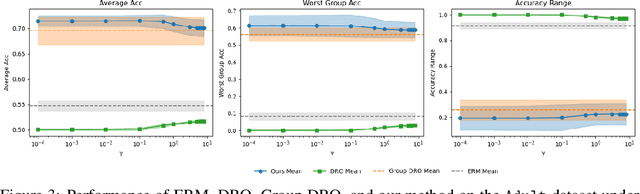
The performance of machine learning (ML) models critically depends on the quality and representativeness of the training data. In applications with multiple heterogeneous data generating sources, standard ML methods often learn spurious correlations that perform well on average but degrade performance for atypical or underrepresented groups. Prior work addresses this issue by optimizing the worst-group performance. However, these approaches typically assume that the underlying data distributions for each group can be accurately estimated using the training data, a condition that is frequently violated in noisy, non-stationary, and evolving environments. In this work, we propose a novel framework that relies on Wasserstein-based distributionally robust optimization (DRO) to account for the distributional uncertainty within each group, while simultaneously preserving the objective of improving the worst-group performance. We develop a gradient descent-ascent algorithm to solve the proposed DRO problem and provide convergence results. Finally, we validate the effectiveness of our method on real-world data.
Source-Guided Flow Matching
Aug 20, 2025Guidance of generative models is typically achieved by modifying the probability flow vector field through the addition of a guidance field. In this paper, we instead propose the Source-Guided Flow Matching (SGFM) framework, which modifies the source distribution directly while keeping the pre-trained vector field intact. This reduces the guidance problem to a well-defined problem of sampling from the source distribution. We theoretically show that SGFM recovers the desired target distribution exactly. Furthermore, we provide bounds on the Wasserstein error for the generated distribution when using an approximate sampler of the source distribution and an approximate vector field. The key benefit of our approach is that it allows the user to flexibly choose the sampling method depending on their specific problem. To illustrate this, we systematically compare different sampling methods and discuss conditions for asymptotically exact guidance. Moreover, our framework integrates well with optimal flow matching models since the straight transport map generated by the vector field is preserved. Experimental results on synthetic 2D benchmarks, image datasets, and physics-informed generative tasks demonstrate the effectiveness and flexibility of the proposed framework.
FairPOT: Balancing AUC Performance and Fairness with Proportional Optimal Transport
Aug 05, 2025Fairness metrics utilizing the area under the receiver operator characteristic curve (AUC) have gained increasing attention in high-stakes domains such as healthcare, finance, and criminal justice. In these domains, fairness is often evaluated over risk scores rather than binary outcomes, and a common challenge is that enforcing strict fairness can significantly degrade AUC performance. To address this challenge, we propose Fair Proportional Optimal Transport (FairPOT), a novel, model-agnostic post-processing framework that strategically aligns risk score distributions across different groups using optimal transport, but does so selectively by transforming a controllable proportion, i.e., the top-lambda quantile, of scores within the disadvantaged group. By varying lambda, our method allows for a tunable trade-off between reducing AUC disparities and maintaining overall AUC performance. Furthermore, we extend FairPOT to the partial AUC setting, enabling fairness interventions to concentrate on the highest-risk regions. Extensive experiments on synthetic, public, and clinical datasets show that FairPOT consistently outperforms existing post-processing techniques in both global and partial AUC scenarios, often achieving improved fairness with slight AUC degradation or even positive gains in utility. The computational efficiency and practical adaptability of FairPOT make it a promising solution for real-world deployment.
Enhancing Cooperative Multi-Agent Reinforcement Learning with State Modelling and Adversarial Exploration
May 08, 2025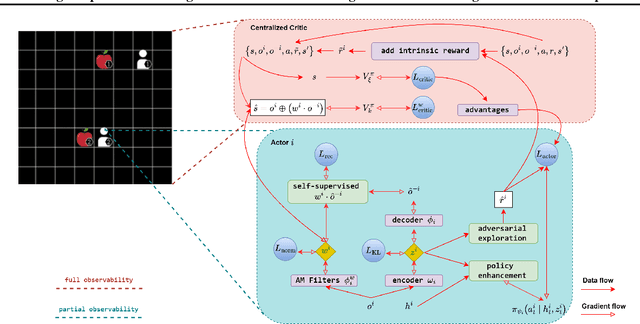


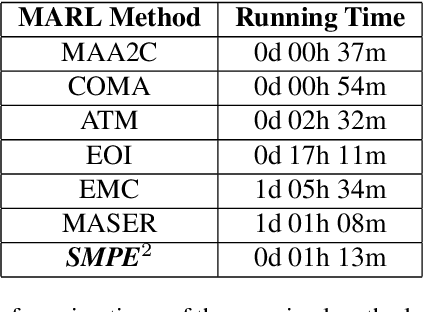
Learning to cooperate in distributed partially observable environments with no communication abilities poses significant challenges for multi-agent deep reinforcement learning (MARL). This paper addresses key concerns in this domain, focusing on inferring state representations from individual agent observations and leveraging these representations to enhance agents' exploration and collaborative task execution policies. To this end, we propose a novel state modelling framework for cooperative MARL, where agents infer meaningful belief representations of the non-observable state, with respect to optimizing their own policies, while filtering redundant and less informative joint state information. Building upon this framework, we propose the MARL SMPE algorithm. In SMPE, agents enhance their own policy's discriminative abilities under partial observability, explicitly by incorporating their beliefs into the policy network, and implicitly by adopting an adversarial type of exploration policies which encourages agents to discover novel, high-value states while improving the discriminative abilities of others. Experimentally, we show that SMPE outperforms state-of-the-art MARL algorithms in complex fully cooperative tasks from the MPE, LBF, and RWARE benchmarks.
LAPP: Large Language Model Feedback for Preference-Driven Reinforcement Learning
Apr 21, 2025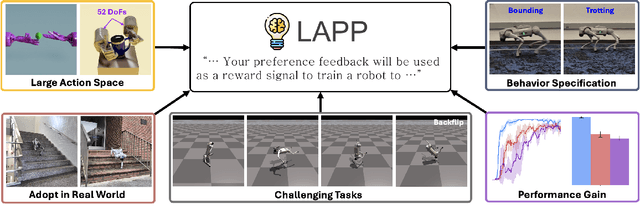
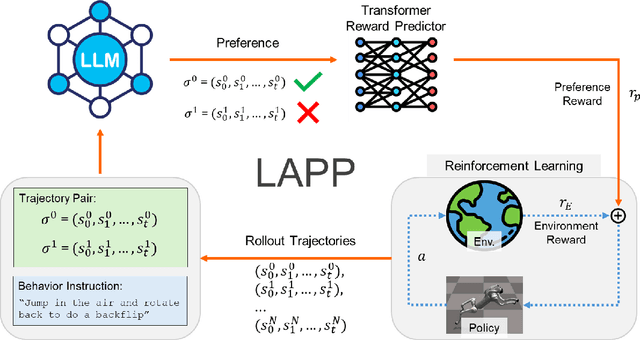
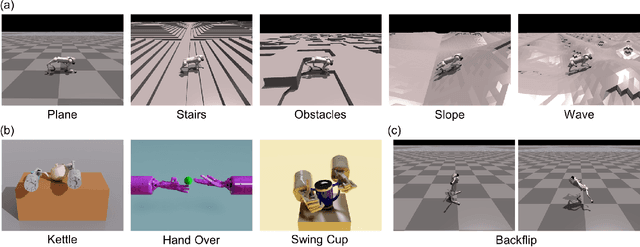
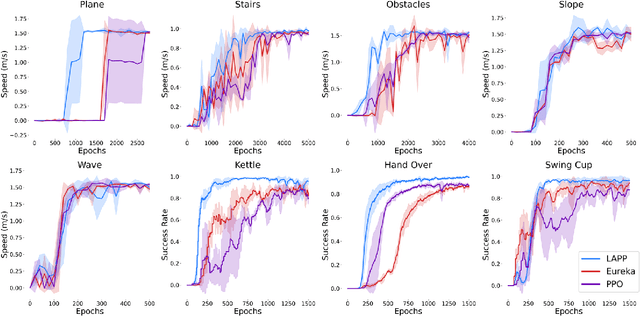
We introduce Large Language Model-Assisted Preference Prediction (LAPP), a novel framework for robot learning that enables efficient, customizable, and expressive behavior acquisition with minimum human effort. Unlike prior approaches that rely heavily on reward engineering, human demonstrations, motion capture, or expensive pairwise preference labels, LAPP leverages large language models (LLMs) to automatically generate preference labels from raw state-action trajectories collected during reinforcement learning (RL). These labels are used to train an online preference predictor, which in turn guides the policy optimization process toward satisfying high-level behavioral specifications provided by humans. Our key technical contribution is the integration of LLMs into the RL feedback loop through trajectory-level preference prediction, enabling robots to acquire complex skills including subtle control over gait patterns and rhythmic timing. We evaluate LAPP on a diverse set of quadruped locomotion and dexterous manipulation tasks and show that it achieves efficient learning, higher final performance, faster adaptation, and precise control of high-level behaviors. Notably, LAPP enables robots to master highly dynamic and expressive tasks such as quadruped backflips, which remain out of reach for standard LLM-generated or handcrafted rewards. Our results highlight LAPP as a promising direction for scalable preference-driven robot learning.
Distributionally Robust Multi-Agent Reinforcement Learning for Dynamic Chute Mapping
Mar 12, 2025In Amazon robotic warehouses, the destination-to-chute mapping problem is crucial for efficient package sorting. Often, however, this problem is complicated by uncertain and dynamic package induction rates, which can lead to increased package recirculation. To tackle this challenge, we introduce a Distributionally Robust Multi-Agent Reinforcement Learning (DRMARL) framework that learns a destination-to-chute mapping policy that is resilient to adversarial variations in induction rates. Specifically, DRMARL relies on group distributionally robust optimization (DRO) to learn a policy that performs well not only on average but also on each individual subpopulation of induction rates within the group that capture, for example, different seasonality or operation modes of the system. This approach is then combined with a novel contextual bandit-based predictor of the worst-case induction distribution for each state-action pair, significantly reducing the cost of exploration and thereby increasing the learning efficiency and scalability of our framework. Extensive simulations demonstrate that DRMARL achieves robust chute mapping in the presence of varying induction distributions, reducing package recirculation by an average of 80\% in the simulation scenario.