 Add to Chrome
 Add to Firefox
 Add to Edge
Gemini: A Family of Highly Capable Multimodal Models
Dec 19, 2023
This report introduces a new family of multimodal models, Gemini, that exhibit remarkable capabilities across image, audio, video, and text understanding. The Gemini family consists of Ultra, Pro, and Nano sizes, suitable for applications ranging from complex reasoning tasks to on-device memory-constrained use-cases. Evaluation on a broad range of benchmarks shows that our most-capable Gemini Ultra model advances the state of the art in 30 of 32 of these benchmarks - notably being the first model to achieve human-expert performance on the well-studied exam benchmark MMLU, and improving the state of the art in every one of the 20 multimodal benchmarks we examined. We believe that the new capabilities of Gemini models in cross-modal reasoning and language understanding will enable a wide variety of use cases and we discuss our approach toward deploying them responsibly to users.

Learning Discrete-Time Major-Minor Mean Field Games
Dec 17, 2023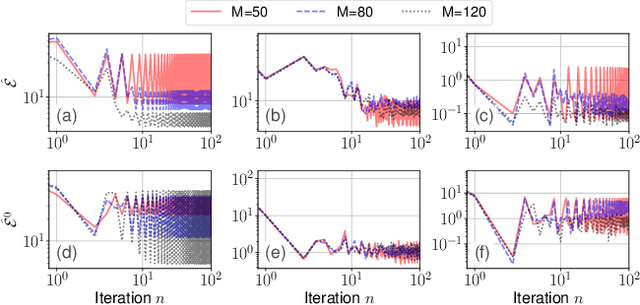
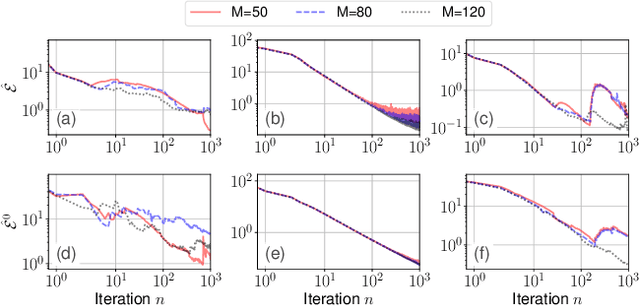
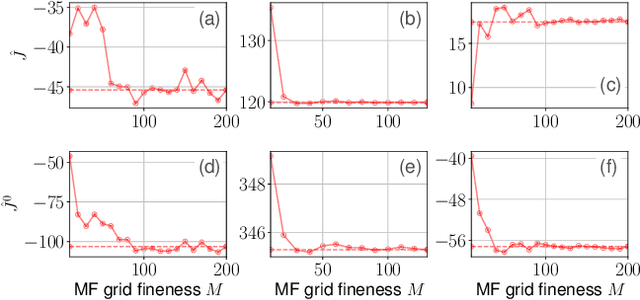
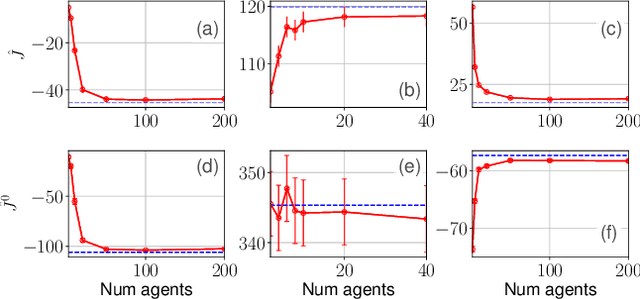
Recent techniques based on Mean Field Games (MFGs) allow the scalable analysis of multi-player games with many similar, rational agents. However, standard MFGs remain limited to homogeneous players that weakly influence each other, and cannot model major players that strongly influence other players, severely limiting the class of problems that can be handled. We propose a novel discrete time version of major-minor MFGs (M3FGs), along with a learning algorithm based on fictitious play and partitioning the probability simplex. Importantly, M3FGs generalize MFGs with common noise and can handle not only random exogeneous environment states but also major players. A key challenge is that the mean field is stochastic and not deterministic as in standard MFGs. Our theoretical investigation verifies both the M3FG model and its algorithmic solution, showing firstly the well-posedness of the M3FG model starting from a finite game of interest, and secondly convergence and approximation guarantees of the fictitious play algorithm. Then, we empirically verify the obtained theoretical results, ablating some of the theoretical assumptions made, and show successful equilibrium learning in three example problems. Overall, we establish a learning framework for a novel and broad class of tractable games.
Nash Learning from Human Feedback
Dec 06, 2023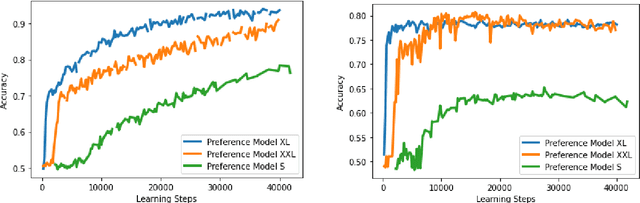


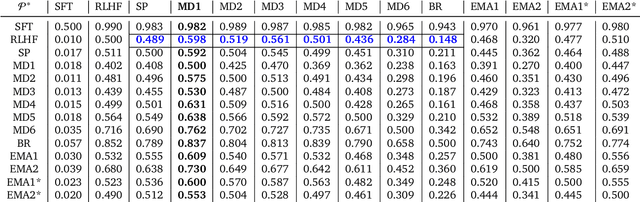
Reinforcement learning from human feedback (RLHF) has emerged as the main paradigm for aligning large language models (LLMs) with human preferences. Typically, RLHF involves the initial step of learning a reward model from human feedback, often expressed as preferences between pairs of text generations produced by a pre-trained LLM. Subsequently, the LLM's policy is fine-tuned by optimizing it to maximize the reward model through a reinforcement learning algorithm. However, an inherent limitation of current reward models is their inability to fully represent the richness of human preferences and their dependency on the sampling distribution. In this study, we introduce an alternative pipeline for the fine-tuning of LLMs using pairwise human feedback. Our approach entails the initial learning of a preference model, which is conditioned on two inputs given a prompt, followed by the pursuit of a policy that consistently generates responses preferred over those generated by any competing policy, thus defining the Nash equilibrium of this preference model. We term this approach Nash learning from human feedback (NLHF). In the context of a tabular policy representation, we present a novel algorithmic solution, Nash-MD, founded on the principles of mirror descent. This algorithm produces a sequence of policies, with the last iteration converging to the regularized Nash equilibrium. Additionally, we explore parametric representations of policies and introduce gradient descent algorithms for deep-learning architectures. To demonstrate the effectiveness of our approach, we present experimental results involving the fine-tuning of a LLM for a text summarization task. We believe NLHF offers a compelling avenue for preference learning and policy optimization with the potential of advancing the field of aligning LLMs with human preferences.
A Survey of Temporal Credit Assignment in Deep Reinforcement Learning
Dec 02, 2023
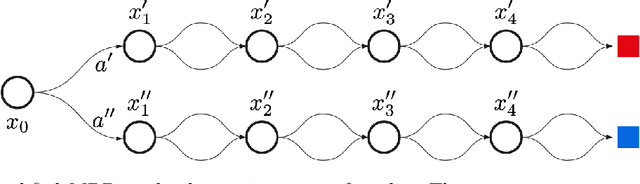


The Credit Assignment Problem (CAP) refers to the longstanding challenge of Reinforcement Learning (RL) agents to associate actions with their long-term consequences. Solving the CAP is a crucial step towards the successful deployment of RL in the real world since most decision problems provide feedback that is noisy, delayed, and with little or no information about the causes. These conditions make it hard to distinguish serendipitous outcomes from those caused by informed decision-making. However, the mathematical nature of credit and the CAP remains poorly understood and defined. In this survey, we review the state of the art of Temporal Credit Assignment (CA) in deep RL. We propose a unifying formalism for credit that enables equitable comparisons of state of the art algorithms and improves our understanding of the trade-offs between the various methods. We cast the CAP as the problem of learning the influence of an action over an outcome from a finite amount of experience. We discuss the challenges posed by delayed effects, transpositions, and a lack of action influence, and analyse how existing methods aim to address them. Finally, we survey the protocols to evaluate a credit assignment method, and suggest ways to diagnoses the sources of struggle for different credit assignment methods. Overall, this survey provides an overview of the field for new-entry practitioners and researchers, it offers a coherent perspective for scholars looking to expedite the starting stages of a new study on the CAP, and it suggests potential directions for future research
DRIFT: Deep Reinforcement Learning for Intelligent Floating Platforms Trajectories
Oct 06, 2023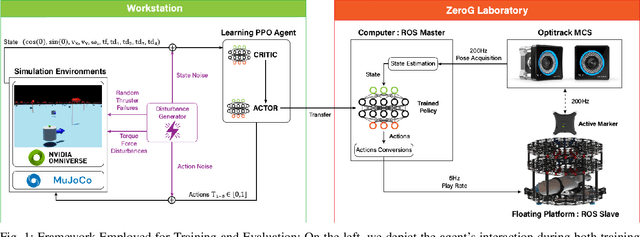
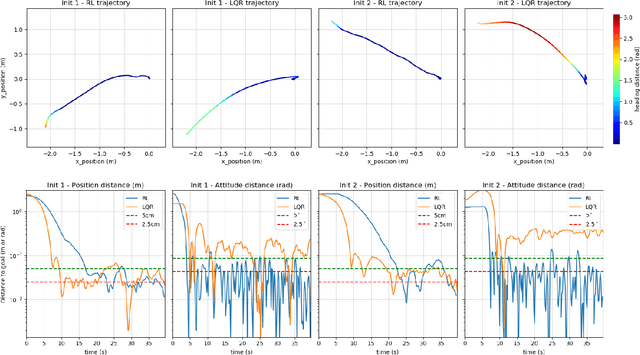
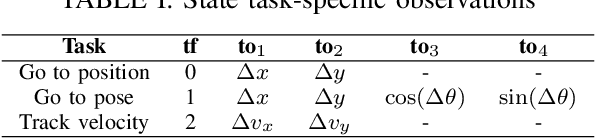
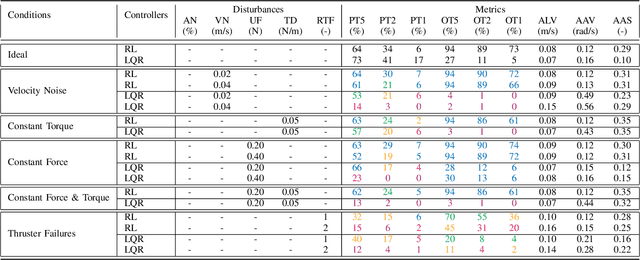
This investigation introduces a novel deep reinforcement learning-based suite to control floating platforms in both simulated and real-world environments. Floating platforms serve as versatile test-beds to emulate microgravity environments on Earth. Our approach addresses the system and environmental uncertainties in controlling such platforms by training policies capable of precise maneuvers amid dynamic and unpredictable conditions. Leveraging state-of-the-art deep reinforcement learning techniques, our suite achieves robustness, adaptability, and good transferability from simulation to reality. Our Deep Reinforcement Learning (DRL) framework provides advantages such as fast training times, large-scale testing capabilities, rich visualization options, and ROS bindings for integration with real-world robotic systems. Beyond policy development, our suite provides a comprehensive platform for researchers, offering open-access at https://github.com/elharirymatteo/RANS/tree/ICRA24.
Offline Reinforcement Learning with On-Policy Q-Function Regularization
Jul 25, 2023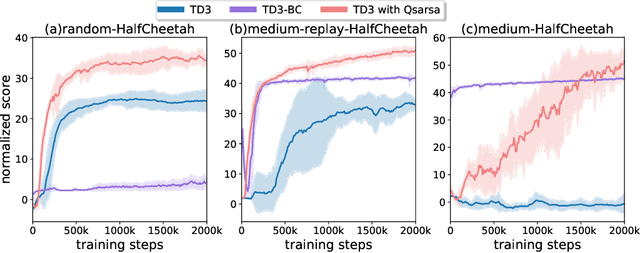
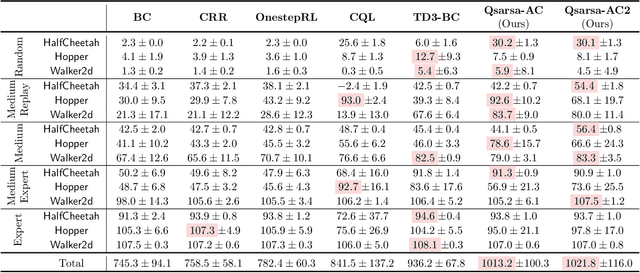
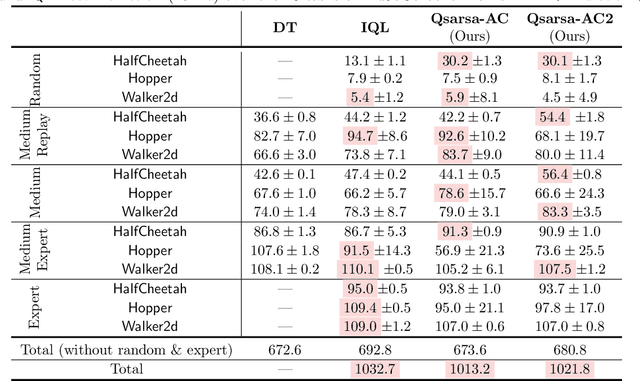
The core challenge of offline reinforcement learning (RL) is dealing with the (potentially catastrophic) extrapolation error induced by the distribution shift between the history dataset and the desired policy. A large portion of prior work tackles this challenge by implicitly/explicitly regularizing the learning policy towards the behavior policy, which is hard to estimate reliably in practice. In this work, we propose to regularize towards the Q-function of the behavior policy instead of the behavior policy itself, under the premise that the Q-function can be estimated more reliably and easily by a SARSA-style estimate and handles the extrapolation error more straightforwardly. We propose two algorithms taking advantage of the estimated Q-function through regularizations, and demonstrate they exhibit strong performance on the D4RL benchmarks.
A Connection between One-Step Regularization and Critic Regularization in Reinforcement Learning
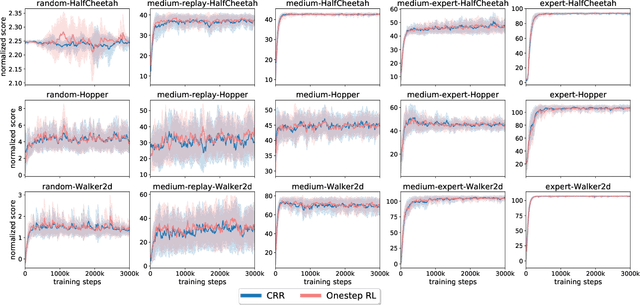
Jul 24, 2023As with any machine learning problem with limited data, effective offline RL algorithms require careful regularization to avoid overfitting. One-step methods perform regularization by doing just a single step of policy improvement, while critic regularization methods do many steps of policy improvement with a regularized objective. These methods appear distinct. One-step methods, such as advantage-weighted regression and conditional behavioral cloning, truncate policy iteration after just one step. This ``early stopping'' makes one-step RL simple and stable, but can limit its asymptotic performance. Critic regularization typically requires more compute but has appealing lower-bound guarantees. In this paper, we draw a close connection between these methods: applying a multi-step critic regularization method with a regularization coefficient of 1 yields the same policy as one-step RL. While practical implementations violate our assumptions and critic regularization is typically applied with smaller regularization coefficients, our experiments nevertheless show that our analysis makes accurate, testable predictions about practical offline RL methods (CQL and one-step RL) with commonly-used hyperparameters. Our results that every problem can be solved with a single step of policy improvement, but rather that one-step RL might be competitive with critic regularization on RL problems that demand strong regularization.
On Imitation in Mean-field Games
Jun 26, 2023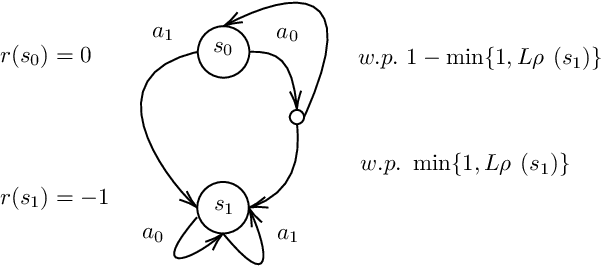
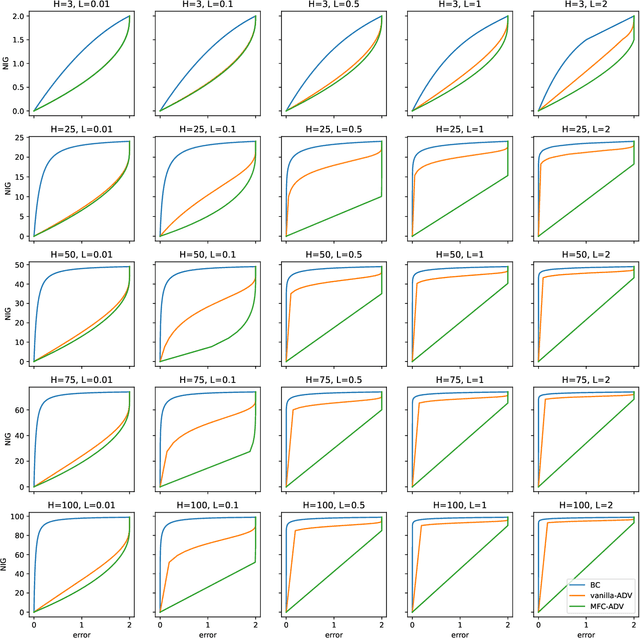
We explore the problem of imitation learning (IL) in the context of mean-field games (MFGs), where the goal is to imitate the behavior of a population of agents following a Nash equilibrium policy according to some unknown payoff function. IL in MFGs presents new challenges compared to single-agent IL, particularly when both the reward function and the transition kernel depend on the population distribution. In this paper, departing from the existing literature on IL for MFGs, we introduce a new solution concept called the Nash imitation gap. Then we show that when only the reward depends on the population distribution, IL in MFGs can be reduced to single-agent IL with similar guarantees. However, when the dynamics is population-dependent, we provide a novel upper-bound that suggests IL is harder in this setting. To address this issue, we propose a new adversarial formulation where the reinforcement learning problem is replaced by a mean-field control (MFC) problem, suggesting progress in IL within MFGs may have to build upon MFC.
GKD: Generalized Knowledge Distillation for Auto-regressive Sequence Models
Jun 23, 2023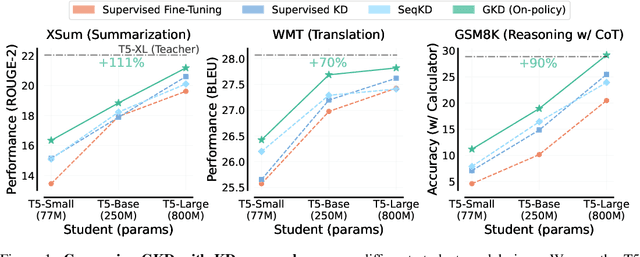
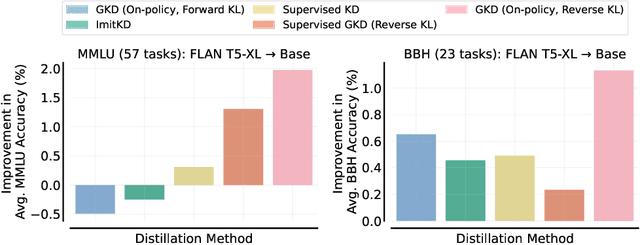
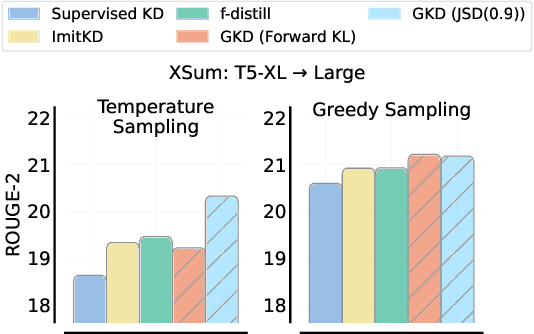
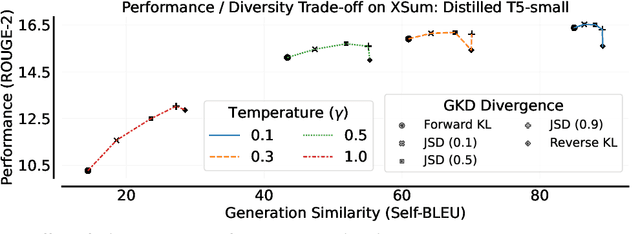
Knowledge distillation is commonly used for compressing neural networks to reduce their inference cost and memory footprint. However, current distillation methods for auto-regressive models, such as generative language models (LMs), suffer from two key issues: (1) distribution mismatch between output sequences during training and the sequences generated by the student during its deployment, and (2) model under-specification, where the student model may not be expressive enough to fit the teacher's distribution. To address these issues, we propose Generalized Knowledge Distillation (GKD). GKD mitigates distribution mismatch by sampling output sequences from the student during training. Furthermore, GKD handles model under-specification by optimizing alternative divergences, such as reverse KL, that focus on generating samples from the student that are likely under the teacher's distribution. We demonstrate that GKD outperforms commonly-used approaches for distilling LLMs on summarization, machine translation, and arithmetic reasoning tasks.
Factually Consistent Summarization via Reinforcement Learning with Textual Entailment Feedback
May 31, 2023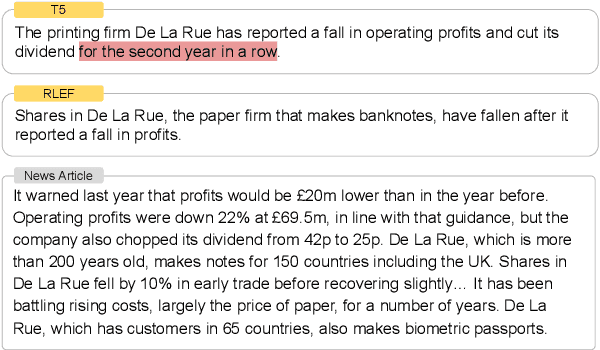
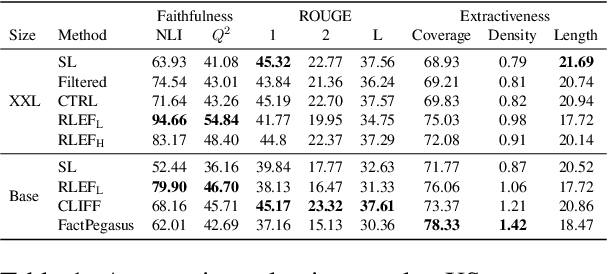

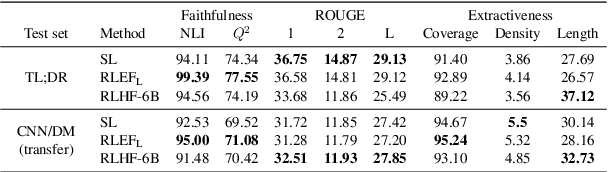
Despite the seeming success of contemporary grounded text generation systems, they often tend to generate factually inconsistent text with respect to their input. This phenomenon is emphasized in tasks like summarization, in which the generated summaries should be corroborated by their source article. In this work, we leverage recent progress on textual entailment models to directly address this problem for abstractive summarization systems. We use reinforcement learning with reference-free, textual entailment rewards to optimize for factual consistency and explore the ensuing trade-offs, as improved consistency may come at the cost of less informative or more extractive summaries. Our results, according to both automatic metrics and human evaluation, show that our method considerably improves the faithfulness, salience, and conciseness of the generated summaries.