 Add to Chrome
 Add to Firefox
 Add to Edge
Kastor: An efficient fine-tuning strategy for generative emulation of PDE simulations
Aug 06, 2026
Machine learning offers a promising avenue to accelerate physical simulations by replacing computationally expensive traditional Partial Differential Equation (PDE) solvers with fast, differentiable surrogate models. However, standard auto-regressive ML emulators often suffer from error accumulation over long horizons and struggle to capture the stochasticity of complex physical systems. In this paper, we propose Kastor, a comprehensive methodology to adapt a deterministic physics foundation model into a highly efficient and accurate generative surrogate. First, we introduce a two-stage inference scheme that combines a large-stride causal auto-regressive model with a non-causal temporal super-resolution network, significantly reducing error accumulation while minimizing computational cost. Second, we present Mean prediction regularization (MPR), a novel training objective that constrains the generative model to predict the deterministic distribution mean under null noise conditioning. This regularization dramatically improves the performance and stability of both Functional Generative Networks (FGN) and diffusion-based emulators. Finally, we demonstrate that incorporating spatial gradient matching improves the accuracy and physical fidelity of the simulations as measured by power spectrum density. Extensive evaluations on diverse simulation datasets of the benchmark The Well show that with these components, our model outperforms competing methods in forecasting accuracy, spectral consistency, and computational efficiency. Our model achieves a 42.9% average reduction in forecasting compared to our reference based on the Walrus finetuning methodology, and outperforms Walrus for 8 out of 10 datasets on variance-normalized RMSE (VRMSE).

DiffusionGemma Technical Report
Jul 31, 2026We introduce DiffusionGemma, an experimental open-weight language model that uses discrete diffusion to generate text at exceptionally high speed. Rather than decoding one token at a time, DiffusionGemma iteratively refines blocks of 256 tokens in parallel, avoiding the sequential decoding bottleneck of conventional autoregressive (AR) large language models. Instead of training from scratch, we obtain DiffusionGemma by fine-tuning the mixture-of-experts Gemma 4 model with 3.8B activated and 25.2B total parameters. Our compute-efficient two-stage training pipeline uses fewer than 10% of the starting AR model's total training token budget. The first stage uses supervised fine-tuning to teach bidirectional denoising, while the second stage combines reinforcement learning with sampler distillation to jointly improve generation quality and inference efficiency. DiffusionGemma establishes a new Pareto frontier for the trade-off between generation speed and model capability. Averaged across our full evaluation suite, it generates around 20 tokens per forward pass and achieves roughly 1,500 output tokens per second on a single NVIDIA H100 GPU, which is substantially faster than AR models even with state-of-the-art speculative decoding. DiffusionGemma also retains the starting model's support for thinking mode, multimodal inputs, and long contexts. Despite diffusion fine-tuning, it remains capable of AR generation with only minor performance degradation, suggesting a path toward hybrid diffusion-AR decoding.
Diffusion Fine-tuning with Rewarded Moment Matching Distillation
Jun 29, 2026Distillation and Reinforcement Learning (RL) fine-tuning are the primary pillars of diffusion post-training. While traditionally studied in isolation, the interaction between these phases remains poorly understood, and in particular how fine-tuning impacts the generative quality of distilled models. We introduce Rewarded Moment Matching Distillation (RMMD), a novel framework that simultaneously distills diffusion models and maximizes a reward function. RMMD preserves the high-fidelity ``naturalness'' characteristic of advanced distillation (such as 8-step Moment Matching) by adapting the sampling loop for on-policy training and repurposing the distillation loss as a proxy for integral KL regularization. By evaluating the FID-Reward Pareto fronts on ImageNet, we demonstrate that RMMD achieves superior trade-offs compared to single-step baselines (DI++) and multi-step competitors (DRaFT, HyperNoise). Finally, we apply RMMD to GenCast, a state-of-the-art weather forecasting model, to distill it while optimizing the Continuous Ranked Probability Score (CRPS) metric. The resulting distilled model achieves a 7.5x speedup while outperforming the teacher model on 93% of target weather variables, and being better calibrated. This proves that RMMD scales to complex, high-dimensional scientific domains.
C3PO: Learning to Achieve Arbitrary Goals via Massively Entropic Pretraining
Nov 07, 2022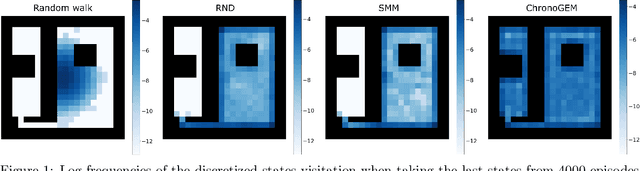
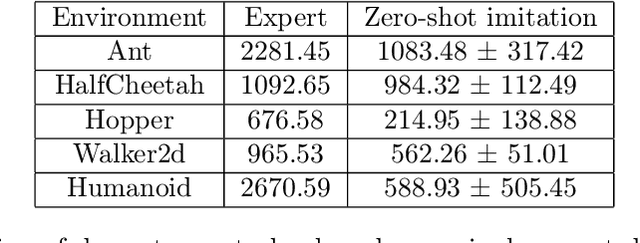
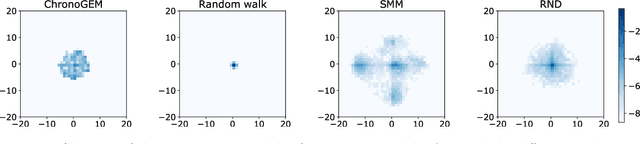
Given a particular embodiment, we propose a novel method (C3PO) that learns policies able to achieve any arbitrary position and pose. Such a policy would allow for easier control, and would be re-useable as a key building block for downstream tasks. The method is two-fold: First, we introduce a novel exploration algorithm that optimizes for uniform coverage, is able to discover a set of achievable states, and investigates its abilities in attaining both high coverage, and hard-to-discover states; Second, we leverage this set of achievable states as training data for a universal goal-achievement policy, a goal-based SAC variant. We demonstrate the trained policy's performance in achieving a large number of novel states. Finally, we showcase the influence of massive unsupervised training of a goal-achievement policy with state-of-the-art pose-based control of the Hopper, Walker, Halfcheetah, Humanoid and Ant embodiments.
Lazy-MDPs: Towards Interpretable Reinforcement Learning by Learning When to Act
Mar 16, 2022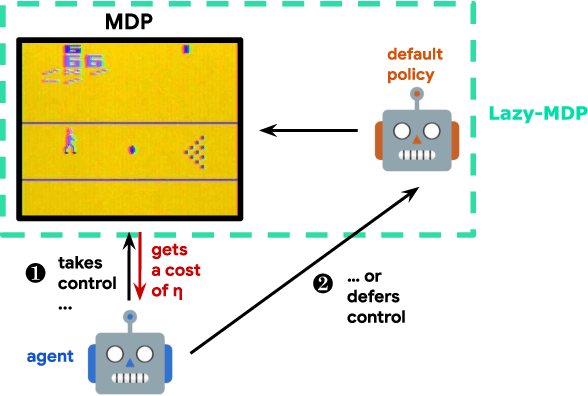
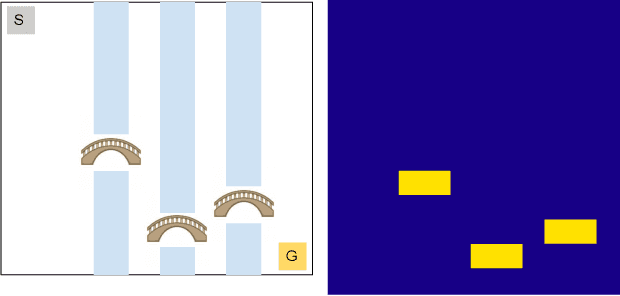
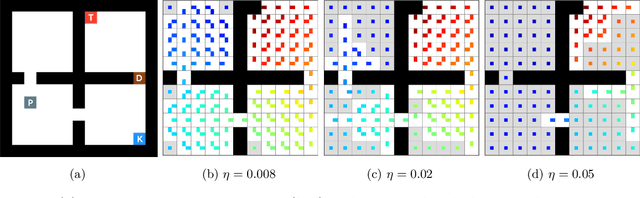
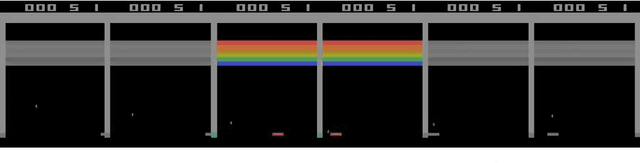
Traditionally, Reinforcement Learning (RL) aims at deciding how to act optimally for an artificial agent. We argue that deciding when to act is equally important. As humans, we drift from default, instinctive or memorized behaviors to focused, thought-out behaviors when required by the situation. To enhance RL agents with this aptitude, we propose to augment the standard Markov Decision Process and make a new mode of action available: being lazy, which defers decision-making to a default policy. In addition, we penalize non-lazy actions in order to encourage minimal effort and have agents focus on critical decisions only. We name the resulting formalism lazy-MDPs. We study the theoretical properties of lazy-MDPs, expressing value functions and characterizing optimal solutions. Then we empirically demonstrate that policies learned in lazy-MDPs generally come with a form of interpretability: by construction, they show us the states where the agent takes control over the default policy. We deem those states and corresponding actions important since they explain the difference in performance between the default and the new, lazy policy. With suboptimal policies as default (pretrained or random), we observe that agents are able to get competitive performance in Atari games while only taking control in a limited subset of states.
* AAMAS 2022 (14 pages extended version, added Sec. 7.4 and appendix K)
Foolproof Cooperative Learning
Jun 24, 2019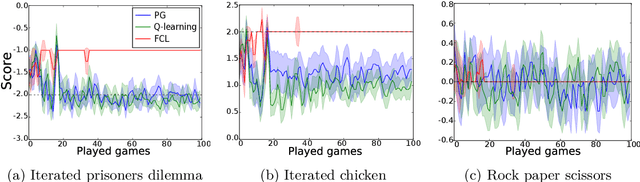
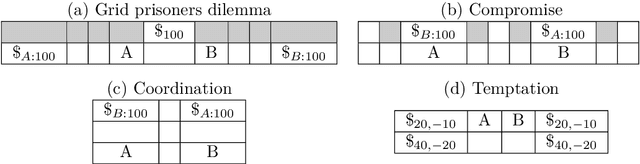
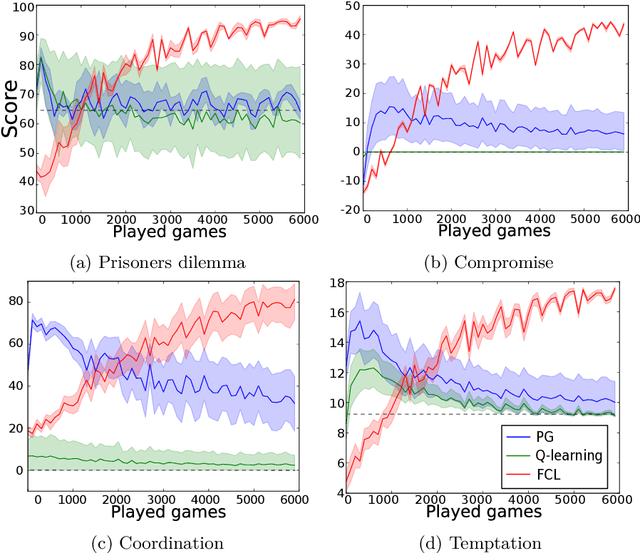
This paper extends the notion of equilibrium in game theory to learning algorithms in repeated stochastic games. We define a learning equilibrium as an algorithm used by a population of players, such that no player can individually use an alternative algorithm and increase its asymptotic score. We introduce Foolproof Cooperative Learning (FCL), an algorithm that converges to a Tit-for-Tat behavior. It allows cooperative strategies when played against itself while being not exploitable by selfish players. We prove that in repeated symmetric games, this algorithm is a learning equilibrium. We illustrate the behavior of FCL on symmetric matrix and grid games, and its robustness to selfish learners.
Cognitive Architecture for Mutual Modelling
Feb 22, 2016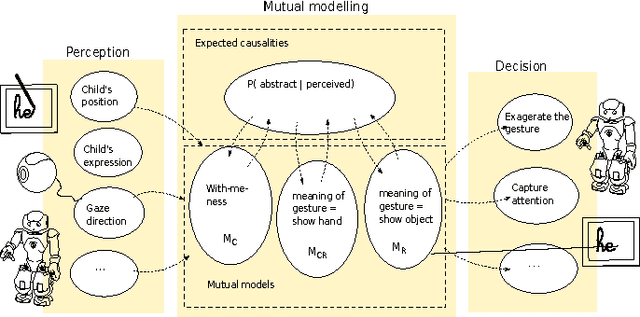
In social robotics, robots needs to be able to be understood by humans. Especially in collaborative tasks where they have to share mutual knowledge. For instance, in an educative scenario, learners share their knowledge and they must adapt their behaviour in order to make sure they are understood by others. Learners display behaviours in order to show their understanding and teachers adapt in order to make sure that the learners' knowledge is the required one. This ability requires a model of their own mental states perceived by others: \textit{"has the human understood that I(robot) need this object for the task or should I explain it once again ?"} In this paper, we discuss the importance of a cognitive architecture enabling second-order Mutual Modelling for Human-Robot Interaction in educative contexts.