 Add to Chrome
 Add to Firefox
 Add to Edge
The Model's Tell: Measuring Context-Leakage Attack Signals with Behavior Gauges
Aug 18, 2026
LLMs increasingly rely on external contexts, such as pre-defined system prompts or retrieved documents, to improve generation quality. However, processing these contexts alongside user queries creates an attack surface: adversarial inputs can induce models to disclose them. Prior probing studies suggest that leakage-related signals emerge in hidden states, yet the need to extract these states poses additional deployment challenges. In this paper, we explore whether this internal signal leaves a more accessible ``tell'' before decoding. We propose LeakGauge, which probes this response by appending a suffix that gauges leakage behavior and mapping its prefill token probabilities to an attack-risk score. While a direct gauge uses the initial tokens of confidential content, we find that a content-agnostic one that verbalizes leakage behavior yields more robust signals. Across 11 LLMs, including GLM-5.2 (753B) and Kimi-K3 (2.8T), LeakGauge reaches an AUROC range of 0.944--0.996 on unseen attacks. The signal remains stable when the content changes language or the attack shifts from verbatim to semantic disclosure. By activation-steering interventions, we further show that the risk score is sensitive to an internal leakage-related direction, relating the observable signal to the model's internal representation. In addition, LeakGauge enables an input detector with fewer than 0.5K extra parameters and added latency of 10.34 ms. Code: \href{https://github.com/yeasen-z/LeakGauge}.

Your Agentic LLMs Secretly Encode Latent Signals of Indirect Prompt-Injection Exposure
Aug 01, 2026Agentic LLMs are vulnerable to indirect prompt injection (IPI) attacks, e.g., malicious side-tasks hidden in external tool results. While many efforts have sought to address the threats, little is known about the internals of agentic LLMs when they are exposed to IPI attacks, a condition which we call IPI exposure. In this paper, we study this problem in depth from three aspects. (1) Probing: Across six models, including the giant 753B-parameter GLM-5.2, simple linear probes trained on pre-generation hidden states can predict LLMs' IPI exposure. These probes achieve 90%+ AUROC on unseen attacks, agent instructions, and task suites; they exhibit high robustness under adaptive attacks and in cross-lingual settings. (2) Defense: Our CoT measurement reveals a recognition--action gap: though models encode such signals, they often fail to translate them into safe actions. We then introduce AGRI, a probe-gated reasoning-based defense that prepends anti-injection reasoning on demand. On difficult AgentDojo settings, AGRI substantially reduces attack success rate, e.g., from 34.6% to 0% on Qwen3.5-27B, while largely maintaining clean-task utility. (3) Explanation: We introduce an analysis framework that identifies natural-language explanations most strongly correlated with probe-captured signals. The resulting profiles differ across models: latent signals can align with either direct IPI-exposure claims or indirect operational cues. Code is available: https://github.com/jianshuod/IPI-exposure-signal.
LeakDojo: Decoding the Leakage Threats of RAG Systems
May 07, 2026Retrieval-Augmented Generation (RAG) enables large language models (LLMs) to leverage external knowledge, but also exposes valuable RAG databases to leakage attacks. As RAG systems grow more complex and LLMs exhibit stronger instruction-following capabilities, existing studies fall short of systematically assessing RAG leakage risks. We present LeakDojo, a configurable framework for controlled evaluation of RAG leakage. Using LeakDojo, we benchmark six existing attacks across fourteen LLMs, four datasets, and diverse RAG systems. Our study reveals that (1) query generation and adversarial instructions contribute independently to leakage, with overall leakage well approximated by their product; (2) stronger instruction-following capability correlates with higher leakage risk; and (3) improvements in RAG faithfulness can introduce increased leakage risk. These findings provide actionable insights for understanding and mitigating RAG leakage in practice. Our codebase is available at https://github.com/yeasen-z/LeakDojo.
GISA: A Benchmark for General Information-Seeking Assistant
Feb 09, 2026The advancement of large language models (LLMs) has significantly accelerated the development of search agents capable of autonomously gathering information through multi-turn web interactions. Various benchmarks have been proposed to evaluate such agents. However, existing benchmarks often construct queries backward from answers, producing unnatural tasks misaligned with real-world needs. Moreover, these benchmarks tend to focus on either locating specific information or aggregating information from multiple sources, while relying on static answer sets prone to data contamination. To bridge these gaps, we introduce GISA, a benchmark for General Information-Seeking Assistants comprising 373 human-crafted queries that reflect authentic information-seeking scenarios. GISA features four structured answer formats (item, set, list, and table), enabling deterministic evaluation. It integrates both deep reasoning and broad information aggregation within unified tasks, and includes a live subset with periodically updated answers to resist memorization. Notably, GISA provides complete human search trajectories for every query, offering gold-standard references for process-level supervision and imitation learning. Experiments on mainstream LLMs and commercial search products reveal that even the best-performing model achieves only 19.30\% exact match score, with performance notably degrading on tasks requiring complex planning and comprehensive information gathering. These findings highlight substantial room for future improvement.
COSMIC: Compress Satellite Images Efficiently via Diffusion Compensation
Oct 02, 2024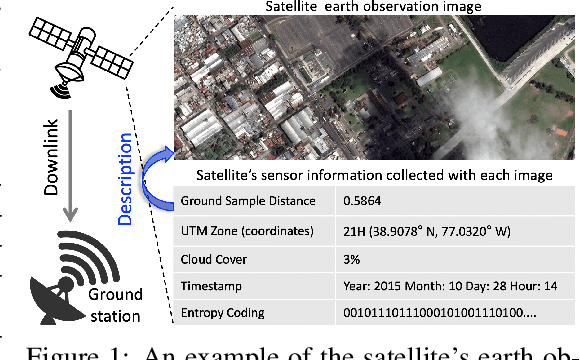
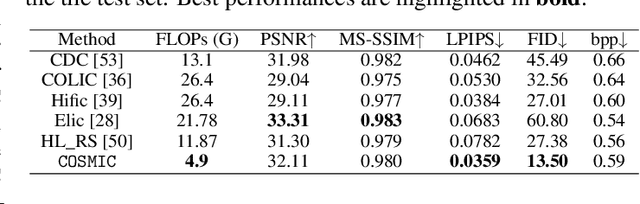
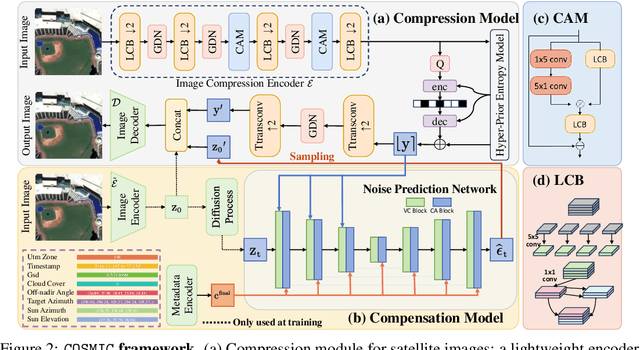

With the rapidly increasing number of satellites in space and their enhanced capabilities, the amount of earth observation images collected by satellites is exceeding the transmission limits of satellite-to-ground links. Although existing learned image compression solutions achieve remarkable performance by using a sophisticated encoder to extract fruitful features as compression and using a decoder to reconstruct, it is still hard to directly deploy those complex encoders on current satellites' embedded GPUs with limited computing capability and power supply to compress images in orbit. In this paper, we propose COSMIC, a simple yet effective learned compression solution to transmit satellite images. We first design a lightweight encoder (i.e. reducing FLOPs by $2.6\sim 5\times $) on satellite to achieve a high image compression ratio to save satellite-to-ground links. Then, for reconstructions on the ground, to deal with the feature extraction ability degradation due to simplifying encoders, we propose a diffusion-based model to compensate image details when decoding. Our insight is that satellite's earth observation photos are not just images but indeed multi-modal data with a nature of Text-to-Image pairing since they are collected with rich sensor data (e.g. coordinates, timestamp, etc.) that can be used as the condition for diffusion generation. Extensive experiments show that COSMIC outperforms state-of-the-art baselines on both perceptual and distortion metrics.
Language Generation via Combinatorial Constraint Satisfaction: A Tree Search Enhanced Monte-Carlo Approach
Nov 30, 2020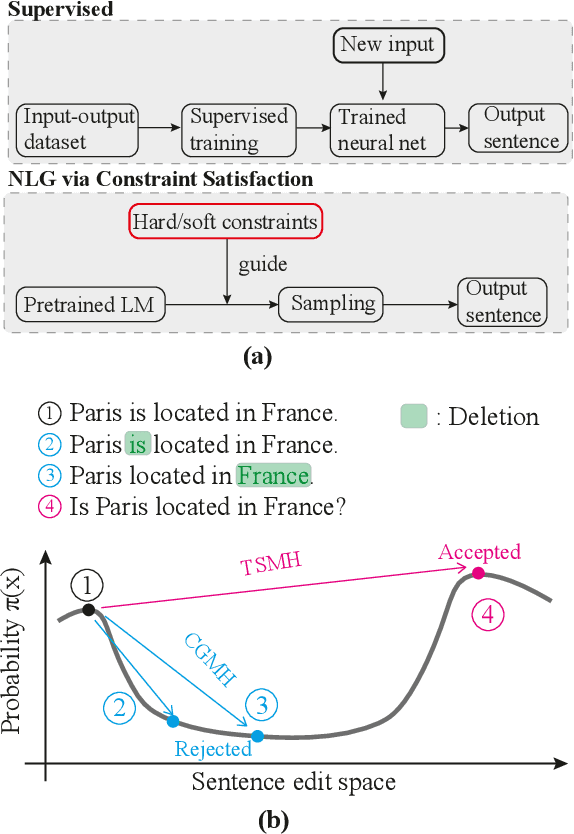
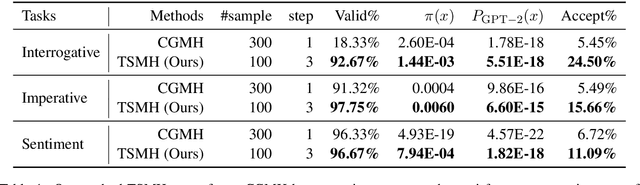
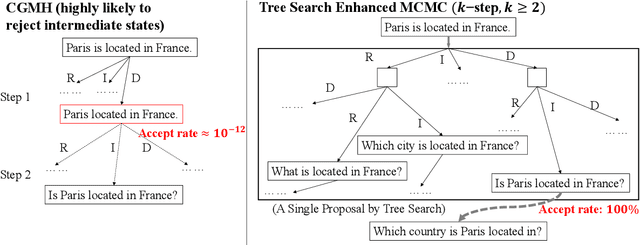
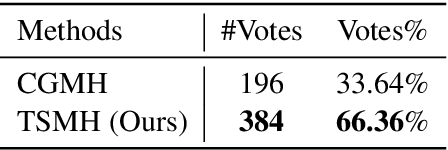
Generating natural language under complex constraints is a principled formulation towards controllable text generation. We present a framework to allow specification of combinatorial constraints for sentence generation. We propose TSMH, an efficient method to generate high likelihood sentences with respect to a pre-trained language model while satisfying the constraints. Our approach is highly flexible, requires no task-specific training, and leverages efficient constraint satisfaction solving techniques. To better handle the combinatorial constraints, a tree search algorithm is embedded into the proposal process of the Markov chain Monte Carlo (MCMC) to explore candidates that satisfy more constraints. Compared to existing MCMC approaches, our sampling approach has a better mixing performance. Experiments show that TSMH achieves consistent and significant improvement on multiple language generation tasks.
* Findings of the Association for Computational Linguistics: EMNLP 2020, pages 1286-1298. November 16 - 20, 2020. 2020 Association for Computational Linguistics
Looking Beyond Label Noise: Shifted Label Distribution Matters in Distantly Supervised Relation Extraction
Apr 19, 2019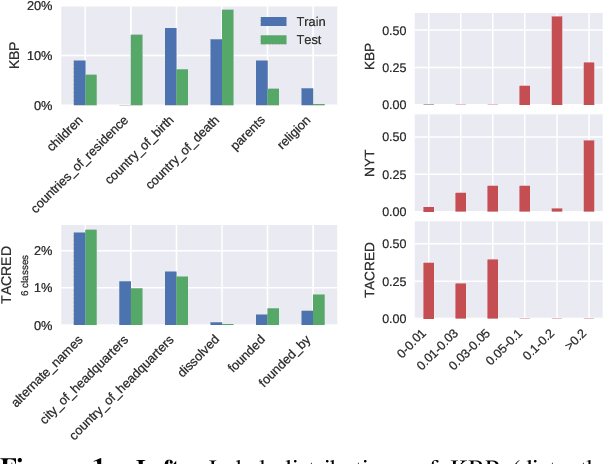
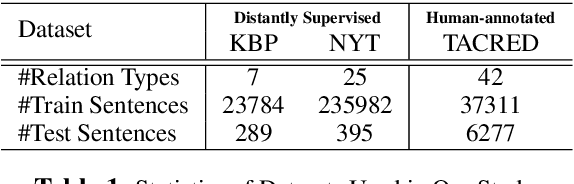
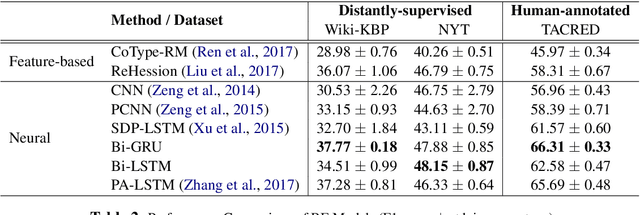
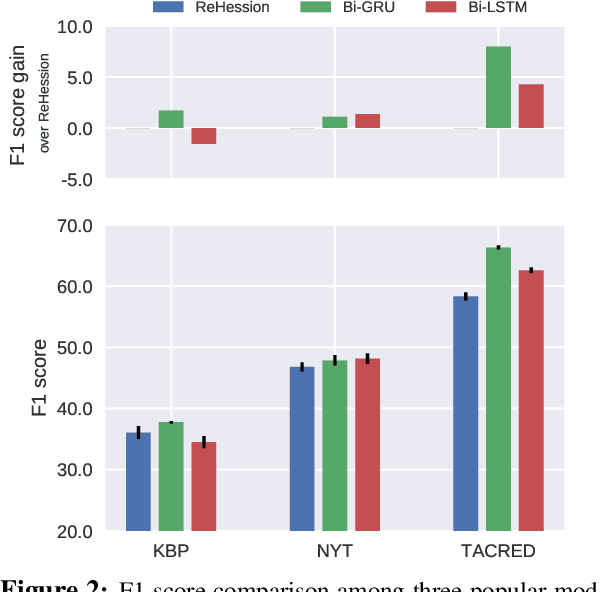
In recent years there is surge of interest in applying distant supervision (DS) to automatically generate training data for relation extraction. However, despite extensive efforts have been done on constructing advanced neural models, our experiments reveal that these neural models demonstrate only similar (or even worse) performance as compared with simple, feature-based methods. In this paper, we conduct thorough analysis to answer the question what other factors limit the performance of DS-trained neural models? Our results show that shifted labeled distribution commonly exists on real-world DS datasets, and impact of such issue is further validated using synthetic datasets for all models. Building upon the new insight, we develop a simple yet effective adaptation method for DS methods, called bias adjustment, to update models learned over source domain (i.e., DS training set) with label distribution statistics estimated on target domain (i.e., evaluation set). Experiments demonstrate that bias adjustment achieves consistent performance gains on all methods, especially on neural models, with up to a 22% relative F1 improvement.