 Add to Chrome
 Add to Firefox
 Add to Edge
Diffusion-Proof: Recipe for Formal Theorem Proving Beyond Auto-Regressive Generation
Jun 17, 2026
Enhancing the formal math reasoning capabilities of Large Language Models (LLMs) has become a key focus in both mathematical and computer science communities in recent years. While significant progress has been made in using state-of-the-art Auto-Regressive (AR) LLMs for formal theorem proving, these models suffer from inherent limitations. Their next-token prediction generation methods may yield suboptimal performance due to the challenges of long-range coherence and the compounding of errors over long sequences. Recent advancements in diffusion LLMs (dLLMs), which generate text through iterative denoising of a multi-token block, offer a promising alternative. However, the application of dLLMs to formal mathematics, where maintaining long-range coherence is critical, remains largely understudied. To address the challenges above, we propose **Diffusion-Proof**, to the best of our knowledge, the first framework to train and apply dLLMs for formal theorem proving. Our frameworks contain training and inference methods for two models. The first one is *dLLM-Prover-7B*, which performs whole-proof writing with long-range coherent tactic usage. The second one is *dLLM-Corrector-7B*, which is a novel large block diffusion-based correction model. It leverages the in-filling capabilities of dLLMs to perform local proof correction using bi-directional information. Extensive experiments demonstrate that **Diffusion-Proof** relatively significantly outperforms the AR LLM baseline trained under the same dataset. **Diffusion-Proof** achieves an absolute improvement of **1.61%** on ProofNet-Test and **6.14%** on MiniF2F-Test benchmarks compare to the baseline. Notably, **Diffusion-Proof** successfully resolves one IMO problem that more advanced thinking model DeepSeek-Prover-V2-7B could not solve, showcasing the unique advantage of dLLMs in formal theorem proving.

Lean4Agent: Formal Modeling and Verification for Agent Workflow and Trajectory
Jun 02, 2026Equipping Large Language Models (LLMs) to execute reliable multi-step workflows has become a central challenge in artificial intelligence. Despite recent advances in LLMs' agentic capabilities, most agent systems still lack formal methods for specifying, verifying, and debugging their workflow and execution trajectories. This challenge mirrors a long-standing problem in mathematics, where the ambiguity of natural languages (NLs) motivates the development of formal languages (FLs). Inspired by this paradigm, we propose **Lean4Agent**, to the best of our knowledge, the first framework that uses Lean4, a dependent-type FL to model and verify agent behavior. **Lean4Agent** launches **FormalAgentLib**, an extensible Lean4 library for formally modeling and verifying agent workflows' semantic consistency under explicit assumptions, and enabling localization of execution-time failures revealed by trajectories. Building on **FormalAgentLib**, we further develop **LeanEvolve**, which applies results in **FormalAgentLib** to revise workflows to enhance its capability. Extensive experiments on a hard problem subset of SWE-Bench-Verified and a subset of ELAIP-Bench across 5 leading LLMs indicate that the verification-passing workflows outperform the failing ones by an average of **11.94%**, and **LeanEvolve** further improves SWE performance by **7.47%** on average. Furthermore, **Lean4Agent** establishes a foundation for a new field of using expressive dependent-type FL to formally model and verify agent behavior.
Code as Agent Harness
May 18, 2026Recent large language models (LLMs) have demonstrated strong capabilities in understanding and generating code, from competitive programming to repository-level software engineering. In emerging agentic systems, code is no longer only a target output. It increasingly serves as an operational substrate for agent reasoning, acting, environment modeling, and execution-based verification. We frame this shift through the lens of agent harnesses and introduce code as agent harness: a unified view that centers code as the basis for agent infrastructure. To systematically study this perspective, we organize the survey around three connected layers. First, we study the harness interface, where code connects agents to reasoning, action, and environment modeling. Second, we examine harness mechanisms: planning, memory, and tool use for long-horizon execution, together with feedback-driven control and optimization that make harness reliable and adaptive. Third, we discuss scaling the harness from single-agent systems to multi-agent settings, where shared code artifacts support multi-agent coordination, review, and verification. Across these layers, we summarize representative methods and practical applications of code as agent harness, spanning coding assistants, GUI/OS automation, embodied agents, scientific discovery, personalization and recommendation, DevOps, and enterprise workflows. We further outline open challenges for harness engineering, including evaluation beyond final task success, verification under incomplete feedback, regression-free harness improvement, consistent shared state across multiple agents, human oversight for safety-critical actions, and extensions to multimodal environments. By centering code as the harness of agentic AI, this survey provides a unified roadmap toward executable, verifiable, and stateful AI agent systems.
AgentSPEX: An Agent SPecification and EXecution Language
Apr 14, 2026Language-model agent systems commonly rely on reactive prompting, in which a single instruction guides the model through an open-ended sequence of reasoning and tool-use steps, leaving control flow and intermediate state implicit and making agent behavior potentially difficult to control. Orchestration frameworks such as LangGraph, DSPy, and CrewAI impose greater structure through explicit workflow definitions, but tightly couple workflow logic with Python, making agents difficult to maintain and modify. In this paper, we introduce AgentSPEX, an Agent SPecification and EXecution Language for specifying LLM-agent workflows with explicit control flow and modular structure, along with a customizable agent harness. AgentSPEX supports typed steps, branching and loops, parallel execution, reusable submodules, and explicit state management, and these workflows execute within an agent harness that provides tool access, a sandboxed virtual environment, and support for checkpointing, verification, and logging. Furthermore, we provide a visual editor with synchronized graph and workflow views for authoring and inspection. We include ready-to-use agents for deep research and scientific research, and we evaluate AgentSPEX on 7 benchmarks. Finally, we show through a user study that AgentSPEX provides a more interpretable and accessible workflow-authoring paradigm than a popular existing agent framework.
PhysProver: Advancing Automatic Theorem Proving for Physics
Jan 22, 2026The combination of verifiable languages and LLMs has significantly influenced both the mathematical and computer science communities because it provides a rigorous foundation for theorem proving. Recent advancements in the field provide foundation models and sophisticated agentic systems pushing the boundaries of formal mathematical reasoning to approach the natural language capability of LLMs. However, little attention has been given to the formal physics reasoning, which also heavily relies on similar problem-solving and theorem-proving frameworks. To solve this problem, this paper presents, to the best of our knowledge, the first approach to enhance formal theorem proving in the physics domain. We compose a dedicated dataset PhysLeanData for the task. It is composed of theorems sampled from PhysLean and data generated by a conjecture-based formal data generation pipeline. In the training pipeline, we leverage DeepSeek-Prover-V2-7B, a strong open-source mathematical theorem prover, and apply Reinforcement Learning with Verifiable Rewards (RLVR) to train our model PhysProver. Comprehensive experiments demonstrate that, using only $\sim$5K training samples, PhysProver achieves an overall 2.4\% improvement in multiple sub-domains. Furthermore, after formal physics training, we observe 1.3\% gains on the MiniF2F-Test benchmark, which indicates non-trivial generalization beyond physics domains and enhancement for formal math capability as well. The results highlight the effectiveness and efficiency of our approach, which provides a paradigm for extending formal provers outside mathematical domains. To foster further research, we will release both our dataset and model to the community.
PRL: Process Reward Learning Improves LLMs' Reasoning Ability and Broadens the Reasoning Boundary
Jan 15, 2026Improving the reasoning abilities of Large Language Models (LLMs) has been a continuous topic recently. But most relevant works are based on outcome rewards at the trajectory level, missing fine-grained supervision during the reasoning process. Other existing training frameworks that try to combine process signals together to optimize LLMs also rely heavily on tedious additional steps like MCTS, training a separate reward model, etc., doing harm to the training efficiency. Moreover, the intuition behind the process signals design lacks rigorous theoretical support, leaving the understanding of the optimization mechanism opaque. In this paper, we propose Process Reward Learning (PRL), which decomposes the entropy regularized reinforcement learning objective into intermediate steps, with rigorous process rewards that could be assigned to models accordingly. Starting from theoretical motivation, we derive the formulation of PRL that is essentially equivalent to the objective of reward maximization plus a KL-divergence penalty term between the policy model and a reference model. However, PRL could turn the outcome reward into process supervision signals, which helps better guide the exploration during RL optimization. From our experiment results, we demonstrate that PRL not only improves the average performance for LLMs' reasoning ability measured by average @ n, but also broadens the reasoning boundary by improving the pass @ n metric. Extensive experiments show the effectiveness of PRL could be verified and generalized.
Lean4Physics: Comprehensive Reasoning Framework for College-level Physics in Lean4
Oct 30, 2025We present **Lean4PHYS**, a comprehensive reasoning framework for college-level physics problems in Lean4. **Lean4PHYS** includes *LeanPhysBench*, a college-level benchmark for formal physics reasoning in Lean4, which contains 200 hand-crafted and peer-reviewed statements derived from university textbooks and physics competition problems. To establish a solid foundation for formal reasoning in physics, we also introduce *PhysLib*, a community-driven repository containing fundamental unit systems and theorems essential for formal physics reasoning. Based on the benchmark and Lean4 repository we composed in **Lean4PHYS**, we report baseline results using major expert Math Lean4 provers and state-of-the-art closed-source models, with the best performance of DeepSeek-Prover-V2-7B achieving only 16% and Claude-Sonnet-4 achieving 35%. We also conduct a detailed analysis showing that our *PhysLib* can achieve an average improvement of 11.75% in model performance. This demonstrates the challenging nature of our *LeanPhysBench* and the effectiveness of *PhysLib*. To the best of our knowledge, this is the first study to provide a physics benchmark in Lean4.
Generalizable Geometric Image Caption Synthesis
Sep 18, 2025Multimodal large language models have various practical applications that demand strong reasoning abilities. Despite recent advancements, these models still struggle to solve complex geometric problems. A key challenge stems from the lack of high-quality image-text pair datasets for understanding geometric images. Furthermore, most template-based data synthesis pipelines typically fail to generalize to questions beyond their predefined templates. In this paper, we bridge this gap by introducing a complementary process of Reinforcement Learning with Verifiable Rewards (RLVR) into the data generation pipeline. By adopting RLVR to refine captions for geometric images synthesized from 50 basic geometric relations and using reward signals derived from mathematical problem-solving tasks, our pipeline successfully captures the key features of geometry problem-solving. This enables better task generalization and yields non-trivial improvements. Furthermore, even in out-of-distribution scenarios, the generated dataset enhances the general reasoning capabilities of multimodal large language models, yielding accuracy improvements of $2.8\%\text{-}4.8\%$ in statistics, arithmetic, algebraic, and numerical tasks with non-geometric input images of MathVista and MathVerse, along with $2.4\%\text{-}3.9\%$ improvements in Art, Design, Tech, and Engineering tasks in MMMU.
Let's Reason Formally: Natural-Formal Hybrid Reasoning Enhances LLM's Math Capability
May 29, 2025Enhancing the mathematical reasoning capabilities of LLMs has garnered significant attention in both the mathematical and computer science communities. Recent works have made substantial progress in both Natural Language (NL) reasoning and Formal Language (FL) reasoning by leveraging the potential of pure Reinforcement Learning (RL) methods on base models. However, RL approaches struggle to impart new capabilities not presented in the base model, highlighting the need to integrate more knowledge like FL into NL math reasoning effectively. Yet, this integration is challenging due to inherent disparities in problem structure and reasoning format between NL and FL. To address these challenges, we introduce **NL-FL HybridReasoning**, an end-to-end framework designed to incorporate the FL expert into NL math problem-solving. To bridge the NL and FL input format gap, we propose the *NL-FL Problem Alignment* method, which reformulates the Question-Answering (QA) problems in NL as existence theorems in FL. Subsequently, the *Mixed Problem Input* technique we provide enables the FL reasoner to handle both QA and existence problems concurrently. Lastly, we mitigate the NL and FL output format gap in reasoning through an LLM-based *Answer Extraction* mechanism. Comprehensive experiments demonstrate that the **HybridReasoning** framework achieves **89.80%** and **84.34%** accuracy rates on the MATH-500 and the AMC benchmarks, surpassing the NL baseline by 4.60% and 4.82%, respectively. Notably, some problems resolved by our framework remain unsolved by the NL baseline model even under a larger number of trials.
MA-LoT: Multi-Agent Lean-based Long Chain-of-Thought Reasoning enhances Formal Theorem Proving
Mar 05, 2025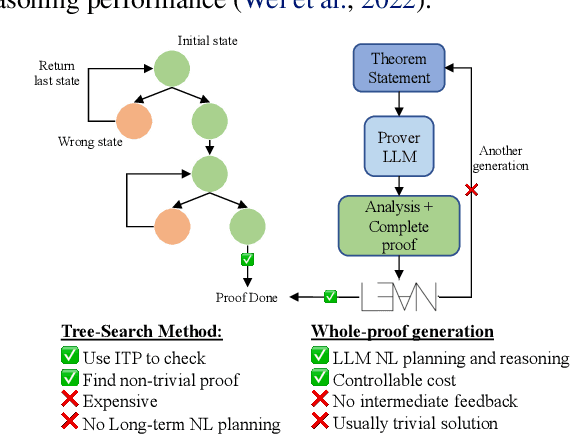
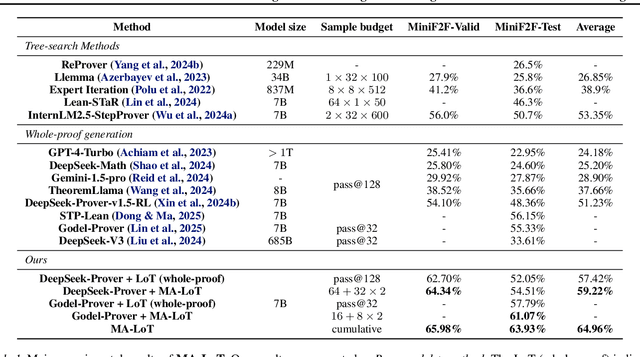
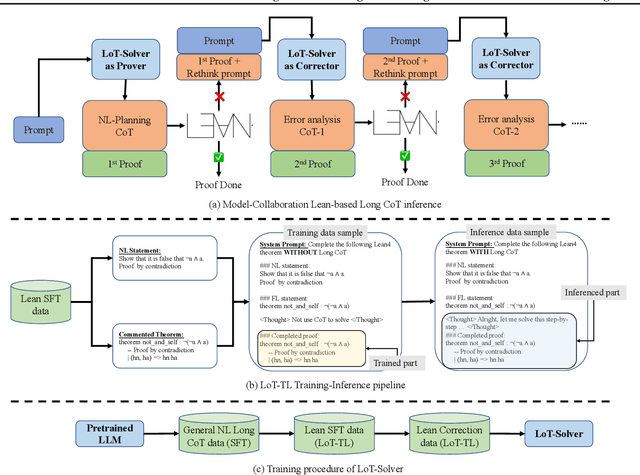
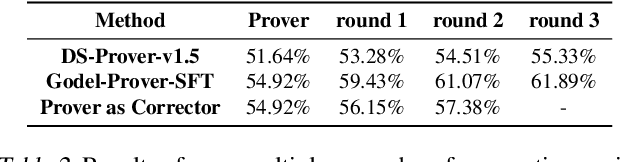
Solving mathematical problems using computer-verifiable languages like Lean has significantly impacted mathematical and computer science communities. State-of-the-art methods utilize single Large Language Models (LLMs) as agents or provers to either generate complete proof or perform tree searches. However, single-agent methods inherently lack a structured way to combine high-level reasoning in Natural Language (NL) with Formal Language (FL) verification feedback. To solve these issues, we propose MA-LoT: Multi-Agent Lean-based Long Chain-of-Thought framework, (to the best of our knowledge), the first multi-agent framework for Lean4 theorem proving that balance high-level NL reasoning and FL verification in Long CoT. Using this structured interaction, our approach enables deeper insights and long-term coherence in proof generation, with which past methods struggle. We do this by leveraging emergent formal reasoning ability in Long CoT using our novel LoT-Transfer Learning training-inference pipeline. Extensive experiments show that our framework achieves 54.51% accuracy rate on the Lean4 version of MiniF2F-Test dataset, largely outperforming GPT-4 (22.95%), single-agent tree search (InternLM-Step-Prover, 50.70%), and whole-proof generation (DeepSeek-Prover-v1.5, 48.36%) baselines. Furthermore, our findings highlight the potential of combining Long CoT with formal verification for a more insightful generation in a broader perspective.