 Add to Chrome
 Add to Firefox
 Add to Edge
Improving Factuality with Explicit Working Memory
Dec 24, 2024


Large language models can generate factually inaccurate content, a problem known as hallucination. Recent works have built upon retrieved-augmented generation to improve factuality through iterative prompting but these methods are limited by the traditional RAG design. To address these challenges, we introduce EWE (Explicit Working Memory), a novel approach that enhances factuality in long-form text generation by integrating a working memory that receives real-time feedback from external resources. The memory is refreshed based on online fact-checking and retrieval feedback, allowing EWE to rectify false claims during the generation process and ensure more accurate and reliable outputs. Our experiments demonstrate that Ewe outperforms strong baselines on four fact-seeking long-form generation datasets, increasing the factuality metric, VeriScore, by 2 to 10 points absolute without sacrificing the helpfulness of the responses. Further analysis reveals that the design of rules for memory updates, configurations of memory units, and the quality of the retrieval datastore are crucial factors for influencing model performance.

When Worse is Better: Navigating the compression-generation tradeoff in visual tokenization
Dec 20, 2024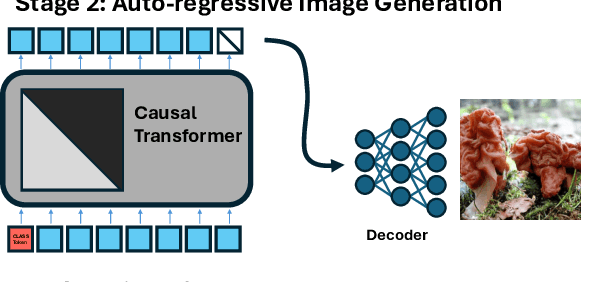
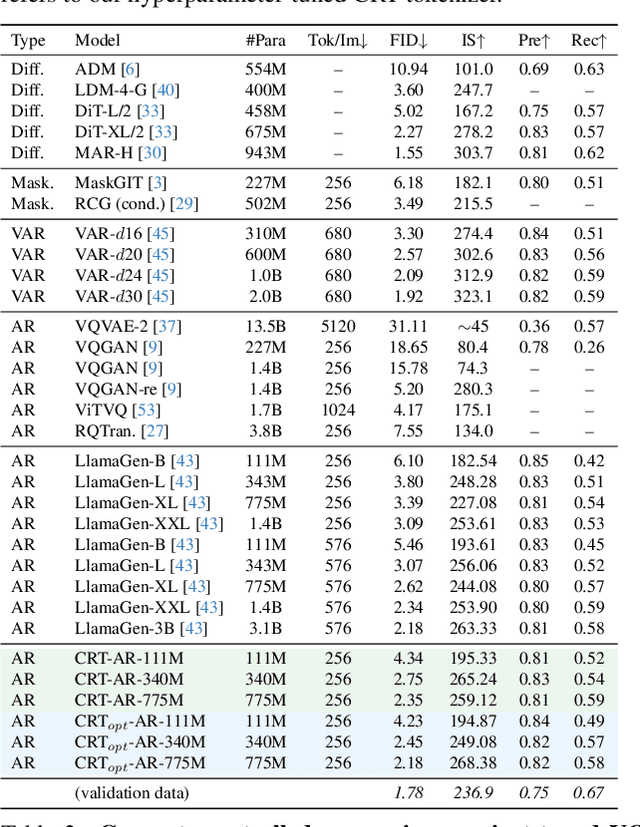

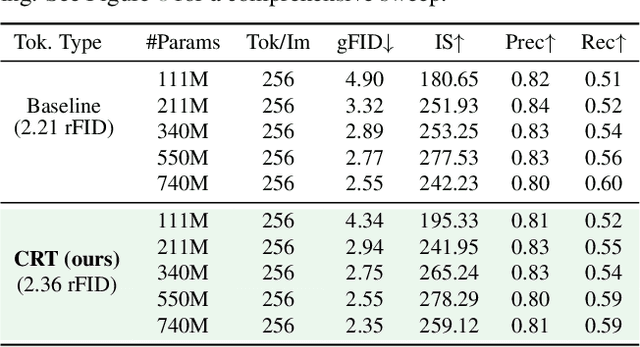
Current image generation methods, such as latent diffusion and discrete token-based generation, depend on a two-stage training approach. In stage 1, an auto-encoder is trained to compress an image into a latent space; in stage 2, a generative model is trained to learn a distribution over that latent space. Most work focuses on maximizing stage 1 performance independent of stage 2, assuming better reconstruction always leads to better generation. However, we show this is not strictly true. Smaller stage 2 models can benefit from more compressed stage 1 latents even if reconstruction performance worsens, showing a fundamental trade-off between compression and generation modeling capacity. To better optimize this trade-off, we introduce Causally Regularized Tokenization (CRT), which uses knowledge of the stage 2 generation modeling procedure to embed useful inductive biases in stage 1 latents. This regularization makes stage 1 reconstruction performance worse, but makes stage 2 generation performance better by making the tokens easier to model: we are able to improve compute efficiency 2-3$\times$ over baseline and match state-of-the-art discrete autoregressive ImageNet generation (2.18 FID) with less than half the tokens per image (256 vs. 576) and a fourth the total model parameters (775M vs. 3.1B) as the previous SOTA (LlamaGen).
LlamaFusion: Adapting Pretrained Language Models for Multimodal Generation
Dec 19, 2024

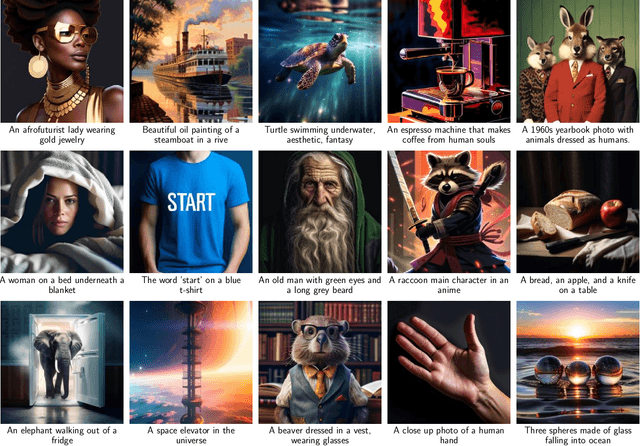
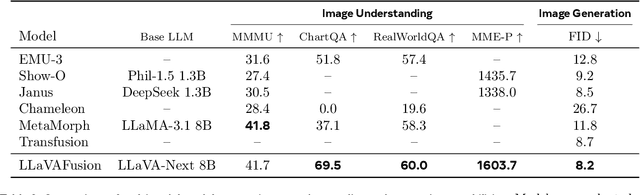
We present LlamaFusion, a framework for empowering pretrained text-only large language models (LLMs) with multimodal generative capabilities, enabling them to understand and generate both text and images in arbitrary sequences. LlamaFusion leverages existing Llama-3's weights for processing texts autoregressively while introducing additional and parallel transformer modules for processing images with diffusion. During training, the data from each modality is routed to its dedicated modules: modality-specific feedforward layers, query-key-value projections, and normalization layers process each modality independently, while the shared self-attention layers allow interactions across text and image features. By freezing the text-specific modules and only training the image-specific modules, LlamaFusion preserves the language capabilities of text-only LLMs while developing strong visual understanding and generation abilities. Compared to methods that pretrain multimodal generative models from scratch, our experiments demonstrate that, LlamaFusion improves image understanding by 20% and image generation by 3.6% using only 50% of the FLOPs while maintaining Llama-3's language capabilities. We also demonstrate that this framework can adapt existing vision-language models with multimodal generation ability. Overall, this framework not only leverages existing computational investments in text-only LLMs but also enables the parallel development of language and vision capabilities, presenting a promising direction for efficient multimodal model development.
Byte Latent Transformer: Patches Scale Better Than Tokens
Dec 13, 2024We introduce the Byte Latent Transformer (BLT), a new byte-level LLM architecture that, for the first time, matches tokenization-based LLM performance at scale with significant improvements in inference efficiency and robustness. BLT encodes bytes into dynamically sized patches, which serve as the primary units of computation. Patches are segmented based on the entropy of the next byte, allocating more compute and model capacity where increased data complexity demands it. We present the first FLOP controlled scaling study of byte-level models up to 8B parameters and 4T training bytes. Our results demonstrate the feasibility of scaling models trained on raw bytes without a fixed vocabulary. Both training and inference efficiency improve due to dynamically selecting long patches when data is predictable, along with qualitative improvements on reasoning and long tail generalization. Overall, for fixed inference costs, BLT shows significantly better scaling than tokenization-based models, by simultaneously growing both patch and model size.
Memory Layers at Scale
Dec 12, 2024


Memory layers use a trainable key-value lookup mechanism to add extra parameters to a model without increasing FLOPs. Conceptually, sparsely activated memory layers complement compute-heavy dense feed-forward layers, providing dedicated capacity to store and retrieve information cheaply. This work takes memory layers beyond proof-of-concept, proving their utility at contemporary scale. On downstream tasks, language models augmented with our improved memory layer outperform dense models with more than twice the computation budget, as well as mixture-of-expert models when matched for both compute and parameters. We find gains are especially pronounced for factual tasks. We provide a fully parallelizable memory layer implementation, demonstrating scaling laws with up to 128B memory parameters, pretrained to 1 trillion tokens, comparing to base models with up to 8B parameters.
ALMA: Alignment with Minimal Annotation
Dec 05, 2024
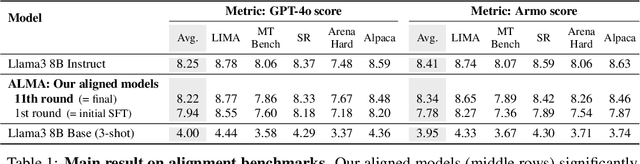
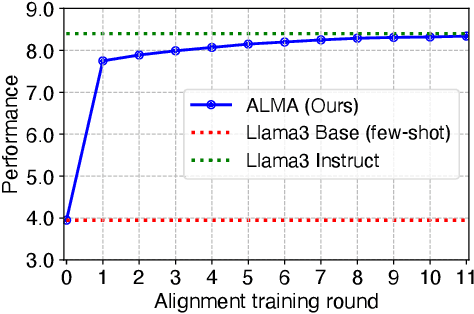
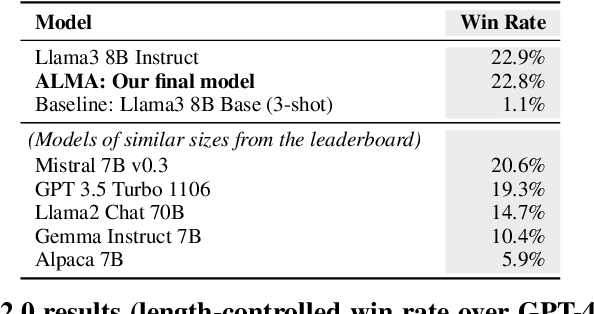
Recent approaches to large language model (LLM) alignment typically require millions of human annotations or rely on external aligned models for synthetic data generation. This paper introduces ALMA: Alignment with Minimal Annotation, demonstrating that effective alignment can be achieved using only 9,000 labeled examples -- less than 1% of conventional approaches. ALMA generates large amounts of high-quality synthetic alignment data through new techniques: diverse prompt synthesis via few-shot learning, diverse response generation with multiple model checkpoints, and judge (reward model) enhancement through score aggregation and self-distillation. Using only a pretrained Llama3 base model, 5,000 SFT examples, and 4,000 judge annotations, ALMA achieves performance close to Llama3-Instruct across diverse alignment benchmarks (e.g., 0.1% difference on AlpacaEval 2.0 score). These results are achieved with a multi-round, self-bootstrapped data synthesis and training recipe that continues to improve for 10 rounds, surpassing the typical 3-round ceiling of previous methods. These results suggest that base models already possess sufficient knowledge for effective alignment, and that synthetic data generation methods can expose it.
Negative Token Merging: Image-based Adversarial Feature Guidance
Dec 02, 2024


Text-based adversarial guidance using a negative prompt has emerged as a widely adopted approach to push the output features away from undesired concepts. While useful, performing adversarial guidance using text alone can be insufficient to capture complex visual concepts and avoid undesired visual elements like copyrighted characters. In this paper, for the first time we explore an alternate modality in this direction by performing adversarial guidance directly using visual features from a reference image or other images in a batch. In particular, we introduce negative token merging (NegToMe), a simple but effective training-free approach which performs adversarial guidance by selectively pushing apart matching semantic features (between reference and output generation) during the reverse diffusion process. When used w.r.t. other images in the same batch, we observe that NegToMe significantly increases output diversity (racial, gender, visual) without sacrificing output image quality. Similarly, when used w.r.t. a reference copyrighted asset, NegToMe helps reduce visual similarity with copyrighted content by 34.57%. NegToMe is simple to implement using just few-lines of code, uses only marginally higher (<4%) inference times and generalizes to different diffusion architectures like Flux, which do not natively support the use of a separate negative prompt. Code is available at https://negtome.github.io
OpenScholar: Synthesizing Scientific Literature with Retrieval-augmented LMs
Nov 21, 2024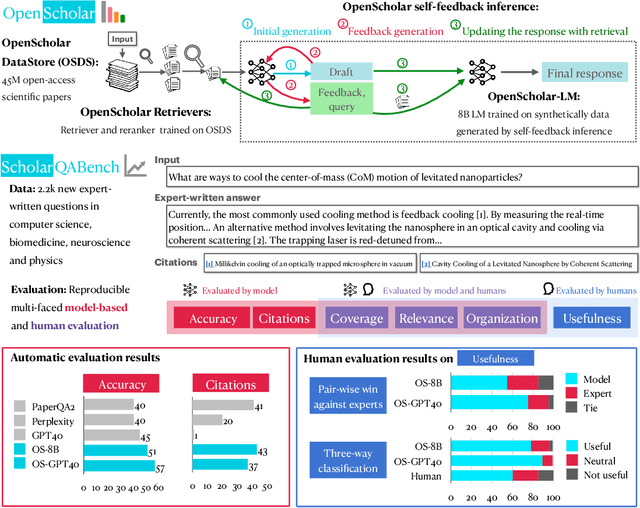


Scientific progress depends on researchers' ability to synthesize the growing body of literature. Can large language models (LMs) assist scientists in this task? We introduce OpenScholar, a specialized retrieval-augmented LM that answers scientific queries by identifying relevant passages from 45 million open-access papers and synthesizing citation-backed responses. To evaluate OpenScholar, we develop ScholarQABench, the first large-scale multi-domain benchmark for literature search, comprising 2,967 expert-written queries and 208 long-form answers across computer science, physics, neuroscience, and biomedicine. On ScholarQABench, OpenScholar-8B outperforms GPT-4o by 5% and PaperQA2 by 7% in correctness, despite being a smaller, open model. While GPT4o hallucinates citations 78 to 90% of the time, OpenScholar achieves citation accuracy on par with human experts. OpenScholar's datastore, retriever, and self-feedback inference loop also improves off-the-shelf LMs: for instance, OpenScholar-GPT4o improves GPT-4o's correctness by 12%. In human evaluations, experts preferred OpenScholar-8B and OpenScholar-GPT4o responses over expert-written ones 51% and 70% of the time, respectively, compared to GPT4o's 32%. We open-source all of our code, models, datastore, data and a public demo.
Generative Adapter: Contextualizing Language Models in Parameters with A Single Forward Pass
Nov 08, 2024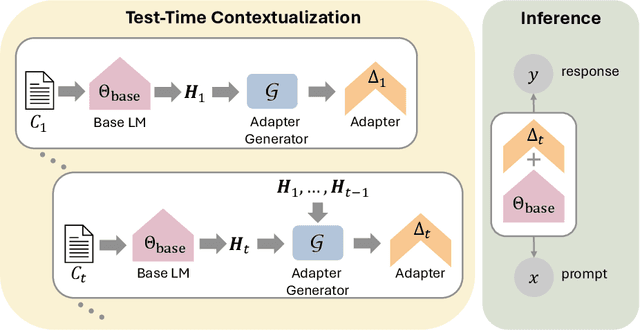

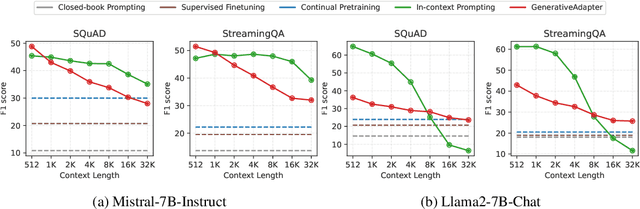
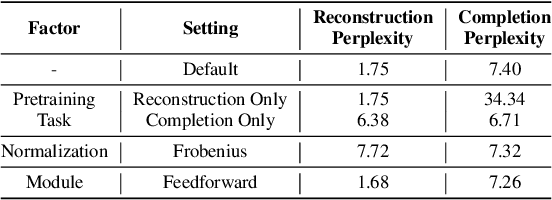
Large language models (LMs) are typically adapted to improve performance on new contexts (\eg text prompts that define new tasks or domains) through fine-tuning or prompting. However, there is an accuracy compute tradeoff -- fine-tuning incurs significant training cost and prompting increases inference overhead. We introduce $GenerativeAdapter$, an effective and efficient adaptation method that directly maps new contexts to low-rank LM adapters, thereby significantly reducing inference overhead with no need for finetuning. The adapter generator is trained via self-supervised learning, and can be used to adapt a single frozen LM for any new task simply by mapping the associated task or domain context to a new adapter. We apply $GenerativeAdapter$ to two pretrained LMs (Mistral-7B-Instruct and Llama2-7B-Chat) and evaluate the adapted models in three adaption scenarios: knowledge acquisition from documents, learning from demonstrations, and personalization for users. In StreamingQA, our approach is effective in injecting knowledge into the LM's parameters, achieving a 63.5% improvement in F1 score over the model with supervised fine-tuning (from $19.5$ to $31.5$) for contexts as long as 32K tokens. In the MetaICL in-context learning evaluation, our method achieves an average accuracy of $44.9$ across 26 tasks, outperforming the base model. On MSC, our method proves to be highly competitive in memorizing user information from conversations with a 4x reduction in computation and memory costs compared to prompting with full conversation history. Together, these results suggest that $GenerativeAdapter$ should allow for general adaption to a wide range of different contexts.
Mixture-of-Transformers: A Sparse and Scalable Architecture for Multi-Modal Foundation Models
Nov 07, 2024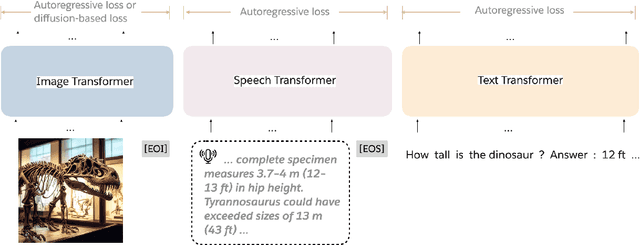



The development of large language models (LLMs) has expanded to multi-modal systems capable of processing text, images, and speech within a unified framework. Training these models demands significantly larger datasets and computational resources compared to text-only LLMs. To address the scaling challenges, we introduce Mixture-of-Transformers (MoT), a sparse multi-modal transformer architecture that significantly reduces pretraining computational costs. MoT decouples non-embedding parameters of the model by modality -- including feed-forward networks, attention matrices, and layer normalization -- enabling modality-specific processing with global self-attention over the full input sequence. We evaluate MoT across multiple settings and model scales. In the Chameleon 7B setting (autoregressive text-and-image generation), MoT matches the dense baseline's performance using only 55.8\% of the FLOPs. When extended to include speech, MoT reaches speech performance comparable to the dense baseline with only 37.2\% of the FLOPs. In the Transfusion setting, where text and image are trained with different objectives, a 7B MoT model matches the image modality performance of the dense baseline with one third of the FLOPs, and a 760M MoT model outperforms a 1.4B dense baseline across key image generation metrics. System profiling further highlights MoT's practical benefits, achieving dense baseline image quality in 47.2\% of the wall-clock time and text quality in 75.6\% of the wall-clock time (measured on AWS p4de.24xlarge instances with NVIDIA A100 GPUs).