 Add to Chrome
 Add to Firefox
 Add to Edge
Z-ICL: Zero-Shot In-Context Learning with Pseudo-Demonstrations
Dec 19, 2022
Although large language models can be prompted for both zero- and few-shot learning, performance drops significantly when no demonstrations are available. In this paper, we introduce Z-ICL, a new zero-shot method that closes the gap by constructing pseudo-demonstrations for a given test input using a raw text corpus. Concretely, pseudo-demonstrations are constructed by (1) finding the nearest neighbors to the test input from the corpus and pairing them with random task labels, and (2) applying a set of techniques to reduce the amount of direct copying the model does from the resulting demonstrations. Evaluation on nine classification datasets shows that Z-ICL outperforms previous zero-shot methods by a significant margin, and is on par with in-context learning with labeled training data in the few-shot setting. Overall, Z-ICL provides a significantly higher estimate of the zero-shot performance levels of a model, and supports future efforts to develop better pseudo-demonstrations that further improve zero-shot results.

Training Trajectories of Language Models Across Scales
Dec 19, 2022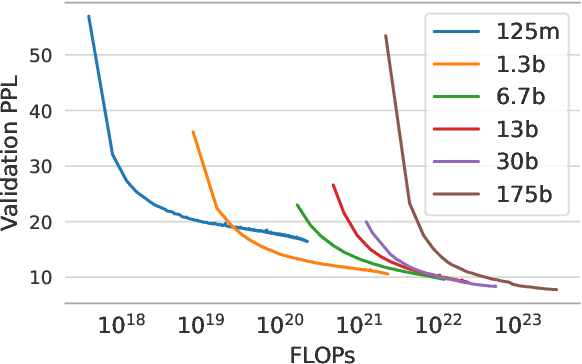
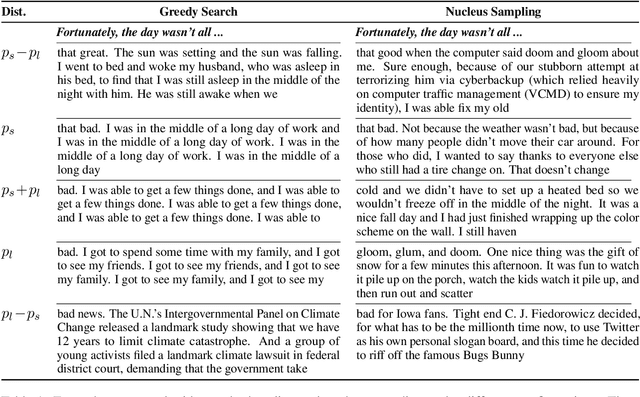
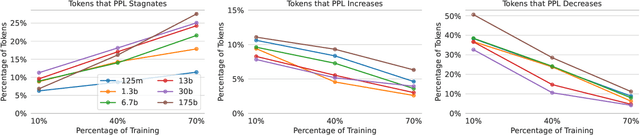
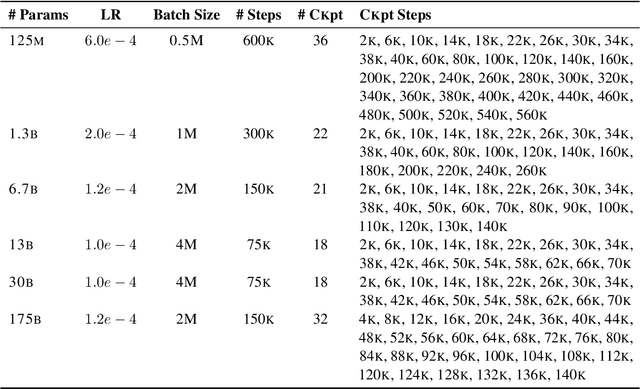
Scaling up language models has led to unprecedented performance gains, but little is understood about how the training dynamics change as models get larger. How do language models of different sizes learn during pre-training? Why do larger language models demonstrate more desirable behaviors? In this paper, we analyze the intermediate training checkpoints of differently sized OPT models (Zhang et al.,2022)--from 125M to 175B parameters--on next-token prediction, sequence-level generation, and downstream tasks. We find that 1) at a given perplexity and independent of model sizes, a similar subset of training tokens see the most significant reduction in loss, with the rest stagnating or showing double-descent behavior; 2) early in training, all models learn to reduce the perplexity of grammatical sequences that contain hallucinations, with small models halting at this suboptimal distribution and larger ones eventually learning to assign these sequences lower probabilities; 3) perplexity is a strong predictor of in-context learning performance on 74 multiple-choice tasks from BIG-Bench, and this holds independent of the model size. Together, these results show that perplexity is more predictive of model behaviors than model size or training computation.
ROSCOE: A Suite of Metrics for Scoring Step-by-Step Reasoning
Dec 15, 2022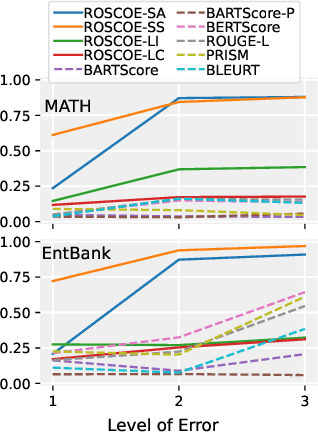
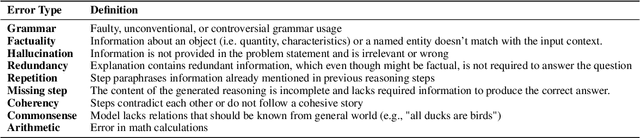
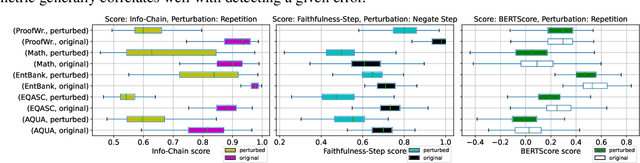
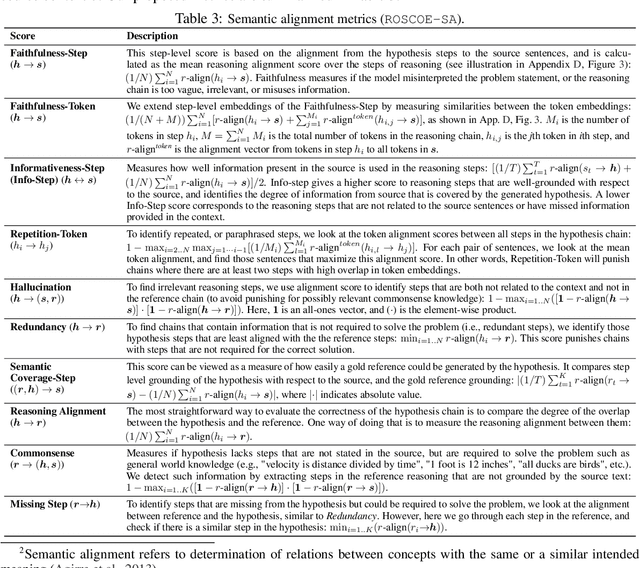
Large language models show improved downstream task performance when prompted to generate step-by-step reasoning to justify their final answers. These reasoning steps greatly improve model interpretability and verification, but objectively studying their correctness (independent of the final answer) is difficult without reliable methods for automatic evaluation. We simply do not know how often the stated reasoning steps actually support the final end task predictions. In this work, we present ROSCOE, a suite of interpretable, unsupervised automatic scores that improve and extend previous text generation evaluation metrics. To evaluate ROSCOE against baseline metrics, we design a typology of reasoning errors and collect synthetic and human evaluation scores on commonly used reasoning datasets. In contrast with existing metrics, ROSCOE can measure semantic consistency, logicality, informativeness, fluency, and factuality - among other traits - by leveraging properties of step-by-step rationales. We empirically verify the strength of our metrics on five human annotated and six programmatically perturbed diagnostics datasets - covering a diverse set of tasks that require reasoning skills and show that ROSCOE can consistently outperform baseline metrics.
AGRO: Adversarial Discovery of Error-prone groups for Robust Optimization
Dec 08, 2022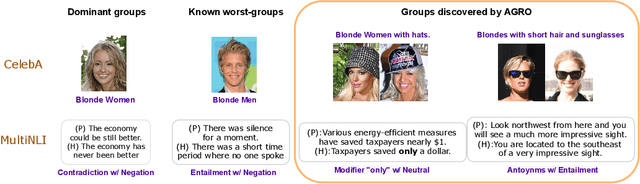


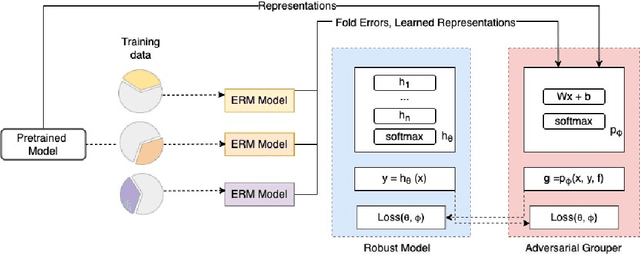
Models trained via empirical risk minimization (ERM) are known to rely on spurious correlations between labels and task-independent input features, resulting in poor generalization to distributional shifts. Group distributionally robust optimization (G-DRO) can alleviate this problem by minimizing the worst-case loss over a set of pre-defined groups over training data. G-DRO successfully improves performance of the worst-group, where the correlation does not hold. However, G-DRO assumes that the spurious correlations and associated worst groups are known in advance, making it challenging to apply it to new tasks with potentially multiple unknown spurious correlations. We propose AGRO -- Adversarial Group discovery for Distributionally Robust Optimization -- an end-to-end approach that jointly identifies error-prone groups and improves accuracy on them. AGRO equips G-DRO with an adversarial slicing model to find a group assignment for training examples which maximizes worst-case loss over the discovered groups. On the WILDS benchmark, AGRO results in 8% higher model performance on average on known worst-groups, compared to prior group discovery approaches used with G-DRO. AGRO also improves out-of-distribution performance on SST2, QQP, and MS-COCO -- datasets where potential spurious correlations are as yet uncharacterized. Human evaluation of ARGO groups shows that they contain well-defined, yet previously unstudied spurious correlations that lead to model errors.
Demystifying Prompts in Language Models via Perplexity Estimation
Dec 08, 2022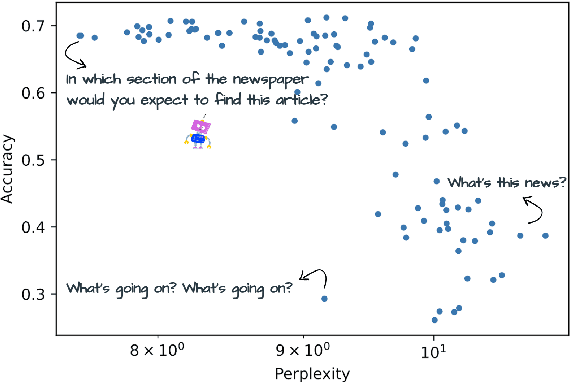
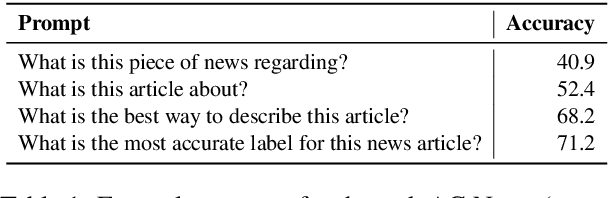

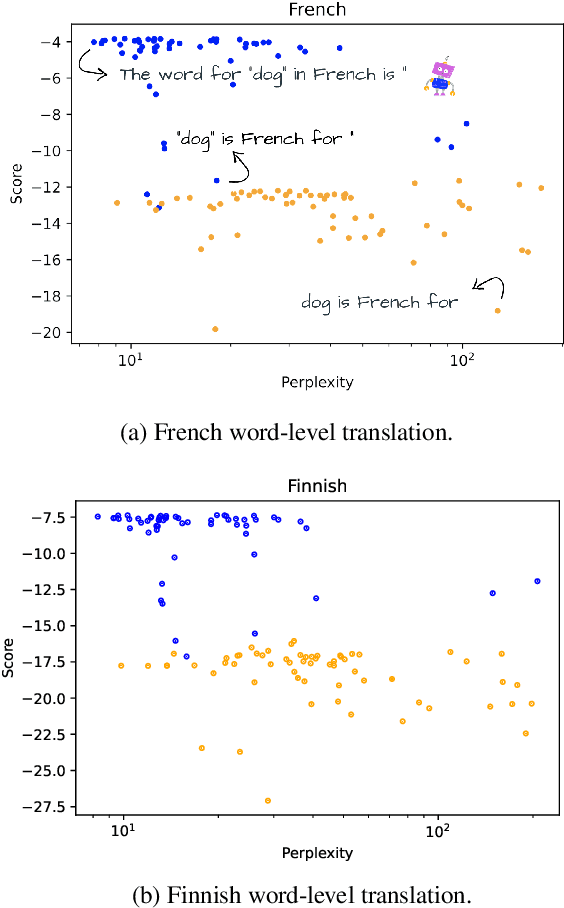
Language models can be prompted to perform a wide variety of zero- and few-shot learning problems. However, performance varies significantly with the choice of prompt, and we do not yet understand why this happens or how to pick the best prompts. In this work, we analyze the factors that contribute to this variance and establish a new empirical hypothesis: the performance of a prompt is coupled with the extent to which the model is familiar with the language it contains. Over a wide range of tasks, we show that the lower the perplexity of the prompt is, the better the prompt is able to perform the task. As a result, we devise a method for creating prompts: (1) automatically extend a small seed set of manually written prompts by paraphrasing using GPT3 and backtranslation and (2) choose the lowest perplexity prompts to get significant gains in performance.
In-context Examples Selection for Machine Translation
Dec 05, 2022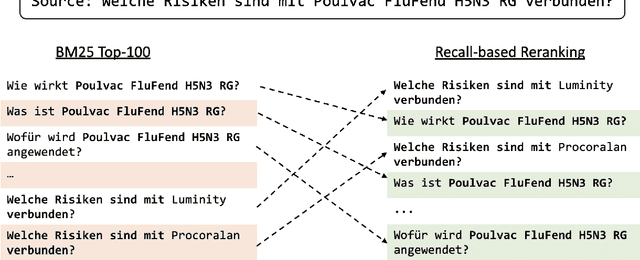
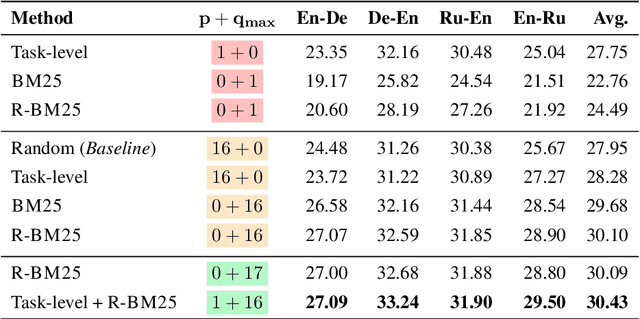
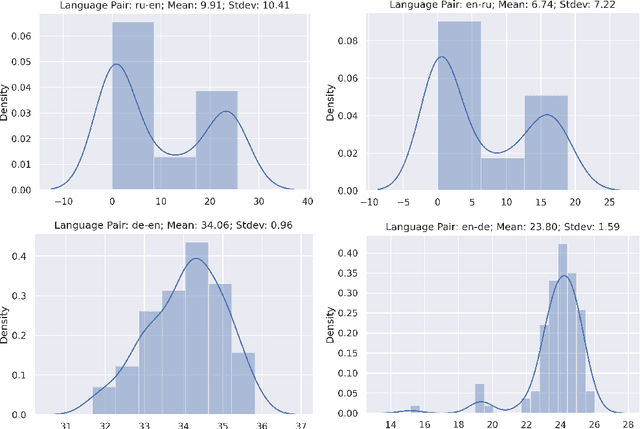
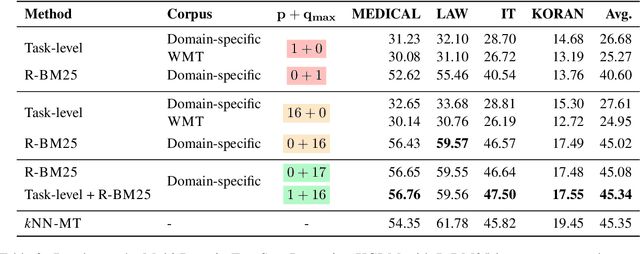
Large-scale generative models show an impressive ability to perform a wide range of Natural Language Processing (NLP) tasks using in-context learning, where a few examples are used to describe a task to the model. For Machine Translation (MT), these examples are typically randomly sampled from the development dataset with a similar distribution as the evaluation set. However, it is unclear how the choice of these in-context examples and their ordering impacts the output translation quality. In this work, we aim to understand the properties of good in-context examples for MT in both in-domain and out-of-domain settings. We show that the translation quality and the domain of the in-context examples matter and that 1-shot noisy unrelated example can have a catastrophic impact on output quality. While concatenating multiple random examples reduces the effect of noise, a single good prompt optimized to maximize translation quality on the development dataset can elicit learned information from the pre-trained language model. Adding similar examples based on an n-gram overlap with the test source significantly and consistently improves the translation quality of the outputs, outperforming a strong kNN-MT baseline in 2 out of 4 out-of-domain datasets.
Nonparametric Masked Language Modeling
Dec 02, 2022Existing language models (LMs) predict tokens with a softmax over a finite vocabulary, which can make it difficult to predict rare tokens or phrases. We introduce NPM, the first nonparametric masked language model that replaces this softmax with a nonparametric distribution over every phrase in a reference corpus. We show that NPM can be efficiently trained with a contrastive objective and an in-batch approximation to full corpus retrieval. Zero-shot evaluation on 9 closed-set tasks and 7 open-set tasks demonstrates that NPM outperforms significantly larger parametric models, either with or without a retrieve-and-generate approach. It is particularly better on dealing with rare patterns (word senses or facts), and predicting rare or nearly unseen words (e.g., non-Latin script). We release the model and code at github.com/facebookresearch/NPM.
CREPE: Open-Domain Question Answering with False Presuppositions
Nov 30, 2022Information seeking users often pose questions with false presuppositions, especially when asking about unfamiliar topics. Most existing question answering (QA) datasets, in contrast, assume all questions have well defined answers. We introduce CREPE, a QA dataset containing a natural distribution of presupposition failures from online information-seeking forums. We find that 25% of questions contain false presuppositions, and provide annotations for these presuppositions and their corrections. Through extensive baseline experiments, we show that adaptations of existing open-domain QA models can find presuppositions moderately well, but struggle when predicting whether a presupposition is factually correct. This is in large part due to difficulty in retrieving relevant evidence passages from a large text corpus. CREPE provides a benchmark to study question answering in the wild, and our analyses provide avenues for future work in better modeling and further studying the task.
Retrieval-Augmented Multimodal Language Modeling
Nov 22, 2022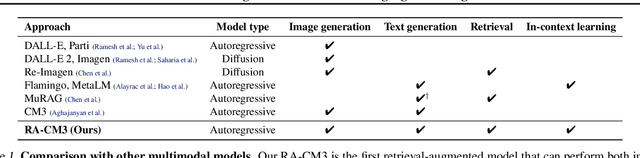
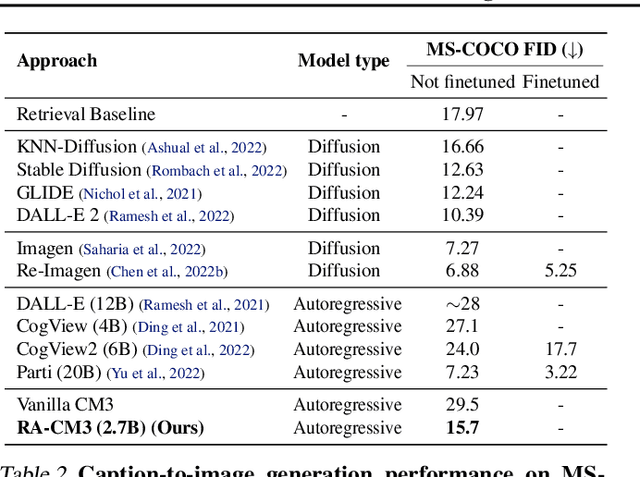
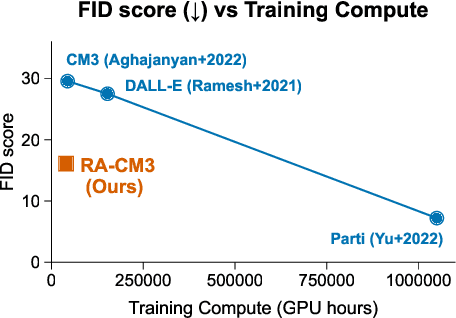
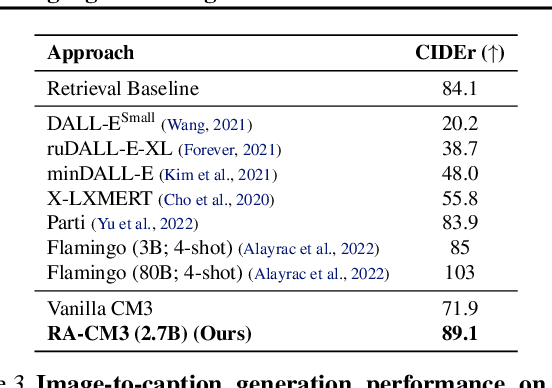
Recent multimodal models such as DALL-E and CM3 have achieved remarkable progress in text-to-image and image-to-text generation. However, these models store all learned knowledge (e.g., the appearance of the Eiffel Tower) in the model parameters, requiring increasingly larger models and training data to capture more knowledge. To integrate knowledge in a more scalable and modular way, we propose a retrieval-augmented multimodal model, which enables a base multimodal model (generator) to refer to relevant knowledge fetched by a retriever from external memory (e.g., multimodal documents on the web). Specifically, we implement a retriever using the pretrained CLIP model and a generator using the CM3 Transformer architecture, and train this model using the LAION dataset. Our resulting model, named Retrieval-Augmented CM3 (RA-CM3), is the first multimodal model that can retrieve and generate mixtures of text and images. We show that RA-CM3 significantly outperforms baseline multimodal models such as DALL-E and CM3 on both image and caption generation tasks (12 FID and 17 CIDEr improvements on MS-COCO), while requiring much less compute for training (<30% of DALL-E). Moreover, we show that RA-CM3 exhibits novel capabilities such as knowledge-intensive image generation and multimodal in-context learning.
DS-1000: A Natural and Reliable Benchmark for Data Science Code Generation
Nov 18, 2022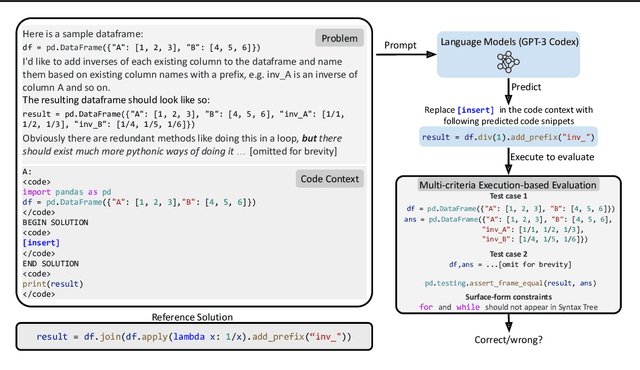
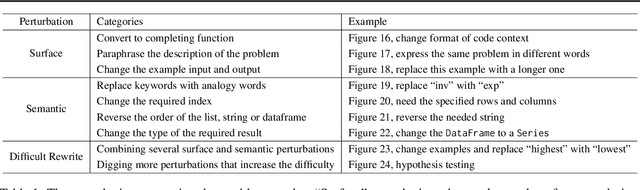
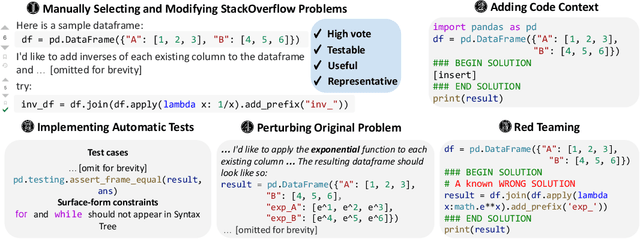
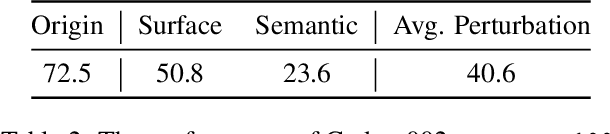
We introduce DS-1000, a code generation benchmark with a thousand data science problems spanning seven Python libraries, such as NumPy and Pandas. Compared to prior works, DS-1000 incorporates three core features. First, our problems reflect diverse, realistic, and practical use cases since we collected them from StackOverflow. Second, our automatic evaluation is highly specific (reliable) -- across all Codex-002-predicted solutions that our evaluation accept, only 1.8% of them are incorrect; we achieve this with multi-criteria metrics, checking both functional correctness by running test cases and surface-form constraints by restricting API usages or keywords. Finally, we proactively defend against memorization by slightly modifying our problems to be different from the original StackOverflow source; consequently, models cannot answer them correctly by memorizing the solutions from pre-training. The current best public system (Codex-002) achieves 43.3% accuracy, leaving ample room for improvement. We release our benchmark at https://ds1000-code-gen.github.io.