 Add to Chrome
 Add to Firefox
 Add to Edge
PaDoc: Layout-Grounded Parallel Decoding for Document Parsing
Aug 06, 2026
End-to-end document parsers provide a unified interface, but serialize page layouts and regional contents into one autoregressive sequence. This formulation forces independent regions onto a decoding path whose length grows with the total content, whereas crop-based two-stage parsers expose region-level parallelism at the cost of repeated visual prefills and fragmented page context. To retain full-page context while removing dependencies, we propose PaDoc, a layout-grounded parser that treats the predicted layout as a branching structure over a shared page representation. Under a region-sufficiency assumption, we derive a prefix-conditioned factorization in which the layout stream and regional content branches advance concurrently, reducing the decoding depth to the longest layout-content path. We realize this factorization within a single MLLM: packed variable-length ancestor attention preserves the visibility under standard next-token training, while masked parallel decoding creates branches that the evaluated vLLM backend serves as concurrent requests with cache-resident shared-prefix reuse. On OmniDocBench Full, PaDoc attains an Overall layout F1 of 91.1 and, among end-to-end parsers, a top-tier Overall score of 94.24 together with the best Text Edit (0.038) and Formula CDM (95.59). On a 384-page subset and one A800 GPU, it is the fastest end-to-end parser at five concurrency levels, improving valid-page throughput by 67.4-118% and reducing P95 latency by 39.2-54.9% relative to a same-backbone Sequential SFT baseline. Code is available at https://github.com/Longin-Yu/Padoc

MARS2 2025 Challenge on Multimodal Reasoning: Datasets, Methods, Results, Discussion, and Outlook
Sep 17, 2025
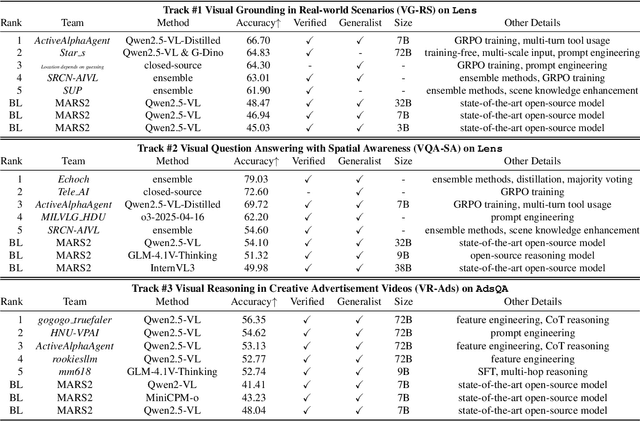

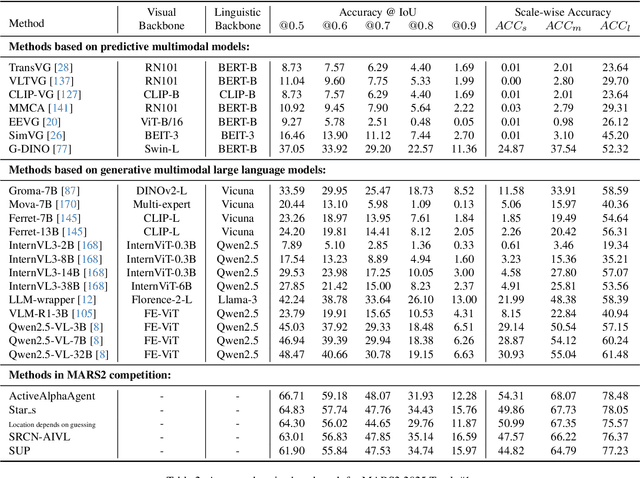
This paper reviews the MARS2 2025 Challenge on Multimodal Reasoning. We aim to bring together different approaches in multimodal machine learning and LLMs via a large benchmark. We hope it better allows researchers to follow the state-of-the-art in this very dynamic area. Meanwhile, a growing number of testbeds have boosted the evolution of general-purpose large language models. Thus, this year's MARS2 focuses on real-world and specialized scenarios to broaden the multimodal reasoning applications of MLLMs. Our organizing team released two tailored datasets Lens and AdsQA as test sets, which support general reasoning in 12 daily scenarios and domain-specific reasoning in advertisement videos, respectively. We evaluated 40+ baselines that include both generalist MLLMs and task-specific models, and opened up three competition tracks, i.e., Visual Grounding in Real-world Scenarios (VG-RS), Visual Question Answering with Spatial Awareness (VQA-SA), and Visual Reasoning in Creative Advertisement Videos (VR-Ads). Finally, 76 teams from the renowned academic and industrial institutions have registered and 40+ valid submissions (out of 1200+) have been included in our ranking lists. Our datasets, code sets (40+ baselines and 15+ participants' methods), and rankings are publicly available on the MARS2 workshop website and our GitHub organization page https://github.com/mars2workshop/, where our updates and announcements of upcoming events will be continuously provided.
PVUW 2025 Challenge Report: Advances in Pixel-level Understanding of Complex Videos in the Wild
Apr 15, 2025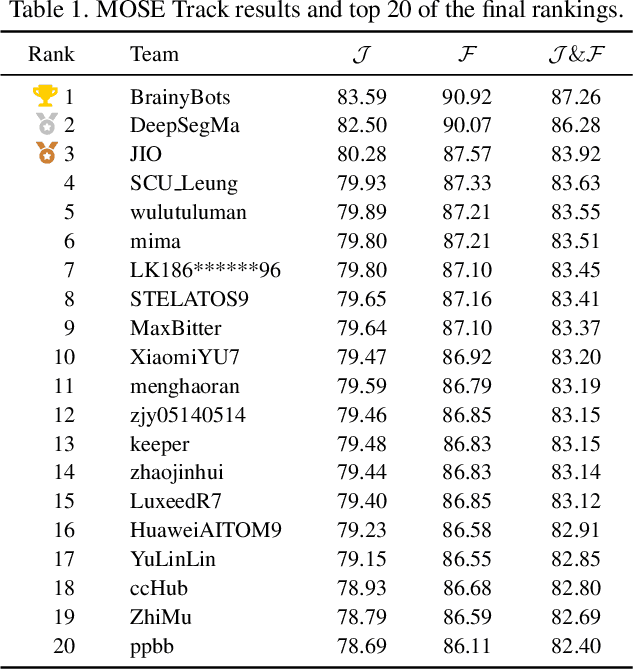
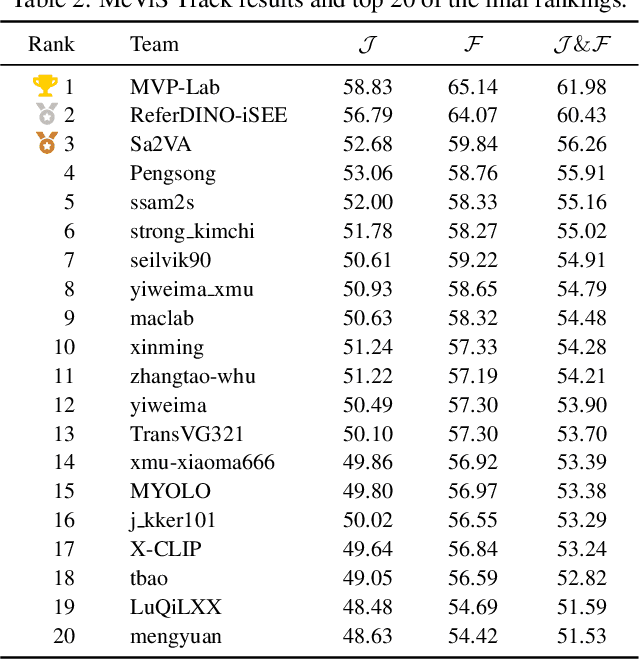
This report provides a comprehensive overview of the 4th Pixel-level Video Understanding in the Wild (PVUW) Challenge, held in conjunction with CVPR 2025. It summarizes the challenge outcomes, participating methodologies, and future research directions. The challenge features two tracks: MOSE, which focuses on complex scene video object segmentation, and MeViS, which targets motion-guided, language-based video segmentation. Both tracks introduce new, more challenging datasets designed to better reflect real-world scenarios. Through detailed evaluation and analysis, the challenge offers valuable insights into the current state-of-the-art and emerging trends in complex video segmentation. More information can be found on the workshop website: https://pvuw.github.io/.
MASSeg : 2nd Technical Report for 4th PVUW MOSE Track
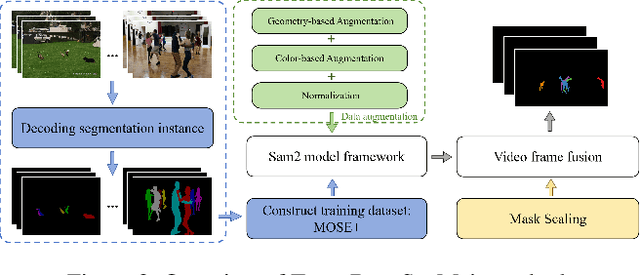
Apr 14, 2025Complex video object segmentation continues to face significant challenges in small object recognition, occlusion handling, and dynamic scene modeling. This report presents our solution, which ranked second in the MOSE track of CVPR 2025 PVUW Challenge. Based on an existing segmentation framework, we propose an improved model named MASSeg for complex video object segmentation, and construct an enhanced dataset, MOSE+, which includes typical scenarios with occlusions, cluttered backgrounds, and small target instances. During training, we incorporate a combination of inter-frame consistent and inconsistent data augmentation strategies to improve robustness and generalization. During inference, we design a mask output scaling strategy to better adapt to varying object sizes and occlusion levels. As a result, MASSeg achieves a J score of 0.8250, F score of 0.9007, and a J&F score of 0.8628 on the MOSE test set.