 Add to Chrome
 Add to Firefox
 Add to Edge
PaDoc: Layout-Grounded Parallel Decoding for Document Parsing
Aug 06, 2026
End-to-end document parsers provide a unified interface, but serialize page layouts and regional contents into one autoregressive sequence. This formulation forces independent regions onto a decoding path whose length grows with the total content, whereas crop-based two-stage parsers expose region-level parallelism at the cost of repeated visual prefills and fragmented page context. To retain full-page context while removing dependencies, we propose PaDoc, a layout-grounded parser that treats the predicted layout as a branching structure over a shared page representation. Under a region-sufficiency assumption, we derive a prefix-conditioned factorization in which the layout stream and regional content branches advance concurrently, reducing the decoding depth to the longest layout-content path. We realize this factorization within a single MLLM: packed variable-length ancestor attention preserves the visibility under standard next-token training, while masked parallel decoding creates branches that the evaluated vLLM backend serves as concurrent requests with cache-resident shared-prefix reuse. On OmniDocBench Full, PaDoc attains an Overall layout F1 of 91.1 and, among end-to-end parsers, a top-tier Overall score of 94.24 together with the best Text Edit (0.038) and Formula CDM (95.59). On a 384-page subset and one A800 GPU, it is the fastest end-to-end parser at five concurrency levels, improving valid-page throughput by 67.4-118% and reducing P95 latency by 39.2-54.9% relative to a same-backbone Sequential SFT baseline. Code is available at https://github.com/Longin-Yu/Padoc

A Multibias-mitigated and Sentiment Knowledge Enriched Transformer for Debiasing in Multimodal Conversational Emotion Recognition
Jul 17, 2022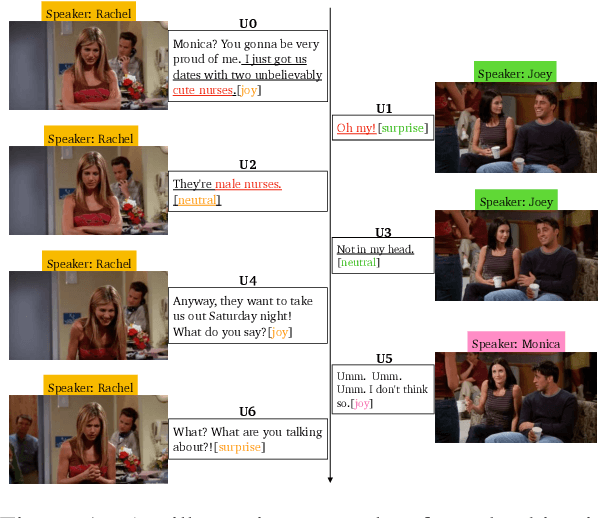
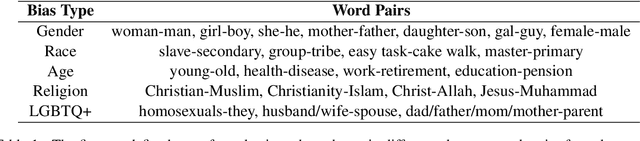
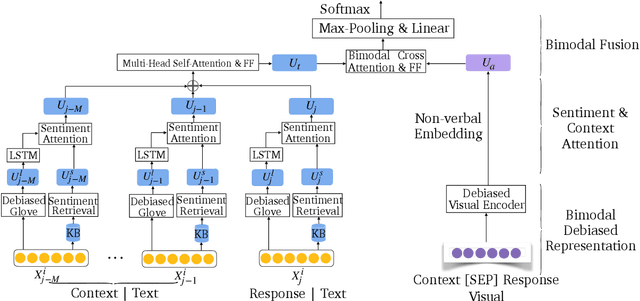
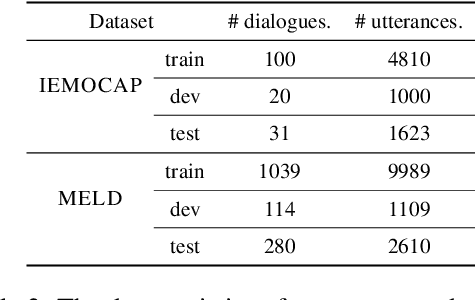
Multimodal emotion recognition in conversations (mERC) is an active research topic in natural language processing (NLP), which aims to predict human's emotional states in communications of multiple modalities, e,g., natural language and facial gestures. Innumerable implicit prejudices and preconceptions fill human language and conversations, leading to the question of whether the current data-driven mERC approaches produce a biased error. For example, such approaches may offer higher emotional scores on the utterances by females than males. In addition, the existing debias models mainly focus on gender or race, where multibias mitigation is still an unexplored task in mERC. In this work, we take the first step to solve these issues by proposing a series of approaches to mitigate five typical kinds of bias in textual utterances (i.e., gender, age, race, religion and LGBTQ+) and visual representations (i.e, gender and age), followed by a Multibias-Mitigated and sentiment Knowledge Enriched bi-modal Transformer (MMKET). Comprehensive experimental results show the effectiveness of the proposed model and prove that the debias operation has a great impact on the classification performance for mERC. We hope our study will benefit the development of bias mitigation in mERC and related emotion studies.