 Add to Chrome
 Add to Firefox
 Add to Edge
VMamba: Visual State Space Model
Jan 18, 2024


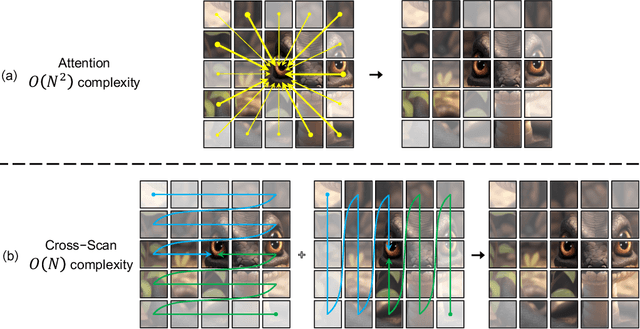
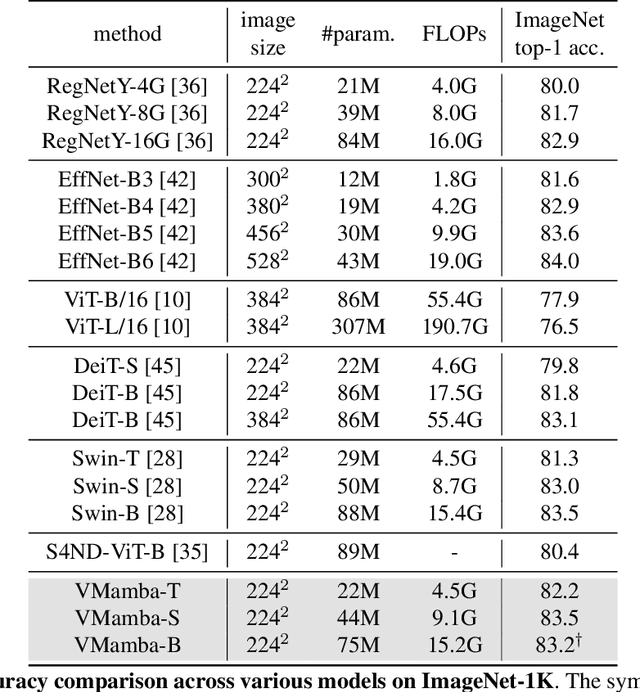
Convolutional Neural Networks (CNNs) and Vision Transformers (ViTs) stand as the two most popular foundation models for visual representation learning. While CNNs exhibit remarkable scalability with linear complexity w.r.t. image resolution, ViTs surpass them in fitting capabilities despite contending with quadratic complexity. A closer inspection reveals that ViTs achieve superior visual modeling performance through the incorporation of global receptive fields and dynamic weights. This observation motivates us to propose a novel architecture that inherits these components while enhancing computational efficiency. To this end, we draw inspiration from the recently introduced state space model and propose the Visual State Space Model (VMamba), which achieves linear complexity without sacrificing global receptive fields. To address the encountered direction-sensitive issue, we introduce the Cross-Scan Module (CSM) to traverse the spatial domain and convert any non-causal visual image into order patch sequences. Extensive experimental results substantiate that VMamba not only demonstrates promising capabilities across various visual perception tasks, but also exhibits more pronounced advantages over established benchmarks as the image resolution increases. Source code has been available at https://github.com/MzeroMiko/VMamba.

Incorporating Visual Experts to Resolve the Information Loss in Multimodal Large Language Models
Jan 13, 2024Multimodal Large Language Models (MLLMs) are experiencing rapid growth, yielding a plethora of noteworthy contributions in recent months. The prevailing trend involves adopting data-driven methodologies, wherein diverse instruction-following datasets are collected. However, a prevailing challenge persists in these approaches, specifically in relation to the limited visual perception ability, as CLIP-like encoders employed for extracting visual information from inputs. Though these encoders are pre-trained on billions of image-text pairs, they still grapple with the information loss dilemma, given that textual captions only partially capture the contents depicted in images. To address this limitation, this paper proposes to improve the visual perception ability of MLLMs through a mixture-of-experts knowledge enhancement mechanism. Specifically, we introduce a novel method that incorporates multi-task encoders and visual tools into the existing MLLMs training and inference pipeline, aiming to provide a more comprehensive and accurate summarization of visual inputs. Extensive experiments have evaluated its effectiveness of advancing MLLMs, showcasing improved visual perception achieved through the integration of visual experts.
Cascade-Zero123: One Image to Highly Consistent 3D with Self-Prompted Nearby Views
Dec 07, 2023
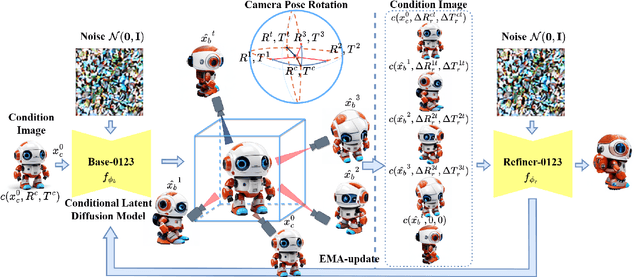

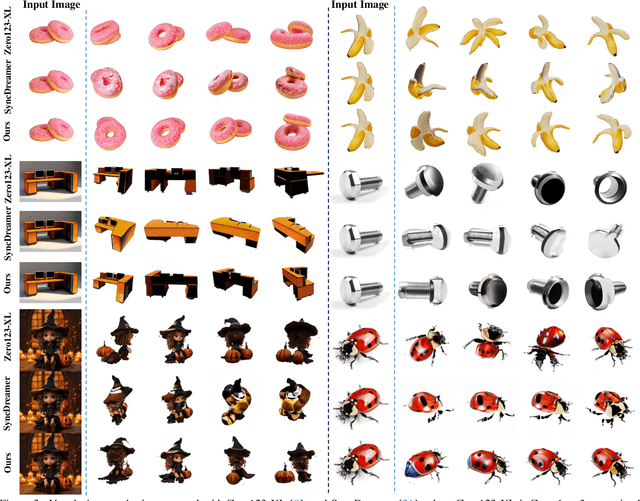
Synthesizing multi-view 3D from one single image is a significant and challenging task. For this goal, Zero-1-to-3 methods aim to extend a 2D latent diffusion model to the 3D scope. These approaches generate the target-view image with a single-view source image and the camera pose as condition information. However, the one-to-one manner adopted in Zero-1-to-3 incurs challenges for building geometric and visual consistency across views, especially for complex objects. We propose a cascade generation framework constructed with two Zero-1-to-3 models, named Cascade-Zero123, to tackle this issue, which progressively extracts 3D information from the source image. Specifically, a self-prompting mechanism is designed to generate several nearby views at first. These views are then fed into the second-stage model along with the source image as generation conditions. With self-prompted multiple views as the supplementary information, our Cascade-Zero123 generates more highly consistent novel-view images than Zero-1-to-3. The promotion is significant for various complex and challenging scenes, involving insects, humans, transparent objects, and stacked multiple objects etc. The project page is at https://cascadezero123.github.io/.
Segment Any 3D Gaussians
Dec 01, 2023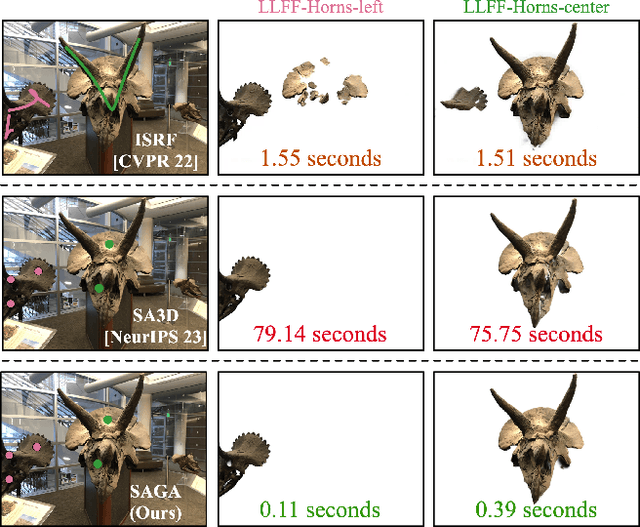
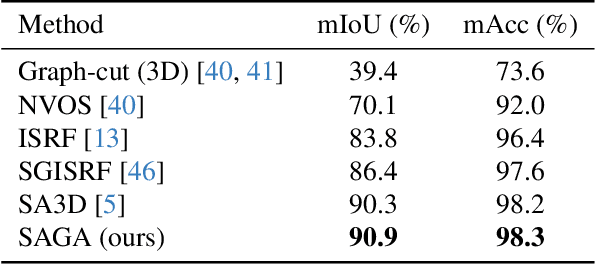
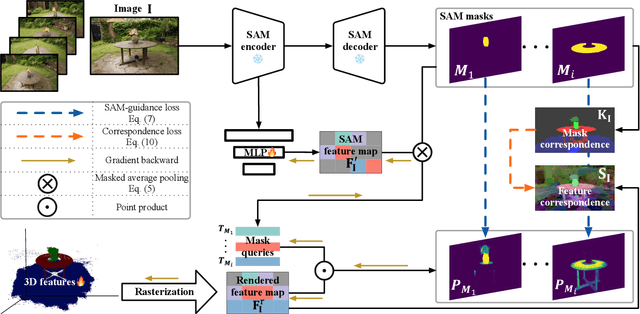
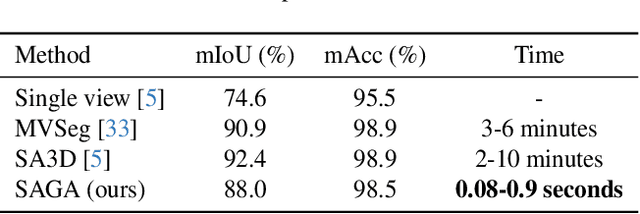
Interactive 3D segmentation in radiance fields is an appealing task since its importance in 3D scene understanding and manipulation. However, existing methods face challenges in either achieving fine-grained, multi-granularity segmentation or contending with substantial computational overhead, inhibiting real-time interaction. In this paper, we introduce Segment Any 3D GAussians (SAGA), a novel 3D interactive segmentation approach that seamlessly blends a 2D segmentation foundation model with 3D Gaussian Splatting (3DGS), a recent breakthrough of radiance fields. SAGA efficiently embeds multi-granularity 2D segmentation results generated by the segmentation foundation model into 3D Gaussian point features through well-designed contrastive training. Evaluation on existing benchmarks demonstrates that SAGA can achieve competitive performance with state-of-the-art methods. Moreover, SAGA achieves multi-granularity segmentation and accommodates various prompts, including points, scribbles, and 2D masks. Notably, SAGA can finish the 3D segmentation within milliseconds, achieving nearly 1000x acceleration compared to previous SOTA. The project page is at https://jumpat.github.io/SAGA.
Parameter Efficient Fine-tuning via Cross Block Orchestration for Segment Anything Model
Nov 28, 2023Parameter-efficient fine-tuning (PEFT) is an effective methodology to unleash the potential of large foundation models in novel scenarios with limited training data. In the computer vision community, PEFT has shown effectiveness in image classification, but little research has studied its ability for image segmentation. Fine-tuning segmentation models usually require a heavier adjustment of parameters to align the proper projection directions in the parameter space for new scenarios. This raises a challenge to existing PEFT algorithms, as they often inject a limited number of individual parameters into each block, which prevents substantial adjustment of the projection direction of the parameter space due to the limitation of Hidden Markov Chain along blocks. In this paper, we equip PEFT with a cross-block orchestration mechanism to enable the adaptation of the Segment Anything Model (SAM) to various downstream scenarios. We introduce a novel inter-block communication module, which integrates a learnable relation matrix to facilitate communication among different coefficient sets of each PEFT block's parameter space. Moreover, we propose an intra-block enhancement module, which introduces a linear projection head whose weights are generated from a hyper-complex layer, further enhancing the impact of the adjustment of projection directions on the entire parameter space. Extensive experiments on diverse benchmarks demonstrate that our proposed approach consistently improves the segmentation performance significantly on novel scenarios with only around 1K additional parameters.
GaussianEditor: Editing 3D Gaussians Delicately with Text Instructions
Nov 27, 2023Recently, impressive results have been achieved in 3D scene editing with text instructions based on a 2D diffusion model. However, current diffusion models primarily generate images by predicting noise in the latent space, and the editing is usually applied to the whole image, which makes it challenging to perform delicate, especially localized, editing for 3D scenes. Inspired by recent 3D Gaussian splatting, we propose a systematic framework, named GaussianEditor, to edit 3D scenes delicately via 3D Gaussians with text instructions. Benefiting from the explicit property of 3D Gaussians, we design a series of techniques to achieve delicate editing. Specifically, we first extract the region of interest (RoI) corresponding to the text instruction, aligning it to 3D Gaussians. The Gaussian RoI is further used to control the editing process. Our framework can achieve more delicate and precise editing of 3D scenes than previous methods while enjoying much faster training speed, i.e. within 20 minutes on a single V100 GPU, more than twice as fast as Instruct-NeRF2NeRF (45 minutes -- 2 hours).
One-bit Supervision for Image Classification: Problem, Solution, and Beyond
Nov 26, 2023This paper presents one-bit supervision, a novel setting of learning with fewer labels, for image classification. Instead of training model using the accurate label of each sample, our setting requires the model to interact with the system by predicting the class label of each sample and learn from the answer whether the guess is correct, which provides one bit (yes or no) of information. An intriguing property of the setting is that the burden of annotation largely alleviates in comparison to offering the accurate label. There are two keys to one-bit supervision, which are (i) improving the guess accuracy and (ii) making good use of the incorrect guesses. To achieve these goals, we propose a multi-stage training paradigm and incorporate negative label suppression into an off-the-shelf semi-supervised learning algorithm. Theoretical analysis shows that one-bit annotation is more efficient than full-bit annotation in most cases and gives the conditions of combining our approach with active learning. Inspired by this, we further integrate the one-bit supervision framework into the self-supervised learning algorithm which yields an even more efficient training schedule. Different from training from scratch, when self-supervised learning is used for initialization, both hard example mining and class balance are verified effective in boosting the learning performance. However, these two frameworks still need full-bit labels in the initial stage. To cast off this burden, we utilize unsupervised domain adaptation to train the initial model and conduct pure one-bit annotations on the target dataset. In multiple benchmarks, the learning efficiency of the proposed approach surpasses that using full-bit, semi-supervised supervision.
GaussianDreamer: Fast Generation from Text to 3D Gaussian Splatting with Point Cloud Priors
Oct 12, 2023In recent times, the generation of 3D assets from text prompts has shown impressive results. Both 2D and 3D diffusion models can generate decent 3D objects based on prompts. 3D diffusion models have good 3D consistency, but their quality and generalization are limited as trainable 3D data is expensive and hard to obtain. 2D diffusion models enjoy strong abilities of generalization and fine generation, but the 3D consistency is hard to guarantee. This paper attempts to bridge the power from the two types of diffusion models via the recent explicit and efficient 3D Gaussian splatting representation. A fast 3D generation framework, named as \name, is proposed, where the 3D diffusion model provides point cloud priors for initialization and the 2D diffusion model enriches the geometry and appearance. Operations of noisy point growing and color perturbation are introduced to enhance the initialized Gaussians. Our \name can generate a high-quality 3D instance within 25 minutes on one GPU, much faster than previous methods, while the generated instances can be directly rendered in real time. Demos and code are available at https://taoranyi.com/gaussiandreamer/.
4D Gaussian Splatting for Real-Time Dynamic Scene Rendering
Oct 12, 2023Representing and rendering dynamic scenes has been an important but challenging task. Especially, to accurately model complex motions, high efficiency is usually hard to maintain. We introduce the 4D Gaussian Splatting (4D-GS) to achieve real-time dynamic scene rendering while also enjoying high training and storage efficiency. An efficient deformation field is constructed to model both Gaussian motions and shape deformations. Different adjacent Gaussians are connected via a HexPlane to produce more accurate position and shape deformations. Our 4D-GS method achieves real-time rendering under high resolutions, 70 FPS at a 800$\times$800 resolution on an RTX 3090 GPU, while maintaining comparable or higher quality than previous state-of-the-art methods. More demos and code are available at https://guanjunwu.github.io/4dgs/.
QA-LoRA: Quantization-Aware Low-Rank Adaptation of Large Language Models
Sep 26, 2023
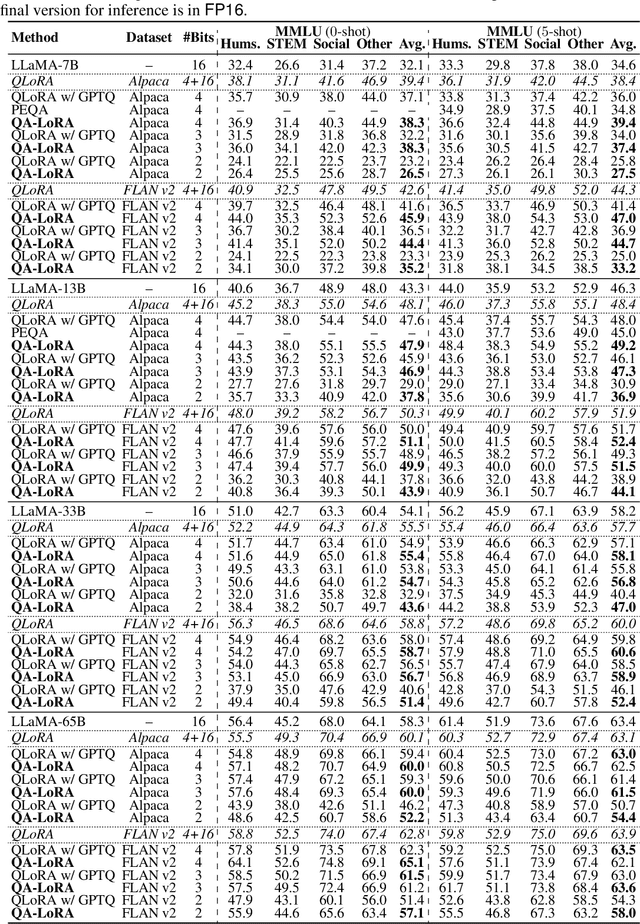
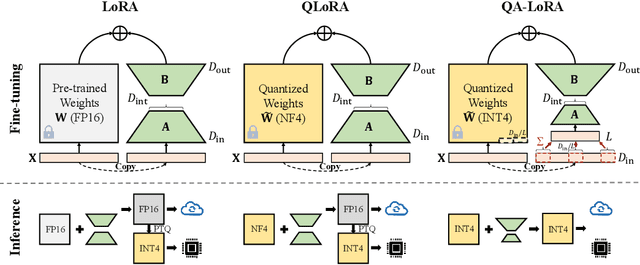

Recently years have witnessed a rapid development of large language models (LLMs). Despite the strong ability in many language-understanding tasks, the heavy computational burden largely restricts the application of LLMs especially when one needs to deploy them onto edge devices. In this paper, we propose a quantization-aware low-rank adaptation (QA-LoRA) algorithm. The motivation lies in the imbalanced degrees of freedom of quantization and adaptation, and the solution is to use group-wise operators which increase the degree of freedom of quantization meanwhile decreasing that of adaptation. QA-LoRA is easily implemented with a few lines of code, and it equips the original LoRA with two-fold abilities: (i) during fine-tuning, the LLM's weights are quantized (e.g., into INT4) to reduce time and memory usage; (ii) after fine-tuning, the LLM and auxiliary weights are naturally integrated into a quantized model without loss of accuracy. We apply QA-LoRA to the LLaMA and LLaMA2 model families and validate its effectiveness in different fine-tuning datasets and downstream scenarios. Code will be made available at https://github.com/yuhuixu1993/qa-lora.