 Add to Chrome
 Add to Firefox
 Add to Edge
MBGR: Multi-Business Prediction for Generative Recommendation at Meituan
Apr 03, 2026
Generative recommendation (GR) has recently emerged as a promising paradigm for industrial recommendations. GR leverages Semantic IDs (SIDs) to reduce the encoding-decoding space and employs the Next Token Prediction (NTP) framework to explore scaling laws. However, existing GR methods suffer from two critical issues: (1) a \textbf{seesaw phenomenon} in multi-business scenarios arises due to NTP's inability to capture complex cross-business behavioral patterns; and (2) a unified SID space causes \textbf{representation confusion} by failing to distinguish distinct semantic information across businesses. To address these issues, we propose Multi-Business Generative Recommendation (MBGR), the first GR framework tailored for multi-business scenarios. Our framework comprises three key components. First, we design a Business-aware semantic ID (BID) module that preserves semantic integrity via domain-aware tokenization. Then, we introduce a Multi-Business Prediction (MBP) structure to provide business-specific prediction capabilities. Furthermore, we develop a Label Dynamic Routing (LDR) module that transforms sparse multi-business labels into dense labels to further enhance the multi-business generation capability. Extensive offline and online experiments on Meituan's food delivery platform validate MBGR's effectiveness, and we have successfully deployed it in production.

Parameter-efficient Fine-tuning in Hyperspherical Space for Open-vocabulary Semantic Segmentation
May 29, 2024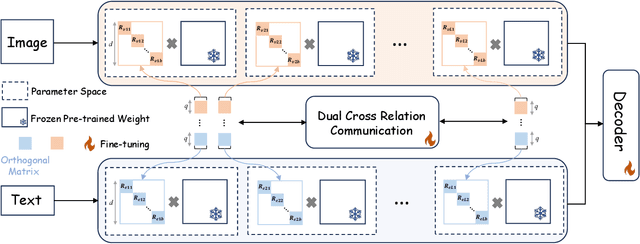
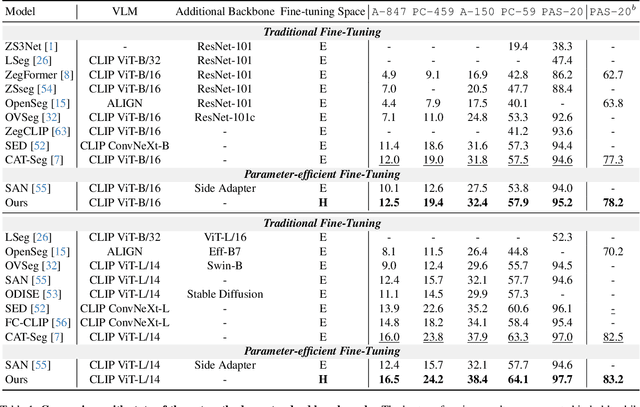
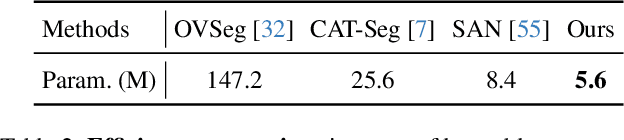
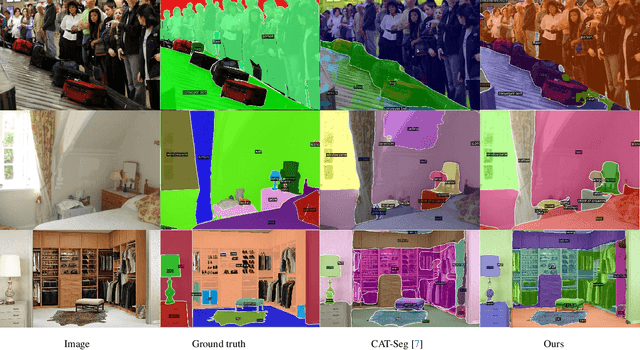
Open-vocabulary semantic segmentation seeks to label each pixel in an image with arbitrary text descriptions. Vision-language foundation models, especially CLIP, have recently emerged as powerful tools for acquiring open-vocabulary capabilities. However, fine-tuning CLIP to equip it with pixel-level prediction ability often suffers three issues: 1) high computational cost, 2) misalignment between the two inherent modalities of CLIP, and 3) degraded generalization ability on unseen categories. To address these issues, we propose H-CLIP a symmetrical parameter-efficient fine-tuning (PEFT) strategy conducted in hyperspherical space for both of the two CLIP modalities. Specifically, the PEFT strategy is achieved by a series of efficient block-diagonal learnable transformation matrices and a dual cross-relation communication module among all learnable matrices. Since the PEFT strategy is conducted symmetrically to the two CLIP modalities, the misalignment between them is mitigated. Furthermore, we apply an additional constraint to PEFT on the CLIP text encoder according to the hyperspherical energy principle, i.e., minimizing hyperspherical energy during fine-tuning preserves the intrinsic structure of the original parameter space, to prevent the destruction of the generalization ability offered by the CLIP text encoder. Extensive evaluations across various benchmarks show that H-CLIP achieves new SOTA open-vocabulary semantic segmentation results while only requiring updating approximately 4% of the total parameters of CLIP.
Parameter Efficient Fine-tuning via Cross Block Orchestration for Segment Anything Model
Nov 28, 2023Parameter-efficient fine-tuning (PEFT) is an effective methodology to unleash the potential of large foundation models in novel scenarios with limited training data. In the computer vision community, PEFT has shown effectiveness in image classification, but little research has studied its ability for image segmentation. Fine-tuning segmentation models usually require a heavier adjustment of parameters to align the proper projection directions in the parameter space for new scenarios. This raises a challenge to existing PEFT algorithms, as they often inject a limited number of individual parameters into each block, which prevents substantial adjustment of the projection direction of the parameter space due to the limitation of Hidden Markov Chain along blocks. In this paper, we equip PEFT with a cross-block orchestration mechanism to enable the adaptation of the Segment Anything Model (SAM) to various downstream scenarios. We introduce a novel inter-block communication module, which integrates a learnable relation matrix to facilitate communication among different coefficient sets of each PEFT block's parameter space. Moreover, we propose an intra-block enhancement module, which introduces a linear projection head whose weights are generated from a hyper-complex layer, further enhancing the impact of the adjustment of projection directions on the entire parameter space. Extensive experiments on diverse benchmarks demonstrate that our proposed approach consistently improves the segmentation performance significantly on novel scenarios with only around 1K additional parameters.
SAM-PARSER: Fine-tuning SAM Efficiently by Parameter Space Reconstruction
Aug 31, 2023Segment Anything Model (SAM) has received remarkable attention as it offers a powerful and versatile solution for object segmentation in images. However, fine-tuning SAM for downstream segmentation tasks under different scenarios remains a challenge, as the varied characteristics of different scenarios naturally requires diverse model parameter spaces. Most existing fine-tuning methods attempt to bridge the gaps among different scenarios by introducing a set of new parameters to modify SAM's original parameter space. Unlike these works, in this paper, we propose fine-tuning SAM efficiently by parameter space reconstruction (SAM-PARSER), which introduce nearly zero trainable parameters during fine-tuning. In SAM-PARSER, we assume that SAM's original parameter space is relatively complete, so that its bases are able to reconstruct the parameter space of a new scenario. We obtain the bases by matrix decomposition, and fine-tuning the coefficients to reconstruct the parameter space tailored to the new scenario by an optimal linear combination of the bases. Experimental results show that SAM-PARSER exhibits superior segmentation performance across various scenarios, while reducing the number of trainable parameters by $\approx 290$ times compared with current parameter-efficient fine-tuning methods.